
You can reduce fall risk in busy facilities by addressing the root causes: wet or contaminated floors, poor drainage, inadequate matting, and high-traffic zones with no slip resistance. The most effective approach combines smart flooring choices, targeted mat placement, and regular floor safety inspections. This article walks through the most common questions facility managers ask about slip and fall prevention.
What surfaces in busy facilities cause the most falls?
The surfaces most likely to cause falls in busy facilities are smooth hard floors that become wet or contaminated, transitions between flooring types, and areas with poor drainage. Entrances, kitchens, loading docks, and production floors are among the highest-risk zones because they combine foot traffic with moisture, oils, or debris.
Hard surfaces like polished concrete, tile, and vinyl are common in commercial and industrial settings because they are durable and easy to clean. But when these surfaces get wet, their slip resistance drops significantly. Floor hazards are not always visible either. A thin film of oil or a lightly damp floor can be just as dangerous as a standing puddle.
Transitions between two different flooring materials also create trip hazards, especially when one surface is slightly raised or has a different texture. Workers moving quickly through a facility often do not notice these changes until it is too late. High-traffic areas wear down faster too, which means the anti-slip texture built into a floor surface can disappear over time, leaving a smooth and slippery patch in a busy walkway.
How does flooring choice affect slip and fall risk?
Flooring choice directly affects slip and fall risk because different materials offer very different levels of slip resistance, especially when wet or contaminated. A floor that performs well under dry conditions may become dangerous in wet environments if it lacks adequate surface texture or drainage capability.
The coefficient of friction is the measure used to describe how much grip a floor surface provides. Floors with a higher coefficient of friction are harder to slip on. Smooth, polished surfaces have a low coefficient of friction when wet, while textured or porous surfaces maintain better grip. This is why flooring selection should always account for the specific conditions of the space, not just how the floor looks or how easy it is to clean.
Beyond the base material, surface treatments and coatings can improve slip resistance on existing floors. Anti-slip coatings, abrasive strips, and rubber matting are all practical tools for improving floor safety without replacing the entire floor. Rubber matting in particular is effective in areas where water, oils, or other liquids are regularly present, because rubber maintains grip even in wet conditions.
What are the most effective ways to reduce fall risk in a facility?
The most effective ways to reduce fall risk in a facility include improving floor surface grip, managing moisture and contamination, using appropriate matting in high-risk areas, and conducting regular floor safety inspections. No single measure is enough on its own. A combination of physical interventions and ongoing maintenance delivers the best results.
Here are the most practical steps facilities can take:
- Install anti-slip matting at entrances, wet areas, and anywhere spills are likely
- Improve drainage in areas where water accumulates, such as wash stations or loading docks
- Use warning signage to alert workers to wet floors or recently cleaned surfaces
- Conduct regular floor safety inspections to identify worn surfaces, damaged mats, or new hazards
- Train staff to report floor hazards and follow safe walking practices
- Replace worn flooring that has lost its surface texture or grip
- Use proper footwear policies that require slip-resistant shoes in high-risk areas
Floor safety inspections deserve special attention. A routine inspection schedule helps you catch problems before they cause injuries. Check for curling mat edges, cracked flooring, pooling water, and areas where the floor surface has worn smooth. Documenting these inspections also supports compliance with workplace safety regulations.
Where should rubber mats be placed to prevent workplace falls?
Rubber mats should be placed at building entrances, near sinks and wash stations, in front of workstations where employees stand for long periods, along walkways that cross wet or oily areas, and anywhere liquids are regularly present on the floor. These are the zones where floor hazards are most likely to develop.
Entrances are a top priority because people track in water, mud, and debris from outside. A mat at the entrance captures that contamination before it spreads across the rest of the floor. In kitchens and food processing areas, grease and water on the floor are constant concerns, making rubber matting with drainage holes a practical choice. The same logic applies to industrial environments where coolants, oils, or cleaning agents are used.
Workstation mats serve a dual purpose. They reduce slip risk and also provide ergonomic support for workers who stand for extended periods, which reduces fatigue and the kind of inattentiveness that leads to accidents. In warehouses and manufacturing facilities, marking safe walkways with matting also helps define traffic flow and keeps workers away from areas where heavy equipment operates.
What should you look for in a safety mat for high-traffic areas?
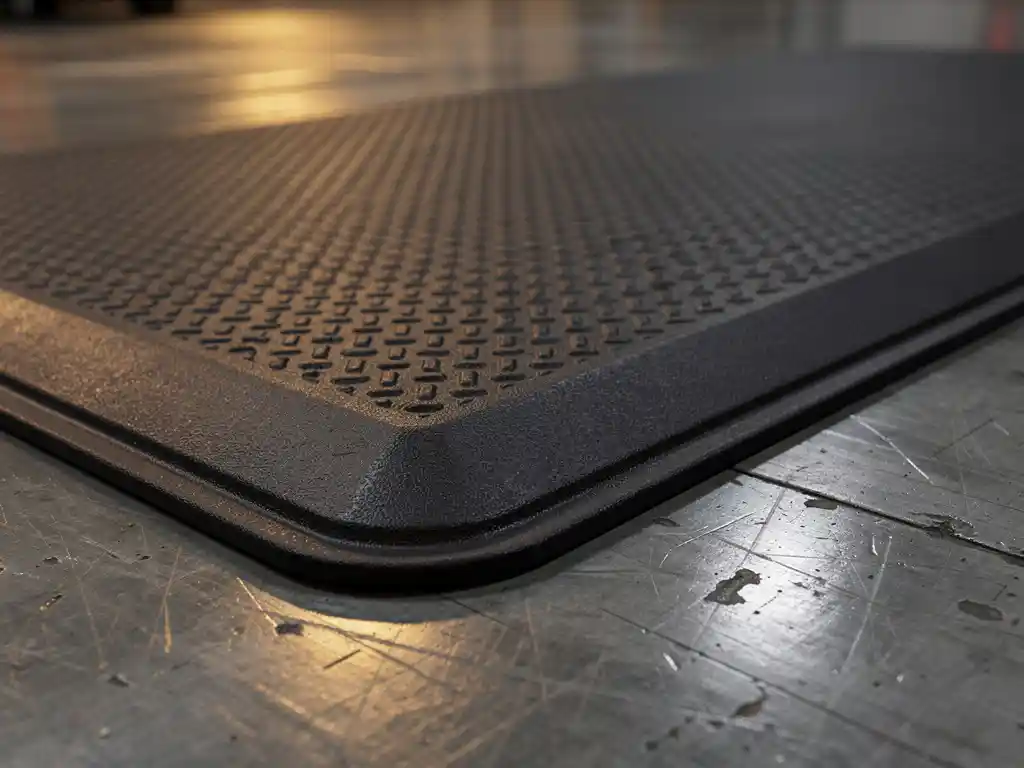
For high-traffic areas, look for a safety mat with strong slip resistance on both the top surface and the underside, durable construction that holds up under constant use, beveled edges to prevent tripping, and a material that resists moisture, oils, and heavy loads. The mat should stay flat and stable over time without curling or shifting.
Here are the key features to evaluate when choosing a safety mat:
- Surface texture: A raised pattern or textured surface increases grip underfoot, especially when wet
- Underside grip: The mat itself should not slide on the floor, so look for a non-slip backing
- Beveled edges: Sloped edges reduce the trip hazard created by the mat’s border
- Drainage capability: In wet environments, mats with holes or open-grid designs let liquids pass through so the surface stays dry
- Material durability: Rubber holds up well under heavy foot traffic and does not crack, peel, or absorb moisture
- Size and coverage: A mat that is too small leaves gaps where people step onto unprotected floor
- Ease of cleaning: High-traffic mats need regular cleaning, so choose a material that is easy to maintain
At LRP Matting, we manufacture rubber mats built for exactly these conditions. Our mats are made from 100% recycled rubber, including many made with our proprietary Fiber Reinforced Rubber Compound (FRC®), which gives them extra strength and durability compared to standard rubber flooring. They are non-porous, easy to clean, and designed to stay flat and stable even in demanding environments. If you are looking for matting that holds up in heavy-use commercial or industrial spaces, our industrial rubber mats are worth a close look.
Frequently Asked Questions
How do I know if my current floor surfaces meet minimum slip resistance standards?
Slip resistance is measured using the coefficient of friction (COF), and most safety standards recommend a minimum COF of 0.5 for walking surfaces and 0.6 or higher for ramps or high-risk areas. You can have your floors professionally tested using a tribometer, or you can use the OSHA and ANSI/NFSI guidelines as a reference point. If your floors have not been tested recently — or if they have been polished, recoated, or worn down since installation — scheduling a slip resistance assessment is a smart first step before an incident occurs.
How often should floor safety inspections be conducted in a busy facility?
In most commercial and industrial facilities, a formal floor safety inspection should be conducted at least monthly, with quick visual walkthroughs happening daily or at the start of each shift. High-risk areas like kitchens, loading docks, and wet process zones may warrant more frequent checks. The key is consistency — document each inspection with dates, findings, and any corrective actions taken, which also helps demonstrate due diligence if a slip-and-fall incident ever leads to a liability claim.
What is the biggest mistake facility managers make when trying to prevent workplace falls?
The most common mistake is treating slip and fall prevention as a one-time fix rather than an ongoing program. Purchasing mats or applying an anti-slip coating is a good start, but those measures degrade over time — mats curl, coatings wear down, and new hazards emerge as facility operations change. A sustainable prevention program includes regular inspections, staff training, maintenance schedules for matting and flooring, and periodic reassessment of high-risk zones, especially after any layout or workflow changes.
Can anti-slip coatings replace the need for rubber matting, or do facilities need both?
Anti-slip coatings and rubber matting serve different purposes and work best together rather than as substitutes for each other. Coatings improve the grip of a fixed floor surface and are ideal for large open areas where matting is impractical. Rubber mats, on the other hand, provide targeted protection in the highest-risk zones — entrances, wet work areas, and standing workstations — and also offer ergonomic benefits. In most facilities, using coatings on general walkways and rubber mats at key hazard points gives you the most comprehensive coverage.
How should rubber mats be maintained to keep them effective over time?
Rubber mats should be cleaned regularly to prevent the buildup of oils, grease, and debris that can reduce their surface grip. For most mats, hosing them down or scrubbing with a mild detergent is sufficient. Beyond cleaning, inspect mats routinely for curling edges, tears, or compression that has flattened the surface texture — these are signs the mat needs to be repositioned, secured, or replaced. A mat that has shifted, curled, or lost its texture is no longer a safety asset; it becomes a trip hazard in its own right.
Are there specific rubber mat features that make them better suited for industrial environments versus commercial ones?
Yes — industrial environments typically demand mats with heavier load ratings, resistance to chemicals and oils, and open-grid or drainage-hole designs that handle liquid runoff from machinery or wash-down processes. Commercial settings like retail stores or office lobbies usually prioritize aesthetics, comfort underfoot, and ease of cleaning over chemical resistance. When selecting a mat, match the product specifications to the actual conditions of the space: the types of contaminants present, the volume of foot traffic, whether wheeled equipment rolls over the mat, and how the area is cleaned.
What role does employee footwear play in slip and fall prevention, and how should facilities enforce footwear policies?
Footwear is one of the most direct and controllable factors in slip and fall prevention — even the best floor surface or mat cannot fully compensate for smooth-soled shoes. Facilities should establish a clear footwear policy that requires slip-resistant shoes in all high-risk areas, and this requirement should be part of onboarding, posted in relevant zones, and reinforced during safety training. To make compliance easier, some employers partner with footwear vendors to offer discounts or reimbursement programs, which increases buy-in and ensures workers actually wear appropriate shoes on the job.
Related Articles
- How do chemicals affect floor durability?
- What makes an animal housing facility safe?
- What is the easiest floor to disinfect in an animal clinic?
- How do you know when a horse trailer floor needs replacing?
- How do you maintain a safe surface in a professional athletic facility year-round?
- How do anti-fatigue mats reduce workplace injury claims?
- How do you make a horse stall more comfortable for an older horse?
- What are the pros of rubber mats in a horse stall?
- How do you make a veterinary recovery stall safer for horses?
- What floor is best for a horse with arthritis?