
A floor is safe when it provides enough traction to prevent slipping, supports the body to reduce fatigue and injury, and stays free of hazards like standing water or uneven surfaces. The material, texture, drainage, and maintenance of a floor all play a role in how safe it actually is. Below, we break down the most important factors so you can make informed decisions about the floors in your space.
What are the main causes of slip-and-fall accidents on floors?
Slip-and-fall accidents most commonly happen when there is not enough friction between a person’s footwear and the floor surface. The most frequent causes include wet or contaminated floors, smooth or worn surfaces, poor lighting, and the absence of slip-resistant matting in high-traffic areas. Understanding these causes is the first step toward preventing them.
Wet floors are by far the most common trigger. Spills, rainwater tracked in from outside, cleaning residue, and condensation can all create a thin film of moisture that dramatically reduces grip. In workplaces like kitchens, warehouses, or manufacturing facilities, this happens constantly throughout the day.
Surface wear is another major factor that often goes unnoticed. A floor that was perfectly textured when new can become dangerously smooth over time as foot traffic gradually polishes the surface. This is especially common with certain tiles, concrete, and vinyl flooring in busy environments.
Other contributing causes include:
- Uneven surfaces, raised edges, or damaged flooring sections
- Inadequate drainage in areas exposed to liquids
- Cluttered walkways or poor housekeeping
- Footwear that is not appropriate for the floor surface
- Transitions between different flooring types with varying friction levels
Many floor hazards are preventable with the right combination of surface selection, maintenance, and protective measures. Identifying which causes are most relevant to your specific environment makes it much easier to address them effectively.
What properties make a floor surface slip resistant?
A slip-resistant floor surface has a high coefficient of friction, meaning it creates enough resistance between the floor and a shoe sole to prevent unintended sliding. Key properties include surface texture, material hardness, porosity, and how the surface performs when wet. No single property determines slip resistance on its own — it is the combination that matters.
Surface texture is the most visible factor. Floors with raised patterns, grooves, or a rough finish give footwear more contact points to grip. This is why brushed concrete, textured rubber, and embossed flooring tend to outperform smooth, polished surfaces in terms of traction.
The behavior of the surface when wet is equally important. Some materials that grip well when dry become slippery the moment moisture is introduced. Non-porous materials, for example, do not absorb liquids, which means water sits on the surface rather than being channeled away. This is why surface texture and drainage design need to work together rather than being treated as separate concerns.
Hardness also plays a role. Very hard surfaces like polished stone or glazed tile offer little give, which reduces the contact area between a shoe and the floor. Slightly softer materials, including rubber, conform better to the sole of a shoe, which increases grip naturally without relying entirely on texture.
Does flooring material affect how safe a floor is?
Yes, flooring material directly affects floor safety. Different materials have different friction levels, durability under load, moisture behavior, and surface wear rates. Choosing the wrong material for a given environment is one of the most common reasons floors become hazardous over time.
Here is how common flooring materials compare from a safety perspective:
- Polished concrete and stone: Durable and easy to clean, but can become very slippery when wet or worn smooth. Requires added texture or coating to maintain safe traction levels.
- Vinyl and laminate: Affordable and widely used, but surface texture often degrades with heavy use, reducing slip resistance over time.
- Ceramic and porcelain tile: Performance varies widely depending on the finish. Matte or textured tiles perform better than glazed tiles, especially in wet areas.
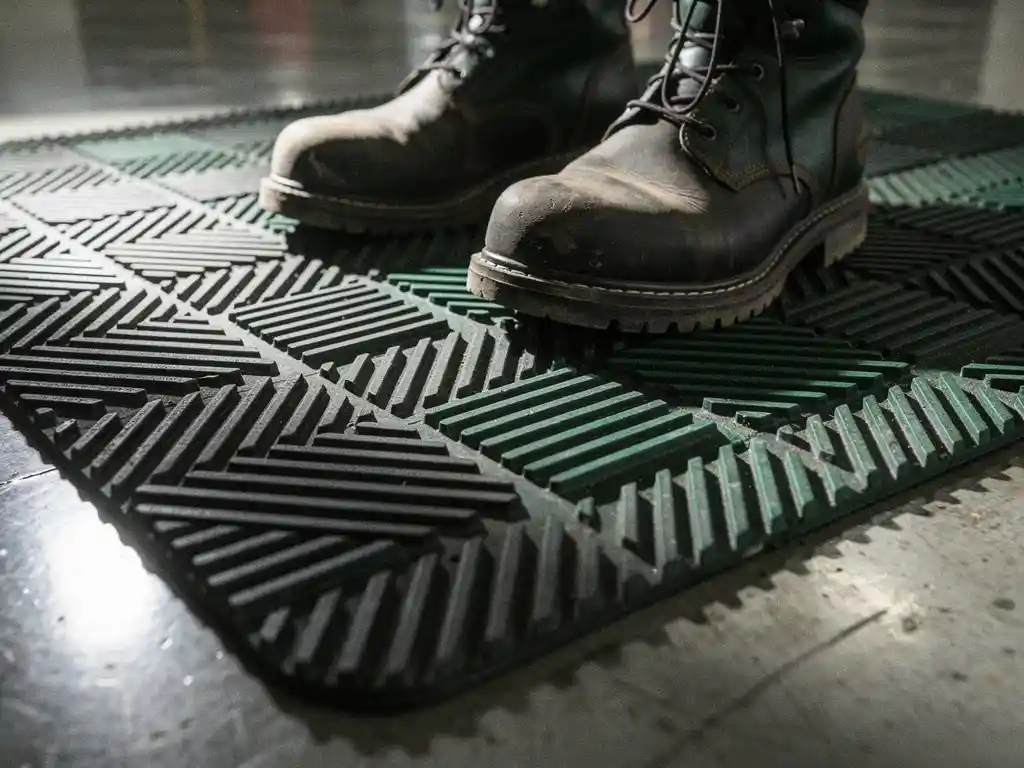
- Rubber flooring: Naturally high friction, non-porous, and resistant to moisture. Maintains its grip characteristics over time and performs well in both dry and wet conditions.
- Epoxy coatings: Can be formulated with added grit for improved traction, but the anti-slip properties can wear down in high-traffic zones.
Material selection should always match the specific demands of the environment. A material that works well in a dry retail space may be completely unsuitable for a food processing facility or a gym locker room. Thinking about how the floor will actually be used, and what it will be exposed to, leads to much better long-term safety outcomes.
How does floor cushioning reduce workplace injuries?
Floor cushioning reduces workplace injuries by absorbing the physical stress placed on the body during prolonged standing or repetitive movement. When a floor has some give to it, the impact of each step is partially absorbed by the surface rather than being transferred entirely through the feet, ankles, knees, and lower back. Over a full workday, this difference adds up significantly.
Workers who stand on hard surfaces for extended periods commonly experience musculoskeletal fatigue, joint pain, and discomfort in the lower limbs. This is not just a comfort issue. Fatigue reduces alertness and reaction time, which increases the likelihood of accidents and errors on the job. A floor that reduces physical strain also helps people stay focused and move more safely.
Anti-fatigue matting is the most practical way to introduce cushioning into a workplace without replacing the underlying floor. These mats are designed with materials that compress slightly underfoot, encouraging small, continuous micro-movements in the leg muscles. This subtle movement promotes better circulation and reduces the buildup of muscle tension that leads to fatigue.
Cushioning is especially useful in environments like assembly lines, retail checkouts, commercial kitchens, and any workstation where people remain in one position for long periods. The benefits are immediate and measurable in terms of comfort, but the longer-term impact on reducing strain-related injuries and absenteeism makes it a practical investment for most workplaces.
What role does drainage play in keeping floors safe?
Drainage plays a direct role in floor safety by removing liquids from the surface before they can create slip hazards. In any environment where water, oils, cleaning agents, or other liquids are regularly present, a floor without adequate drainage will accumulate moisture and become dangerous quickly. Good drainage design keeps surfaces drier and reduces the frequency of hazardous conditions.
In industrial and commercial settings, drainage is often built into the floor itself through sloped surfaces that direct liquid toward drains. However, even a well-designed drainage system can fall short if the floor surface does not allow liquid to move freely. Flat, non-textured floors can trap liquid in puddles rather than channeling it away efficiently.
Drainage matting is a practical solution that works alongside existing drainage infrastructure. These mats are designed with open grid or raised patterns that allow liquids to pass through and away from the surface where people walk. This keeps the standing surface drier and maintains better traction even in environments with constant liquid exposure.
Environments where drainage is especially important include:
- Commercial kitchens and food preparation areas
- Locker rooms and shower areas
- Car washes and vehicle service areas
- Industrial wash-down zones
- Livestock facilities and agricultural spaces
Drainage alone does not make a floor safe, but ignoring it in wet environments almost guarantees that the floor will become a slip hazard at some point. Combining good drainage design with appropriate surface texture and material gives you the strongest foundation for floor safety in liquid-prone areas.
When should you use rubber matting instead of permanent flooring?
Rubber matting is a better choice than permanent flooring when you need targeted protection in specific zones, when the floor surface cannot be replaced, or when conditions change frequently enough that a fixed solution would not keep up. It is also the right call when you need to add slip resistance, cushioning, or drainage to an existing floor without major renovation work.
Permanent flooring makes sense when you are starting from scratch or doing a full renovation and want a consistent surface throughout a space. But in many real-world situations, replacing an entire floor is not practical or cost-effective. Rubber matting lets you address specific problem areas, such as a wet entrance, a standing workstation, or a high-traffic corridor, without touching the rest of the floor.
Rubber matting is also a strong option when your needs are likely to evolve. Businesses that reconfigure workspaces, change production layouts, or expand into new areas benefit from the flexibility of matting solutions that can be moved, replaced, or added to as requirements shift. This is something a poured or glued-down floor simply cannot offer.
From a performance standpoint, rubber is non-porous, highly durable, and naturally resistant to moisture, which makes it effective in environments where permanent flooring materials struggle. It also maintains its slip-resistant properties over time without needing refinishing or recoating the way some other surfaces do.
At LRP Matting, we produce rubber mats for a wide range of environments, from industrial and commercial spaces to agricultural facilities. All of our mats are made from 100% recycled rubber, and many are reinforced with our proprietary FRC® compound for added strength and longevity. If you are looking for a practical, durable way to improve floor safety in your space, explore our industrial rubber matting solutions to find the right fit for your environment.
Frequently Asked Questions
How do I know if my current floor meets safe slip-resistance standards?
The most reliable way to assess your floor’s slip resistance is to have it tested using a pendulum test or a tribometer, both of which measure the coefficient of friction (COF) under dry and wet conditions. A COF of 0.5 or higher is generally considered the minimum safe threshold for pedestrian surfaces, though some industries have stricter requirements. If professional testing is not immediately available, a practical first step is to inspect your floor for visible wear, polish buildup, or areas where moisture tends to pool — these are strong indicators that your surface may no longer meet safe traction levels.
What is the best way to maintain slip resistance on floors over time?
Regular cleaning is essential, but the type of cleaning matters just as much as the frequency. Using the wrong detergent can leave a residue that acts like a lubricant on the surface, actually reducing traction rather than improving it — always use pH-neutral, residue-free cleaners suited to your floor type. Beyond cleaning, schedule periodic inspections to catch surface wear early, and consider reapplying anti-slip coatings or replacing worn matting before traction degrades to a dangerous level. In high-traffic areas, proactive maintenance is far more cost-effective than addressing a slip-and-fall incident after the fact.
Can rubber matting be used outdoors, or is it only suitable for indoor environments?
Many rubber mats are specifically designed for outdoor use and can handle UV exposure, temperature fluctuations, rain, and heavy foot or vehicle traffic. The key is to choose a mat formulated for outdoor conditions, as not all rubber compounds offer the same level of weather resistance. Look for mats with drainage features to prevent water from pooling underneath, and ensure the mat has a stable, non-curl design so it does not become a trip hazard in wind or heavy use. At LRP Matting, several of our rubber mat solutions are built to perform in demanding outdoor environments, including agricultural and industrial exterior zones.
How do I choose the right anti-fatigue mat thickness for my workplace?
Mat thickness directly affects the level of cushioning provided, but thicker does not always mean better — the right thickness depends on the type of work being performed and how long workers are standing. For most standing workstations, a mat between 9mm and 19mm offers a good balance of comfort and stability. Thicker mats (20mm and above) are better suited for environments with very hard concrete floors and prolonged standing, but they can feel unstable underfoot during tasks that require frequent movement or precise footwork. Always consider the work activity alongside the standing duration when selecting thickness.
What should I do if I cannot replace my flooring but it has become dangerously slippery?
There are several effective options for improving traction on an existing floor without replacing it. Anti-slip coatings and treatments can be applied to many hard surface types to etch or chemically texture the surface, increasing grip without altering the appearance significantly. Rubber or vinyl anti-slip mats can be deployed in the most hazardous zones — such as entrances, wet areas, or workstations — as an immediate and cost-effective solution. For floors with drainage requirements, open-grid drainage mats provide both improved traction and liquid management without any permanent modification to the underlying surface.
Are there specific flooring safety requirements I need to comply with for my industry?
Yes, many industries are subject to specific floor safety regulations set by bodies such as OSHA (in the United States), HSE (in the United Kingdom), or equivalent national authorities. For example, OSHA’s General Industry Standards (29 CFR 1910.22) require that workplace floors be kept clean, dry, and free of hazards, while food industry environments are often governed by additional hygiene and drainage standards. It is important to review the regulations applicable to your specific sector and jurisdiction, as non-compliance can result in fines, liability exposure, and most importantly, preventable injuries. Consulting a health and safety professional is a practical step if you are unsure which standards apply to your facility.
How often should rubber mats be replaced, and what signs indicate they need replacing?
The lifespan of a rubber mat depends on the quality of the material, the intensity of use, and the environment it is exposed to — but most commercial-grade rubber mats last several years with proper care. Key signs that a mat needs replacing include visible surface wear that has smoothed out the texture, curling or lifting edges that create a trip hazard, cracking or crumbling of the rubber compound, and a noticeable reduction in cushioning or grip underfoot. Mats made from high-quality recycled rubber with reinforced compounds, like those produced by LRP Matting, tend to have a longer service life and hold their safety properties for longer before replacement becomes necessary.
Related Articles
- What creates a safe recovery environment for animals?
- How do you prevent seasonal floor hazards?
- How do different floor materials affect slip resistance?
- What flooring works best in a high-moisture veterinary environment?
- How do you level a horse stall floor before laying mats?
- What is the best flooring for a factory assembly line?
- How do you make a veterinary recovery stall safer for horses?
- How do you keep a sports facility floor safe in wet conditions?
- How do you fit flooring in an irregularly shaped sports facility area?
- What flooring works best in an outdoor or covered sports venue?