
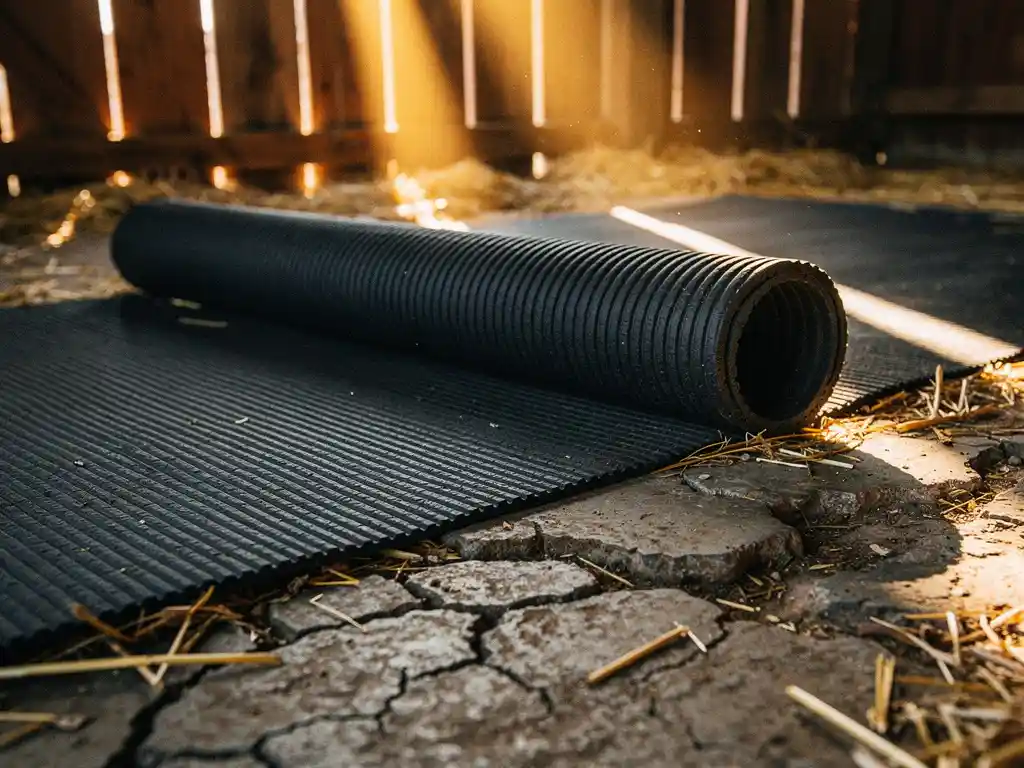
The best way to cover an uneven barn floor is to use thick rubber mats—ideally at least 3/4 inch thick—which flex slightly to conform to surface irregularities and create stable, comfortable footing for your animals. For moderate unevenness, rubber mats alone do the job well. For severe dips or raised areas, a quick patch with sand, gravel, or a concrete leveling compound before laying the mats will give you the best long-term results.
Uneven barn floors are one of those problems that sneak up on you. What starts as a slight dip or a rough patch can quickly turn into a safety hazard for your animals and a headache for you. The good news is that covering an uneven barn floor doesn’t have to be complicated or expensive. The right matting solution can smooth things out, protect your animals, and even help you reduce horse bedding costs over time. Here’s everything you need to know.
Why does an uneven barn floor cause problems for livestock?
An uneven barn floor creates serious risks for livestock because animals constantly adjust their posture to compensate for unstable footing. This puts strain on joints and hooves, increases the chance of slips and falls, and causes ongoing low-level stress that affects health, weight gain, and milk production over time.
When a cow, horse, or pig is standing on a surface that rocks or dips, its muscles and tendons work harder than they should just to stay balanced. That extra effort adds up over hours and days. For dairy cows in particular, stress and discomfort directly reduce the time they spend lying down, which is closely linked to milk yield. Horses on uneven flooring are more prone to hoof problems and leg injuries, especially in high-traffic areas like alleyways and stall entrances.
Beyond animal welfare, uneven floors also make daily barn management harder. Water and waste pool in low spots, creating hygiene problems that are difficult to clean properly. Bedding shifts and bunches unevenly, meaning you end up using more of it to compensate. Over time, the combination of moisture, waste, and pressure accelerates floor deterioration, turning a manageable problem into a costly repair job.
What are the best materials for covering an uneven barn floor?
Rubber matting is the most practical and widely used material for covering an uneven barn floor. It is durable, non-porous, easy to clean, and flexible enough to accommodate minor surface irregularities. Other options, such as sand, straw, or wood shavings, can be used as bedding on top of mats, but they do not address the underlying floor problem the way a solid rubber mat does.
Here is a quick comparison of common options:
- Rubber mats: Long-lasting, hygienic, comfortable, and effective over mildly uneven surfaces. The top choice for permanent barn flooring.
- Sand or gravel: Useful as a base layer to fill in low spots before laying mats, but not a standalone solution for uneven floors.
- Concrete patching compound: Good for filling specific dips or cracks before installing mats, especially in areas with significant height differences.
- Wood shavings or straw: Provide cushioning but do not stabilize the surface, shift around constantly, and need regular replacement.
- Interlocking foam tiles: Not suitable for barn environments due to low durability and poor resistance to moisture and heavy animal traffic.
For most barns, the smartest approach is to use rubber mats as the primary floor covering, with minor leveling work done beforehand where the floor is particularly rough. This gives you a stable, clean, and comfortable surface that lasts for years rather than months.
How do rubber mats help with uneven barn floors?
Rubber mats help with uneven barn floors by providing a stable, cushioned surface that absorbs the impact of minor irregularities and distributes weight evenly across the floor. Their natural flexibility allows them to conform to slight dips and bumps, reducing the pressure points that cause discomfort and injury to animals standing or lying on the floor.
Thick rubber mats act as a buffer between the animal and the hard, uneven concrete or compacted earth beneath. Instead of a hoof landing directly on a raised edge or dropping into a low spot, the mat absorbs and spreads that load. This is especially useful in stalls, alleyways, and milking parlors, where animals spend extended periods on their feet.
Rubber is also non-porous, meaning it does not absorb moisture, urine, or manure. This matters a lot on uneven floors because low spots tend to collect liquid. A rubber mat sits over those areas and keeps the surface clean and dry, reducing the bacterial buildup that leads to hoof rot and other health issues. And because rubber does not crack, peel, or crumble even in extreme temperatures, it holds up through winter cold and summer heat without losing its protective qualities.
Should you level a barn floor before laying mats?
You should level a barn floor before laying mats if the surface has significant dips, raised edges, or structural damage. For minor unevenness, thick rubber mats can handle it on their own. But if there are gaps larger than about half an inch between the floor and the mat, leveling first will give you a more stable, longer-lasting installation.
Think about it this way: a rubber mat laid over a large hollow will flex downward when an animal steps on it, creating movement underfoot. That movement is uncomfortable for the animal and can cause the mat edges to lift over time, creating a trip hazard. Filling those low spots with a concrete patching compound, sand, or fine gravel before laying your mats eliminates that problem entirely.
For floors with widespread unevenness rather than isolated spots, a thin layer of compacted sand or fine stone dust can act as a leveling bed for the mats. This approach is common in older barns where the original concrete has settled unevenly over decades. It does not need to be a perfect surface—just consistent enough that the mats lie flat and stable across the whole area.
What thickness of rubber mat works best for uneven surfaces?
For uneven barn floors, rubber mats with a thickness of at least 3/4 inch are recommended. Thicker mats provide more cushioning, conform better to surface irregularities, and offer greater durability under the constant weight and movement of large animals. For heavy livestock like cattle or horses, mats between 3/4 inch and 1 inch thick are a practical starting point.
Thinner mats, such as those around 1/2 inch thick, work well on relatively flat surfaces but offer less forgiveness over bumps and dips. On an uneven floor, a thin mat will telegraph the irregularities right through to the animal’s hooves rather than absorbing them. The extra material in a thicker mat creates a more forgiving layer that smooths out the surface underfoot.
It is also worth thinking about the weight of the mat. Heavier, thicker mats tend to stay in place better, which is especially useful on uneven floors where lighter mats might shift or buckle. For example, a 4 x 6 stall mat at 3/4 inch thickness weighs around 90 to 115 pounds, depending on the rubber compound, which gives it enough mass to stay flat and stable without needing adhesive or fasteners in most stall applications.
How do you install rubber mats on an uneven barn floor?
Installing rubber mats on an uneven barn floor involves four practical steps: assess and patch the floor, choose the right mat size and thickness, lay mats starting from a corner or wall, and secure them in place if needed. Taking a bit of time to prepare the surface before laying mats makes the whole installation smoother and more durable.
- Assess the floor: Walk the area and identify any major dips, raised edges, or damaged sections. Use a straightedge or level to get a clear picture of how uneven the surface is.
- Patch and prepare: Fill significant low spots with concrete patching compound or compacted sand. You do not need a perfectly smooth finish, just a stable base that minimizes large gaps under the mats.
- Choose your mats: Select mats that are thick enough for your livestock and sized to minimize seams. Fewer seams mean less opportunity for waste and moisture to get underneath the mats.
- Lay from a fixed point: Start from a wall or corner and work outward. Butt mats tightly together, and use interlocking designs where available to keep edges aligned and prevent shifting.
- Secure if needed: In high-traffic areas or on slatted floors, use a purpose-designed fastener to keep mats in place. Our patented Slat Mat Fastener, for example, holds mats securely on slatted concrete without any metal components that could harm animals.
Choosing large-format mats wherever possible also simplifies installation on uneven floors. Fewer pieces mean fewer edges that can lift or shift, and a cleaner overall surface that is easier to manage day to day.
How do you keep barn floor mats clean and long-lasting?
Keeping barn floor mats clean and long-lasting comes down to regular removal of waste, periodic washing with mild detergent and water, and allowing mats to dry before putting bedding back down. Rubber mats are low-maintenance by nature, but a simple routine keeps them hygienic and extends their working life significantly. This routine also helps you reduce horse bedding costs because clean mats mean less bedding contamination and less waste overall.
For daily maintenance, scrape off manure and wet bedding before it has a chance to sit and break down. Rubber is non-porous, so waste sits on the surface rather than soaking in, which makes this job quick and straightforward. A stiff brush and a hose-down with water handle most of what daily use throws at a mat.
For a deeper clean, a mild detergent solution and a scrub brush will remove built-up residue and bacteria. Avoid harsh solvents or bleach-based cleaners, as these can degrade the rubber over time. After washing, let the mats air-dry before replacing bedding. This prevents moisture from getting trapped underneath, which is where mold and bacteria problems tend to start.
Periodically lifting your mats to clean the floor underneath is also a good habit. Even with a non-porous mat, moisture can work its way to the edges and underneath over time. Lifting, cleaning, and repositioning mats every few months keeps both the mat and the floor in good condition.
When it comes to finding the right matting solution for your barn, we at LRP Matting — the natural solution have been helping farmers and livestock operators since 1971. Whether you need standard stall mats, large-format cow comfort runners, or a fully custom rubber matting solution cut to fit your exact barn dimensions, we can help you find the right fit. Our mats are made from 100% recycled rubber and built to last, so you get a surface that works hard, stays clean, and keeps your animals comfortable for years to come.
Frequently Asked Questions
Can I use rubber mats directly on a dirt barn floor, or does it need to be concrete?
Rubber mats can absolutely be used on compacted dirt floors, but preparation matters more than it does with concrete. The dirt base needs to be firmly compacted and as level as possible before laying mats — loose or soft soil will shift underfoot, causing the mats to move and creating gaps. Tamping the dirt down thoroughly, adding a layer of compacted gravel or stone dust if needed, and then laying your mats will give you a stable, long-lasting result even without a concrete base.
How do I stop rubber mats from sliding or shifting on an uneven barn floor?
The most effective way to keep mats in place is to choose heavier, thicker mats — their weight alone keeps them stable in most stall applications. Beyond that, using interlocking mat designs reduces individual mat movement significantly. In high-traffic areas like alleyways or slatted-floor sections, purpose-built fasteners are the most reliable solution. Avoid using adhesive on uneven floors, as it prevents you from lifting mats for cleaning underneath and can cause damage when you eventually need to remove them.
What's the best way to cut rubber mats to fit around posts, walls, or irregular barn layouts?
A sharp utility knife with a fresh blade is the standard tool for cutting rubber barn mats, and it handles most straight cuts well. For curves or cutouts around posts and fixtures, score the cut line first with the knife, then flex the mat along the score to guide a clean break, or use a jigsaw with a coarse blade for more complex shapes. Always measure twice and cut conservatively — you can always trim more, but you can’t add rubber back. Many suppliers, including custom matting manufacturers, will also pre-cut mats to your exact dimensions if you’d rather avoid the work on-site.
How long do rubber barn mats typically last, and what are the signs they need replacing?
High-quality rubber barn mats typically last 10 to 20 years with proper care, though this varies depending on mat thickness, rubber quality, and the intensity of daily use. Signs that a mat needs replacing include significant cracking or tearing across the surface, permanent compression in high-traffic areas that no longer provides adequate cushioning, edges that have curled or crumbled and can’t be kept flat, and persistent odor that doesn’t resolve even after thorough cleaning. Catching these signs early is important — a deteriorating mat can create the same trip and injury hazards as an uncovered uneven floor.
Are rubber barn mats safe for horses with hoof problems or animals recovering from injury?
Yes — rubber mats are widely recommended by equine vets and farriers for horses with hoof issues or those in rehabilitation, precisely because they reduce concussion and provide a stable, non-slip surface that takes pressure off stressed joints and tendons. For horses recovering from injury, pairing a thick rubber mat (3/4 inch to 1 inch) with a layer of appropriate bedding on top offers both the stability of a firm base and the cushioning of softer material. Always consult your vet about specific footing requirements for horses with serious conditions, as some rehabilitation cases may call for additional support or specialized matting.
Can rubber mats help with drainage issues caused by an uneven barn floor?
Rubber mats improve the situation but don’t fully solve drainage problems on their own — they cover low spots and keep animals off pooled liquid, but water can still work its way to mat edges and underneath over time. For stalls or alleyways with persistent drainage issues, the most effective approach is to address the drainage problem at the floor level first — either by re-grading the floor, adding drainage channels, or filling low spots — and then laying mats over the corrected surface. Some rubber mats also feature drainage grooves or perforations on the underside specifically designed to channel moisture away, which can be a good option for wet barn environments.
Is it worth investing in custom-cut rubber mats versus standard sizes for an irregularly shaped barn?
For irregularly shaped barns, custom-cut mats are almost always worth the investment. Standard-sized mats in an irregular space create more seams, gaps, and awkward cuts that you have to manage yourself — and every seam is a potential point where waste and moisture can get underneath, where edges can lift, and where animals can catch a hoof. Custom mats cover the space cleanly with minimal seams, are easier to maintain, and tend to last longer because they sit flat and stable from day one. The upfront cost difference is usually offset fairly quickly by reduced maintenance time and longer mat lifespan.
Related Articles
- How does floor related fatigue impact workplace safety?
- Why is regular floor maintenance important for long term performance?
- What causes sports facility floors to wear out?
- How do uneven floors increase accident risk?
- What is the best flooring for a sports facility?
- How do you fit stall mats to a non-standard stall size?
- What makes a floor surface safe for a horse coming out of anesthesia?
- How do you protect a concrete floor from heavy machinery?
- What type of flooring reduces the risk of slip and fall accidents in a factory?
- How do you choose the right rubber flooring for an indoor sports complex?