
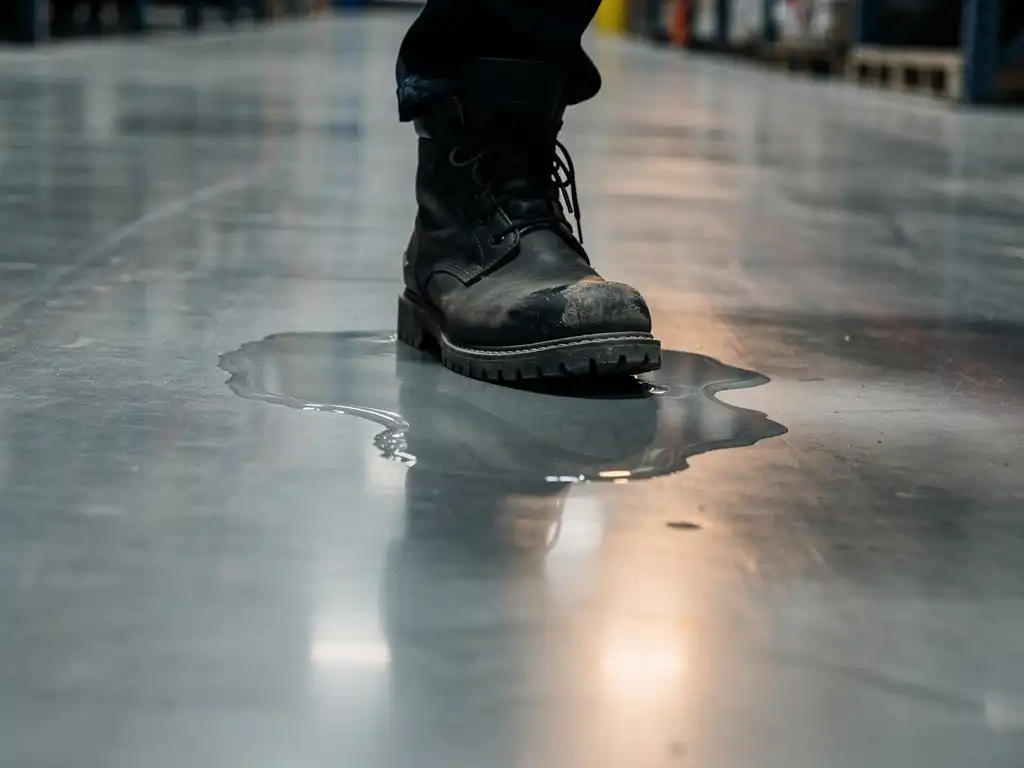
Polished concrete becomes slippery because the grinding and polishing process smooths out the microscopic texture that gives raw concrete its natural grip. The smoother the surface, the less friction it creates underfoot, and the easier it is for shoes to slide across it. Add water, cleaning products, or dust to the mix, and the slip risk increases significantly. Below, we break down exactly what causes this and what you can do about it.
What makes a floor surface slippery in the first place?
A floor becomes slippery when there is not enough friction between the shoe sole and the floor surface. Friction depends on two things: the texture of the surface and the presence of any substance between the shoe and the floor. When a surface is smooth, or when a liquid or fine particles reduce contact between the two, traction drops and the risk of slipping goes up.
Concrete in its natural, unfinished state has a rough, porous texture. That roughness creates grip. But as soon as you start changing the surface through polishing, coating, or heavy foot traffic, that natural texture changes. The result is a floor that looks great but performs poorly from a floor safety standpoint. Understanding this basic mechanism helps explain why so many polished concrete environments end up on floor safety inspection checklists.
How does the polishing process reduce concrete’s grip?
The polishing process reduces concrete’s grip by physically abrading the surface with progressively finer grinding tools. Each pass removes more of the rough texture, closing the pores and flattening the microscopic peaks that create friction. The higher the polish level, the smoother and more reflective the surface becomes, and the lower its slip resistance.
Concrete is typically polished in multiple stages, starting with coarse diamond tooling and finishing with fine grits that produce a mirror-like sheen. By the final stage, the surface can be as smooth as polished stone. While this finish is popular in retail spaces, showrooms, and commercial buildings because of its appearance and durability, it comes at a cost: the surface becomes significantly less forgiving underfoot, especially when conditions are less than ideal.
Why does water make polished concrete even more dangerous?
Water makes polished concrete more dangerous because it acts as a lubricant between the shoe and the floor. On a rough surface, water can drain into the texture and still allow some contact between the sole and the floor. On a polished surface, there is nowhere for the water to go, so it sits on top and creates a thin film that dramatically reduces friction.
This is why polished concrete floors in kitchens, entryways, bathrooms, and outdoor-adjacent areas are considered high-risk zones for slip and fall prevention. Even a small amount of moisture from wet shoes, spilled drinks, cleaning, or humidity can make the surface feel almost frictionless. The problem is made worse by the fact that a wet polished floor can look dry at a glance, making it hard for people to recognize the hazard before it is too late.
What other factors increase the slip risk on polished concrete?
Several factors beyond water can increase the slip risk on polished concrete. Dust, fine debris, cleaning product residue, and worn shoe soles all reduce the friction available between foot and floor. In industrial or commercial settings, oils, powders, and other materials tracked across the floor can make an already smooth surface significantly more hazardous.
The type of footwear matters too. Smooth-soled shoes, dress shoes, or shoes with worn treads perform poorly on polished concrete regardless of conditions. Age and mobility also play a role, as people who are less steady on their feet are more vulnerable on low-friction surfaces. From a floor safety inspection perspective, polished concrete floors often require additional controls precisely because so many variables can compound the baseline risk created by the smooth surface itself.
Where are polished concrete slip hazards most common?
Polished concrete slip hazards are most common in commercial and industrial environments where the floor sees heavy foot traffic combined with moisture or debris. Retail stores, warehouses, gyms, restaurants, hospitals, and manufacturing facilities are all settings where polished concrete is widely used and where floor hazards are a recurring concern.
Entryways and transition zones are particularly risky because people track in water and dirt from outside. Kitchen and food preparation areas face constant moisture exposure. In industrial settings, spills of oils, chemicals, or fine materials add another layer of risk. These are the spaces where floor safety inspection protocols tend to flag polished concrete most frequently, and where proactive slip and fall prevention measures are most important.
How can rubber mats reduce slip risk on polished concrete?
Rubber mats reduce slip risk on polished concrete by adding a high-friction surface layer over the smooth floor. A quality rubber mat provides grip both for the person standing on it and for the mat itself against the floor below. This creates a stable, non-slip zone in exactly the areas where the polished concrete presents the greatest risk.
Rubber mats work well in entryways where wet shoes are common, in front of workstations where people stand for long periods, and in transition zones between wet and dry areas. They are easy to clean, do not absorb moisture, and hold their shape under heavy use. In commercial and industrial environments, placing mats strategically in high-risk zones is one of the most practical and cost-effective steps you can take for slip and fall prevention without altering the floor itself.
At LRP Matting, we offer a wide range of rubber mats built specifically for demanding environments. Our mats are made from genuine rubber, which is non-porous and provides reliable grip even in wet or high-traffic conditions. Many of our products are made with our proprietary Fiber Reinforced Rubber Compound (FRC®), which adds extra strength and durability for long-term performance. If you are looking for a practical solution to floor hazards in a commercial or industrial space, explore our commercial matting solutions to find the right fit for your environment.
Frequently Asked Questions
How do I know if my polished concrete floor meets minimum slip resistance standards?
Slip resistance is measured using a Coefficient of Friction (COF) test, and most safety standards recommend a minimum COF of 0.42 for level walking surfaces and higher for ramps or wet areas. You can hire a certified floor safety inspector to conduct a professional pendulum or tribometer test on your floor. If your floor falls below the recommended threshold, it is a strong signal that additional controls — such as anti-slip treatments, matting, or signage — need to be put in place before an incident occurs.
Can anti-slip coatings or treatments be applied to polished concrete without ruining its appearance?
Yes, there are penetrating anti-slip treatments specifically designed for polished concrete that work by micro-etching the surface to restore some texture without visibly dulling the finish. These products are applied as liquids, absorbed into the surface, and do not leave a coating on top, so the aesthetic of the floor is largely preserved. Results vary depending on the polish level and the product used, so it is worth testing on a small inconspicuous area first and re-testing the COF after application to confirm the improvement.
How often should rubber mats on polished concrete be inspected or replaced?
Rubber mats should be inspected at least weekly in high-traffic commercial or industrial environments, with particular attention paid to curling edges, worn surface texture, and any signs of the mat shifting or bunching — all of which create trip hazards of their own. A quality rubber mat made from dense, reinforced rubber compound can last several years under normal use, but mats in entryways or wet zones tend to wear faster and may need replacing annually. Replacing a mat proactively is far less costly than dealing with a slip-and-fall incident.
What is the biggest mistake facility managers make when trying to address polished concrete slip hazards?
The most common mistake is relying solely on wet floor signage or cleaning schedules as the primary safety control, rather than addressing the root cause — the low-friction surface itself. Warning signs are a reactive measure and do nothing to improve the actual grip of the floor. A more effective approach combines surface-level solutions (anti-slip treatments or mats in high-risk zones) with good housekeeping practices and regular floor safety inspections to catch new hazards before they lead to incidents.
Are there specific types of rubber mats that work better for certain polished concrete environments?
Yes — the right mat depends heavily on the environment. For entryways, a scraper or wiper-scraper mat is ideal because it removes moisture and debris from shoe soles before people step onto the polished floor. For kitchen or food prep areas, a grease-resistant rubber mat with drainage holes is the better choice. For industrial workstations, a thicker anti-fatigue rubber mat provides both slip resistance and ergonomic support for workers standing for long periods. Matching the mat type to the specific hazard in each zone is key to getting the best safety outcome.
Does the gloss level of polished concrete directly affect how slippery it is?
Generally speaking, yes — a higher gloss level correlates with a smoother surface and lower slip resistance, because achieving that mirror-like finish requires removing more of the surface texture through finer and finer grinding stages. However, gloss level alone is not a reliable safety indicator, since a floor can look matte but still have low COF depending on the products applied to it. Always rely on an actual slip resistance measurement rather than visual appearance when assessing floor safety.
Can polished concrete be made permanently slip-resistant, or do treatments need to be reapplied over time?
Most anti-slip treatments for polished concrete are not permanent and will diminish over time due to foot traffic, cleaning, and general wear — typically requiring reapplication every one to three years depending on traffic levels. Mechanical solutions like rubber matting are more consistently reliable because they can be inspected, cleaned, and replaced as needed without altering the floor. For the most durable long-term result, many facility managers combine a surface treatment with strategic mat placement in the highest-risk zones, creating layered protection that does not depend on any single solution holding up indefinitely.
Related Articles
- What are the biggest flooring maintenance mistakes?
- What makes a flooring material sustainable?
- How do weather conditions affect outdoor sports surfaces?
- What makes a sports surface safe?
- How do you clean and maintain a horse trailer floor?
- How do you reduce noise in a sports facility through flooring choice?
- How do you stop steel-tracked vehicles from damaging a concrete floor?
- What type of flooring reduces the risk of slip and fall accidents in a factory?
- What are the pros of rubber mats in a horse stall?
- How do you insulate a horse stall floor in winter?