
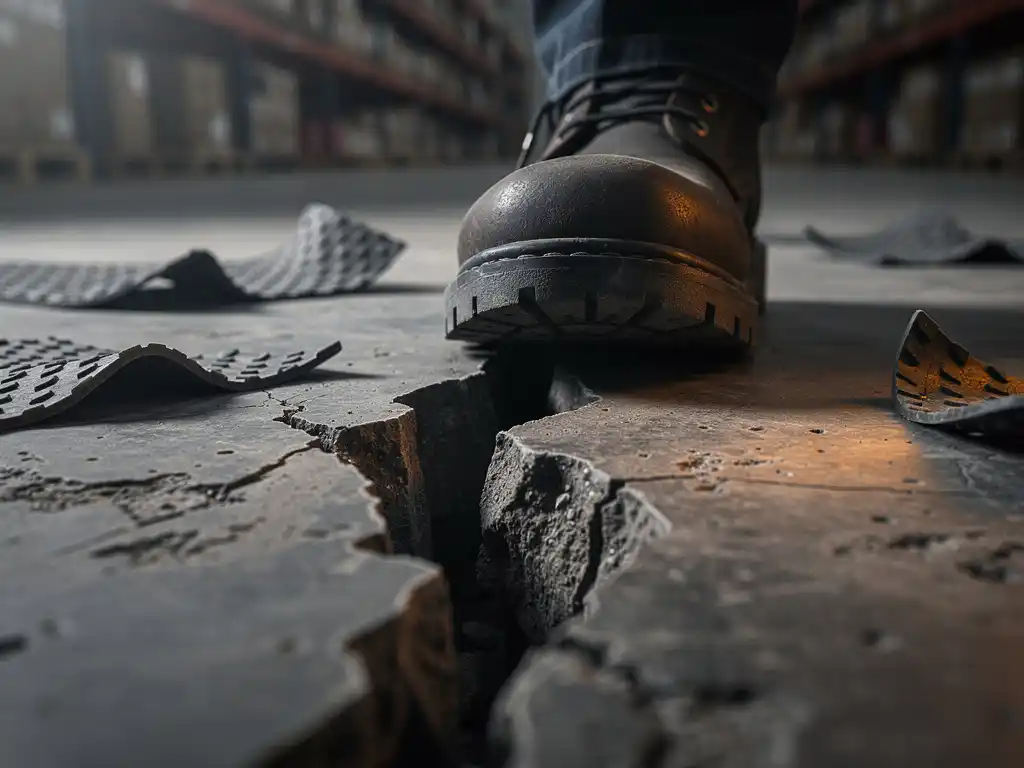
Uneven floors increase accident risk by creating unpredictable surfaces where people can trip, slip, or lose their balance without warning. Even small height differences or surface irregularities can be enough to cause a serious fall, especially when someone is moving quickly, carrying a load, or working in low-light conditions. The risk is even higher in industrial, commercial, and agricultural environments where floors take a beating over time. Below, we break down exactly how uneven floors cause harm and what you can do about it.
What types of injuries do uneven floors cause?
Uneven floors most commonly cause slip and fall injuries, including sprains, fractures, and head injuries. When a person steps onto an unexpected height change or an unstable surface, the body cannot react fast enough to regain balance. The result can range from a minor twist of the ankle to a serious fall with lasting consequences.
The most frequent injuries from floor hazards include:
- Ankle and knee sprains from stepping onto a raised or sunken area
- Wrist and arm fractures from instinctively reaching out to break a fall
- Hip fractures, particularly serious in older workers
- Head injuries and concussions when someone falls onto a hard surface
- Back injuries caused by sudden, awkward movements
What makes these injuries especially frustrating is that they are largely preventable. Floor safety is not complicated in principle, but it does require consistent attention. Identifying and correcting uneven surfaces before someone gets hurt is always the better option.
Why are uneven floors especially dangerous in industrial settings?
Uneven floors are especially dangerous in industrial settings because workers are often moving fast, carrying heavy loads, operating machinery, or wearing bulky protective gear that limits their range of motion and visibility. Any one of these factors raises the stakes of a floor hazard. Combine them, and the risk multiplies quickly.
In factories, warehouses, and heavy manufacturing areas, floors are exposed to constant mechanical stress from forklifts, pallet jacks, and heavy equipment. This wear creates cracks, dips, and raised edges over time. Workers navigating these spaces may not always be looking down, especially if they are focused on a task or moving between workstations.
Spills are also more common in industrial environments, and when a liquid settles into an uneven surface, it creates a pooling hazard that is harder to see and harder to clean. Slip and fall prevention in these settings depends on both good housekeeping and a floor surface that minimizes the risk in the first place. Floor safety inspections should be a regular part of any industrial safety program, not just something done after an incident occurs.
How do uneven floors affect animals in agricultural environments?
Uneven floors in barns and livestock facilities cause physical stress, injury, and behavioral changes in animals. Cattle, horses, and other livestock rely on stable footing to move comfortably and confidently. When floors are uneven, cracked, or worn down, animals can slip, stumble, or develop joint problems from repeatedly compensating for poor surfaces.
For dairy cows, floor quality has a direct impact on productivity. Cows that are uncomfortable or in pain from poor flooring spend less time standing at feeding stations and more time lying down in ways that can cause additional health problems. Lameness is one of the most costly issues in dairy farming, and floor conditions play a significant role in its development.
Horses are similarly sensitive to footing quality. An uneven stable or arena floor increases the risk of slipping, which can cause leg injuries that take months to heal. Beyond the physical risk, animals that feel unsafe on a surface become anxious and harder to handle, which creates safety concerns for the people working with them as well.
What makes a floor surface uneven over time?
Floor surfaces become uneven over time through a combination of mechanical wear, moisture damage, temperature changes, and the gradual settling of the building itself. No floor stays perfectly level forever, but some environments accelerate the process significantly.
Common causes of floor unevenness include:
- Heavy equipment and vehicle traffic that compresses or cracks the floor material
- Moisture infiltration that causes concrete to erode or wooden floors to warp
- Freeze and thaw cycles that expand and contract the floor material, especially in outdoor or semi-outdoor areas
- Chemical exposure from cleaning agents or industrial fluids that degrade the surface
- Improper installation that leaves weak spots prone to early wear
- Natural settling of the building foundation over time
Regular floor safety inspections help catch these changes early. A floor that looks fine to the eye can already have developed enough unevenness to pose a real slip and fall risk, especially in areas with heavy foot traffic or equipment use.
How do rubber mats reduce the risks of uneven floors?
Rubber mats reduce the risks of uneven floors by creating a stable, slip-resistant surface layer that compensates for minor irregularities beneath. A quality rubber mat conforms slightly to the surface below while providing a consistent, level top layer for people or animals to walk on. This reduces the chance of an unexpected step and improves overall floor safety.
The slip resistance of rubber is one of its most practical advantages. Unlike hard flooring materials, rubber grips footwear and hooves effectively, even when the surface is wet or contaminated. This makes it useful in environments where spills or moisture are hard to avoid.
Rubber mats also absorb impact, which reduces fatigue for workers standing for long periods. Tired workers are less alert and more likely to make the kind of small misstep that leads to a fall. By improving comfort alongside slip resistance, rubber matting addresses floor hazards from more than one angle.
In agricultural settings, rubber mats provide stable footing for livestock on concrete floors that have become worn or uneven. They also protect the animals’ joints from the hard, unforgiving surface beneath, reducing the long-term physical toll of living on concrete.
What should you look for in a mat designed for uneven or heavy-duty floors?
For uneven or heavy-duty floors, look for a rubber mat that is thick enough to bridge minor surface irregularities, durable enough to withstand the specific demands of your environment, and slip-resistant on both the top and bottom surfaces. The mat should stay in place under load and not curl at the edges, which can create a new tripping hazard.
Key features to prioritize include:
- Adequate thickness to provide cushioning and surface leveling without creating a raised edge that becomes a trip hazard
- High-grip top surface for effective slip and fall prevention
- Non-slip backing to prevent the mat from shifting under foot traffic or equipment
- Resistance to moisture, chemicals, and temperature extremes so the mat holds up in demanding conditions
- Large format sizing to reduce the number of seams, since seams between mats can themselves become uneven over time
- Non-porous material that does not absorb liquids, making it easier to clean and maintain
For industrial applications, look for mats built with reinforced materials that can handle heavy machinery and repeated impact without breaking down. For livestock environments, prioritize mats that are firm enough to provide stable footing but cushioned enough to protect joints over the long term.
At LRP Matting, we make rubber mats from 100% recycled materials, including our proprietary Fiber Reinforced Rubber Compound (FRC®), which gives our mats extra strength without sacrificing the surface quality that makes them effective on uneven or high-traffic floors. We also offer some of the largest mat sizes in the industry, which means fewer seams and a more consistent surface across your entire space. If you are looking for a practical solution for floor hazards in industrial or agricultural settings, explore our industrial rubber mats to find the right fit for your environment.
Frequently Asked Questions
How often should I inspect floors for unevenness in an industrial or agricultural setting?
In high-traffic industrial environments, floors should be inspected at least once a month, with additional checks after any incident, heavy equipment relocation, or significant weather event. In agricultural settings, a weekly visual walkthrough is a good baseline, especially in areas where livestock are housed or frequently moved. The key is to document findings consistently so you can track how quickly problem areas are developing and prioritize repairs before they become serious hazards.
Can rubber mats fully replace floor repairs, or do they only work as a temporary fix?
Rubber mats are highly effective for managing minor surface irregularities and reducing slip and fall risk, but they are not a substitute for structural floor repairs when the underlying damage is significant. If a floor has deep cracks, large sunken areas, or compromised structural integrity, those issues need to be addressed at the source. Think of rubber matting as a complementary layer of protection that improves safety and comfort on surfaces that are worn but still structurally sound, while floor repair addresses more serious underlying problems.
What are the most common mistakes people make when placing rubber mats on uneven floors?
One of the most frequent mistakes is using mats that are too thin, which means they fail to bridge surface irregularities and may still flex or shift underfoot. Another common error is placing multiple small mats with many seams, since those seam edges can themselves become trip hazards over time. Finally, many people overlook the importance of a non-slip backing, assuming the mat’s weight alone will keep it in place — but under heavy foot traffic or equipment movement, even heavy mats can shift if the backing is not specifically designed for grip.
Are there specific regulatory or compliance standards related to uneven floors in workplaces?
Yes — in the United States, OSHA standards (particularly 29 CFR 1910.22 for general industry) require that workplace floors be kept clean, dry, and in good repair, and that walking surfaces be free of hazards that could cause slips, trips, or falls. Similar regulations exist in other countries under their respective occupational health and safety frameworks. Failing to address known floor hazards can expose employers to significant liability in the event of an injury, making proactive floor safety inspections not just a best practice but a legal responsibility.
How do I know what mat thickness is right for my specific floor conditions?
As a general rule, floors with minor surface wear or light irregularities are well-served by mats in the 3/8u0022 to 1/2u0022 thickness range, while more heavily worn or uneven surfaces benefit from mats that are 3/4u0022 or thicker. For livestock environments, thicker mats also provide better joint protection, which is especially important for large animals spending long hours on concrete. When in doubt, consult with your mat supplier and describe the specific conditions — surface type, traffic load, and the nature of the unevenness — so they can recommend the right product for your situation.
Can uneven floors affect workers' long-term health even if no acute injury occurs?
Absolutely. Even without a dramatic fall, consistently walking or standing on uneven surfaces forces the body to make constant micro-adjustments in posture and gait, which over time can lead to chronic issues like knee pain, hip misalignment, lower back strain, and fatigue-related musculoskeletal disorders. Workers who spend hours each day on poor flooring may not connect their discomfort to the floor itself, making it an underreported but significant occupational health concern. Addressing floor quality is therefore not just about preventing acute injuries — it’s also an investment in long-term workforce health and productivity.
What is the best way to get started with improving floor safety across a large facility?
Start by conducting a systematic floor audit of the entire facility, mapping out problem areas by severity — distinguishing between surfaces that need immediate repair, those that can be managed with matting, and areas that simply need closer monitoring. Prioritize high-traffic zones, areas near machinery, and any spaces where spills or moisture are common. From there, develop a phased plan that combines structural repairs where needed with rubber matting solutions for ongoing protection, and establish a regular inspection schedule to keep the safety program proactive rather than reactive.
Related Articles
- How do you improve hygiene in animal facilities?
- How does flooring lifespan affect total cost of ownership?
- How do modern animal facilities improve safety?
- What causes a floor surface to become slippery over time?
- How do weather conditions affect outdoor floor safety?
- How can you improve traction on existing floors?
- How do you protect a performance horse's legs during stabling?
- How does stall flooring affect a horse's hooves long term?
- What type of flooring is best for a horse recovery stall?
- What is the fastest way to muck out a horse stall?