
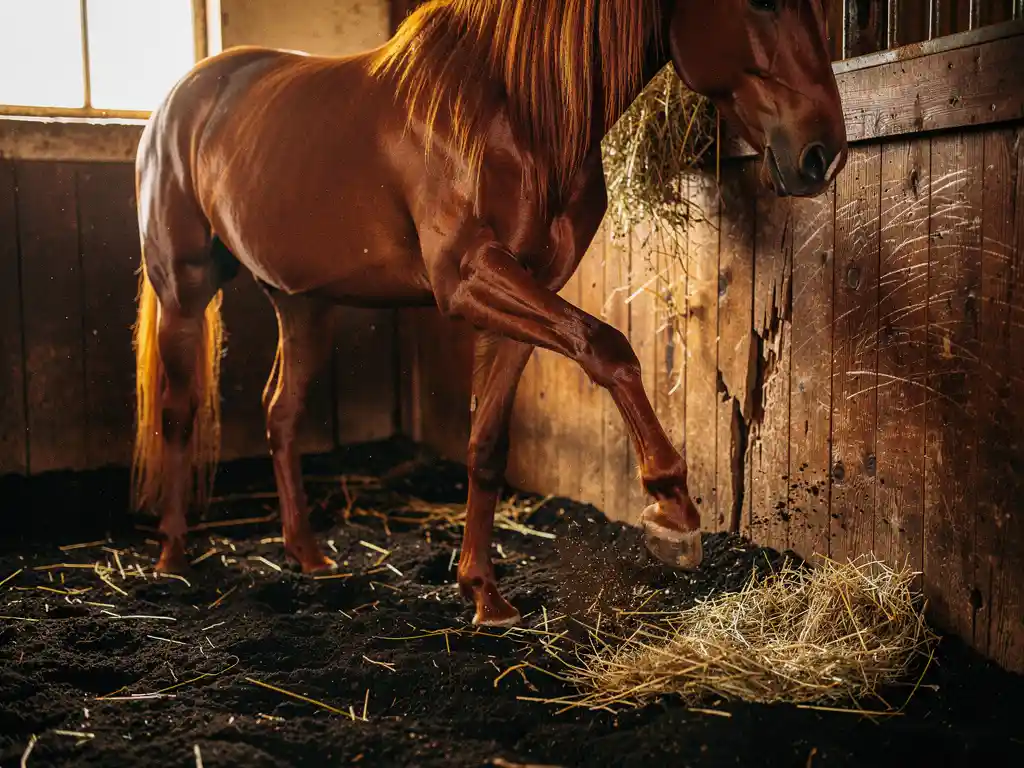
Horses paw at the stall floor for a range of reasons, from boredom and frustration to hunger, anxiety, or physical discomfort. It is a natural behavior rooted in instinct, but when it becomes frequent or intense, it is worth paying attention to. Understanding why your horse paws helps you address the root cause and protect both the animal and the stall. This guide walks you through common triggers, the damage pawing can cause, and practical steps you can take to reduce it.
Why do horses paw at the stall floor?
Horses paw at the stall floor primarily as a form of communication and emotional expression. It is a natural behavior that signals frustration, impatience, anticipation, or discomfort. In the wild, horses also paw to uncover food or water beneath snow or dry ground, so the instinct is deeply ingrained.
In a domestic setting, the most common trigger is simply waiting. A horse that knows feeding time is approaching, hears other horses being fed, or is ready to go out but cannot will often paw repeatedly at the floor. It is their way of saying, “I am ready; let’s go.” Some horses paw when they are left alone, when they are stressed by a change in routine, or when they feel confined for too long. In most cases, it is a behavioral signal rather than a random habit.
It is worth noting that some horses are simply more expressive than others. A horse with a high-energy temperament, or one that has learned that pawing gets a response from its handler, may paw more frequently than a calmer, more laid-back horse.
Is pawing a sign of a health problem in horses?
Pawing can sometimes indicate a health problem, particularly colic. A horse that paws persistently, looks at its flank, refuses food, or seems restless and uncomfortable may be experiencing abdominal pain. In this case, pawing is one symptom within a broader picture of distress, and it warrants immediate veterinary attention.
Outside of colic, pawing is less commonly a direct sign of illness, but it can reflect discomfort related to horse stall joint health. A horse standing on hard, unforgiving flooring for extended periods may paw out of physical discomfort, as hard surfaces place stress on joints, hooves, and legs. Horses with existing joint issues or hoof soreness may shift their weight and paw more than usual in response to that discomfort.
If your horse has recently developed a pawing habit it did not have before, or if the pawing is accompanied by other behavioral or physical changes, a veterinary check-up is a sensible first step. Ruling out pain or illness gives you a clearer picture of whether the behavior is physical, emotional, or habitual.
What triggers excessive pawing in a stall?
Excessive pawing in a stall is most commonly triggered by boredom, anticipation, separation anxiety, and inadequate turnout time. Horses are social, active animals that evolved to move and graze for most of the day. Stall confinement limits both movement and social interaction, which can build up into frustrated energy expressed through pawing.
Feeding routines and anticipation
Feeding time is one of the strongest triggers. Horses develop highly accurate internal clocks, and a horse that expects its feed at a certain time will often begin pawing several minutes before it arrives. If pawing is consistently rewarded by the arrival of food, the behavior becomes reinforced over time.
Separation and social stress
Horses are herd animals, and being separated from companions causes genuine stress. A horse that can hear or smell other horses but cannot see or interact with them may paw out of anxiety. This is especially common when a horse’s stablemate is moved or when a horse is new to a facility and has not yet settled in.
Insufficient exercise and turnout
A horse that does not get enough daily movement has physical energy to burn. Without an outlet, that energy often comes out as stall vices, including pawing. Increasing turnout time, adding structured exercise, or providing enrichment inside the stall can help reduce this significantly.
How does pawing damage stall floors and hooves?
Pawing causes two types of damage simultaneously: it wears down the stall floor surface and puts repetitive stress on the horse’s hooves, legs, and joints. Over time, both forms of damage can become costly and difficult to reverse.
Damage to the stall floor
Concrete and compacted dirt floors are particularly vulnerable. Repeated pawing creates uneven depressions in the surface, which leads to drainage problems, unstable footing, and increased bedding use. Wooden stall floors can splinter or crack. Repairs to damaged stall flooring are not only expensive but also disruptive to your horse’s routine.
Impact on hooves and joints
From a horse stall joint health perspective, the repetitive concussive impact of pawing on hard surfaces is a real concern. Each strike sends vibration up through the hoof, into the lower leg, and toward the joints. Over time, this can contribute to bruising of the sole, hoof wall stress, and increased wear on fetlock and knee joints. Horses that paw heavily on hard floors are at greater risk of developing chronic soreness in their lower limbs.
What type of stall flooring best reduces pawing damage?
Rubber stall matting is widely considered the most effective flooring solution for reducing pawing damage. It absorbs the impact of each strike, protecting both the hoof and the underlying floor structure. A good rubber mat cushions the concussive force that would otherwise travel up through the horse’s leg, which directly supports joint health over the long term.
The right mat should be thick enough to provide genuine cushioning, non-porous so it does not absorb moisture or bacteria, and stable enough that it does not shift under the horse’s weight. Thin or lightweight mats can bunch up or slide, which creates uneven surfaces and potential tripping hazards.
Beyond impact absorption, quality rubber matting also provides better grip than bare concrete or dirt, reducing the risk of slipping during pawing or when the horse moves around the stall. It also insulates against cold from the ground, which contributes to overall comfort and can reduce the restlessness that leads to pawing in the first place. Mats that install easily over existing surfaces, without requiring major renovation, are a practical choice for most barn setups.
How can you stop or reduce a horse’s pawing habit?
Reducing pawing starts with identifying the trigger. Once you know whether the behavior is driven by anticipation, boredom, anxiety, or physical discomfort, you can take targeted action. There is no single fix that works for every horse, but a combination of management changes and environmental improvements tends to produce the best results.
- Adjust feeding timing: If your horse paws before meals, try varying the exact time you feed slightly so the behavior is not consistently reinforced by the arrival of food.
- Increase turnout and exercise: More time outside and more structured movement reduces the buildup of energy that fuels stall vices.
- Provide stall enrichment: Hay nets, lick blocks, and safe toys give horses something to focus on and reduce boredom-driven pawing.
- Improve social visibility: Allowing horses to see and interact with neighbors through bars or windows can ease separation anxiety significantly.
- Do not reward the behavior: Avoid going to your horse immediately when it paws, as this teaches the horse that pawing gets your attention.
- Upgrade the stall floor: Installing quality rubber matting reduces the physical discomfort of standing on hard surfaces, which can lower the frequency of pawing driven by discomfort.
Consistency matters. Behavioral habits in horses take time to develop and time to change. Most horses respond well to a routine that meets their social, physical, and nutritional needs, and pawing often decreases naturally when those needs are properly addressed.
If you are looking to protect your stall floor and support your horse’s joint health at the same time, upgrading your flooring is one of the most practical steps you can take. At LRP Matting, we offer a range of horse stall mats engineered for exactly this purpose, including made-to-measure options through our custom rubber matting solutions that fit your stall dimensions precisely, minimizing seams and simplifying installation. Our mats are made from genuine, non-porous rubber that cushions impact, insulates against cold, and holds up to the daily demands of an active horse.
Frequently Asked Questions
How long does it typically take to break a horse's pawing habit once I've addressed the root cause?
The timeline varies depending on how long the behavior has been established and how consistently you apply management changes. A recently developed pawing habit may improve within a few weeks of targeted adjustments, while a deeply ingrained habit in an older horse can take several months of consistent effort. The key is patience and consistency — avoid rewarding the behavior at any point during the process, as even occasional reinforcement can reset your progress.
Can certain horse breeds or personalities be more prone to pawing than others?
Yes, high-energy and sensitive breeds such as Thoroughbreds, Arabians, and warmbloods tend to be more expressive and reactive to their environment, which can make them more prone to pawing. Horses with naturally bold or impatient temperaments are also more likely to develop the habit, particularly when their exercise or social needs are not fully met. That said, any horse can develop a pawing habit under the wrong conditions, so management quality matters more than breed alone.
My horse only paws at night — could this be a different issue than daytime pawing?
Nighttime pawing often points to specific triggers such as hunger if hay runs out overnight, anxiety from reduced barn activity, or discomfort from lying on a hard floor for extended periods. It can also be linked to gastric discomfort, as horses are prone to ulcers and acid buildup during long gaps between forage. Ensuring your horse has access to forage throughout the night, improving stall comfort with quality rubber matting, and ruling out ulcers or colic with a vet check are good starting points.
How thick should rubber stall mats be to genuinely protect a horse's joints from pawing impact?
For effective impact absorption and joint protection, rubber stall mats should generally be at least 17mm (around ¾ inch) thick, with many equine professionals recommending mats in the 17–22mm range for horses that paw heavily. Thinner mats may cover the floor surface but provide minimal cushioning against the concussive force of repeated strikes. It is also important that mats are made from dense, high-quality rubber rather than lightweight recycled material, as density directly affects how well the mat absorbs and disperses impact energy.
Is it ever a good idea to use anti-pawing devices or leg hobbles to stop the behavior?
Anti-pawing devices and hobbles are generally not recommended as a first-line approach, as they address the symptom rather than the underlying cause and can introduce new welfare concerns such as skin irritation, stress, or injury if a horse panics. Most equine behavior specialists advocate for management-based solutions — increasing turnout, reducing anticipation triggers, and improving the stall environment — before considering any physical deterrents. If you feel a device is necessary, consult your veterinarian or a qualified equine behaviorist first to ensure it is appropriate and safe for your specific horse.
Will adding rubber matting help even if my horse paws on top of deep bedding?
Yes, rubber matting remains beneficial even when covered with bedding, because it provides a stable, cushioned base layer that protects the underlying floor structure and reduces the hard impact that travels up through the hoof regardless of bedding depth. Deep bedding alone can shift and compact unevenly over time, especially in the areas where a horse paws most, leaving hard spots that a rubber mat beneath would help absorb. As an added benefit, non-porous rubber mats prevent urine and moisture from penetrating to the subfloor, making stall hygiene easier to maintain.
Can stall enrichment really make a meaningful difference, or is it just a temporary distraction?
Stall enrichment can make a genuine and lasting difference when it is well-matched to your horse’s needs, rather than just a novelty that loses interest quickly. The most effective options are those that mimic natural behaviors — slow-feed hay nets encourage prolonged foraging, which is one of the most powerful ways to reduce boredom and anxiety in a stabled horse. Rotating enrichment items, placing them in different locations, or using food-based puzzles keeps the environment mentally stimulating over the long term rather than offering only a short-term distraction.
Related Articles
- How do high traffic areas affect floor performance?
- How do you know when a horse trailer floor needs replacing?
- How do you stop floor damage in a high-traffic shipping and receiving area?
- What is the difference between anti-fatigue mats and standard rubber mats?
- How do you reduce fall risk for horses in a veterinary facility?
- How do you set up a new horse stall from scratch?
- What should you put on a concrete barn floor to protect your horse?
- How do you calculate how much bedding a horse stall needs?
- What is the most comfortable floor surface for a horse to stand on?
- What flooring works best in an outdoor or covered sports venue?