
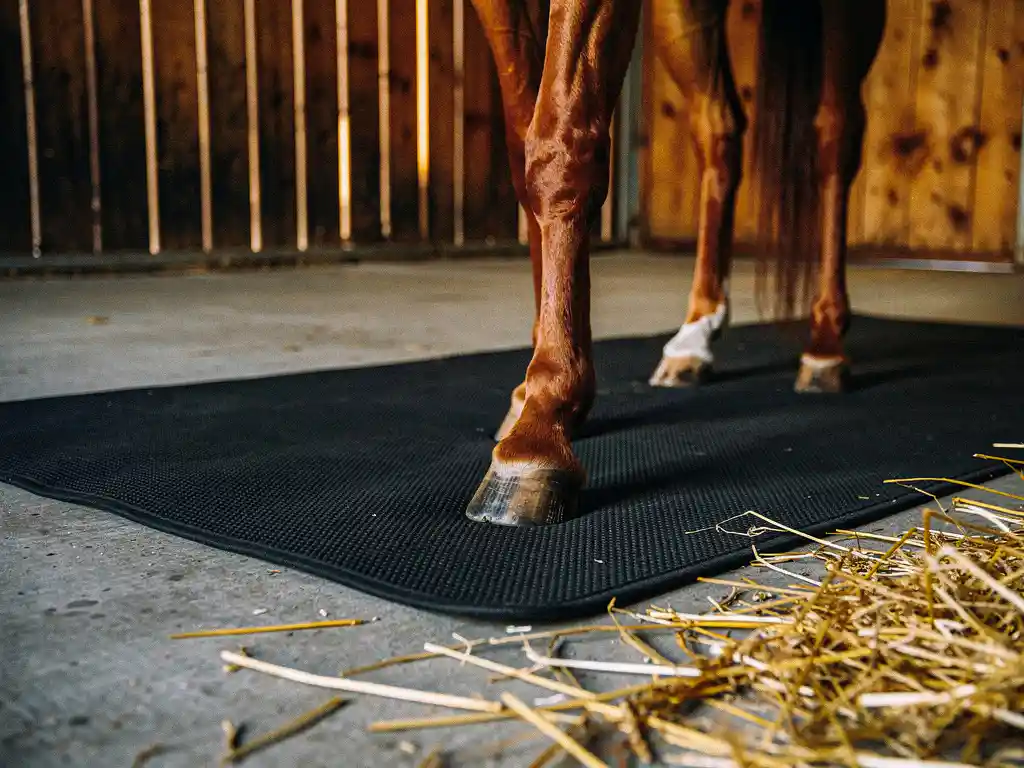
The best thing to put on a concrete barn floor to protect your horse is a rubber mat. Rubber mats cushion your horse’s joints, prevent slipping, reduce bedding needs, and create a warmer, more comfortable surface than bare concrete. For horse stalls, mats that are at least 3/4 inch thick work best, and they should cover the entire stall floor to eliminate gaps where hooves can catch.
If you are setting up a new stall or upgrading an existing one, getting the flooring right makes a real difference to your horse’s health and your daily workload. This guide walks you through everything you need to know about horse stall flooring, from why concrete alone is a problem to what to look for when you are ready to buy.
Why is a bare concrete barn floor bad for horses?
Bare concrete is hard, cold, and slippery, which makes it one of the worst surfaces for horses to stand on for long periods. It puts constant pressure on hooves, legs, and joints, and provides no cushioning when a horse lies down or shifts its weight. Over time, this leads to joint stress, hoof problems, and general discomfort that affects your horse’s well-being and performance.
Concrete also gets slippery when wet, which is almost unavoidable in a stall environment. A horse that slips, even slightly, experiences stress and can sustain injuries ranging from minor scrapes to serious leg trauma. Beyond the physical risks, a horse that feels unsteady on its feet tends to stand more rigidly, rest less, and show signs of behavioral stress.
Temperature is another issue. Concrete draws heat away from the body, which means horses standing on it for hours lose warmth through their hooves. In colder climates, this contributes to stiffness and discomfort, especially in older horses or those recovering from injury. Bare concrete also retains moisture and is difficult to keep truly clean, which creates hygiene problems over time.
What are the best options to put on a concrete barn floor?
The most practical options for covering a concrete barn floor are rubber mats, rubber pavers, or a combination of rubber matting with bedding on top. Rubber mats are the most widely used and recommended solution because they are durable, easy to clean, provide excellent grip, and offer meaningful cushioning without requiring thick layers of bedding underneath.
Other options include:
- Rubber mats: The most popular choice. Durable, non-porous, easy to maintain, and available in a range of sizes and thicknesses suited to horse stalls.
- Interlocking rubber tiles: Useful for irregular spaces or areas where full mats are difficult to fit. They connect together to form a continuous surface.
- Rubber pavers: Thicker and heavier than standard mats, often used in high-traffic areas like barn aisles and wash bays.
- Bedding alone (straw, shavings, sand): Provides some cushioning but compresses quickly, requires constant topping up, and does not address the cold or slippery nature of the concrete underneath.
For most horse owners, rubber mats paired with a thin layer of bedding on top give the best results. The mat handles the hard work of cushioning, insulation, and grip, while the bedding absorbs moisture and adds comfort. This combination also reduces how much bedding you need to use, which saves money over time.
What makes rubber mats the top choice for horse stalls?
Rubber mats are the top choice for horse stall flooring because they combine cushioning, grip, insulation, durability, and ease of maintenance in a single product. No other material delivers all of these benefits at the same time, at a practical price point, with a lifespan that justifies the investment.
Cushioning and joint protection
Rubber absorbs impact and reduces the pressure that hard flooring places on a horse’s hooves, legs, and joints. This is particularly valuable for horses that spend a lot of time in the stall, older horses, or those recovering from injury. A well-cushioned floor encourages horses to lie down more, which supports better rest and recovery.
Grip and safety
Quality rubber mats feature textured surfaces that give horses secure footing even when the floor is wet. This significantly reduces the risk of slipping compared to bare concrete. A horse that feels confident on its feet is calmer, easier to handle, and less likely to injure itself.
Insulation and warmth
Rubber acts as a thermal barrier between the cold concrete and your horse’s hooves. This is especially useful during the winter months and in barns without heating. Warmer flooring means a more comfortable horse and less energy spent by the animal maintaining its body temperature.
Non-porous and hygienic
Genuine rubber does not absorb moisture, urine, or bacteria. This makes stall cleaning faster and more effective. Unlike wood or porous materials, rubber will not rot, harbor mold, or break down when exposed to the wet conditions typical of a horse stall.
How thick should rubber mats be for a horse stall?
For a horse stall, rubber mats should be at least 3/4 inch thick. This thickness provides enough cushioning to protect joints, enough weight to stay in place, and enough durability to handle the constant movement and pressure of a full-sized horse. Thinner mats compress too easily and wear out faster under heavy use.
A 3/4-inch mat is the standard recommendation for most horses and works well in both standard stalls and box stalls. For larger breeds, heavy horses, or animals that are particularly active in their stalls, a thicker mat, such as 5/8 to 3/4 inch, offers added protection and longevity. The extra thickness also provides better insulation from cold concrete floors.
Keep in mind that thickness alone is not the only factor. The quality of the rubber compound matters just as much. A thicker mat made from low-quality rubber will compress and degrade faster than a well-made mat at the standard thickness. Look for mats made from high-quality, dense rubber that maintains its shape and resilience over years of use.
How do you install rubber mats on a concrete barn floor?
Installing rubber mats on a concrete barn floor is straightforward. Start with a clean, dry concrete surface, lay the mats flat starting from one corner, fit them snugly against the walls and each other, and secure them if needed. Most rubber mats do not require adhesive and stay in place through their own weight.
Here is a simple step-by-step process:
- Clean the concrete: Sweep and wash the floor, then let it dry completely. Any debris or moisture underneath the mat can cause movement and uneven wear.
- Measure the stall: Take accurate measurements of the stall floor so you know exactly what mat sizes you need. Gaps between mats or between mats and walls are a safety hazard.
- Lay the mats: Start in one corner and work outward. Place mats tightly against each other and against the walls to minimize gaps.
- Trim if necessary: If your stall has an irregular shape or features like drains, you may need to trim mats to fit. A sharp utility knife or jigsaw works well for this.
- Check for movement: Walk over the mats and press them with your hands to confirm they are lying flat and not shifting. Most quality rubber mats stay in place through weight alone, but in areas with heavy activity, interlocking mats or mat fasteners add extra stability.
Large mats that cover more of the floor with fewer seams are easier to install and create a safer surface. Fewer seams mean fewer edges for hooves to catch and fewer gaps where bedding and moisture can collect underneath.
How do you clean and maintain horse stall rubber mats?
Cleaning rubber mats in a horse stall is simple. Remove soiled bedding daily, rinse the mat with water, and scrub with a mild detergent when needed. Rubber is non-porous, so it does not absorb urine or bacteria, which makes it much easier to keep hygienic than wood or bare concrete.
For daily maintenance, pick out wet and soiled bedding as you normally would and allow the mat surface to air out. This prevents ammonia buildup and keeps the stall smelling fresh. For a deeper clean, lift the mats out of the stall periodically, rinse both sides, scrub with a mild soap and a stiff brush, and let them dry before replacing them.
A few maintenance tips worth keeping in mind:
- Avoid harsh chemical cleaners that can degrade the rubber over time. Mild detergent and water are all you need.
- Check the edges and seams regularly for any lifting or curling, and press them back flat if needed.
- Inspect the mats for cuts or deep gouges periodically. Minor surface wear is normal, but deep damage can compromise the mat’s cushioning and grip.
- Let mats dry fully before adding fresh bedding to prevent moisture from getting trapped underneath.
With proper care, high-quality rubber mats last many years and require very little replacement. This makes them a cost-effective investment compared to constantly replacing worn-out bedding or repairing damaged flooring.
What should you look for when buying horse stall mats?
When buying horse stall mats, look for genuine rubber construction, a minimum thickness of 3/4 inch, a textured anti-slip surface, and a size that minimizes seams in your stall. The mat should be non-porous, resistant to moisture and temperature extremes, and made to last under the daily demands of a working horse stall.
Here is a checklist of the most important features to evaluate:
- Material quality: Look for mats made from dense, high-quality rubber. Mats made from a fiber-reinforced rubber compound offer extra strength and durability that standard rubber cannot match.
- Thickness: At minimum, 3/4 inch for standard use. Thicker options are available for heavier horses or high-use stalls.
- Surface texture: A textured or studded top surface provides grip and helps prevent slipping.
- Size options: Larger mats mean fewer seams, which improves safety and makes installation easier. Look for suppliers that offer a range of sizes or custom cutting.
- Weight: Heavier mats stay in place better. A mat around 100 lb or more is unlikely to shift under normal use.
- Non-porous construction: Genuine rubber does not absorb moisture, making it hygienic and easy to clean.
- Temperature resistance: The mat should not crack, harden, or degrade in cold winters or hot summers.
If your barn has an unusual layout or non-standard stall dimensions, a custom rubber matting solution is worth considering. Made-to-measure mats cut to your exact stall dimensions eliminate awkward gaps, reduce the number of seams, and give you a cleaner, safer finish than trying to make standard sizes work in a space they were not designed for.
At LRP Matting, we have been producing high-quality rubber mats for horse stalls and agricultural environments since 1971. Our mats are made from 100% recycled rubber, including our proprietary Fiber-Reinforced Rubber Compound (FRC®), which gives them extra strength and a longer service life. Whether you need standard sizes or a fully custom solution, we are here to help you find the right fit for your horses and your barn.
Frequently Asked Questions
Can I use rubber mats on a concrete floor that has an existing drain or slope?
Yes, rubber mats can be used on sloped concrete floors or floors with drains. For drains, simply cut a hole in the mat to match the drain location using a utility knife or jigsaw. For sloped floors, ensure the mats lie flat and do not create raised edges that could catch a hoof. Interlocking rubber tiles can be especially useful here, as their smaller size makes it easier to accommodate irregular surfaces and slopes.
How many rubber mats do I need to cover a standard horse stall?
A standard 12×12 foot box stall typically requires four 6×6 foot mats or a combination of sizes that covers the full floor area without significant gaps. Always measure your stall carefully before ordering, including any alcoves or irregular corners. It is better to order slightly more than you think you need than to end up with uncovered patches, which create safety hazards and reduce the overall effectiveness of the flooring.
Do rubber mats smell, and will the odor bother my horse?
New rubber mats can have a noticeable rubber odor when first unpackaged, but this typically dissipates within a few days to a couple of weeks, especially with good ventilation in the barn. Most horses adjust to the smell quickly and it does not cause behavioral issues. To speed up off-gassing, unroll or lay out the mats in a well-ventilated area for a day or two before installing them in the stall.
Is it worth using rubber mats in a stall where the horse is only kept overnight?
Yes, even for horses that are only stalled overnight, rubber mats are a worthwhile investment. Horses lie down during rest periods, and a cushioned, non-slip surface supports better quality sleep and reduces joint stress during those hours. The reduced bedding requirements also make the cost-benefit case strong even for part-time stall use, as you will spend less on shavings or straw over time.
Can rubber mats be used in areas outside the stall, like barn aisles or wash bays?
Absolutely. Rubber mats and rubber pavers are excellent choices for barn aisles, wash bays, grooming areas, and trailer floors, anywhere horses walk or stand on hard surfaces. For high-traffic areas like aisles, thicker rubber pavers or heavy-duty mats are recommended for extra durability. In wash bays, a textured rubber surface provides critical grip where water and soap make concrete especially slippery.
What is the most common mistake horse owners make when installing stall mats?
The most common mistake is leaving gaps between mats or between mats and the stall walls. Even small gaps can catch a horse’s hoof, trap moisture and bedding underneath, and allow urine to seep down to the concrete below, creating odor and hygiene problems. Always measure carefully, fit mats snugly, and trim them to fill awkward corners rather than leaving open spaces. A seamless, wall-to-wall installation is always the goal.
How long should a good set of horse stall rubber mats last?
High-quality rubber mats made from dense, durable rubber compounds can last 10 to 20 years or more with proper care. The key factors affecting lifespan are the quality of the rubber compound, the thickness of the mat, and how well they are maintained. Regularly checking for deep cuts, keeping mats clean, and allowing them to dry properly all extend their service life significantly. Cheaper, low-density mats may need replacing within a few years, which is why investing in quality upfront pays off in the long run.
Related Articles
- What role does drainage play in animal welfare?
- What affects the lifespan of sports flooring?
- What are the most common causes of slip and fall accidents?
- How do you support a horse's joints during long periods of stabling?
- What flooring is best for a large animal veterinary wash area?
- What is the best floor surface for a standing workstation?
- How do you keep a large animal veterinary floor hygienic?
- How do you set up a new horse stall from scratch?
- How do you reduce fatigue for workers who stand all day on a concrete floor?
- How do you choose the right anti-fatigue mat thickness for a factory?