
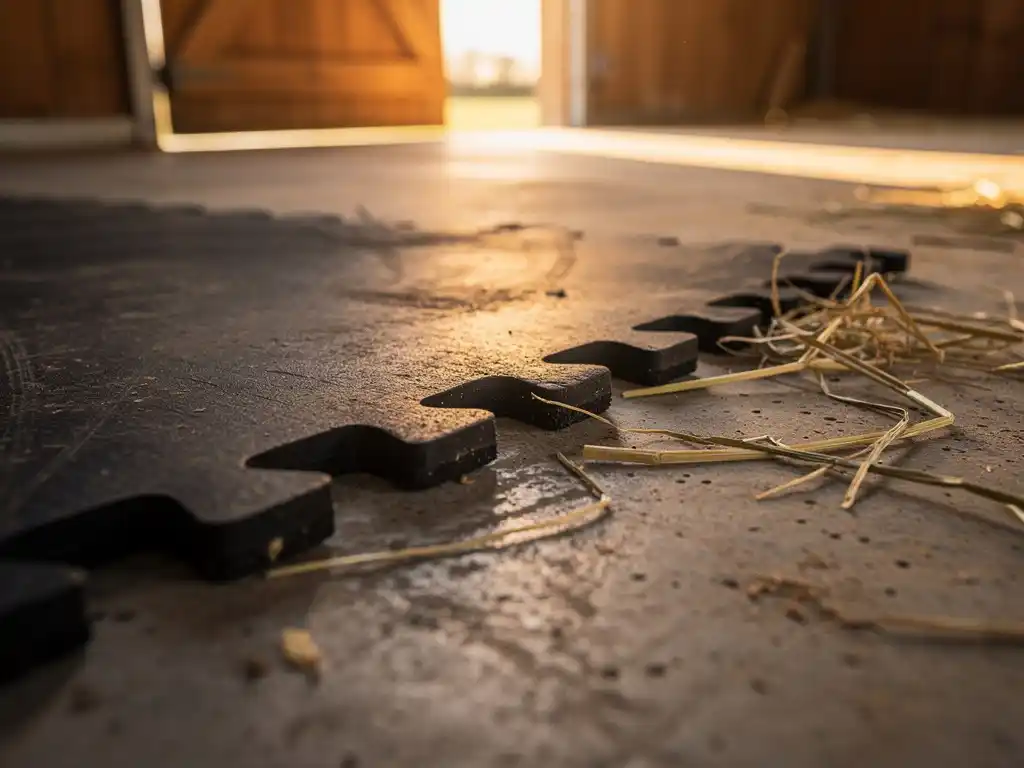
Stall mats come in two main edge styles: interlocking and straight edge. Interlocking mats have puzzle-like tabs and slots that connect the mats together, while straight edge mats have flat, clean sides that sit flush against each other. Interlocking mats stay in place better and work well for large, open areas, while straight edge mats are simpler to cut and fit against walls or in fixed stalls. The right choice depends on your space, your animals, and how permanent you want the installation to be.
What are stall mats, and what are they used for?
Stall mats are thick rubber mats placed on the floors of horse stalls, livestock barns, and other animal housing areas to provide cushioning, traction, and insulation. They sit directly on top of concrete, dirt, or other hard surfaces, creating a more comfortable and safer environment for animals to stand, move, and rest.
The practical benefits go well beyond basic comfort. Good horse stall flooring reduces strain on joints and hooves from hours spent standing on hard concrete. It also improves grip, which cuts down on slips and fall-related injuries. On the management side, rubber mats can significantly reduce the amount of bedding you need, since the mat itself provides insulation and cushioning. That means lower bedding costs over time and easier daily cleanup.
Stall mats are also used in milking parlors, alleyways, wash bays, calving pens, and trailer ramps—not just horse stalls. Any area where animals spend time on hard flooring can benefit from the added protection and comfort a quality rubber mat provides. The key is choosing the right mat style for the specific space and the animal you are working with.
What is an interlocking stall mat?
An interlocking stall mat has specially designed edges—typically tabs and corresponding slots—that fit together with adjacent mats like puzzle pieces. This connection system locks the mats in place, preventing them from shifting or separating under the weight and movement of animals.
The interlocking design is particularly useful in larger, open areas such as free-stall barns, alleyways, and milking parlors, where multiple mats need to cover a wide surface seamlessly. Because the mats connect to each other, there is less risk of gaps forming between them over time. Gaps are not just an aesthetic problem; they can trap moisture, harbor bacteria, and create tripping hazards for both animals and handlers.
Interlocking mats also tend to be the better choice for long-term applications where you are covering a continuous stretch of flooring. The connected system behaves more like a unified surface rather than a collection of individual pieces, which improves both stability and cleanliness. Some interlocking designs also allow for modular customization, letting you configure the layout to suit irregular or large spaces without leaving awkward gaps at the edges.
What is a straight edge stall mat?
A straight edge stall mat has flat, smooth sides with no tabs or connectors. These mats sit next to each other with their edges butted up against one another, relying on the weight of the mat and the surrounding walls or fixtures to stay in position rather than on a physical connection between mats.
Straight edge mats are the more traditional option and are widely used in individual horse stalls, where the walls of the stall naturally hold the mats in place on three or four sides. In a standard 12-by-12 stall, for example, you might use four 4-by-6 mats arranged in a two-by-two grid, with the walls keeping everything snug and contained.
One practical advantage of straight edge mats is that they are generally easier to cut and trim. If you need to fit a mat around a post, a drain, or an irregular corner, a straight edge mat with no tabs to work around is much simpler to modify with a utility knife or saw. They are also typically easier to lift and move individually, which makes replacing a single worn mat more straightforward without disturbing the rest of the floor.
What’s the difference between interlocking and straight edge stall mats?
The main difference between interlocking and straight edge stall mats is how their edges are designed and how the mats relate to one another. Interlocking mats physically connect to each other through tabs and slots, while straight edge mats simply sit side by side without any mechanical connection. This single design difference has a ripple effect on installation, stability, and the types of spaces each mat suits best.
Stability and movement
Interlocking mats win on stability. Because they are physically joined, they resist shifting even when large animals move around, paw at the ground, or change positions repeatedly. Straight edge mats can creep and separate over time, especially in open areas without walls to contain them. In an enclosed stall, this is less of an issue, but in a wide alleyway or barn aisle, straight edge mats without walls on all sides can become a maintenance headache.
Seams and hygiene
Both mat types have seams where edges meet, but interlocking connections tend to create tighter seams that are harder for moisture and debris to penetrate. Straight edge mats, when they shift even slightly, can open up gaps that collect urine, manure, and bedding material. Regular cleaning helps, but tighter seams from interlocking mats simply give bacteria and moisture fewer places to hide.
Flexibility and trimming
Straight edge mats are easier to cut and customize on site. You do not need to worry about preserving a tab or slot when trimming to fit an unusual space. Interlocking mats require more careful planning during installation to make sure the connecting edges are positioned correctly and that any trimming does not compromise the connection system.
Which type of stall mat is easier to install?
For a single stall or a small, enclosed space, straight edge mats are generally easier to install. You lay them down, butt the edges together, and the surrounding walls do the rest of the work. There is no need to align tabs and slots or plan the layout carefully in advance.
For larger, open areas, interlocking mats can actually be easier to work with in the long run, even if the initial setup takes a bit more thought. Once you understand the connection pattern, the mats go together quickly and stay where you put them. You do not need to come back later to reposition mats that have shifted during the day.
Weight is also a factor worth considering. Rubber stall mats are heavy, often 90 to 115 pounds or more per mat, depending on size and thickness. Having a second person on hand makes installation much safer and more manageable, regardless of which edge style you choose. For very large installations, planning your layout on paper before you start can save a lot of time and effort on the day.
Which stall mat type is better for horses and livestock?
For horses in individual stalls, straight edge mats are a proven and practical choice. The stall walls keep the mats contained, and the flat edges are easy to trim around posts or other fixtures. A typical horse stall setup uses several 4-by-6 mats arranged to cover the full floor area, and this configuration works well with either edge style.
For dairy cows, beef cattle, and other livestock in open barn environments, interlocking mats or large-format mats tend to perform better. Cows move more freely across wide-open spaces, and the connected system of interlocking mats holds up better to that kind of constant, heavy traffic. Interlocking designs are also a strong fit for alleyways, milking parlors, and calving pens, where maintaining a stable, hygienic surface across a large area is a priority.
For hogs and pigs, the Double Button Mat is a popular option because of its built-in drainage and traction properties. Standard versions come with straight edges, but interlocking options are available on request, which is worth considering for larger confinement-barn setups. The bottom line is that the best mat type depends more on the space and the animal’s behavior than on a simple blanket rule.
How do you choose the right stall mat for your barn or facility?
Choosing the right stall mat comes down to four key factors: the size and shape of your space, the type of animal, the level of traffic and movement in the area, and your budget. Getting clear on these four things makes the decision much more straightforward.
Consider your space first
In a small, enclosed stall with fixed walls on all sides, straight edge mats are usually the simpler and more cost-effective choice. In a large, open barn, alleyway, or milking parlor, interlocking mats or large-format mats that minimize seams are worth the extra planning. The fewer seams you have in a high-traffic area, the easier your floor is to keep clean and the longer it will last.
Think about how your animals use the space
A horse that stands quietly in a stall puts different demands on flooring than a dairy cow that walks back and forth to a milking parlor multiple times a day. High-movement environments benefit from the stability of interlocking or large-format mats. Lower-traffic stall environments are well served by straight edge mats, provided the surrounding walls keep them in place.
Factor in maintenance and cleaning
If easy cleaning is a top priority, look for mats with tighter seams and non-porous surfaces. Rubber mats in general are easy to clean with mild detergent and water, but minimizing the number and size of seams makes daily maintenance faster. Interlocking mats tend to have tighter seams, which is an advantage in high-moisture environments like wash bays and milking parlors.
Get the right size from the start
One of the most useful things you can do before ordering is to measure your space carefully and think about how many mats you will need and how they will be arranged. If standard sizes do not quite fit your barn layout, a custom rubber mat solution cut to your exact specifications can eliminate awkward gaps and reduce the number of seams in your installation. We offer made-to-measure options for exactly this reason, so you are not left trying to make a standard size work in a non-standard space. Reach out to us, and we will help you find the right fit for your barn, your animals, and your budget.
Frequently Asked Questions
How thick should stall mats be for horses vs. cattle?
For horses, a minimum thickness of 3/4 inch is generally recommended to provide adequate cushioning and joint support during long hours of standing. For cattle, especially dairy cows in high-traffic alleyways and milking parlors, mats that are 3/4 inch to 1 inch thick offer better durability under heavier, more constant use. Thicker mats also provide better insulation from cold concrete floors, which benefits animal comfort and health year-round.
Can stall mats be used directly on dirt floors, or do they require a concrete base?
Stall mats can be used on dirt floors, but the surface should be as level and compacted as possible before installation to prevent the mats from shifting, rocking, or creating uneven pressure points. Concrete is the most stable and hygienic base because it does not shift over time and is easier to clean beneath the mats. If you are working with a dirt floor, consider adding a compacted gravel or stone dust base layer first to improve drainage and long-term stability.
How do you properly clean and maintain rubber stall mats to extend their lifespan?
For daily maintenance, remove soiled bedding and rinse the mat surface with water to prevent ammonia and bacteria buildup from urine and manure. For a deeper clean, use a mild detergent or a diluted disinfectant solution and a stiff-bristle brush, then rinse thoroughly and allow the mats to dry before replacing bedding. Periodically lifting the mats to clean the floor underneath is also important, as moisture can accumulate beneath them and lead to mold, odor, and floor deterioration over time.
What is the best way to cut stall mats to fit around posts, drains, or irregular corners?
A sharp utility knife with a heavy-duty blade is the most common tool for cutting rubber stall mats, and it works well for straight cuts and gentle curves. For more complex cutouts around round posts or drains, marking the shape clearly with chalk or a marker first and then using a jigsaw with a coarse blade will give you a cleaner, more precise result. Always measure twice and cut slowly, since rubber mats are difficult to piece back together once trimmed incorrectly.
Will interlocking stall mats stay connected if a single mat needs to be removed or replaced?
Yes, one of the practical advantages of a well-designed interlocking system is that individual mats can typically be disconnected and removed without disturbing the surrounding mats. The process usually involves lifting the mat at an angle to disengage the tabs and slots, which may require two people given the weight involved. Once the replacement mat is in place, it reconnects to the adjacent mats the same way it was originally installed, restoring the unified surface.
Are there any common mistakes to avoid when installing stall mats for the first time?
One of the most common mistakes is skipping the layout planning phase and simply placing mats as you go, which often results in awkward gaps, misaligned seams, or running short on mats. Another frequent issue is not accounting for the weight of the mats during installation—always have at least two people on hand to avoid injury and to position mats accurately. Finally, avoid installing mats on an uneven or uncleaned surface, as bumps, debris, or moisture trapped underneath can cause mats to rock, shift, and deteriorate prematurely.
How many stall mats do I need to cover a standard 12×12 horse stall?
A standard 12-by-12 foot horse stall is most commonly covered using six 4-by-6 foot mats arranged in a two-by-three grid, which provides full floor coverage with minimal cutting. Some barn owners use four mats in a two-by-two arrangement if they are comfortable with a slightly smaller covered area or have walls and feeders that reduce the usable floor space. Measuring your stall carefully before ordering—including noting any fixed obstacles like posts or water lines—will help you determine the exact number and configuration that works best for your setup.
Related Articles
- How do professional equine facilities improve horse welfare?
- What makes a veterinary facility safer?
- How do weather conditions affect outdoor floor safety?
- What areas of a facility have the highest slip risk?
- How do uneven floors increase accident risk?
- What causes polished concrete to become slippery?
- How do you choose flooring for a multi-sport facility?
- How do large boarding facilities manage bedding costs across many stalls?
- How do you keep a horse stall dry without using excessive bedding?
- How do you make a workshop floor more comfortable to work on?