
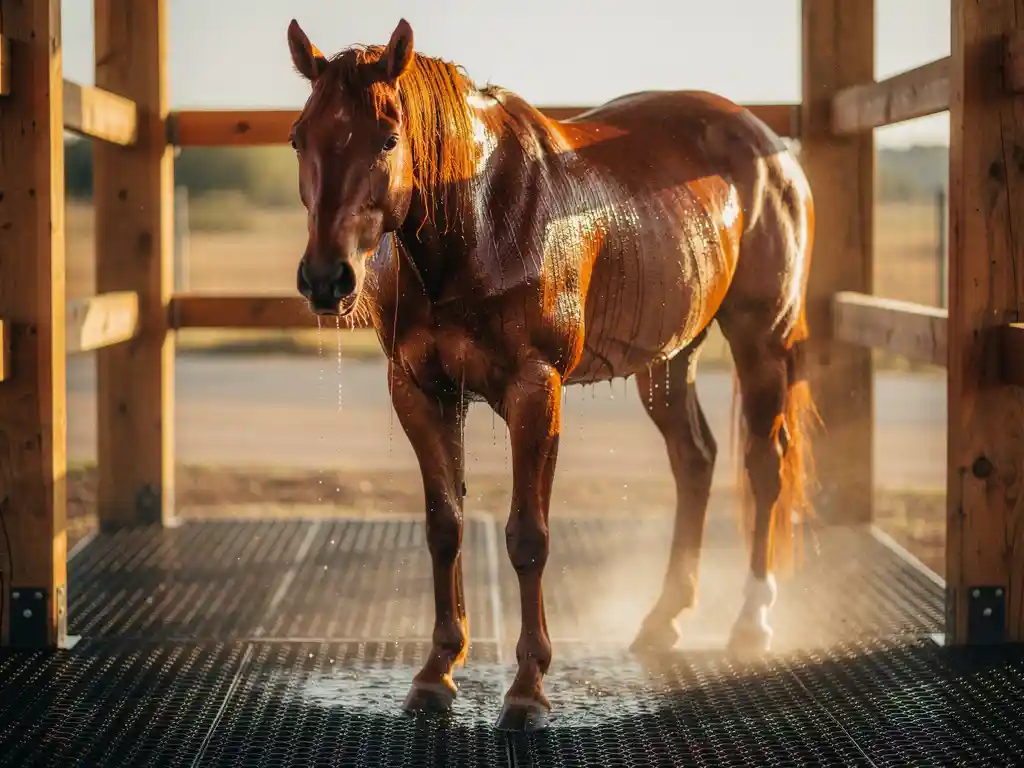
The best flooring for a horse wash rack is rubber matting. Rubber is non-slip when wet, easy to drain, comfortable for horses to stand on, and simple to clean. A perforated or textured rubber mat placed directly on a concrete base provides the safest, most hygienic, and most practical surface you can put under a horse during bathing.
Choosing the right surface for your wash rack matters more than most people realize. Horses can be nervous in the wash area, and a slippery or uncomfortable floor adds unnecessary risk for both the animal and the handler. The good news is that once you understand what to look for, the decision is pretty straightforward. Here is everything you need to know about horse wash rack flooring, from the basics to the practical details.
What is a horse wash rack, and why does flooring matter?
A horse wash rack is a designated area in a barn or stable where horses are bathed, hosed down, or groomed. It is typically a small, enclosed or semi-enclosed space with water access, drainage, and tie points. The flooring in this area takes more abuse than almost any other surface in your facility because it is constantly wet, exposed to soap and debris, and supporting the full weight of a moving, sometimes anxious horse.
Flooring matters in a wash rack for three main reasons: safety, hygiene, and comfort. A wet horse on a slick surface is a genuine hazard. Horses can slip, panic, and injure themselves or the person handling them. Beyond safety, wash rack floors constantly collect water, soap residue, hair, and dirt, so a surface that is easy to clean and does not absorb moisture is important for maintaining a healthy environment. Finally, a horse that stands comfortably on a cushioned surface during bathing is calmer and easier to manage, making the whole process smoother for everyone involved.
What are the most common flooring options for horse wash racks?
The most common horse wash rack flooring options are bare concrete, poured rubber, interlocking pavers, and rubber mats. Each has trade-offs in terms of cost, safety, and maintenance. Rubber mats are the most widely recommended because they combine traction, drainage, and comfort in a way that other materials simply do not match.
Bare concrete
Concrete is the default in many older facilities. It is durable and inexpensive, but it becomes dangerously slippery when wet. It is also hard on horses’ joints and hooves, especially during longer grooming sessions. Without a textured surface treatment, bare concrete in a wash rack is not a safe long-term choice.
Poured rubber or epoxy coatings
Poured rubber and textured epoxy coatings add grip to concrete and are seamless, which helps with drainage. However, they are expensive to install, difficult to repair if damaged, and cannot be removed or replaced easily. Over time, heavy use and cleaning chemicals can degrade the surface.
Interlocking pavers or tiles
Rubber or plastic interlocking tiles offer flexibility and are easy to replace section by section. The joints between tiles can collect debris and bacteria, though, which makes thorough cleaning more demanding. The quality of the interlocking connection also varies, and poorly fitting tiles can shift under a horse’s weight.
Rubber mats
Rubber mats are the most practical solution for most horse owners. They install over existing concrete without adhesive, provide immediate traction and cushioning, and can be lifted and cleaned underneath. Perforated designs allow water and soap to drain through quickly, keeping the surface as dry as possible during and after washing.
What makes rubber mats the best choice for horse wash racks?
Rubber mats are the best choice for horse wash racks because they deliver the right combination of grip, drainage, cushioning, and ease of maintenance in a single product. Unlike hard surfaces, rubber gives slightly under pressure, which reduces fatigue and stress on a horse’s legs and hooves during extended periods of standing. Unlike porous materials, rubber does not absorb water, soap, or bacteria.
The anti-slip surface is the most immediate benefit. A textured or perforated rubber mat provides consistent traction even when saturated with water and soap. This protects horses from slipping and gives handlers a safer working surface, too. Perforated mats, such as ring-style designs, are especially effective in wash racks because the holes allow liquids and debris to pass through and drain away rather than pooling on the surface.
Rubber is also non-porous by nature, which means it will not absorb moisture or harbor bacteria the way wood or certain composites can. You can clean a rubber mat with mild detergent and water in minutes, and it will not crack, peel, or degrade under repeated washing. For a space that gets wet every single day, that kind of durability makes a real difference over the long term. Rubber mats also install directly over concrete without adhesive or special tools, so you can have a functional wash rack surface up and running quickly.
How thick should rubber mats be for a horse wash area?
For a horse wash rack, rubber mats should be at least half an inch thick, with three-quarters of an inch being the most commonly recommended thickness for comfort and durability. Thicker mats provide better cushioning for the horse’s joints and are more resistant to shifting or curling at the edges under regular use.
A half-inch mat is a solid baseline. It offers meaningful cushioning over concrete and holds up well under daily washing and foot traffic. For horses that spend longer periods in the wash area, or for facilities with heavier use, a three-quarter-inch mat provides noticeably better support and tends to lie flatter and stay in place more reliably. The added thickness also provides a small degree of thermal insulation, which can matter in colder climates where concrete floors get very cold.
Thickness also affects how the mat handles drainage. A thinner mat sits closer to the floor, which can sometimes trap water underneath if the concrete base is not perfectly level. A slightly thicker mat with a textured or waffle-pattern underside creates small channels that allow water to escape from beneath the mat, reducing the risk of moisture buildup. This is particularly useful in a wash rack where water volume is high.
How do you install rubber mats in a horse wash rack?
Installing rubber mats in a horse wash rack is straightforward. Start with a clean, level concrete base, lay the mats flat with the textured or perforated side facing up, and position them so they cover the full wash area with minimal gaps. No adhesive is required for most installations, though heavy mats tend to stay in place better than lighter ones.
Before laying any mats, sweep and rinse the concrete base thoroughly. Any debris trapped underneath will create uneven spots that cause the mat to rock or shift. If the floor has a drain, make sure the mats are positioned to allow water to flow toward it rather than pooling in a low spot.
For larger wash rack areas, mats with interlocking edges are a practical choice because they connect cleanly without leaving gaps where hooves could catch. If your wash rack is an unusual shape or size, made-to-measure rubber mats cut to your exact dimensions reduce the number of seams and give you a cleaner, more secure fit. Fewer seams also mean fewer places for water, soap, and debris to collect, which simplifies cleaning considerably.
Once the mats are in place, check that the edges are flush with walls or tie-in points and that there are no raised corners. A mat that curls at the edge is a trip hazard for both horses and handlers. Heavier mats and interlocking designs are the most reliable way to prevent this.
How do you keep horse wash rack mats clean and hygienic?
Keeping horse wash rack mats clean is simple: rinse them after every use, scrub with mild detergent and water regularly, and lift them periodically to clean the concrete surface underneath. Because rubber is non-porous, it does not absorb bacteria or odors, which makes routine cleaning quick and effective.
After each wash session, a quick rinse with the hose removes most soap residue, hair, and debris from the mat surface. This prevents buildup and keeps the mat hygienic between deeper cleans. Once or twice a week, depending on how busy your wash rack is, scrub the mat surface with a stiff brush and a mild detergent, then rinse thoroughly and allow it to drain.
Lifting the mats every few weeks to clean the concrete underneath is just as important as cleaning the surface. Water and soap that seep under the mat can create a damp environment where bacteria and mold can grow. A quick sweep and rinse of the concrete base, followed by allowing everything to dry before replacing the mats, keeps the whole system hygienic.
Avoid harsh chemical cleaners or bleach-based products, as these can degrade rubber over time. Mild soap and water are genuinely all you need for routine maintenance. The non-porous nature of rubber means that bacteria and odors do not penetrate the material, so you are always cleaning the surface rather than fighting deep contamination. With this simple routine, a good-quality rubber mat in a wash rack will stay clean, safe, and functional for many years.
If you are ready to find the right rubber matting for your wash rack, our custom rubber matting solutions can be cut to your exact dimensions, so you get a precise fit with fewer seams and less maintenance. We have been making high-quality rubber mats since 1971, and we are happy to help you find the right product for your facility. Get in touch with us to request a quote, and we will take it from there.
Frequently Asked Questions
Can I use rubber mats on a wash rack that doesn't have a concrete base?
Yes, but the base material matters for safety and drainage. Compacted gravel or pavers can work as a sub-base, provided the surface is firm, level, and stable enough to prevent the mat from rocking under a horse’s weight. Avoid laying rubber mats directly on bare soil or soft ground, as uneven settling can create raised edges and drainage problems over time. If you are building a new wash rack, a concrete base is strongly recommended as the most reliable foundation for rubber matting.
How do I stop the edges of my rubber mats from curling up over time?
Edge curling is usually caused by mats that are too thin, too light, or not properly fitted to the space. Choosing a heavier mat of at least three-quarters of an inch thick significantly reduces curling because the weight holds the mat flat. Interlocking mats or custom-cut mats sized to fit wall-to-wall eliminate free edges entirely, which is the most reliable long-term fix. If you have existing mats that curl, beveled edge strips designed for rubber flooring can also be added along exposed edges to create a smooth, flush transition.
What is the best way to improve drainage in a wash rack before laying rubber mats?
Before installing mats, make sure your concrete base has a slight slope — typically around a 1–2% grade — directing water toward the drain. If the floor is flat or drains poorly, a plumber or contractor can regrade the concrete or add a channel drain to improve flow. Once the base drains correctly, pairing it with perforated or ring-pattern rubber mats ensures water moves through the mat surface and off the floor efficiently. Addressing drainage at the base level first prevents water from pooling under the mats, which is the main source of mold and bacteria buildup.
Are there any rubber mat features I should specifically look for when buying for a wash rack versus a stall?
Yes — wash rack mats have different demands than stall mats. For a wash rack, prioritize perforated or open-ring designs that allow water and soap to drain through quickly, rather than the solid-surface mats commonly used in stalls. A textured top surface for wet-condition traction is also more critical in a wash rack than in a dry stall environment. Stall mats are often chosen for maximum cushioning and insulation, while wash rack mats should balance cushioning with drainage performance — so don’t assume the same mat works equally well in both settings.
How long should a good-quality rubber wash rack mat last?
A high-quality rubber mat used in a wash rack should last 10 years or more with proper care, and many last considerably longer. The key factors affecting lifespan are mat thickness, rubber compound quality, and how well you maintain the cleaning routine. Avoiding harsh chemical cleaners like bleach is especially important, as these accelerate surface degradation. Periodically lifting and drying the mats to prevent trapped moisture underneath also extends their life significantly.
Is it safe to use a rubber wash rack mat in cold climates where temperatures drop below freezing?
Rubber mats perform well in cold climates, but there are a few things to keep in mind. High-quality vulcanized rubber remains flexible in freezing temperatures and won’t crack the way some cheaper rubber compounds can. However, any standing water that seeps under the mat can freeze and cause the mat to lift or buckle, so ensuring good drainage and periodically checking underneath is especially important in winter. In unheated facilities, thicker mats also provide slightly better thermal buffering between the horse’s hooves and a frozen concrete floor.
Can rubber wash rack mats be used outdoors, or are they only suitable for covered areas?
Many rubber mats are suitable for outdoor use, but you should confirm that the specific product is UV-stabilized if it will be exposed to direct sunlight regularly. Prolonged UV exposure can cause untreated rubber to dry out, fade, and become brittle over time. For a covered or shaded wash area, standard rubber mats will perform just as well outdoors as indoors. If your wash rack is fully exposed to the elements, look for mats specifically rated for outdoor use to ensure they maintain their flexibility and traction over the long term.
Related Articles
- What role does drainage play in animal welfare?
- Why do floor surfaces wear unevenly?
- How do facility layouts affect animal movement?
- How do you reduce stress through facility design?
- What makes an animal housing facility safe?
- How do you protect a sports facility floor from moisture and heavy use?
- How do you stop floor damage in a high-traffic shipping and receiving area?
- What is the best flooring for a sports facility?
- How do you reduce fall risk for horses in a veterinary facility?
- How do you make a veterinary recovery stall safer for horses?