
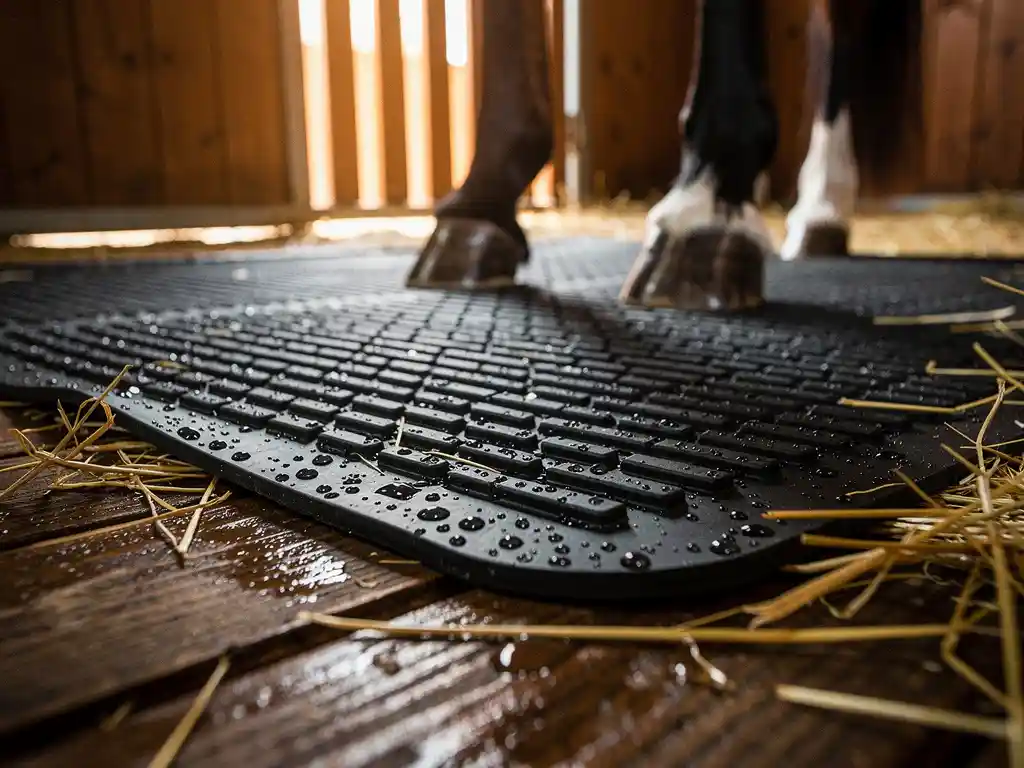
The most effective way to keep a horse stall floor from getting slippery when wet is to install rubber mats with a textured, non-slip surface. Rubber mats grip both the floor beneath them and your horse’s hooves, even when urine, water, or manure are present. Combined with good drainage and regular cleaning, the right rubber matting essentially solves the slippery-floor problem for good. Below, we walk through everything you need to know to make the right choice for your stall.
Why do horse stall floors get slippery when wet?
Horse stall floors get slippery when wet because most base materials, including concrete, packed clay, and wood, lose traction as soon as moisture is introduced. Urine, water from buckets or washdowns, and manure can all create a film on the surface that dramatically reduces friction. The result is a floor that offers little grip for your horse’s hooves, raising the risk of slipping, stumbling, or falling.
Concrete is one of the most common offenders. It is durable and easy to clean, but its smooth surface becomes dangerously slick when wet. Packed clay softens and shifts when wet, creating uneven footing. Even rubber surfaces can become slippery over time if they are worn smooth, clogged with debris, or simply the wrong type for a wet environment. Understanding the cause helps you choose the right fix rather than just treating the symptom.
What are the best flooring options for preventing slips in horse stalls?
The best flooring options for preventing slips in horse stalls are rubber mats, interlocking rubber tiles, and textured rubber sheets installed over a stable base such as concrete or compacted gravel. Rubber consistently outperforms other materials because it maintains grip when wet, cushions impact, and does not absorb moisture. Other options, such as sand or shavings alone, do not provide reliable, consistent traction.
Rubber mats vs. other materials
Sand and shavings can shift and compact over time, leaving bare, slippery patches underneath. Wood planks warp and rot with repeated exposure to moisture. Concrete on its own is low maintenance but high risk when wet. Rubber mats sit flat, stay put, and deliver consistent grip across the entire stall floor, making them the practical choice for long-term safety.
Bedding on top of rubber mats
Many horse owners use a thin layer of shavings or straw on top of rubber mats. This combination works well: the rubber provides structural grip and cushioning, while the bedding absorbs moisture and adds comfort. You can often reduce your bedding use significantly, which saves money over time without compromising your horse’s comfort or safety.
How do rubber mats prevent horse stall floors from getting slippery?
Rubber mats prevent horse stall floors from getting slippery by providing a textured, high-friction surface that maintains grip even when wet. The rubber material itself has natural traction properties, and most stall mats feature a patterned or studded top surface that further increases grip. Rubber is also non-porous, so it does not absorb urine or water, which means liquids drain away rather than pooling and creating a hazard.
Beyond grip, rubber mats are naturally resilient. They flex slightly underfoot, which helps your horse maintain balance on uneven footing. A solid rubber mat also stays firmly in place once installed, eliminating the shifting and bunching that can create trip hazards with looser flooring materials. The combination of surface texture, material properties, and stability is what makes rubber the go-to solution for wet stall environments.
What should you look for in a non-slip horse stall mat?
When choosing a non-slip horse stall mat, look for a textured or patterned top surface, a thickness of at least half an inch, genuine rubber construction, and a non-porous composition. Together, these features deliver the grip, durability, and hygiene performance that a stall environment demands. Mats that are too thin or made from inferior compounds wear down quickly and lose their non-slip properties.
Surface texture
The top-surface pattern makes a big difference. Studded, waffle, or hammer-top textures all create contact points that grip your horse’s hooves and resist sliding. A completely flat rubber surface, while better than bare concrete, does not perform as well in wet conditions as a textured one.
Thickness and weight
Thicker mats stay in place better and provide more cushioning for your horse’s joints. A mat in the range of three-quarters of an inch is a reliable choice for most stall applications. Heavier mats are harder to shift, which means they maintain their position and coverage over time without bunching or creating gaps.
Material quality
Genuine rubber—not synthetic foam or recycled crumb rubber of unknown quality—is what you want for a stall environment. High-quality rubber will not crack, peel, or crumble under the temperature swings common in a barn, and it holds its surface texture far longer than lower-grade alternatives.
How do you properly install rubber mats in a horse stall?
To properly install rubber mats in a horse stall, start with a clean, level base, then lay the mats tightly together to eliminate gaps, and secure them so they cannot shift. Proper installation is just as important as mat quality. A well-chosen mat that is poorly installed can still bunch up, leave exposed floor areas, or create edges that your horse can catch a hoof on.
- Prepare the base: Clean the stall floor thoroughly and repair any uneven spots, cracks, or low areas. A flat, stable base helps the mats lie evenly and prevents rocking.
- Measure carefully: Measure the stall dimensions before ordering mats. Knowing your exact floor size helps you choose the right mat configuration and minimizes gaps or overlapping edges.
- Lay mats tightly: Place mats edge to edge with no gaps between them. Gaps collect debris and create uneven footing. If your stall dimensions do not match standard mat sizes, consider custom-cut options.
- Secure the edges: Mats can shift over time, especially near the stall door. Use interlocking designs where available, or place heavy bedding along the edges to hold them in position.
- Check for movement: After the first few days of use, walk on the mats and press on them to check for any shifting or lifting. Adjust as needed before your horse settles into regular use.
One practical tip: larger mats mean fewer seams. Fewer seams mean fewer gaps for hooves to catch on and fewer spots for moisture and bacteria to collect. If your stall has an unusual shape or size, a custom-cut mat is a smart investment that simplifies the whole process.
How do you clean and maintain horse stall mats to keep them non-slip?
To keep horse stall mats non-slip, clean them regularly with mild detergent and water, remove manure and wet bedding daily, and inspect the surface periodically for wear or debris buildup. Rubber mats are low maintenance by nature, but consistent cleaning preserves their surface texture and prevents buildup that can reduce traction over time.
Daily maintenance
Remove manure and wet bedding daily. This is the single most effective step for maintaining a hygienic, non-slip stall floor. Leaving wet material on the mats for extended periods allows ammonia from urine to break down the rubber surface over time and creates slippery patches under the bedding.
Deep cleaning
Periodically remove the mats entirely and scrub both the mat surface and the floor beneath with a mild detergent and water. Allow everything to dry thoroughly before replacing the mats. This prevents moisture from being trapped underneath, which can degrade both the mats and the base floor over time.
Inspection and replacement
Check your mats regularly for signs of wear, particularly in the surface texture. A mat that has been worn smooth in high-traffic areas, such as where your horse stands at the feeder, has lost much of its non-slip benefit and should be replaced or repositioned. Genuine rubber mats are durable and long-lasting, but no mat lasts forever under constant heavy use.
If you are ready to upgrade your stall flooring with mats that are built to last and designed for real barn conditions, we at LRP Matting are here to help. We manufacture high-quality rubber stall mats from genuine rubber, including options with hammer-top and studded surfaces for maximum grip in wet conditions. We also offer custom-cut rubber matting sized to fit your exact stall dimensions, so you get full coverage with minimal seams and a clean, secure installation every time. Reach out to us, and we will help you find the right solution for your horses.
Frequently Asked Questions
How long do rubber horse stall mats typically last before they need to be replaced?
High-quality genuine rubber stall mats can last anywhere from 10 to 20 years with proper care and maintenance. Longevity depends on factors like mat thickness, rubber quality, your horse’s activity level, and how consistently you clean and inspect them. The most common reason for early replacement is surface wear in high-traffic spots rather than full mat failure, so repositioning mats periodically can help extend their overall lifespan.
Can I install rubber mats directly over an existing concrete floor, or does the concrete need to be treated first?
Yes, you can install rubber mats directly over existing concrete, but the concrete should be clean, level, and free of major cracks or low spots before you lay the mats down. If the concrete has significant uneven areas, the mats will rock or flex underfoot, creating gaps and reducing effectiveness. For concrete with drainage issues, it is worth addressing grading or adding drainage channels before installation to prevent moisture from pooling under the mats.
My horse paws aggressively at the stall floor — will rubber mats hold up to that kind of wear?
Rubber mats are generally the most durable flooring option for horses that paw, but heavy pawing will accelerate surface wear, particularly in the textured top layer. Thicker mats (three-quarters of an inch or more) made from genuine rubber will hold up significantly better than thinner or lower-grade alternatives. If your horse is a chronic pawer, inspect those specific areas more frequently and consider rotating or replacing individual mats in the affected zones before the worn surface becomes a traction hazard.
Is there a risk of mold or bacteria growing under the rubber mats, and how do I prevent it?
Yes, moisture trapped under rubber mats can create conditions where mold, bacteria, and ammonia buildup thrive, which can damage both the mats and the base floor over time. The best prevention is a combination of daily removal of wet bedding, ensuring your stall has adequate drainage so liquids do not pool under the mats, and performing periodic deep cleans where you lift the mats entirely and let both the mats and the floor dry completely before reinstalling. A well-drained base, such as sloped concrete or compacted gravel, makes a significant difference in reducing this risk.
Do rubber stall mats help with joint health, or are they purely a safety feature?
Rubber stall mats offer genuine joint health benefits beyond just slip prevention. The natural cushioning of rubber reduces the impact on your horse’s hooves, legs, and joints compared to standing on hard concrete for extended periods, which is especially beneficial for older horses or those with arthritis or hoof conditions. Many veterinarians and farriers recommend rubber matting as part of a broader approach to keeping horses comfortable during the hours they spend standing in their stalls.
What is the best way to cut rubber mats to fit an oddly shaped or non-standard stall?
For minor trimming, a sharp utility knife with a fresh blade and a straight edge can produce clean cuts in most rubber mats, though it requires some physical effort depending on mat thickness. For complex shapes, irregular stall layouts, or thicker mats, ordering custom-cut rubber matting from a manufacturer is a far more practical option — it ensures precise coverage, minimizes waste, and eliminates the uneven edges that can create trip hazards or gap problems. Always measure your stall twice and account for door swings and any built-in fixtures before cutting or ordering.
Are there any situations where rubber mats alone are not enough, and additional anti-slip measures are needed?
In most standard stall environments, quality rubber mats with a textured surface are sufficient on their own. However, in high-moisture situations — such as wash stalls, areas with poor drainage, or stalls used by horses recovering from injury who may have difficulty bearing weight — you may want to pair textured rubber mats with additional drainage improvements or consult your vet about specialized flooring solutions. Regularly worn mats that have lost their surface texture should be replaced promptly rather than supplemented, as no additive fully restores the grip of a fresh textured surface.
Related Articles
- How can preventative maintenance reduce unexpected floor repairs?
- What factors influence animal comfort in housing facilities?
- How do sports facilities prevent slips?
- What makes an animal housing facility safe?
- What causes a floor surface to become slippery over time?
- How do you support a horse's joints during long periods of stabling?
- What is the best flooring for an indoor training facility?
- How do you choose flooring for a professional sports locker room?
- What is the best way to cover an uneven barn floor?
- Is concrete a good floor for a horse stall?