

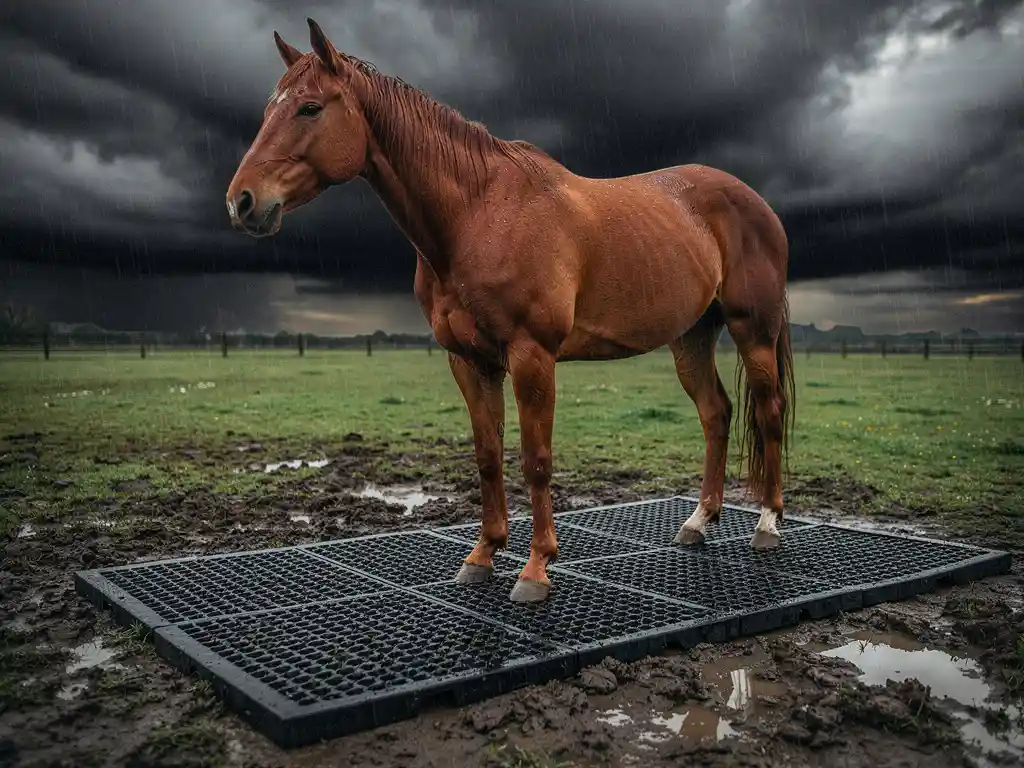
Making a wet paddock safer for horses comes down to three things: better footing, smarter drainage, and knowing where to place protective surfaces. The most effective approach combines a well-graded base that sheds water quickly, high-traction footing materials in high-traffic zones, and rubber mats at key transition points like gates, water troughs, and barn entrances. Get those three elements right, and your horses will stay safer even in the worst weather.
Why is a wet paddock dangerous for horses?
A wet paddock is dangerous because saturated ground loses its grip, turning firm footing into a slick, unpredictable surface. Horses rely on traction to move, stop, and balance. When that traction disappears, the risk of slipping, stumbling, and soft-tissue injuries goes up significantly—especially during feeding time, when horses are moving quickly and jostling for position.
Beyond the slip risk, prolonged exposure to wet, muddy conditions can cause mud fever (also known as pastern dermatitis). Bacteria thrive in warm, wet mud and can infect the soft skin around a horse’s lower legs, leading to painful sores that are slow to heal. Standing on waterlogged ground for extended periods also softens the hoof wall, making horses more vulnerable to bruising and thrush—a bacterial infection of the frog. These are not minor inconveniences. They are the kind of problems that can pull horses out of work for weeks at a time.
What causes paddocks to become unsafe in wet weather?
Paddocks become unsafe in wet weather primarily because of poor drainage, compacted soil, and high foot traffic in concentrated areas. When water cannot drain away quickly, it pools on the surface and saturates the top layer of soil, creating deep, sticky mud that shifts unpredictably under a horse’s weight.
Compacted soil is a big part of the problem. Heavy hooves repeatedly hitting the same ground push air pockets out of the soil, making it dense and almost waterproof. Rain then sits on top rather than soaking in. High-traffic zones around gates, water troughs, hay feeders, and barn entrances take the most punishment, and these spots tend to turn into deep mud bogs first. The underlying slope of your paddock also matters. A flat paddock with no natural gradient gives water nowhere to go, so it simply accumulates. A paddock that slopes toward a low point or drainage outlet moves water away from the areas where your horses spend most of their time.
What are the best footing materials for a wet horse paddock?
The best footing materials for a wet horse paddock are crushed stone, compacted gravel, and rubber matting. Each serves a different purpose, and the strongest paddock setups use a combination of all three, depending on the area and the level of traffic it receives.
Crushed stone and compacted gravel
A base layer of compacted crushed stone (often called road base or crusher run) is the foundation of good paddock footing. It compacts firmly, resists shifting, and allows water to drain through and away from the surface. A layer of smaller pea gravel or coarse sand on top adds cushioning and improves grip without trapping mud. This combination works well across open paddock areas where horses move freely.
Rubber matting for high-traffic zones
Rubber mats are the right tool for the spots that take the hardest wear: gates, water stations, feeding areas, and barn doorways. These zones see concentrated hoof traffic and are the first to deteriorate into mud. A rubber mat provides a firm, non-slip surface that stays stable regardless of what the ground underneath is doing. Unlike gravel, rubber does not shift or scatter, and it gives horses a predictable, grippy surface to stand and move on. It also protects the compacted base beneath it from breaking down as quickly.
Where should rubber mats be placed in a paddock?
Rubber mats should be placed in the highest-traffic areas of a paddock: at gates, around water troughs, at feeding stations, along barn entrances, and at any transition point between the paddock and a hard surface like concrete or asphalt. These are the spots where mud forms fastest and where horses are most likely to slip or stand for long periods.
Gate areas are particularly important. Every time a horse enters or exits, hooves churn the same small patch of ground. Without a protective surface, this becomes a deep mud hole within a few weeks of wet weather. Placing mats here gives horses a stable surface to step onto and off, reducing the risk of a slip at the moment of transition. Around water troughs, horses stand and shuffle while drinking, and the wet ground around the trough breaks down quickly. A mat keeps this area firm and clean. Along barn entrances and wash bays, mats protect both the horse and the handler by providing reliable grip on a surface that would otherwise be wet and slick.
How do you improve paddock drainage to prevent waterlogging?
Improving paddock drainage starts with grading the land so water flows away from high-traffic areas, then installing a compacted base layer that allows water to move through and off the surface. For seriously waterlogged paddocks, adding French drains or perforated drainage pipes beneath the surface can redirect groundwater away before it saturates the root zone.
Grading and surface slope
Even a gentle slope of one to two percent is enough to encourage water to run off rather than pool. If your paddock sits in a natural low point, grading alone may not be enough, but improving the slope around high-traffic areas like gates and shelters makes a noticeable difference. Water that flows away from a gate does not turn it into a mud pit.
Base construction
A well-constructed base is the most durable long-term solution. Dig out the top layer of compacted soil, lay geotextile fabric to separate layers and prevent mixing, then compact a layer of crushed stone before adding a finer surface layer. This structure allows water to percolate downward rather than sitting on top. It also gives hooves a stable, load-bearing surface that does not deform under pressure the way saturated soil does.
French drains and outlet channels
For areas with persistent standing water, a French drain—a trench filled with gravel and a perforated pipe—can intercept groundwater before it reaches the surface. These work best when connected to a proper outlet like a ditch or drainage channel that carries water well away from the paddock. Without a clear outlet, you are just moving the water problem rather than solving it.
How do you maintain a paddock during and after heavy rain?
During heavy rain, the most useful thing you can do is keep horses off the most vulnerable areas of the paddock. Rotating horses to a sacrifice area or a well-drained section prevents the worst damage to your main paddock footing. After rain, give the ground time to firm up before allowing full access again, and check high-traffic zones for damage before horses return.
After heavy rain, walk the paddock and look for areas where water is still pooling. These spots tell you exactly where your drainage needs attention. If the same corners flood every time it rains, that is where you need to invest in base work or drainage infrastructure. Clear any debris from drainage channels or outlets so water can move freely. Check rubber mats and move them if necessary to inspect the surface underneath. Genuine rubber mats are non-porous, so they do not retain moisture and are easy to clean with water and a mild detergent—a quick rinse after wet weather keeps them hygienic and functioning well.
What mistakes should you avoid when managing a wet paddock?
The most common mistakes in wet paddock management are overgrazing, ignoring high-traffic zones until they are already badly damaged, and using the wrong footing materials in the wrong places. Each of these makes wet-weather problems significantly worse and more expensive to fix.
Overgrazing strips grass cover from the paddock, and grass roots are one of the best natural tools for holding soil together and absorbing water. Once the grass is gone, bare soil compacts and erodes much faster. Rotating paddocks and resting sections during wet periods protects your ground cover and keeps the soil structure intact longer. Ignoring gate and feeding areas until they are knee-deep in mud means you are always playing catch-up. Small interventions early in the season, like placing mats before the ground deteriorates, save a lot of remediation work later.
Using the wrong materials is also a frequent problem. Sand, for example, can work well in dry climates but becomes a saturated, heavy mess in consistently wet conditions. Straw and wood chips break down quickly and can create an anaerobic layer that is worse for hooves than bare mud. Stick with materials that drain well and hold their structure under repeated hoof pressure.
When it comes to equipping your paddock with reliable, long-lasting rubber matting, we at LRP Matting offer custom rubber mats cut to any size or shape, so they fit your specific gates, barn entrances, and feeding stations without gaps or awkward seams. Made from our proprietary Fiber-Reinforced Rubber Compound (FRC®), our mats are built to handle the kind of constant wet-weather punishment that paddock environments deliver. If standard sizes do not fit your setup, our made-to-measure matting solutions give you a precise fit that works with your paddock layout from day one.
Frequently Asked Questions
How thick should rubber mats be for outdoor paddock use?
For paddock environments, rubber mats should generally be at least 17–20mm thick to withstand constant hoof pressure, moisture, and UV exposure without cracking or deforming. Thinner mats may work in lower-traffic indoor areas, but outdoor high-traffic zones like gates and water troughs demand a heavier-duty product. If you are unsure, opt for a thicker mat — it will last significantly longer and provide better load distribution across the surface beneath it.
How do I stop rubber mats from shifting or floating in a wet paddock?
The best way to keep rubber mats stable is to ensure the base beneath them is properly compacted and level before laying them down — a loose or uneven base is the most common reason mats shift. Interlocking mat designs or mats with textured undersides grip the surface better than smooth-bottomed alternatives. For gate areas where horses push and pull against the mat repeatedly, you can also use edging stakes or border frames to keep the mat locked in position.
Can I use rubber mats directly on top of existing mud, or do I need to prepare the ground first?
Laying rubber mats directly onto mud is a short-term fix that usually makes things worse — the mat will sink, tilt, and become unstable as the mud beneath it continues to move. For mats to perform properly, the ground underneath needs to be excavated, compacted, and ideally topped with a layer of crushed stone before the mat goes down. Taking the time to prepare the base correctly means your mats will stay flat, drain properly, and last far longer without needing to be reset.
How many horses is a paddock too small to manage safely in wet weather?
A commonly used guideline is a minimum of 0.4–0.5 acres per horse for a sacrifice or dry lot area, though the quality of your drainage and footing matters just as much as raw size. In wet weather, stocking density becomes critical — the more horses concentrated in a small area, the faster the ground deteriorates regardless of how well it was constructed. If you cannot reduce horse numbers, rotating access between sections of the paddock is the most practical way to prevent any single area from breaking down completely.
What is a sacrifice paddock, and should I set one up?
A sacrifice paddock is a small, designated area — typically with hardened footing — where horses are kept during the wettest periods to protect the rest of your pasture from being churned up and damaged. It is called a ‘sacrifice’ area because the ground cover in it is intentionally given up in favour of preserving the larger grazing paddock. If you deal with regular wet seasons, setting up even a small sacrifice area with a compacted base and rubber mats at key points is one of the most cost-effective long-term investments you can make for your paddock management.
How do I treat mud fever once my horse already has it, and can better paddock management prevent it recurring?
Treating mud fever typically involves removing the horse from wet conditions, gently cleaning and drying the affected legs, removing scabs carefully, and applying a veterinarian-recommended antibacterial cream — always consult your vet for a confirmed diagnosis and treatment plan before starting. Preventing recurrence comes down almost entirely to keeping horses out of prolonged wet and muddy conditions, which is where paddock improvements make a direct difference. Horses that have had mud fever once are often more susceptible to it again, so improving footing and drainage is not just about comfort — it is an active health management strategy.
Are there any footing materials I should avoid in a consistently wet climate?
Yes — sand, straw, and wood chips are the three most commonly misused materials in wet paddock environments. Sand becomes waterlogged and heavy in wet climates, loses its drainage properties quickly, and can compact into a slick surface. Straw and wood chips decompose rapidly when wet, creating an anaerobic layer that traps moisture against hooves and can accelerate thrush and other hoof infections. In consistently wet conditions, stick with materials that drain freely and hold their structural integrity under hoof pressure, such as crusher run, coarse gravel, and quality rubber matting.
Related Articles
- How can you improve traction on existing floors?
- How do you reduce impact on a horse's legs during stabling?
- How do you keep a horse stall dry without using excessive bedding?
- What is the best flooring for a sports facility?
- What causes concrete floors to crack and chip in industrial facilities?
- What causes hock sores in stabled horses?
- What is the most durable flooring for a professional athletic facility?
- How do you make a horse stall more comfortable for an older horse?
- What type of floor is easiest to keep clean in a horse barn?
- Can anti-fatigue matting improve worker productivity?