
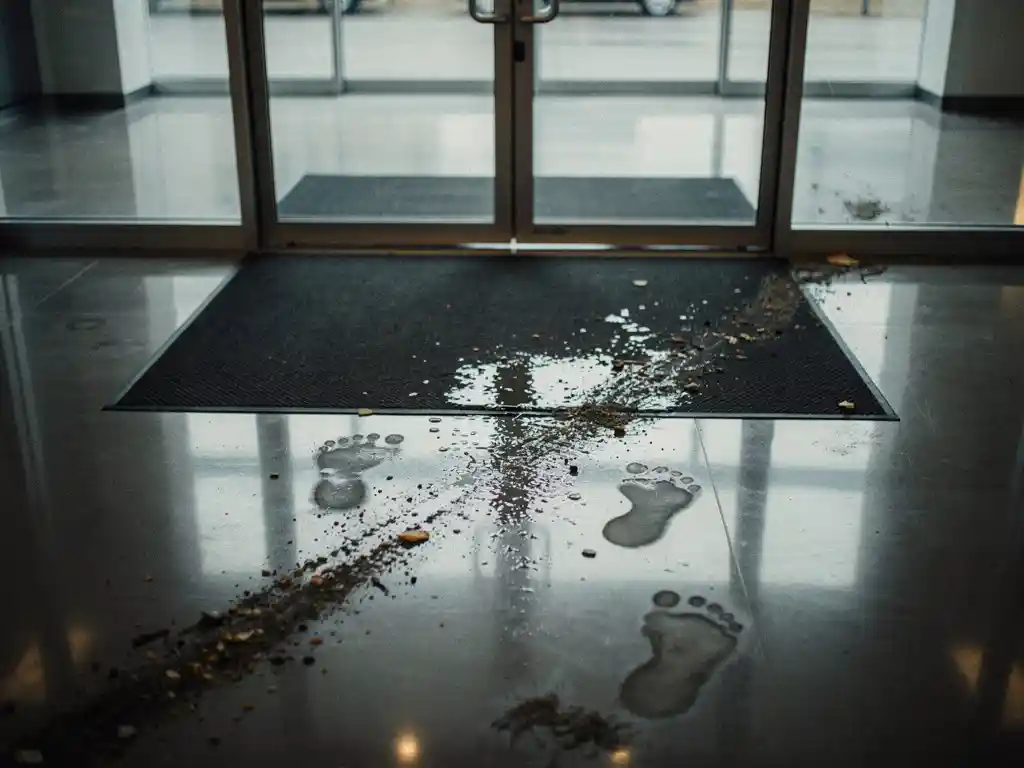
Entrances create floor safety risks primarily because they concentrate moisture, debris, and foot traffic in a small, high-pressure zone. Wet shoes, tracked-in dirt, and abrupt surface changes all combine to make entrance floors significantly more slippery than floors further inside a building. The result is a disproportionately high number of slip and fall incidents happening right at the door. Below, we break down the specific hazards, why they occur, and what you can do about them.
What types of hazards are most common at building entrances?
The most common floor hazards at building entrances are moisture, loose debris, inadequate traction surfaces, and abrupt flooring transitions. These hazards often appear together, which is what makes entrance areas particularly prone to slip and fall incidents. Unlike interior floors, entrances are exposed to outdoor conditions every time a door opens.
Moisture is the biggest offender. Rain, snow, and wet footwear get tracked in constantly, leaving thin films of water that are difficult to see and easy to slip on. Alongside moisture, dirt, grit, sand, and leaves follow people inside and create loose, unstable surface conditions. Even on dry days, fine particles underfoot reduce grip dramatically.
Poor lighting, uneven thresholds, and worn or curling floor coverings also contribute to entrance floor hazards. When you combine low visibility with a slick surface and an unexpected height change, the risk of a fall increases significantly. These are not freak accidents. They are predictable outcomes of environments that have not been designed with floor safety in mind.
Why do wet floors at entrances cause more slips than interior floors?
Wet floors at entrances cause more slips than interior floors because entrances receive continuous moisture input from outside while interior floors stay dry and stable. The volume and frequency of water tracked in at an entrance overwhelms most standard flooring surfaces, reducing friction to a point where even slow walking becomes a slip risk.
Slip resistance depends on the friction between a shoe sole and the floor surface. Water acts as a lubricant between those two surfaces, and the thinner the water film, the harder it is to detect visually. A floor that looks merely damp can be just as slippery as one that appears visibly wet.
Interior floors, by contrast, rarely encounter standing moisture unless there is a spill or leak. Entrances face this condition repeatedly throughout the day, especially during rain or snow. Without a system in place to absorb or redirect that moisture before it spreads, wet entrance floors remain a persistent floor safety hazard that cannot be solved simply by mopping more frequently.
How does foot traffic volume increase entrance floor risk?
Higher foot traffic at entrances increases floor safety risk because more people moving through a small area means more moisture and debris are deposited more frequently, and the floor gets less time to dry or be cleaned between passes. The entrance becomes a constantly refreshed source of hazardous conditions rather than an isolated incident.
In busy commercial or industrial buildings, entrances can see hundreds or thousands of people passing through in a single day. Each person tracks in a small amount of water or dirt. Individually, the contribution seems minor. Cumulatively, it creates a consistently wet, contaminated surface that poses a real slip and fall prevention challenge.
High traffic also accelerates wear on floor surfaces. Flooring that loses its texture or grip coating becomes even more dangerous when wet. This is why entrance floor safety cannot be treated as a one-time fix. It requires flooring solutions that hold up under repeated use and continue to perform as traffic levels grow.
What role does flooring transition play in entrance slip-and-fall incidents?
Flooring transitions at entrances play a significant role in slip and fall incidents because they create sudden changes in surface height, texture, and grip that can catch people off guard. When someone steps from a mat onto a hard floor or from a threshold strip onto tile, even a small height difference can disrupt their balance and cause a fall.
Transitions between materials with very different slip resistance ratings are especially problematic. A rubber mat with strong grip immediately adjacent to a polished stone or smooth vinyl floor creates a sharp contrast in traction. If the mat shifts or curls at the edge, the trip hazard compounds the slip risk.
Poorly secured transition strips, raised door thresholds, and mats that bunch or move underfoot are among the most common physical causes of entrance falls. A floor safety inspection of any building should include a close look at how materials meet at the entrance, whether edges are flush, and whether any mat or covering moves when stepped on near its perimeter.
How do entrance mats reduce floor safety risks?
Entrance mats reduce floor safety risks by capturing moisture and debris from footwear before it spreads across the interior floor. A well-chosen mat absorbs water, scrapes dirt from shoe soles, and provides a higher-traction surface than most standard flooring materials. This directly addresses the two main causes of entrance slips: wet surfaces and loose particles.
The effectiveness of an entrance mat depends on its size, material, and placement. A mat that is too small will not give people enough steps to clean their shoes before they reach the main floor. Industry guidance generally recommends enough matting to cover at least five to seven walking steps from the entrance, though high-traffic or wet-weather environments benefit from even more coverage.
Beyond moisture control, mats with textured or raised surfaces provide grip that smooth flooring cannot. Rubber mats in particular offer consistent slip resistance across a wide range of conditions, do not degrade quickly under heavy use, and are easy to clean. Placing mats both outside and inside the entrance creates a two-stage system that handles significantly more moisture than a single mat can manage alone.
What’s the difference between entrance mats and standard floor mats?
Entrance mats are specifically designed to capture and contain moisture and debris from incoming foot traffic, while standard floor mats are typically designed for comfort, protection, or anti-fatigue purposes in interior spaces. The core difference is function: entrance mats prioritize contamination control and slip resistance at the point of entry, whereas standard mats address different needs further inside a building.
Entrance mats
Entrance mats are built with scraping and absorption as their primary job. They often feature aggressive surface textures, drainage channels, or moisture-wicking materials that pull water away from the surface. Many are designed to stay firmly in place under heavy directional traffic and to withstand repeated cleaning without losing their grip properties. Their slip resistance rating is typically higher because they face the worst conditions in any building.
Standard floor mats
Standard floor mats cover a much broader range of applications. Anti-fatigue mats reduce strain for workers who stand for long periods. Protective mats shield floors from equipment, chemicals, or heavy loads. Decorative mats define spaces or reinforce branding. These mats may offer some slip resistance, but that is usually secondary to their primary purpose. Using a standard interior mat at an entrance often means the mat will not perform well where floor safety pressure is highest.
Choosing the right mat for the right location matters. At LRP Matting, we offer a range of commercial matting solutions built for exactly this kind of environment, including entrance-ready options made from durable rubber that holds up under constant traffic and delivers reliable slip resistance day after day.
Frequently Asked Questions
How do I know if my building's entrance is meeting basic floor safety standards?
Start with a hands-on inspection during or immediately after wet weather, when hazards are most visible. Check whether your current matting covers at least five to seven walking steps from the door, whether any mats shift or curl at the edges, and whether transition strips between surfaces are flush and secure. If you notice water spreading beyond the mat zone onto the interior floor, or if the floor surface shows visible wear in the high-traffic path, those are clear signs your entrance is not meeting a functional floor safety standard.
What are the most common mistakes building managers make when trying to address entrance floor hazards?
The most frequent mistake is relying on a single, undersized mat placed just inside the door and expecting it to handle all moisture and debris. Another common error is using a general-purpose or decorative mat in place of a purpose-built entrance mat, which typically lacks the scraping texture and drainage capacity needed for high-traffic wet conditions. Many managers also treat entrance floor safety as a one-time purchase rather than an ongoing system, neglecting to replace mats that have worn smooth or lost their grip over time.
Does placing a mat outside the entrance as well as inside actually make a meaningful difference?
Yes, a two-stage matting system — one mat outside and one inside — consistently outperforms a single mat because it begins the moisture and debris removal process before people even cross the threshold. The exterior mat handles the heaviest contamination, including mud, gravel, and bulk water, while the interior mat captures residual moisture and finer particles. Studies and industry guidance both support this layered approach as one of the most cost-effective ways to reduce slip and fall risk at a building entrance.
How often should entrance mats be cleaned or replaced to stay effective?
Entrance mats should be cleaned frequently enough that they never reach saturation — a soaked mat stops absorbing moisture and can itself become a slip hazard. In high-traffic or wet-weather environments, this may mean daily cleaning or even mid-day attention during heavy rain or snow. Replacement depends on the mat material and traffic volume, but a rubber entrance mat showing visible surface smoothing, cracking, or backing deterioration has lost meaningful grip performance and should be replaced regardless of how new it looks on a calendar.
Are there specific flooring materials that perform better than others at building entrances?
Rubber flooring and rubber-backed entrance mats consistently rank among the best performers at building entrances because rubber maintains its slip resistance when wet, resists compression under heavy foot traffic, and does not degrade quickly with repeated cleaning. Textured vinyl and coated concrete can also perform well if the surface texture is maintained. Smooth stone, polished tile, and standard vinyl are among the worst choices for entrance zones because their slip resistance drops sharply when wet, which is exactly the condition entrances face most often.
What should I do if a slip and fall incident occurs at our building entrance despite having mats in place?
Document the scene immediately — photograph the mat position, surface conditions, lighting, and the exact location of the incident before anything is moved or cleaned. Review whether the mat was properly sized, secured, and recently cleaned, and note any factors like unusually heavy rain or a mat that had shifted from its correct position. Use the incident as a diagnostic opportunity: if your current matting system failed under real conditions, that is actionable information pointing to a gap in coverage, mat type, or maintenance frequency that needs to be addressed before the next incident occurs.
Can improving entrance floor safety also reduce liability exposure for building owners?
Yes, demonstrating a proactive and documented floor safety program at building entrances is one of the most direct ways to reduce liability exposure. Courts and insurers look at whether a building owner took reasonable steps to identify and address known hazards — and entrances are a well-documented high-risk zone. Maintaining records of mat inspections, cleaning schedules, and any surface upgrades shows due diligence and can significantly affect the outcome of a slip and fall claim. Investing in purpose-built entrance matting is not just a safety decision; it is a risk management decision.
Related Articles
- Why do wet floors become dangerous?
- What is the best flooring for a horse stall?
- What flooring is best for a large animal veterinary wash area?
- How do you protect a sports facility floor from moisture and heavy use?
- How do you prevent cross-contamination through flooring in an animal clinic?
- What is the best flooring solution for a temporary work site?
- What is the difference between anti-fatigue mats and standard rubber mats?
- How do you protect a concrete floor from heavy machinery?
- How do you insulate a horse stall floor in winter?
- How do you choose the right rubber flooring for an indoor sports complex?