
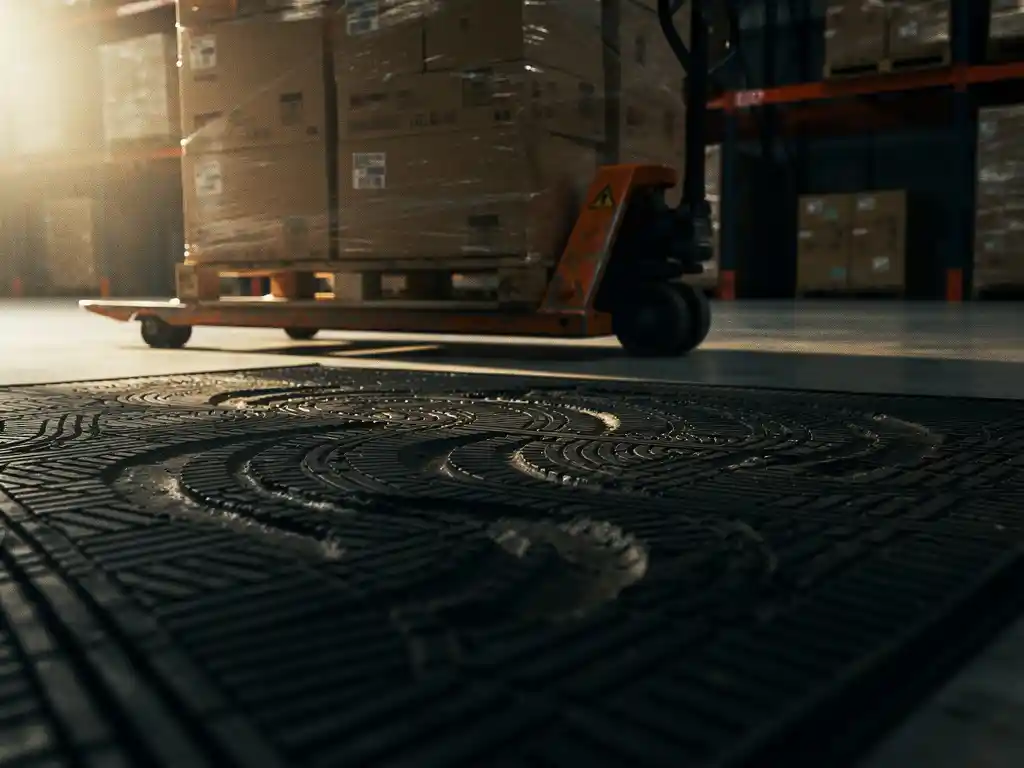
High traffic logistics environments put floors under serious, ongoing stress. Constant forklift movement, heavy pallet loads, and foot traffic combine to wear down flooring faster than in almost any other setting. Concrete floors crack, chip, and become uneven over time, which raises safety risks and increases maintenance costs. The sections below walk through the most common problems, what causes them, and what you can do to protect your floors.
What types of floor damage are most common in logistics facilities?
The most common types of floor damage in logistics facilities are surface abrasion, cracking, spalling, joint deterioration, and chemical staining. These forms of wear are driven by the combination of heavy loads, repeated mechanical impact, and exposure to oils, fuels, and cleaning agents. Concrete is the standard flooring material in most warehouses, and while it is durable, it is not indestructible.
Surface abrasion happens gradually as hard wheels and foot traffic grind away the top layer of concrete. Over time, this produces a rough, dusty surface that becomes harder to clean and more prone to further damage. Cracking and spalling are more serious problems. They develop when concentrated loads stress the concrete beyond its tolerance, or when temperature changes cause the material to expand and contract repeatedly. Spalling, where chunks of the surface break away, creates uneven ground that can cause trips, falls, and equipment instability.
Joint deterioration is another frequent issue. Expansion joints in concrete floors allow for natural movement, but heavy forklift traffic crossing those joints repeatedly causes the edges to chip and break down. Chemical staining from hydraulic fluid, battery acid, or cleaning products can also degrade the concrete binder over time, weakening the surface even where it looks intact on the outside.
How does heavy forklift traffic degrade flooring over time?
Heavy forklift traffic degrades flooring through a combination of point load stress, vibration, and repetitive impact on the same surface areas. Forklifts concentrate enormous weight onto small wheel contact points, which creates localized pressure that concrete was not always designed to handle continuously. Over time, this breaks down the surface layer and can cause subsurface cracking.
The type of forklift wheel matters significantly. Hard polyurethane wheels, which are common on electric forklifts, transmit more shock directly to the floor than pneumatic tires. Every pass over a crack, joint, or uneven patch amplifies the stress on that spot. Turning movements are particularly damaging because they generate lateral shear forces that pull at the surface rather than simply pressing down on it.
Routes that see the most forklift activity, such as loading dock approaches, aisle intersections, and staging areas, tend to show wear much faster than the rest of the facility. This uneven degradation pattern means that warehouse flooring does not fail uniformly. Instead, specific zones deteriorate quickly while other areas remain in good condition, which makes targeted floor protection a practical and cost-effective approach.
What flooring properties matter most in high-traffic logistics areas?
In high-traffic logistics areas, the flooring properties that matter most are compressive strength, surface traction, impact resistance, and ease of maintenance. A floor that performs well in a busy warehouse needs to handle heavy dynamic loads without cracking, provide reliable grip for both pedestrians and equipment, and be practical to clean and repair.
Compressive strength determines how much load a floor can bear before it begins to fail structurally. For logistics facilities operating heavy forklifts and storing dense palletized goods, this is a baseline requirement. Surface traction directly affects warehouse safety. Smooth or contaminated floors increase the risk of slips for workers and can cause pallet loads to shift unexpectedly.
Impact resistance is important in areas where goods are loaded and unloaded frequently. Dropped items, pallet jacks, and forklift impacts all deliver sudden force to the floor. A surface that absorbs or distributes that energy performs better over time than one that transmits it directly into the concrete. Finally, ease of maintenance matters for operational efficiency. Floors that are difficult to clean or require frequent specialist repairs create downtime and ongoing costs that add up quickly in a busy facility.
How do rubber mats protect concrete floors in warehouses?
Rubber mats protect concrete floors in warehouses by acting as a buffer layer that absorbs impact, distributes load, and prevents direct contact between heavy equipment wheels and the concrete surface. This reduces surface abrasion, limits the spread of existing cracks, and keeps the underlying floor in better condition for longer.
In areas where forklift traffic is heaviest, such as loading docks, aisle intersections, and staging zones, rubber matting intercepts the mechanical stress before it reaches the concrete. The mat material flexes slightly under load, spreading the pressure over a wider area rather than concentrating it on a single point. This is particularly useful at expansion joints, where repeated forklift crossings are one of the leading causes of edge chipping and joint failure.
Rubber mats also help with loading dock safety by providing consistent grip in areas that are frequently exposed to rain, condensation, and spilled liquids. A non-porous rubber surface does not absorb moisture, which means it is easier to keep clean and less likely to become a slip hazard than bare concrete that has absorbed oils or water over time. For facilities managing both pedestrian and vehicle traffic in the same zones, this combination of protection and traction is particularly valuable.
What’s the difference between standard rubber mats and fiber-reinforced rubber mats?
The main difference between standard rubber mats and fiber-reinforced rubber mats is structural strength. Standard rubber mats are made from compounded rubber alone, which provides good flexibility and grip. Fiber-reinforced rubber mats incorporate a network of fibers within the rubber compound, which significantly increases tensile strength, resistance to tearing, and overall load-bearing capacity.
In logistics environments, this difference becomes relevant quickly. Standard rubber mats can handle moderate foot traffic and light equipment use well. However, under repeated forklift loads or in areas where heavy pallets are dragged across the surface, standard mats can deform, stretch, or develop tears over time. Fiber-reinforced mats resist these forces more effectively because the internal fiber structure prevents the rubber from stretching beyond its limits.
For industrial facility maintenance, the longer service life of fiber-reinforced mats often makes them a more cost-effective choice in high-demand zones, even if the upfront cost is higher. Replacing a mat less frequently reduces both material costs and the disruption that comes with pulling up worn flooring in an active warehouse. If you are evaluating matting for areas with consistent forklift traffic or heavy point loads, fiber-reinforced options are worth comparing directly against standard alternatives.
When should a logistics facility replace its floor matting?
A logistics facility should replace its floor matting when the surface shows visible deformation, significant tearing, loss of traction, or when the mat no longer lies flat and stable on the floor. These signs indicate that the mat can no longer perform its protective and safety functions reliably. Waiting too long increases the risk of trips, equipment instability, and accelerated damage to the underlying concrete.
Deformation is one of the clearest signals. If a mat has developed permanent ridges, compressed areas, or curled edges, it has reached the end of its effective service life in that location. Curled edges and raised seams are particularly relevant for warehouse safety because they create trip hazards for workers and can catch pallet jack wheels. Surface traction loss is harder to see but equally important. A mat that has become smooth or glazed from heavy use no longer provides the grip it was designed to deliver.
It is also worth inspecting mats regularly in the highest-traffic zones rather than waiting for visible failure. Scheduled checks as part of routine industrial facility maintenance help you identify early wear before it becomes a safety issue. When you do replace matting, it is a good opportunity to reassess whether the mat specification is right for the current traffic levels in each zone. A facility that has grown its forklift fleet or changed its storage layout may need a heavier-duty solution than what was originally installed.
At LRP Matting, we manufacture rubber mats built specifically for demanding environments like these. Our fiber-reinforced rubber mats are made from FRC®, a proprietary compound that delivers strength and durability well beyond standard rubber flooring. We offer standard sizes and fully custom solutions to fit the specific dimensions and traffic patterns of your facility. If you are ready to look at options built for real warehouse conditions, explore our industrial matting solutions and find the right fit for your operation.
Frequently Asked Questions
How do I figure out which zones in my warehouse need floor matting the most?
Start by mapping your highest-traffic routes — loading dock approaches, aisle intersections, staging areas, and any spots where forklifts make frequent turns. These locations accumulate wear far faster than the rest of the floor, so they should be your first priority. Look for existing signs of surface abrasion, joint chipping, or cracking as confirmation, since visible damage almost always points to the zones under the most mechanical stress.
Can rubber mats be used on floors that are already cracked or damaged?
Yes, rubber mats can be installed over floors that already show cracking or surface damage, and in many cases this is actually one of their most practical applications. The mat acts as a protective layer that prevents further deterioration by shielding the damaged area from additional forklift loads and abrasion. However, if the underlying concrete has significant structural damage — such as deep subsurface cracking or large spalled sections — those areas should be repaired before matting is laid down, since an unstable base will cause the mat to shift and wear unevenly.
What's the best way to secure rubber mats in a busy warehouse without creating new trip hazards?
The most effective approach is to use mats with beveled edges, which create a gradual transition from floor level to mat surface rather than a sharp step that can catch feet or pallet jack wheels. For high-traffic areas, mats should fit snugly against walls, racking, or adjacent mats to prevent shifting under forklift loads. In some applications, interlocking mat systems or adhesive-backed edges can add stability without requiring permanent installation, which keeps replacement straightforward when the time comes.
How often should floor mats in a logistics facility be inspected?
In high-traffic zones such as loading docks and aisle intersections, a visual inspection every one to two weeks is a reasonable baseline, with a more thorough check — including lifting edges and checking for deformation underneath — done monthly. Facilities running multiple forklift shifts per day should inspect more frequently, since wear accumulates faster under continuous use. Building mat checks into your existing routine maintenance schedule is the simplest way to ensure they don’t get overlooked until a safety issue develops.
Do rubber mats require any special cleaning or maintenance to stay effective?
Rubber mats are relatively low-maintenance compared to bare concrete, but regular cleaning is still important to preserve their traction properties. Sweeping or blowing off debris regularly prevents abrasive particles from grinding into the surface under forklift wheels. For oil or chemical spills, a mild detergent and water wash is usually sufficient — avoid harsh solvents, as these can degrade the rubber compound over time and accelerate surface glazing.
Is it more cost-effective to repair concrete floors or to install protective matting?
In most active logistics facilities, protective matting is the more cost-effective long-term strategy because it addresses the root cause of wear rather than repeatedly treating its symptoms. Concrete repairs — patching, grinding, or resurfacing — restore the floor temporarily, but without a protective layer in place, the same high-traffic zones will degrade again on a similar timeline. Combining targeted concrete repair with matting installation in the most demanding areas typically delivers the best outcome: a sound substrate protected from the forces that caused the original damage.
Can rubber floor mats handle outdoor or semi-outdoor areas like loading docks exposed to weather?
Quality rubber mats designed for industrial use are well-suited to semi-outdoor environments such as covered loading docks, since rubber is naturally resistant to moisture, temperature fluctuation, and UV exposure. The key is selecting a mat specifically rated for outdoor or transitional use, as not all rubber compounds perform equally in freeze-thaw conditions or under prolonged sun exposure. Fiber-reinforced mats tend to hold up particularly well in these settings because the internal structure limits the expansion and contraction that can cause standard mats to warp or curl at the edges over time.
Related Articles
- How do you evaluate environmentally friendly flooring?
- What factors have the biggest impact on floor maintenance?
- How do you identify floor safety hazards?
- What are the hidden costs of poor horse stall flooring?
- What causes concrete floors to crack and chip in industrial facilities?
- What do you put under heavy equipment to protect a floor?
- What is the best flooring for a horse stable grooming area?
- How do you protect a sports facility floor from cleats and spikes?
- How do you fit flooring in an irregularly shaped sports facility area?
- What causes sports facility floors to deteriorate so quickly?