
To evaluate environmentally friendly flooring, look at three core factors: what the material is made from, how long it lasts, and how it is produced. A floor that uses recycled content, requires little maintenance, and holds up for decades will almost always have a lower environmental impact than a cheaper option that you replace every few years. The questions below walk through each of these factors in practical detail.
What makes a flooring material truly eco-friendly?
A flooring material is truly eco-friendly when its environmental impact is low across its entire life, from raw material sourcing to end-of-life disposal. No single feature makes a floor sustainable on its own. The full picture includes what the material is made from, how it is manufactured, how long it performs, and what happens to it when it is no longer usable.
Recycled content, low emissions, and responsible manufacturing all play a role. So does the question of whether the material can be recycled or repurposed at the end of its life. A floor made from recycled materials but that ends up in a landfill after five years is not necessarily better than a virgin-material floor that lasts thirty years and gets reclaimed afterward.
Sustainable flooring is about the full lifecycle, not just one green attribute on the packaging.
How does recycled content affect a flooring product’s sustainability?
Recycled content reduces a flooring product’s environmental impact by lowering demand for virgin raw materials and diverting waste from landfills. The higher the percentage of recycled content, the less energy and resource extraction is typically required to produce the material. This is one of the most direct ways a flooring product can reduce its environmental footprint.
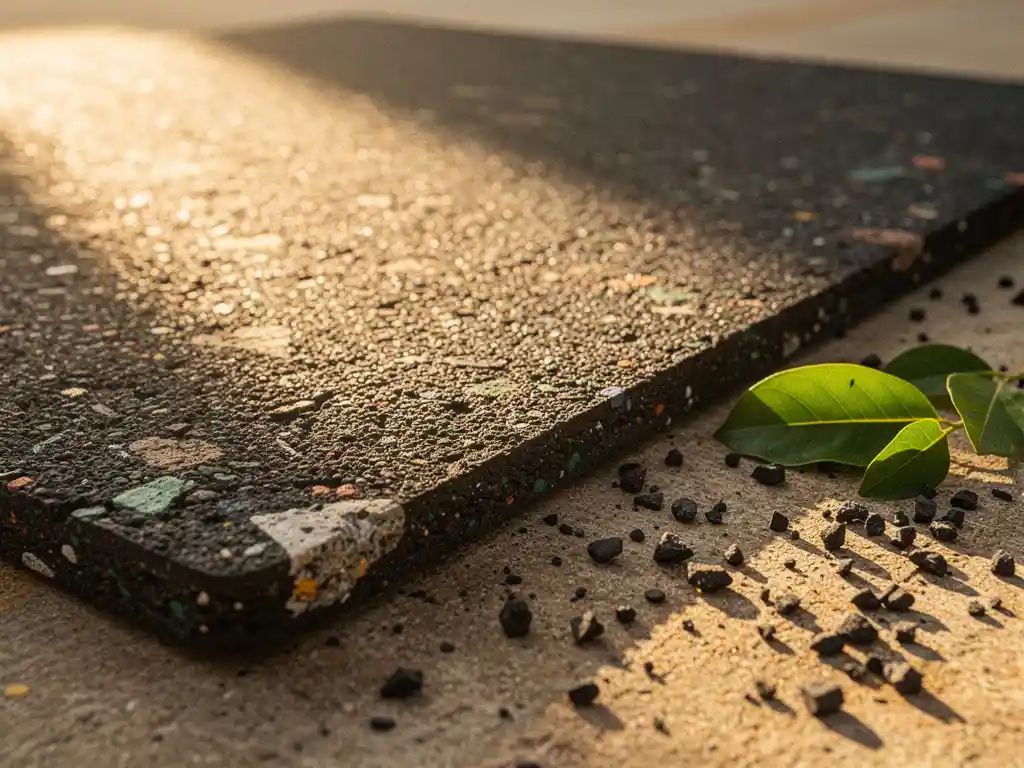
Recycled rubber flooring is a strong example. Old tires and industrial rubber waste are among the most problematic materials in the waste stream, and reprocessing them into durable flooring gives them a second life instead of sending them to a landfill or incineration. This is the foundation of what is sometimes called circular rubber flooring, where materials cycle back into useful products rather than being discarded.
That said, recycled content alone does not tell the whole story. You also want to know how the recycled material is processed, whether any harmful additives are introduced during manufacturing, and whether the finished product can itself be recycled at the end of its life.
What certifications should you look for in sustainable flooring?
When evaluating sustainable flooring, look for certifications that verify environmental claims independently rather than relying on manufacturer self-reporting. The most relevant ones cover emissions, recycled content, and overall environmental performance.
- FloorScore or GREENGUARD: These certify that a product meets indoor air quality standards by limiting volatile organic compound (VOC) emissions, which affect the health of people using the space.
- Cradle to Cradle: This certification evaluates a product across five categories, including material health, recyclability, and renewable energy use in production.
- Environmental Product Declarations (EPDs): EPDs are standardized documents that report a product’s environmental impact data based on a lifecycle assessment. They are not a pass or fail certification, but they give you transparent, comparable data.
- SCS Recycled Content Certification: This verifies the percentage of recycled material in a product, which is useful when comparing recycled rubber or other recycled materials.
Not every good sustainable product carries every certification, and not every certified product is automatically the right choice for your application. Use certifications as one input in your evaluation, not the only one.
How does flooring durability factor into its environmental impact?
Flooring durability is one of the most important factors in environmental impact because a longer-lasting floor means fewer replacements, less material waste, and lower lifecycle costs over time. A product that lasts twenty years instead of five effectively reduces its impact per year of use, even if its upfront production footprint is similar.
This is where lifecycle costing becomes a practical tool. Instead of comparing the purchase price of two flooring options, lifecycle costing accounts for installation, maintenance, replacement frequency, and disposal over the full period of use. A more durable floor often wins this comparison even when it costs more upfront.
Durability also reduces the need for chemical-heavy cleaning products and intensive maintenance routines. Flooring that is non-porous, resistant to moisture, and able to handle heavy loads without cracking or degrading requires less intervention over time, which further reduces its environmental footprint.
What’s the difference between natural rubber and synthetic rubber flooring?
Natural rubber comes from the sap of rubber trees and is a renewable biological material, while synthetic rubber is derived from petroleum-based chemicals. Both can be used in flooring, but they have different environmental profiles and performance characteristics.
Natural rubber
Natural rubber is biodegradable and comes from a renewable source, which gives it a lower carbon footprint in terms of raw material extraction. However, rubber tree cultivation can raise concerns around land use and deforestation if not managed responsibly. Look for sourcing from certified sustainable plantations if this matters to you.
Synthetic rubber
Synthetic rubber is made from fossil fuels, which gives it a higher carbon footprint at the production stage. However, when synthetic rubber is sourced from recycled materials, such as reclaimed tires, the calculation changes significantly. Reprocessed synthetic rubber avoids the extraction of new petroleum and diverts waste from landfills, making it a competitive sustainable materials option when recycled content is high.
In practice, many high-performance rubber floors use a blend of both, or are made entirely from reprocessed rubber. The key question is not simply natural versus synthetic, but how the material was sourced and processed.
Which flooring types have the lowest environmental footprint?
Flooring types with the lowest environmental footprint are generally those made from recycled or rapidly renewable materials, produced with low emissions, and designed to last a long time. No single material tops every category, but a few consistently perform well across most sustainability measures.
- Recycled rubber flooring: Made from reprocessed waste rubber, it diverts material from landfill, requires no virgin raw material extraction, and is highly durable. It is a strong circular rubber flooring option for commercial and industrial applications.
- Cork: Harvested from the bark of cork oak trees without cutting them down, cork is renewable and biodegradable. It performs well in low-to-medium traffic environments.
- Linoleum: Made from linseed oil, cork dust, and wood flour, linoleum is a natural, biodegradable material with a long track record. It is different from vinyl, which is petroleum-based.
- Reclaimed wood: Using salvaged timber avoids new logging and gives existing wood a second use, though sourcing and transportation distances affect the overall footprint.
For heavy-use environments, recycled rubber and linoleum tend to be the most practical sustainable options because they combine durability with a lower environmental profile.
How do you verify a manufacturer’s environmental claims?
To verify a manufacturer’s environmental claims, ask for third-party documentation rather than accepting marketing language at face value. Terms like “eco-friendly,” “green,” or “sustainable” have no regulated definition in the flooring industry, so they can be applied loosely without meaningful accountability.
Here is a practical checklist for verification:
- Request an Environmental Product Declaration (EPD). An EPD is based on a lifecycle assessment conducted by an independent body. It gives you actual data on carbon footprint, energy use, and other impact categories.
- Ask for recycled content certification. If a manufacturer claims a specific percentage of recycled material, that claim should be backed by a third-party audit or certification such as SCS Recycled Content.
- Check indoor air quality certifications. GREENGUARD or FloorScore certification confirms that the product has been tested for VOC emissions by an independent lab.
- Ask about manufacturing practices. Where is the product made? What energy sources power the facility? Does the manufacturer have any environmental management certifications such as ISO 14001?
- Look at the end-of-life story. Can the product be recycled at the end of its life? Does the manufacturer have a take-back program?
At LRP Matting, all our rubber mats are made from 100% recycled materials, and our products are built to last, which means fewer replacements and less waste over time. If you want to see how industrial rubber flooring fits into a sustainable flooring strategy for your facility, we are happy to walk you through the specifics.
Frequently Asked Questions
How do I get started choosing sustainable flooring for a commercial or industrial facility?
Start by defining your performance requirements first — traffic volume, load-bearing needs, moisture exposure, and maintenance capacity — then filter sustainable options against those criteria. From there, request EPDs and recycled content certifications from shortlisted manufacturers so you are comparing verified data rather than marketing claims. This approach ensures you choose a floor that is both environmentally responsible and fit for purpose, rather than sacrificing one for the other.
Can sustainable flooring options handle heavy industrial use without compromising on performance?
Yes, and recycled rubber flooring is the clearest example — it is specifically engineered for high-load, high-traffic environments and is used widely in warehouses, manufacturing floors, and gyms. The misconception that eco-friendly materials are fragile or best suited to light residential use does not hold up in practice. When you prioritize durability as part of your sustainability evaluation, you will find that the most environmentally sound options for industrial settings are also among the most resilient.
What are the most common greenwashing red flags to watch out for when buying flooring?
The biggest red flags are vague, unverified claims such as ‘eco-friendly,’ ‘natural,’ or ‘green’ with no supporting third-party certification or documentation. Be cautious when a manufacturer highlights a single green attribute — such as one recycled ingredient — while the rest of the product’s lifecycle is unaddressed. If a supplier cannot provide an EPD, a recycled content certification, or an indoor air quality certification when asked, treat their environmental claims with skepticism.
Does sustainable flooring typically cost more upfront, and is it worth it?
Sustainable flooring can carry a higher upfront cost in some categories, but lifecycle costing almost always closes or reverses that gap. A durable recycled rubber floor that lasts 20–30 years with minimal maintenance will cost significantly less per year of use than a cheaper alternative replaced every five to seven years. When you factor in reduced disposal costs, lower maintenance inputs, and avoided replacement labor, the long-term financial case for higher-quality sustainable flooring is strong.
What happens to recycled rubber flooring at the end of its life — does it just end up in a landfill anyway?
Not necessarily, and this is an important question to ask before purchasing. Many recycled rubber flooring products can be reprocessed again at the end of their service life, continuing the circular loop rather than ending it. Some manufacturers, including those operating genuine circular rubber flooring programs, offer take-back or recycling schemes. Before committing to a product, ask the manufacturer directly whether an end-of-life recycling pathway exists for their specific product.
How do VOC emissions from flooring affect indoor air quality, and how long do they last?
VOC emissions from flooring — and from adhesives used during installation — can off-gas into the indoor environment for weeks or months after installation, affecting air quality and potentially causing health issues in sensitive occupants. Products certified by GREENGUARD Gold or FloorScore have been independently tested to confirm emissions fall within safe limits. To minimize exposure, also check the VOC content of any adhesives, underlays, or sealants used alongside the floor, since these can contribute as much as or more than the flooring material itself.
Is cork or linoleum a practical alternative to rubber flooring for commercial spaces?
Cork and linoleum are excellent sustainable choices for light-to-medium commercial environments such as offices, retail spaces, and healthcare settings, where their natural composition and biodegradability are strong advantages. However, in heavy-duty commercial or industrial settings with high foot traffic, rolling loads, or exposure to moisture and chemicals, recycled rubber flooring generally outperforms both in durability and resilience. The right choice depends on matching the material’s performance profile to the specific demands of the space.
Related Articles
- What should be included in a sports surface safety inspection?
- How do weather conditions affect outdoor sports surfaces?
- Why do wet floors become dangerous?
- What is the best flooring for a horse wash rack?
- How often should you replace horse stall bedding?
- How do you set up a new horse stall from scratch?
- How do you make a workshop floor more comfortable to work on?
- What is the most durable flooring for a professional athletic facility?
- What is the fastest way to muck out a horse stall?
- How do you stop horse stall mats from shifting?