
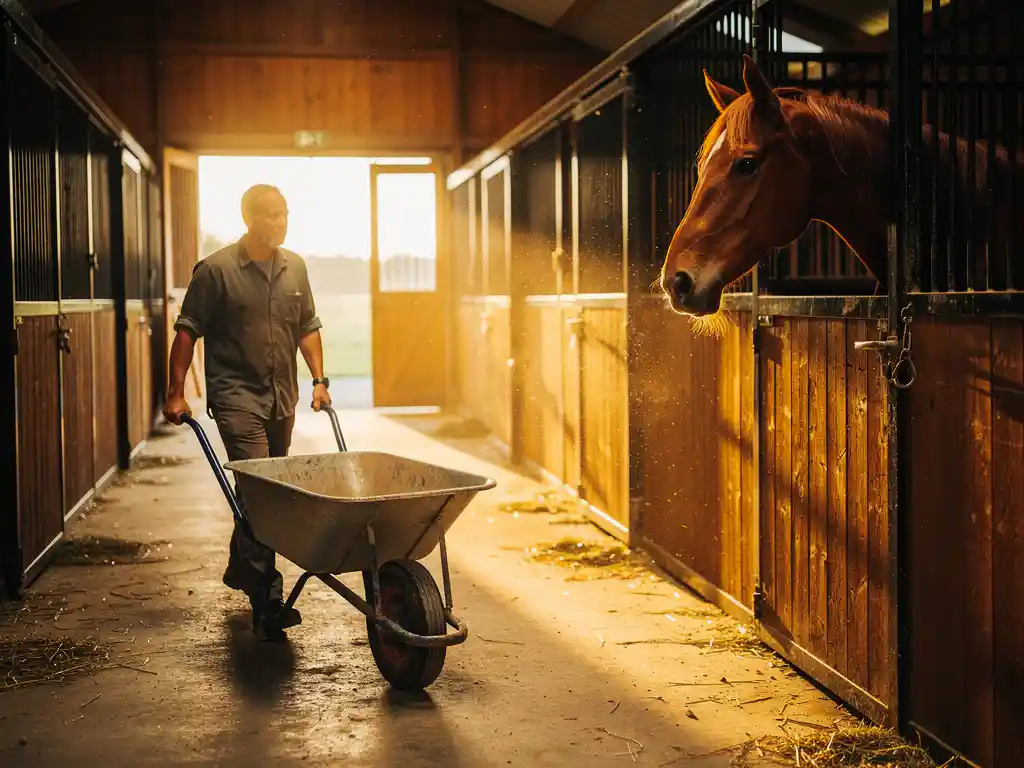
Large equestrian facilities keep stall maintenance costs down by reducing bedding use, choosing low-maintenance flooring, and investing in durable rubber matting that protects barn surfaces and improves horse comfort. The single most impactful change most facilities make is switching to high-quality rubber stall mats, which can significantly reduce how much bedding you need per stall. Combined with smart daily routines and the right flooring setup, you can lower both labor and material costs without compromising horse welfare.
Why do horse stall maintenance costs add up so quickly?
Horse stall maintenance costs rise quickly because bedding, labor, and flooring repairs are recurring expenses that compound over time. A single stall can consume a surprising amount of shavings or straw each week, and when you multiply that across dozens of stalls, the numbers become significant. Add in the time staff spend mucking out, replacing worn flooring, and managing waste disposal, and you have a cost structure that never really stops.
Bare concrete or dirt floors are major hidden cost drivers. Concrete is hard on hooves and joints, which means horses shift around more, churn through bedding faster, and are more prone to injuries that lead to vet bills. Dirt floors absorb urine and harbor bacteria, requiring more frequent deep cleaning and eventual replacement. Flooring that is difficult to sanitize also means higher spending on disinfectants and more labor hours per stall. The floor beneath your horse is not a one-time expense—it shapes every maintenance decision you make afterward.
What flooring options are available for horse stalls?
The main horse stall flooring options are bare concrete, compacted dirt or clay, poured rubber, interlocking rubber tiles, and large rubber stall mats. Each comes with a different cost profile, installation complexity, and maintenance demands. Rubber matting is widely regarded as the most practical long-term option for facilities that want to balance upfront investment with ongoing savings.
Concrete and dirt floors
Concrete is durable and easy to clean, but it is hard, cold, and slippery—which is rough on horses that spend long hours standing. Dirt and clay floors offer more natural cushioning, but they absorb moisture and urine, create uneven surfaces over time, and are genuinely difficult to keep hygienic. Both options typically require heavy bedding to compensate for their shortcomings, which drives up material costs.
Rubber flooring solutions
Rubber stall mats sit on top of existing surfaces, which means you do not need to tear out and replace your current floor to get the benefits. They provide cushioning, insulation, and grip, all of which directly reduce the amount of bedding needed to keep a horse comfortable. For larger facilities, large-format mats that cover more area with fewer seams make installation faster and cleaning easier. Interlocking designs are also available for stalls with nonstandard dimensions.
How does rubber matting reduce horse stall maintenance costs?
Rubber matting reduces horse stall maintenance costs primarily by cutting bedding consumption, protecting the underlying floor, and making daily cleaning faster. When a horse stands and lies on a cushioned, non-slip rubber surface, it needs far less bedding underneath to stay comfortable. Facilities that switch to rubber mats consistently report using noticeably less shavings or straw per stall, and those savings accumulate quickly across a large barn.
Beyond bedding, rubber mats act as a protective layer between the horse and the barn floor. Urine and moisture sit on the mat surface rather than soaking into concrete or dirt, which means less structural damage to the floor over time and fewer costly repairs. Because genuine rubber is nonporous, it does not absorb liquids, and it cleans up easily with mild detergent and water. That makes daily mucking faster and reduces the labor hours your team spends on each stall.
Rubber mats also provide thermal insulation, keeping the stall floor warmer in cold months. A warmer surface means horses are less likely to huddle in corners seeking warmth, and they tend to lie down more willingly, which supports rest and reduces stress-related behaviors that damage stall walls and fittings. Fewer repairs to walls, kickboards, and fittings are another line item that quietly disappears from your maintenance budget.
What should large equestrian facilities look for in stall mats?
Large equestrian facilities should prioritize mat size, material durability, surface texture, and ease of cleaning when choosing stall mats. For a high-volume barn, the logistics of installation and long-term maintenance matter just as much as the product specifications. Getting these details right upfront saves time and money for years to come.
- Mat size: Larger mats mean fewer seams in each stall. Fewer seams mean less opportunity for urine and debris to collect in gaps, and less time spent lifting and cleaning individual pieces. For facilities managing many stalls, this is a meaningful time-saver.
- Material quality: Look for mats made from genuine rubber rather than synthetic alternatives. Genuine rubber holds up under repeated impact, does not crack or crumble in extreme temperatures, and maintains its surface integrity over years of heavy use.
- Surface texture: A textured or studded surface provides grip for horses when they shift their weight or stand up, reducing slips and the injuries that come with them.
- Thickness: Thicker mats offer more cushioning and insulation. A mat in the range of 3/4 inch is a common choice for stall applications where comfort and durability are both priorities.
- Customization options: Stalls are rarely all the same size, especially in older barns. Mats that can be cut to fit or ordered in custom dimensions give you a cleaner, tighter installation without gaps.
For facilities where standard sizes do not quite work, made-to-measure options are worth exploring. A mat cut precisely to your stall dimensions eliminates awkward gaps and reduces the need for additional bedding to fill uneven edges.
How does stall flooring affect horse health and welfare?
Stall flooring directly affects a horse’s joint health, hoof condition, stress levels, and willingness to lie down. Hard or slippery floors put constant strain on legs and hooves, contribute to conditions like bruised soles and joint soreness, and make horses reluctant to rest properly. A horse that does not lie down enough is a horse under chronic stress, which affects both its health and its performance.
Cushioned rubber flooring encourages horses to lie down more readily because the surface feels safe and comfortable. More rest means better recovery, less stress, and reduced risk of fatigue-related injuries. For performance horses or breeding stock, this is not a small thing—it has a real impact on their condition and value over time.
Hygiene is another dimension of welfare that flooring influences. Nonporous rubber does not harbor bacteria the way dirt or porous materials do. A cleaner stall environment reduces the risk of respiratory issues from ammonia buildup and lowers the chance of hoof problems like thrush, which thrive in wet, contaminated bedding. Keeping the stall floor clean is genuinely easier when the surface does not absorb what lands on it.
What other strategies help lower stall upkeep costs at scale?
Beyond flooring, large equestrian facilities can reduce stall upkeep costs by optimizing turnout schedules, standardizing mucking routines, choosing the right bedding type, and protecting stall walls from kick damage. These strategies work best when combined with a good flooring setup, because the floor is the foundation that makes everything else more or less efficient.
Maximize turnout time
Every hour a horse spends outside is an hour it is not adding to the bedding and waste load inside its stall. Structured turnout schedules that keep horses out as long as safely possible reduce the daily volume of mucking and the rate at which bedding breaks down. This is one of the simplest cost-reduction levers available to any facility manager.
Choose bedding strategically
Not all bedding is equal in terms of absorbency, dust levels, or cost per unit of performance. Pelleted bedding, for example, is highly absorbent and often allows for spot cleaning rather than full stall strip-outs, which saves both material and labor. When paired with rubber mats that keep the base layer drier, you can often use less bedding overall and extend the time between full changes.
Protect stall walls and fittings
Kick damage to stall walls and fittings is a recurring repair cost that many facilities underestimate. Rubber wall panels or kickboards absorb impact and prevent the structural damage that comes from horses striking wood or concrete. Protecting these surfaces upfront is almost always cheaper than repairing them repeatedly.
Standardize your cleaning process
In a large facility, inconsistent mucking practices lead to inconsistent results and inconsistent costs. Training staff to follow a consistent routine—removing waste efficiently, checking mat condition, and topping up bedding to a standard depth—reduces waste and keeps labor hours predictable. Small inefficiencies in a single stall become large inefficiencies across fifty.
If you are looking for matting solutions that support all of these strategies, we at LRP Matting offer a full range of horse stall mats made from genuine rubber and our proprietary Fiber-Reinforced Rubber Compound (FRC®). From standard stall mats to custom rubber matting solutions cut precisely to your barn’s dimensions, we have options to fit facilities of every size and budget. Reach out to us, and we will help you find the right fit for your operation.
Frequently Asked Questions
How long do rubber stall mats typically last, and is the upfront cost worth it for smaller facilities?
High-quality rubber stall mats made from genuine rubber can last 10–20 years with proper care, making the upfront investment highly cost-effective even for smaller operations. When you factor in the cumulative savings on bedding, reduced labor hours, and fewer floor repairs over that lifespan, most facilities recoup the initial cost within one to three years. Smaller barns with just a handful of stalls can still see meaningful savings—the math scales down, but the principle holds.
What is the best way to clean and maintain rubber stall mats to extend their lifespan?
For daily maintenance, remove manure and soiled bedding promptly, then rinse the mat surface with water and scrub with a mild detergent as needed—avoid harsh solvents or bleach-based cleaners, which can degrade rubber over time. Periodically lift the mats entirely to clean the floor underneath and allow both surfaces to dry, which prevents moisture buildup and odor. Inspecting mats regularly for curling edges or surface cracking helps you catch wear early and keep the installation tight and hygienic.
Can rubber stall mats be installed over existing concrete or dirt floors without professional help?
Yes, most rubber stall mats are designed for straightforward installation directly over existing surfaces without specialized tools or contractors. The key preparation step is ensuring the base floor is as level and clean as possible before laying the mats—uneven spots underneath will cause mats to rock or shift over time. For large facilities covering many stalls, having a consistent installation process and a mat cutter on hand for trimming will make the job faster and produce a cleaner fit.
How much bedding can a facility realistically expect to save after switching to rubber stall mats?
While exact savings vary depending on the horse, stall size, and bedding type, many facilities report reductions of 30–50% in bedding use per stall after installing quality rubber mats. The cushioning and insulation provided by the mats means horses require less material beneath them to stay comfortable, and the non-absorbent surface keeps the base layer drier for longer. When multiplied across a large barn over a full year, those per-stall savings can translate into thousands of dollars in reduced bedding costs.
What are the most common mistakes facilities make when choosing or installing stall mats?
The most frequent mistakes are choosing mats that are too thin, opting for synthetic rubber alternatives to save money upfront, and leaving gaps between mats or between mats and stall walls. Thin mats compress quickly under a horse’s weight and lose their cushioning benefit, while synthetic materials tend to crack or degrade faster under heavy use and temperature swings. Gaps are a hygiene problem—urine and debris collect in them, creating odor, bacteria, and extra cleaning work that offsets the efficiency gains you installed the mats to achieve.
Are there specific stall mat recommendations for horses that are prone to slipping or have joint issues?
For horses with joint concerns or a history of slipping, prioritize mats with a pronounced textured or studded surface finish, which provides significantly better grip than smooth rubber—especially when wet. Thicker mats in the 3/4-inch range or above offer more meaningful cushioning for horses with arthritis, navicular issues, or post-surgery recovery needs. If a horse has specific veterinary requirements, it is worth consulting your vet alongside your matting supplier to ensure the surface texture, thickness, and firmness are appropriate for that animal’s condition.
How do you handle stall mats in non-standard or irregularly shaped stalls common in older barns?
Irregularly shaped stalls are best handled with mats that can be cut on-site or ordered in custom dimensions—this eliminates the gaps and awkward overlaps that occur when you try to make standard-size mats fit non-standard spaces. Many suppliers, including those offering made-to-measure options, can produce mats cut precisely to your stall’s floor plan, which results in a tighter, cleaner installation with no exposed floor edges. For on-site cutting, a sharp utility knife or mat cutter is typically sufficient for rubber mats up to 3/4 inch thick.
Related Articles
- How do different facility environments affect floor performance?
- How do professional equine facilities improve horse welfare?
- What makes a veterinary facility safer?
- What causes sports facility floors to wear out?
- What are the warning signs of floor deterioration?
- How does stall flooring affect a horse's overall well-being?
- What causes back pain in workers who stand on hard floors all day?
- What floor protection is needed for indoor crane operations?
- How do you maintain rubber flooring in a high-traffic sports venue?
- How do you stop horse stall mats from shifting?