

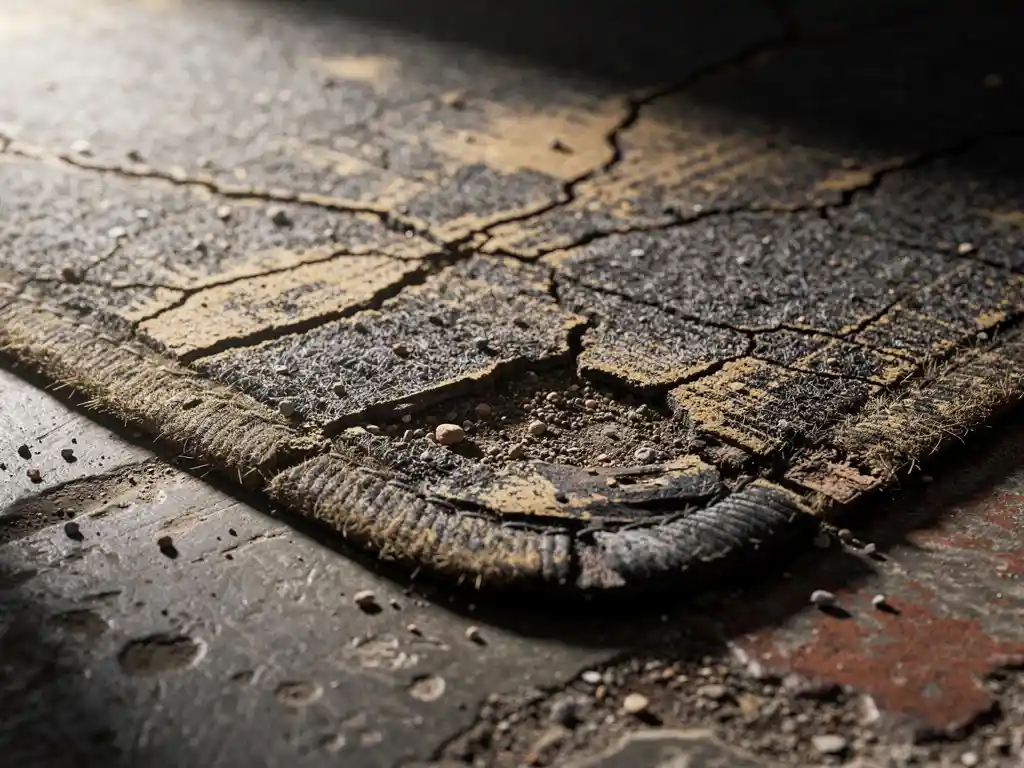
Commercial flooring wears out faster when it faces heavy foot traffic, moisture exposure, poor installation, and inconsistent maintenance. These four factors account for the majority of premature floor failures across industries. The type of flooring material also plays a big role, since not every product is built to handle the same loads or conditions. Below, we answer the most common questions about what actually shortens the life of commercial floors and what you can do about it.
What types of damage wear down commercial flooring fastest?
The fastest sources of floor wear in commercial settings are abrasion from heavy foot traffic, impact from dropped equipment or materials, and chemical exposure from cleaning agents or industrial fluids. These forms of damage strip away surface coatings, create micro-cracks, and gradually break down the structural integrity of the flooring material beneath.
Abrasion is the most common culprit. In high-traffic corridors, entryways, and production floors, the constant friction from shoes, boots, wheels, and machinery grinds down even hard flooring surfaces over time. The damage is often gradual and invisible until the floor has already lost a significant portion of its protective layer.
Impact damage tends to be more sudden. Heavy objects dropped on hard flooring like concrete, tile, or vinyl can cause immediate cracking or chipping. Over time, even smaller repeated impacts from equipment wheels or pallet jacks create surface fatigue that accelerates general floor wear.
Chemical damage is often underestimated. Harsh cleaning chemicals, oils, lubricants, and industrial solvents can degrade adhesives, sealers, and the flooring material itself. Once the surface is compromised, moisture and dirt penetrate more easily, speeding up the deterioration process significantly.
How does moisture shorten the life of commercial floors?
Moisture shortens the life of commercial floors by weakening adhesive bonds, promoting mold and mildew growth, and causing materials like wood, laminate, and certain composites to swell, warp, or delaminate. Even concrete, which is often seen as moisture-resistant, can suffer from water infiltration that leads to surface spalling and structural weakening over time.
In commercial environments, moisture enters floors through several paths: spills, cleaning water that is not properly dried, condensation from temperature changes, and subfloor moisture vapor. When moisture gets beneath the flooring surface, it creates a trapped environment where damage compounds quickly and invisibly.
For facilities like commercial kitchens, food processing areas, locker rooms, or agricultural spaces, moisture management is a daily challenge. Flooring in these areas needs to be non-porous and resistant to water absorption. Materials that absorb moisture will degrade faster, require more frequent replacement, and can become hygiene hazards as bacteria and mold take hold.
Does poor installation cause commercial flooring to fail early?
Yes, poor installation is one of the leading causes of premature commercial flooring failure. Incorrect subfloor preparation, insufficient adhesive coverage, improper seam placement, and failure to account for expansion gaps can all cause flooring to lift, buckle, crack, or separate long before the end of its expected service life.
Subfloor preparation is where many installations go wrong. If the subfloor is uneven, damp, or contaminated with dust and debris, the flooring material will not bond properly. Even a small amount of residual moisture in a concrete subfloor can cause adhesive failure weeks or months after installation, resulting in bubbling or lifting sections.
Seam placement matters more than most people realize. Poorly placed seams in high-traffic areas create weak points that open up under repeated stress. Flooring with fewer seams, or with seams positioned away from the main traffic flow, holds up significantly longer. This is one reason why larger-format flooring materials tend to perform better in demanding commercial spaces.
What cleaning and maintenance mistakes damage commercial flooring?
The most damaging cleaning and maintenance mistakes include using the wrong cleaning products, over-wetting the floor surface, skipping regular dry cleaning before wet mopping, and neglecting to reapply protective coatings on schedule. Each of these mistakes accelerates surface degradation and can void manufacturer warranties.
Harsh or acidic cleaning chemicals are a frequent problem. Products designed for one type of flooring can strip the finish or damage the surface of another. Using bleach-based or solvent-based cleaners on vinyl, for example, can cause discoloration and surface breakdown over time. Always matching the cleaning product to the specific flooring type protects both the surface and its lifespan.
Over-wetting is particularly destructive. Flooding a floor with water during mopping allows liquid to seep into seams, edges, and any micro-cracks in the surface. For materials that are not fully waterproof, this repeated exposure leads to swelling, softening, and adhesive failure. Using a damp mop rather than a soaking wet one, and drying the floor promptly, makes a real difference in long-term floor durability.
Skipping protective coating maintenance is another common oversight. Many commercial floors rely on sealers or wax layers to protect the underlying material. When these coatings wear thin and are not reapplied, the base material is exposed directly to traffic, chemicals, and moisture, accelerating wear considerably.
Which commercial environments are hardest on flooring materials?
The commercial environments hardest on flooring are heavy manufacturing facilities, food processing plants, commercial kitchens, agricultural operations, and high-traffic retail or logistics spaces. These settings combine multiple stress factors simultaneously, including heavy loads, moisture, chemicals, and continuous foot or vehicle traffic, which together accelerate floor wear far faster than any single factor alone.
In manufacturing and industrial settings, the combination of heavy machinery, metal shavings, oils, and constant movement of equipment puts extreme pressure on floors. Concrete floors in these environments often need surface protection to prevent deterioration, and even reinforced flooring materials can show significant wear within a few years without proper protection in place.
Agricultural environments present a different but equally demanding challenge. Livestock facilities deal with constant moisture, animal waste, and the weight of large animals moving across the floor daily. Standard flooring materials deteriorate quickly under these conditions, which is why specialized solutions designed for these environments are necessary rather than optional.
Commercial kitchens and food processing areas combine heat, moisture, grease, and chemical cleaning agents in a way that is particularly aggressive toward flooring surfaces. Floor durability in these spaces depends heavily on choosing materials that can resist all of these factors at once, not just one or two.
What flooring materials last longest under heavy commercial use?
The flooring materials that last longest under heavy commercial use are reinforced rubber, polished or sealed concrete, and epoxy-coated concrete. Each offers a different balance of durability, maintenance requirements, and surface performance, but all are capable of handling the sustained stress of demanding commercial environments when properly installed and maintained.
Sealed or polished concrete is a popular choice for industrial and warehouse settings because it is extremely hard, resistant to heavy loads, and relatively easy to maintain. However, bare concrete without a protective coating is porous and vulnerable to moisture and chemical damage, so surface treatment is important for long-term performance.
Epoxy coatings applied over concrete provide a seamless, non-porous surface that resists chemicals, moisture, and abrasion. The main limitation is that epoxy can be slippery when wet and may chip or peel under severe impact if the coating is not thick enough or the subfloor was not properly prepared.
Rubber flooring, particularly fiber-reinforced rubber, offers a strong combination of durability, slip resistance, and comfort. It handles impact well, does not absorb moisture, and maintains its structural integrity under both heavy loads and temperature extremes. For environments where worker safety and floor protection need to work together, rubber is often the most practical choice.
How can you tell when commercial flooring needs replacing?
Commercial flooring needs replacing when it shows visible structural damage such as cracking, deep gouging, or delamination; when it can no longer be cleaned effectively; when it creates slip or trip hazards; or when the cost of ongoing repairs exceeds the cost of replacement. Surface wear alone does not always mean replacement is needed, but safety and hygiene failures usually do.
Visible cracks and lifting edges are the clearest signs. Once flooring begins to separate from the subfloor or develop cracks that cannot be sealed, it will continue to deteriorate faster. Water and debris collect in these gaps, accelerating damage and creating hygiene issues that are difficult to resolve without full replacement.
Persistent staining or odor that does not respond to cleaning is another reliable indicator. When a floor has absorbed contaminants into its structure, surface cleaning no longer reaches the source of the problem. This is particularly relevant in food service, healthcare, and agricultural settings where hygiene standards are non-negotiable.
Slip hazards are a safety-driven reason to replace flooring immediately. A surface that has become too smooth from wear, or that has developed uneven areas from swelling or cracking, puts people at risk. No amount of maintenance can restore adequate slip resistance to a floor that has worn past its safe service limit.
If you are evaluating your current floor situation and looking for a durable, long-lasting solution that handles heavy use without frequent replacement, we at LRP Matting offer rubber matting products built specifically for demanding commercial and industrial environments. Our mats are made from 100% recycled rubber and many feature our proprietary FRC® fiber-reinforced compound for extra strength. Explore our industrial matting solutions to find the right fit for your space.
Frequently Asked Questions
How often should commercial flooring be professionally inspected to catch problems early?
Most commercial flooring experts recommend a formal inspection at least once or twice a year, depending on the intensity of use. High-traffic or high-moisture environments like kitchens, manufacturing floors, and agricultural facilities may benefit from quarterly walk-throughs. During inspections, look specifically for edge lifting, surface coating wear, seam separation, and any soft or uneven spots that indicate subfloor moisture issues — catching these early can prevent a minor repair from turning into a full replacement.
Can damaged commercial flooring be repaired, or does it always need to be fully replaced?
In many cases, localized damage such as small cracks, surface chips, or limited delamination can be repaired without replacing the entire floor — especially with materials like epoxy-coated concrete or rubber matting. However, repairs are only cost-effective when the damage is isolated and the surrounding flooring is still structurally sound. If damage is widespread, recurring in the same areas, or involves subfloor moisture contamination, full replacement is typically the more economical long-term decision.
What is the best way to protect commercial flooring in high-traffic entry and transition zones?
Entry and transition zones are among the most vulnerable areas in any commercial facility because they concentrate foot traffic, tracked-in moisture, and abrasive debris in a small area. The most effective strategy is to layer protection: use heavy-duty entrance matting to capture dirt and moisture at the door, install transition strips to prevent edge lifting between flooring types, and schedule more frequent cleaning and coating maintenance in these zones specifically. Rubber matting is particularly effective in these areas because it absorbs impact, resists moisture, and is easy to replace independently of the main floor.
Does the type of footwear or equipment used in a facility really make a difference in how fast floors wear?
Yes, significantly. Hard-soled shoes, steel-toed boots, and cleated footwear create much higher surface abrasion than soft-soled alternatives, and metal or hard plastic wheels on carts and pallet jacks cause considerably more surface damage than polyurethane-wheeled equipment. Facilities that switch to softer wheel materials on internal equipment often see a measurable reduction in floor wear over time. Where footwear cannot be controlled — such as in public-facing retail or logistics environments — investing in more abrasion-resistant flooring or protective surface coatings becomes even more important.
How do temperature and humidity fluctuations affect commercial flooring longevity?
Repeated temperature and humidity swings cause flooring materials to expand and contract, which over time weakens adhesive bonds, opens up seams, and causes surface buckling — particularly in materials like vinyl, wood, and laminate. Facilities without climate control, such as warehouses, agricultural buildings, or outdoor-adjacent spaces, are especially vulnerable to this type of damage. Choosing dimensionally stable materials like rubber or properly sealed concrete, and ensuring adequate expansion gaps are built in during installation, significantly reduces the impact of thermal and humidity cycling on floor lifespan.
Are there flooring solutions that work across multiple challenging conditions at once, rather than being optimized for just one?
Yes, and this is an important consideration for facilities that face several stress factors simultaneously — such as moisture, heavy loads, chemicals, and constant traffic all at once. Fiber-reinforced rubber flooring and high-build epoxy systems are among the few material categories designed to handle this combination without significant trade-offs. Rubber in particular offers impact resistance, moisture impermeability, chemical tolerance, and slip resistance in a single product, making it a practical choice for environments like commercial kitchens, agricultural facilities, and industrial production floors where no single-purpose material would hold up adequately.
What should be included in a commercial flooring maintenance schedule to maximize service life?
A well-structured maintenance schedule should include daily dry sweeping or dust mopping to remove abrasive debris before it grinds into the surface, regular damp mopping with a pH-neutral cleaner appropriate for the specific flooring type, and periodic reapplication of surface sealers or protective coatings according to the manufacturer’s recommended timeline. In addition, scheduling prompt spot repairs for any chips, cracks, or lifting edges — rather than waiting for the next scheduled maintenance cycle — prevents localized damage from spreading. Documenting maintenance activities also helps identify patterns, such as areas that wear faster than expected, which can inform future flooring or layout decisions.
Related Articles
- How do you evaluate environmentally friendly flooring?
- How do durable materials reduce waste?
- How do you identify floor safety hazards?
- What is the best flooring for a horse stall?
- What is the best way to protect a sports facility floor from heavy equipment?
- What type of matting is best for a wet industrial work environment?
- What type of flooring holds up best in a high-traffic athletic venue?
- What is the best way to protect a warehouse floor during construction?
- How do you choose the right floor protection for a construction site?
- How do you stop horse stall mats from shifting?