
For wet industrial environments, rubber drainage mats with anti-slip surfaces are the best choice. They channel water away from the surface, reduce the risk of slips and falls, resist moisture damage, and hold up under heavy foot traffic and equipment. For areas where workers stand for long periods, look for rubber mats that combine drainage with anti-fatigue properties. Read on for a full breakdown of what to look for and why it matters.
What makes a wet industrial environment hazardous for flooring?
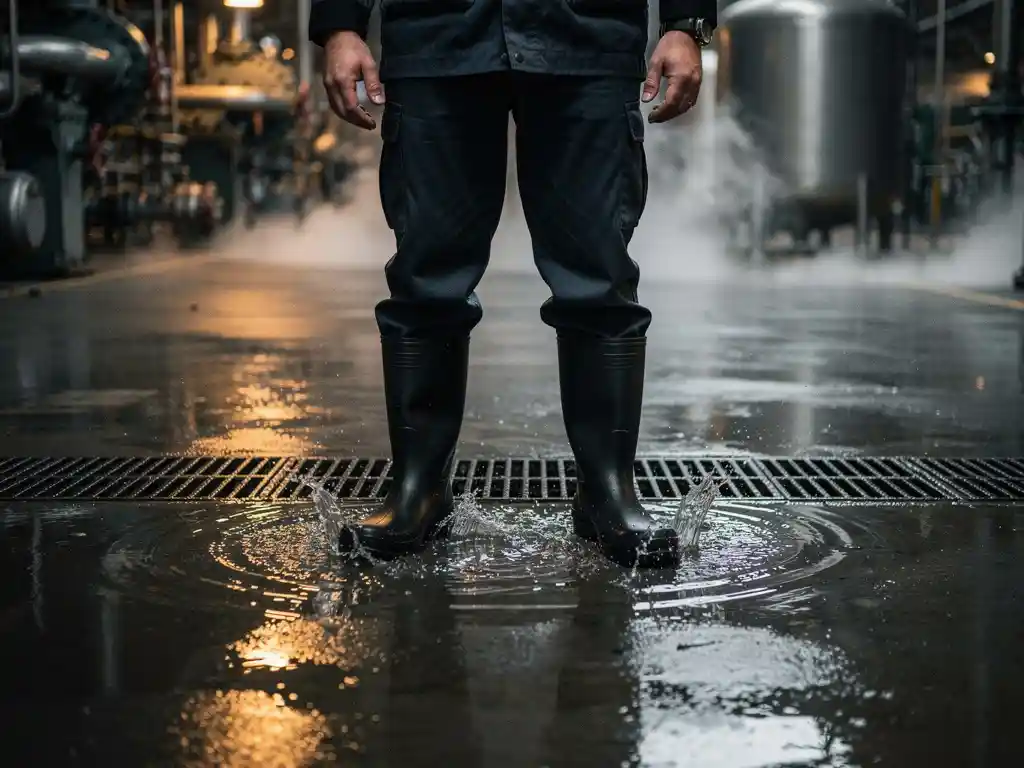
Wet industrial environments are hazardous because standing water, oil, and chemical spills create slippery surfaces that significantly increase the risk of slip-and-fall accidents. Add heavy machinery, constant foot traffic, and workers who need to stay focused on their tasks rather than watching every step, and you have a recipe for serious workplace injuries. Choosing the right flooring is one of the most practical ways to address this risk directly.
Beyond the immediate slip hazard, moisture causes long-term damage to many flooring materials. Concrete absorbs water over time, which leads to cracking and surface degradation. Foam- or carpet-based mats trap moisture, become breeding grounds for bacteria and mold, and break down quickly under industrial conditions. These maintenance headaches add up in both cost and downtime. Flooring in a wet industrial area needs to handle moisture without absorbing it, resist chemical exposure, and remain structurally sound under heavy use.
Worker fatigue is another factor that often gets overlooked. When employees stand on hard, wet surfaces for hours at a time, fatigue sets in faster, reaction times slow, and the chance of an accident increases. That is why flooring in wet industrial areas needs to do more than drain water: it needs to actively support the people working on it.
What types of matting work best in wet industrial areas?
The matting types that work best in wet industrial areas are rubber drainage mats, anti-fatigue mats with drainage holes, and ring mats. Each is designed to let water pass through or channel it away from the surface, keeping the floor underfoot dry and safe. The best choice depends on the specific conditions of your workspace, including the type of liquid present, the level of foot traffic, and whether workers are stationary or moving.
Drainage mats
Drainage mats are designed with open patterns, holes, or elevated structures that allow water and other liquids to flow away from the walking surface. This keeps the top of the mat dry even when the floor beneath is wet. They are a practical first line of defense in areas like wash bays, food-processing floors, and any zone where water is regularly present.
Anti-fatigue mats with drainage
For workstations where employees stand in one place for extended periods, anti-fatigue mats with built-in drainage holes are a smart combination. These mats reduce the physical strain of standing on hard surfaces while still managing moisture effectively. A product like the Heavy Duty Ring Mat, for example, features an elevated underside that promotes fluid drainage and airflow, making it useful for both comfort and wet-area safety.
Ring mats
Ring mats are made from interlocking rubber rings that naturally allow water, debris, and liquids to fall through. They are durable, easy to clean, and well suited to high-traffic industrial areas. Our Heavy Duty Ring Mat, available in 39 by 59 inches with a three-quarter-inch thickness, is built specifically for demanding environments where drainage and durability both matter.
What’s the difference between drainage mats and anti-slip mats?
Drainage mats and anti-slip mats serve different primary functions, though many industrial mats combine both. A drainage mat is designed to move liquid away from the walking surface, using holes, channels, or open structures to prevent pooling. An anti-slip mat is designed to provide grip and traction, using textured surfaces or high-friction rubber compounds to prevent slipping. In wet industrial environments, you generally want a mat that does both.
Think of it this way: a drainage mat removes the hazard at its source by eliminating standing water, while an anti-slip mat manages the hazard by improving the grip between your foot and the surface. Neither is fully effective without the other in a genuinely wet environment. A mat that drains well but has a smooth top surface can still be slippery. A textured mat with no drainage will eventually become waterlogged and lose its effectiveness.
When choosing matting for a wet industrial area, look for products that are explicitly designed with both properties. A textured or raised surface pattern on top, combined with drainage holes or an open structure, gives you the best protection. Our General Purpose Mat, for instance, is slip-resistant, oil- and grease-resistant, and easy to clean, making it a practical option for areas that deal with both water and industrial fluids.
Why is rubber the best material for wet industrial matting?
Rubber is the best material for wet industrial matting because it is non-porous, naturally slip-resistant, chemically resistant, and highly durable under heavy use. Unlike foam or vinyl alternatives, rubber does not absorb moisture, which means it will not warp, swell, or harbor bacteria over time. It maintains its structural integrity in extreme temperatures and holds up under the weight of heavy equipment and constant foot traffic.
The non-porous nature of rubber is particularly important in industrial settings. A mat that absorbs water becomes a hygiene problem as well as a safety one. Rubber mats can be cleaned quickly with mild detergent and water, and they will not crack, peel, or crumble even after years of use in demanding conditions. This makes them a genuinely low-maintenance solution compared to alternatives that need frequent replacement.
Rubber also provides natural cushioning, which reduces the physical impact on workers’ joints and muscles during long shifts. This ergonomic benefit is not just about comfort. Fatigue contributes directly to workplace accidents, so a material that reduces fatigue also improves safety. For environments where both wet conditions and prolonged standing are factors, rubber combines all the necessary properties in a single material.
For even greater performance in heavy industrial settings, fiber-reinforced rubber compounds add an additional layer of strength. This type of rubber construction provides structural reinforcement that standard rubber cannot match, making it suitable for the most demanding applications.
How do you choose the right mat thickness and size for your workspace?
Choosing the right mat thickness and size depends on three main factors: the level of foot traffic, whether workers are stationary or moving, and the specific hazards present in the area. As a general guide, higher-traffic areas and heavier loads require thicker mats, while anti-fatigue applications benefit from a thickness of at least half an inch to provide meaningful cushioning.
Thickness guidelines
For light-duty wet areas like labs, kitchens, or workstations, a half-inch mat typically provides adequate drainage and comfort. For heavy industrial environments with machinery, forklifts, or very high foot traffic, a three-quarter-inch thickness or greater offers better durability and longevity. A thicker mat is also more resistant to curling at the edges, which is a practical safety concern in its own right.
Sizing considerations
Size matters more than many people initially think. A mat that is too small leaves workers stepping on and off the edge repeatedly, which creates a trip hazard and accelerates wear along the edges. Ideally, a mat should cover the full working zone, with enough coverage that workers rarely need to step off it during their tasks.
Fewer seams between mats also means fewer places for water, debris, and bacteria to accumulate. Larger mats simplify installation and create a cleaner, more hygienic surface overall. For spaces with unusual dimensions, made-to-measure options mean you are not forced to compromise with a standard size that almost fits. Our custom rubber matting solutions are cut to your exact specifications, which reduces seams, simplifies installation, and gives you a result that actually fits your workspace rather than one that merely approximates it.
What safety standards should industrial wet-area mats meet?
Industrial wet-area mats should meet standards related to slip resistance, load-bearing capacity, chemical resistance, and hygiene. While specific regulatory requirements vary by country and industry, the core performance criteria are consistent: the mat must prevent slipping on wet surfaces, withstand the mechanical demands of the environment, and be cleanable to a standard that prevents contamination or bacterial growth.
Slip resistance is typically measured by the coefficient of friction. For industrial wet areas, you want a mat with a surface texture and rubber compound that maintains grip even when the top surface is wet or contaminated with oils and chemicals. Mats available in 100% nitrile rubber, for example, offer superior resistance to grease and oil, which is relevant in manufacturing, automotive, and food-processing environments.
Load-bearing capacity is relevant wherever heavy equipment, trolleys, or forklifts operate. A mat that compresses or deforms under load becomes a trip hazard and loses its anti-fatigue and drainage properties. Check manufacturer specifications for weight ratings, and make sure the mat you choose is rated for the actual conditions in your facility.
Hygiene standards matter in food processing, pharmaceutical, and healthcare-adjacent industrial environments. In these settings, the mat must be non-porous, easy to sanitize, and resistant to the cleaning chemicals used in the facility. Rubber meets all of these requirements naturally, which is a large part of why it remains the material of choice for serious industrial wet-area applications. When in doubt, ask your mat supplier for documentation on material composition and cleaning compatibility before committing to a product.
Frequently Asked Questions
How often should wet industrial mats be cleaned and inspected?
Rubber drainage mats in wet industrial environments should be cleaned at least weekly under normal conditions, and more frequently in food processing, pharmaceutical, or high-contamination areas. Cleaning is straightforward: lift the mat, rinse or scrub with a mild detergent and water, and allow it to dry before replacing. During each cleaning, inspect the mat for signs of edge curling, surface cracking, or compression damage, as these are indicators that the mat needs to be replaced before it becomes a safety hazard.
Can these mats be used in areas with chemical spills, not just water?
Yes, but the specific rubber compound matters. Standard rubber mats handle water and mild detergents well, but environments with oils, greases, solvents, or harsh chemicals require mats made from nitrile rubber or other chemical-resistant compounds. Always check the manufacturer’s chemical compatibility chart before deploying a mat in an area with regular chemical exposure, and confirm that the mat’s resistance covers the specific substances used in your facility, not just generic ‘chemicals.’
What's the best way to secure mats in place so they don't shift or become a trip hazard themselves?
Rubber mats have a natural grip due to their weight and surface texture, but in high-traffic or fast-paced environments, additional securing measures are worthwhile. Look for mats with beveled or tapered edges, which reduce the risk of tripping at the perimeter. For areas where mats tend to migrate, anti-slip underlay, mat anchors, or custom-fit mats that fill the entire zone wall-to-wall eliminate movement almost entirely. Avoid using adhesive tape in wet areas, as it degrades quickly and can create its own surface hazard.
How do I know when a rubber drainage mat needs to be replaced?
The clearest signs that a mat needs replacing are persistent curling or lifting at the edges, visible cracking or tearing in the rubber, significant compression in the mat’s body that no longer springs back, and drainage holes that have become clogged or deformed. A mat that has lost its surface texture is also a serious warning sign, as grip is one of its primary safety functions. Rather than waiting for a visible failure, set a scheduled replacement interval based on your traffic levels and manufacturer guidance, and treat mat replacement as a routine maintenance cost rather than a reactive one.
Are rubber drainage mats a viable option for outdoor wet industrial areas, such as loading docks or outdoor wash bays?
Yes, rubber drainage mats are well suited to outdoor industrial applications, provided you choose a mat rated for UV exposure and temperature variation. Standard rubber can degrade over time when exposed to prolonged direct sunlight, so look for UV-stabilized rubber compounds for outdoor use. In freezing climates, also confirm that the mat remains flexible at low temperatures, as some rubber compounds become brittle in extreme cold, which compromises both grip and structural integrity.
Is there a meaningful difference between buying a standard-size mat versus a custom-cut mat for an industrial workspace?
For straightforward rectangular workstations, a standard size may fit well enough, but in most real industrial environments, custom-cut mats offer a significant practical advantage. A mat that precisely fills a zone eliminates the exposed floor gaps that create slip risks, reduces the number of seams where water and debris can accumulate, and removes the edge-stepping problem that accelerates mat wear. The upfront cost difference between standard and custom is often offset quickly by longer mat lifespan and fewer safety incidents caused by poor fit.
Can anti-fatigue drainage mats really make a measurable difference in worker safety and productivity?
Research consistently shows that prolonged standing on hard surfaces increases fatigue, reduces concentration, and slows reaction times, all of which are direct contributors to workplace accidents. Anti-fatigue mats with drainage properties address both the wet-surface slip hazard and the physical strain of standing simultaneously, making them a dual-purpose safety investment. Facilities that have introduced anti-fatigue matting in standing workstations commonly report reductions in worker discomfort and, over time, improvements in both productivity and accident rates, making the business case straightforward beyond the immediate safety benefit.
Related Articles
- How do modern animal facilities improve safety?
- What is the difference between interlocking and straight edge stall mats?
- How do you stop floor damage in a high-traffic shipping and receiving area?
- What flooring is used in equine surgery facilities?
- What causes concrete floors to crack and chip in industrial facilities?
- How do you reduce noise in a sports facility through flooring choice?
- How do you prevent floor damage from forklifts in a warehouse?
- Why is my horse stiff after being in the stall overnight?
- How do you know if your factory floor is causing worker fatigue?
- How do you fit flooring in an irregularly shaped sports facility area?