
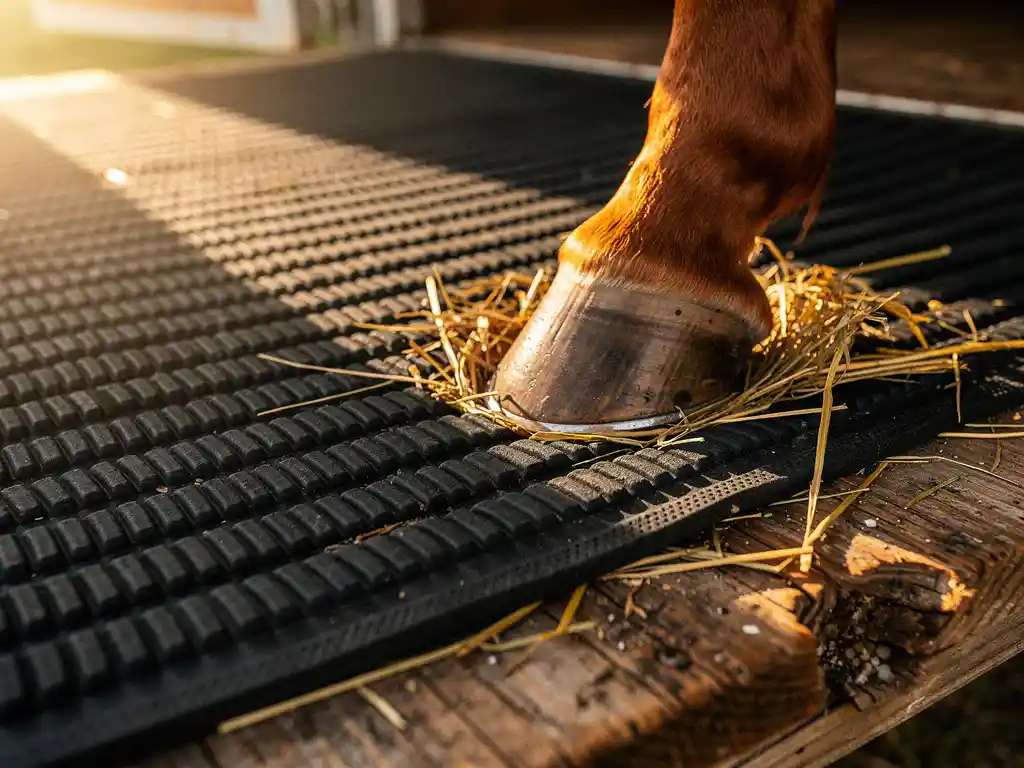
The best thing to put on a horse trailer ramp to prevent slipping is a rubber mat with a textured or grooved surface. Rubber grips the ramp surface firmly, gives your horse’s hooves something to push against, and holds up to the wear and tear of regular loading and unloading. A good trailer ramp mat also cushions each step, which helps keep horses calmer during the process. Make sure the mat fits the ramp properly and is secured so it cannot shift while your horse is on it.
Why do horses slip on trailer ramps?
Horses slip on trailer ramps because smooth metal or wooden surfaces offer very little grip for hooves, especially when wet, muddy, or worn. The angle of a ramp increases the risk further, since horses carry significant weight on each leg as they step up or down, and any lack of traction at that moment can cause a stumble or fall.
The natural shape of a horse’s hoof means contact with a flat surface is concentrated on a relatively small area. When that surface is slick, there is simply not enough friction to keep the hoof stable. Add moisture from rain, morning dew, or a nervous horse sweating, and the problem gets worse quickly. Even horses that load confidently can hesitate or scramble if the ramp surface feels unreliable underfoot. That hesitation can turn into a habit, making future loading harder and more stressful for both of you.
What materials are used to prevent slipping on horse trailer ramps?
The most effective materials for preventing slipping on horse trailer ramps are rubber, non-slip paint or grip tape, and grooved or ribbed metal inserts. Of these, rubber is by far the most popular and practical choice because it combines grip, cushioning, durability, and ease of maintenance in a single solution.
Rubber mats
Rubber mats are the go-to option for most horse owners and professional haulers. They provide consistent traction in wet and dry conditions, absorb the shock of each footfall, and are easy to remove and clean. High-quality rubber does not crack or degrade in extreme temperatures, which matters when your trailer sits in the sun all summer or in a cold barn all winter.
Non-slip paint and grip tape
Non-slip paint mixed with sand or grit and adhesive grip tape are lower-cost alternatives. They can improve traction on a bare ramp, but they wear down faster than rubber and need more frequent reapplication. They also offer no cushioning, so they do not address the comfort aspect of loading and unloading.
Grooved metal inserts
Some trailers come with factory-fitted grooved or ribbed metal ramps. These improve traction over a flat surface but can still become slippery when wet and are harder underfoot than rubber. Many owners add a rubber mat on top of grooved metal for the best of both worlds.
What type of rubber mat works best on a horse trailer ramp?
A purpose-built trailer ramp mat made from dense, high-quality rubber with a textured top surface works best on a horse trailer ramp. Look for a mat that is thick enough to cushion impact, has a grooved or studded surface for grip, and is sized to cover the full length and width of the ramp with minimal overhang.
Texture matters a lot. A smooth rubber mat is still better than bare metal, but a mat with raised ribs, grooves, or a hammer-top pattern gives hooves something to actively grip rather than just a softer surface to land on. The mat should also be dense enough that it does not compress flat under a horse’s weight, since a mat that bottoms out quickly loses its cushioning benefit.
Thickness is another factor worth considering. A thicker mat absorbs more shock and tends to stay in place better due to its own weight. For trailer ramps specifically, a mat in the range of half an inch to three-quarters of an inch thick strikes the right balance between cushioning and practicality. Very thin mats can bunch or fold under repeated use, while very thick mats can create a lip at the ramp edge that becomes a trip hazard.
Fit is just as important as material. A mat that leaves large gaps at the sides or does not reach the full length of the ramp creates uneven footing. If your ramp has an unusual width or length, a custom-cut mat is a smart investment rather than trying to make a standard size work.
How do you install a rubber mat on a horse trailer ramp?
Installing a rubber mat on a horse trailer ramp is straightforward. Clean the ramp surface thoroughly, lay the mat flat to confirm it fits correctly, and then secure it in place using bolts, screws, or heavy-duty fasteners around the edges. Avoid adhesives alone, as they can fail over time with repeated flexing of the ramp.
- Clean the ramp surface. Remove dirt, grease, and any old adhesive. A clean surface helps fasteners grip and prevents debris from creating uneven spots under the mat.
- Measure and confirm fit. Lay the mat on the ramp and check that it covers the surface fully without excessive overhang at the edges or the bottom lip of the ramp.
- Mark fastener positions. Place fasteners at regular intervals along the edges and, if the mat is long, across the middle. Spacing them every 12 to 18 inches provides a secure hold without over-drilling.
- Drill and fasten. Use bolts or screws appropriate for your ramp material. Countersink hardware where possible so there are no raised heads that could catch a hoof.
- Check for movement. Once installed, push and pull the mat firmly to confirm it does not shift. Walk across it yourself before your horse does.
If your ramp folds or hinges, make sure the mat does not interfere with the mechanism. Some ramp mats are designed to flex with the ramp, while others need to be cut or fitted in sections to accommodate the fold point.
How do you keep a trailer ramp mat from shifting or moving?
The most reliable way to keep a trailer ramp mat from shifting is to bolt or screw it directly to the ramp surface. Fasteners placed along all four edges and at intervals across the mat’s surface hold it firmly even when a horse is moving quickly or at an angle. Weight alone is rarely enough to prevent movement on a sloped surface.
Some rubber mats come with pre-drilled holes or reinforced edges specifically designed for fastening, which makes installation cleaner and more secure. If your mat does not have these features, you can drill through the rubber carefully using a sharp bit. Make sure any hardware sits flush or slightly recessed so it does not create a raised surface that could catch a hoof.
For owners who prefer not to permanently fasten a mat, heavy-duty hook-and-loop straps or bungee-style retaining straps attached to the ramp frame can keep the mat in position. This approach works best for thicker, heavier mats that are less prone to bunching. However, straps should be checked before every use, as they can loosen over time. Bolting remains the most dependable long-term solution for a ramp that sees regular use.
How do you clean and maintain a rubber mat on a horse trailer ramp?
Cleaning a rubber trailer ramp mat is simple: rinse it with water, scrub with a mild detergent and a stiff brush, and rinse again. Rubber is non-porous, so it does not absorb moisture, manure, or bacteria the way wood does, which makes it one of the most hygienic options for horse trailer flooring. Regular cleaning after each trip keeps the surface in good condition and prevents buildup in the textured grooves.
For maintenance, inspect the mat periodically for signs of wear, cracking, or lifting at the edges. Rubber holds up well in heat and cold, but fasteners can loosen over time due to the vibration of travel. Tighten any hardware as needed and replace fasteners that show signs of rust or damage. A well-maintained rubber mat can last for many years without needing replacement.
If you need to deep-clean the ramp area, most rubber mats can be temporarily removed, cleaned separately, and refitted. This is also a good opportunity to inspect the ramp surface underneath for rust, rot, or damage that the mat may be hiding. Keeping both the mat and the ramp in good shape is the best way to protect your horse on every trip.
When it comes to finding the right rubber mat for your trailer ramp, we at LRP Matting have you covered. Our custom rubber matting solutions are cut to your exact ramp dimensions, so you get a precise fit without gaps or overhangs. Made from high-quality rubber with a textured surface for reliable grip, our trailer ramp mats are built to handle regular use and the demands of horse transport. If your ramp has an unusual size or shape, our made-to-measure service means you will never have to settle for a mat that almost fits.
Frequently Asked Questions
Can I use a regular stall mat on my trailer ramp instead of a purpose-built ramp mat?
You can use a stall mat in a pinch, but purpose-built trailer ramp mats are a better long-term choice. Standard stall mats are often thicker and heavier than necessary for a ramp, which can create a raised lip at the ramp’s edge and become a trip hazard. They are also typically not designed to flex with a hinged ramp or to be fastened securely on a sloped surface, so they are more likely to shift during loading and unloading.
How do I get a horse that is already scared of the ramp to trust it again after adding a mat?
Introduce the mat gradually by letting your horse inspect and smell it on the ground before it is installed on the ramp. Once fitted, practice loading in a calm, low-pressure environment with no time constraints, rewarding each small step forward. The improved traction and cushioning of the mat often helps horses regain confidence quickly, since a large part of ramp anxiety stems from the surface feeling unstable underfoot. Consistency and patience over several short sessions will typically reset a horse’s association with the ramp.
What should I do if my trailer ramp has rust or rot underneath the old mat?
Do not simply lay a new mat over a damaged ramp surface, as this can mask a serious structural safety issue. For metal ramps, treat rust with a rust-converter product, sand the area smooth, and apply a rust-inhibiting primer before fitting a new mat. Wooden ramp boards that show signs of rot should be replaced entirely before any mat is installed. A ramp that flexes, feels soft underfoot, or shows visible structural damage should be assessed by a trailer repair professional before the trailer is used again.
How often should I replace the rubber mat on my trailer ramp?
A high-quality rubber trailer ramp mat can last five to ten years or more with proper care, but the surface texture is what matters most for safety. Inspect the mat every few months and pay close attention to whether the grooves or raised patterns are wearing smooth, as a worn-flat surface significantly reduces grip. If you notice cracking, large tears, or sections that no longer lie flat against the ramp, it is time to replace the mat regardless of its age.
Does the rubber mat need to extend all the way to the very bottom edge of the ramp?
Yes, ideally the mat should cover the full length of the ramp, including the bottom edge where your horse takes its first step on and last step off. This is actually one of the highest-risk points on the ramp, since hooves often land at an angle as the horse steps onto uneven ground. Leaving the bottom few inches of the ramp uncovered means your horse transitions from a grippy surface to a slick one at exactly the wrong moment. If full coverage is not possible, make sure the mat edge is flush and secure so it does not curl up and become a trip hazard.
Are there any safety precautions I should take beyond fitting a non-slip mat?
A good ramp mat is the foundation, but a few additional habits will further reduce loading and unloading risks. Make sure your horse is wearing well-fitted boots or that its hooves are trimmed and balanced, since overgrown or uneven hooves reduce the contact area with the mat surface. Always load and unload on level ground where possible to minimize the ramp angle, and avoid rushing your horse, as hurried movement increases the chance of a misstep. Periodically check that the ramp hinge mechanism operates smoothly and that the ramp sits at a consistent angle every time it is lowered.
Can I get a rubber mat custom-cut if my trailer ramp has a non-standard size or shape?
Absolutely, and for non-standard ramps it is strongly recommended. Trying to make a standard-size mat fit an unusually wide, narrow, or shaped ramp almost always results in gaps, overhangs, or bunching that create uneven and potentially dangerous footing. Custom-cut mats from suppliers like LRP Matting are sized to your exact ramp dimensions, giving you complete surface coverage and a clean, professional fit. Simply measure the full length and width of your ramp, note any cutouts or fold points, and provide those measurements when ordering.
Related Articles
- How do durable materials reduce waste?
- What makes a sports surface safe?
- Why do wet floors become dangerous?
- How do rubber mats extend the life of a warehouse floor?
- What type of flooring holds up best in a high-traffic athletic venue?
- How do you cover an irregularly shaped horse stall floor?
- How does stall flooring affect a horse's joint health?
- What type of flooring is best for a horse recovery stall?
- How do you stop horse stall mats from shifting?
- What causes sports facility floors to deteriorate so quickly?