
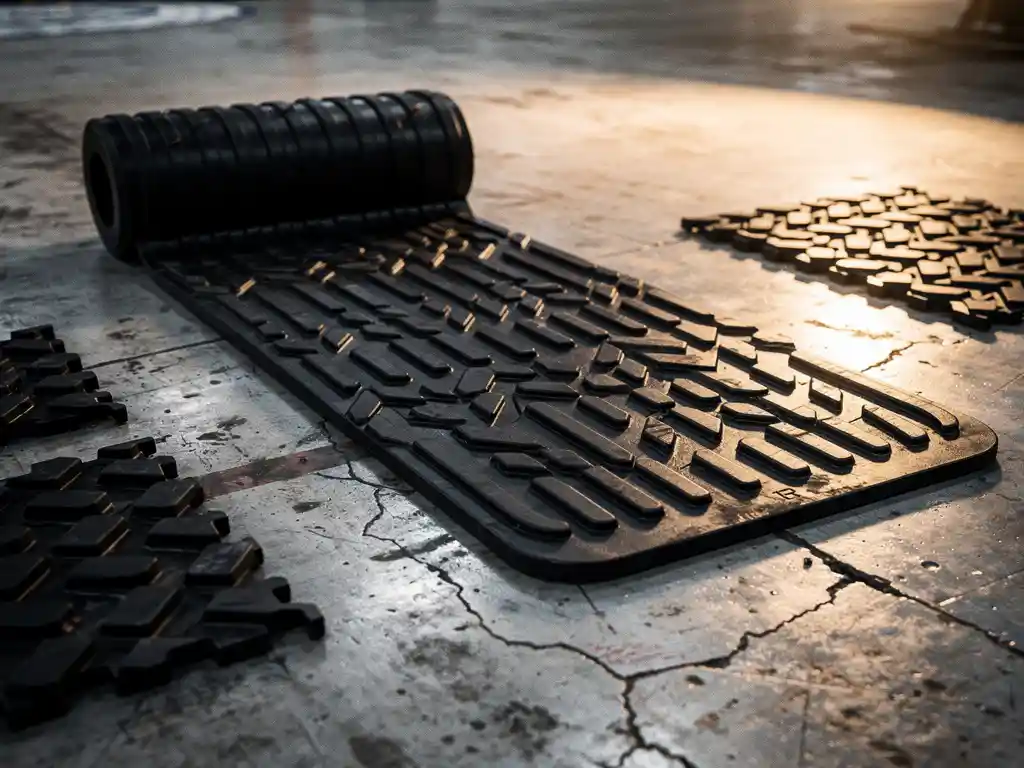
You can improve traction on existing floors by adding slip-resistant mats, applying anti-slip coatings, or using adhesive traction strips. For most spaces, rubber mats are the most practical and versatile option because they work on almost any surface, require no installation tools, and can be removed or repositioned as needed. The sections below walk through the causes of slippery floors and the most effective ways to address them.
What causes floors to become slippery over time?
Floors become slippery over time due to a combination of surface wear, contamination, and moisture. As flooring materials lose their texture through repeated foot traffic, the grip they once offered gradually disappears. Smooth, worn-down surfaces give shoes far less to hold onto, which significantly increases the risk of slip and fall incidents.
Several specific factors accelerate this process:
- Moisture and liquids: Water, oils, and cleaning product residue create a film between the foot and the floor, reducing friction.
- Surface wear: High-traffic zones lose their surface texture faster, making them more hazardous than surrounding areas.
- Dust and debris: Fine particles act like tiny ball bearings underfoot, reducing grip even on dry surfaces.
- Floor coatings: Wax, polish, and sealants can make floors look great but often reduce their natural slip resistance.
- Temperature changes: In cold or outdoor environments, condensation and frost can form on surfaces that would otherwise be safe.
Understanding what is making your floor slippery is the first step toward choosing the right solution. A wet kitchen floor has different needs than a dusty warehouse aisle or a polished lobby entrance.
What are the most effective ways to improve floor traction?
The most effective ways to improve floor traction are adding slip-resistant mats, applying anti-slip coatings or tape, and improving drainage in wet areas. The right approach depends on the floor type, the source of the slip hazard, and whether you need a permanent fix or a flexible one.
Here is a breakdown of the main options:
- Rubber mats: Placed directly on existing floors, rubber mats add immediate grip and can be repositioned as needed. They work well in entrances, kitchens, gyms, and industrial areas.
- Anti-slip tape: A low-cost option for stairs and narrow walkways. It is easy to apply but wears down faster than other solutions and may not cover large areas effectively.
- Anti-slip coatings: Applied directly to the floor surface, these create a textured layer that improves grip. They are a good choice for areas where mats would be impractical, such as ramps or pool surrounds.
- Improved drainage: In wet environments, removing standing water through better drainage or absorbent mats reduces the slip hazard at its source.
- Regular cleaning: Removing grease, dust, and residue keeps floors at their safest. Floor safety inspection routines that include cleaning checks are a simple but effective preventive measure.
For most commercial and industrial settings, a combination of approaches works best. Mats handle high-risk zones, coatings address fixed surfaces, and regular inspections catch new hazards before they cause incidents.
How do rubber mats improve traction compared to other solutions?
Rubber mats improve traction by placing a high-friction surface directly underfoot, regardless of what the floor beneath looks like. Unlike coatings or tape, rubber mats do not alter the existing floor and can be removed without damage. Their surface texture and material density give them strong slip resistance even in wet or oily conditions.
Compared to other solutions, rubber mats offer several practical advantages:
- Immediate effect: No curing time, no tools, and no preparation needed. You place them and they work.
- Wet-condition performance: Rubber is naturally non-porous, so it does not absorb water. Many rubber mats also feature drainage channels or raised patterns that channel liquids away from the walking surface.
- Durability: Quality rubber mats hold their grip over time, unlike anti-slip tape, which peels, or coatings that wear thin under heavy traffic.
- Comfort underfoot: Rubber provides a degree of cushioning that rigid coatings and tape cannot, which matters in environments where people stand for long periods.
- Flexibility: You can reposition, replace, or add mats as your floor safety needs change.
Anti-slip tape and coatings have their place, particularly on stairs and ramps where mats would create a trip hazard. But for flat surfaces in busy environments, rubber mats are generally the more durable and adaptable choice.
Where should rubber mats be placed to maximize traction benefits?
Rubber mats deliver the greatest slip resistance benefit when placed at transition points, high-traffic zones, and areas prone to moisture or contamination. These are the locations where floor hazards are most concentrated and where a slip is most likely to occur.
The highest-priority placements include:
- Entranceways: People tracking in rain, snow, or mud create wet, slippery floors immediately inside a door. Entry mats capture moisture and debris before it spreads.
- Kitchens and food prep areas: Grease and water make these spaces particularly hazardous. Mats with drainage features help manage liquid on the surface.
- Locker rooms and shower areas: Constantly wet surfaces benefit from rubber mats designed to handle standing water.
- Workstations and assembly lines: Industrial environments often have oil, coolant, or other fluids on the floor. Mats in these zones protect workers and reduce fatigue from standing on hard concrete.
- Ramps and loading areas: Any inclined surface carries a higher slip risk, especially when wet or when workers are carrying loads.
A practical floor safety inspection will help you identify which areas in your space see the most foot traffic and the most contamination. Those zones are where mats will have the biggest impact on slip and fall prevention.
What should you look for when choosing a traction mat?
When choosing a traction mat, look for slip-resistant surface texture, appropriate thickness, durability for your environment, and a size that covers the hazard area without creating a trip hazard at the edges. The right mat depends on what is making your floor dangerous and how much traffic it will handle.
Key factors to consider:
- Surface pattern: Raised diamond, ribbed, or drainage-channel patterns improve grip and help channel liquids away from the walking surface.
- Material quality: Genuine rubber outperforms vinyl or foam alternatives in durability and slip resistance, particularly under heavy use or in wet conditions.
- Thickness and beveled edges: Thicker mats offer more cushioning but need beveled or tapered edges to prevent tripping. This is especially important in high-traffic areas.
- Size: A mat that is too small will not cover the hazard zone. Larger mats also mean fewer seams, which reduces trip points and makes cleaning easier.
- Backing: A non-slip backing keeps the mat from shifting underfoot, which is just as important as the top surface for floor safety.
- Maintenance: Look for mats that are easy to clean and do not absorb moisture or odors. Non-porous rubber is a practical choice for this reason.
Can rubber mats be used on top of existing flooring without damage?
Yes, rubber mats can be placed on top of existing flooring without causing damage in most cases. They do not require adhesives, fasteners, or any modification to the floor surface. You simply lay them down, and their own weight and non-slip backing keep them in place. When you remove them, the floor underneath is unchanged.
A few things are worth checking before you place mats on a finished floor:
- Rubber backing on polished or coated floors: Some rubber compounds can leave marks on highly polished floors if left in place for extended periods. Choosing mats with a smooth, non-reactive backing reduces this risk.
- Moisture trapping: If moisture gets under a mat on a wood or laminate floor, it can cause damage over time. In areas with high moisture, make sure the floor is dry before placing mats and check underneath periodically.
- Mat movement: On very smooth floors, even mats with non-slip backing can shift slightly under heavy or sudden loads. Double-sided tape or mat anchors can help in these situations without damaging the floor.
For most commercial and industrial floors, including concrete, tile, and sealed surfaces, rubber mats sit cleanly on top without any negative effect. They are one of the most floor-friendly ways to add slip resistance to an existing surface.
At LRP Matting, we offer a wide range of rubber mats designed to improve floor safety across commercial, industrial, and recreational environments. All our mats are made from genuine, non-porous rubber that will not crack, peel, or lose its grip over time. If you are looking for a practical way to reduce floor hazards, explore our commercial matting solutions to find the right fit for your space.
Frequently Asked Questions
How often should rubber mats be replaced to maintain effective slip resistance?
The lifespan of a rubber mat depends on traffic volume and environmental conditions, but most quality rubber mats in commercial or industrial settings should be inspected every 6–12 months for signs of wear. Replace a mat when its surface texture has flattened noticeably, when the edges start to curl or crack, or when the non-slip backing no longer grips the floor reliably. Investing in genuine rubber over cheaper vinyl or foam alternatives will significantly extend service life and maintain consistent traction performance.
Can anti-slip solutions be combined — for example, using both rubber mats and anti-slip coatings in the same space?
Absolutely — combining solutions is often the most effective approach for complex spaces. A common strategy is to use anti-slip coatings or tape on fixed surfaces like ramps, stairs, and pool surrounds where mats would create a trip hazard, while placing rubber mats in flat, high-traffic zones such as entrances, workstations, and kitchens. Layering solutions this way ensures every type of surface and hazard in your space is addressed with the most appropriate method.
What is the best way to clean rubber mats without reducing their slip resistance?
Clean rubber mats regularly with warm water and a mild detergent, using a stiff brush to work into the surface texture and drainage channels. Avoid using wax-based cleaners, silicone sprays, or oil-based products, as these can leave a residue that reduces grip — the exact problem you are trying to prevent. For heavily soiled industrial mats, a pressure washer on a moderate setting is effective and will not damage quality rubber. Allow mats to dry fully before replacing them, especially if moisture trapping on the floor beneath is a concern.
Are there specific rubber mat types suited for outdoor or exposed environments?
Yes — for outdoor use, look for rubber mats made from UV-stabilized or weather-resistant rubber compounds that will not crack, fade, or harden when exposed to sunlight, rain, or temperature fluctuations. Open-grid or drainage-channel designs are particularly well suited for outdoor areas because they allow rainwater to pass through rather than pool on the surface. Mats intended for indoor use only may degrade quickly outdoors, so always check the manufacturer’s specifications before placing mats in exposed locations.
How do I know if my floor's slip resistance meets safety standards or regulations?
Slip resistance is typically measured using a pendulum test or surface roughness measurement, and many jurisdictions have defined minimum thresholds for different environments — for example, wet commercial kitchens or public walkways often have stricter requirements than dry office corridors. If you manage a commercial or industrial space, it is worth consulting your local workplace health and safety authority or a floor safety specialist to confirm compliance. Adding certified slip-resistant mats to high-risk zones is one of the most straightforward ways to meet or exceed these standards without replacing existing flooring.
What is the most common mistake people make when trying to fix a slippery floor?
The most common mistake is treating the symptom rather than the cause — for example, placing a mat over a floor that is slippery because of ongoing grease or moisture contamination, without addressing the source of that contamination. A mat will help, but if the underlying hazard is not managed, it will saturate the mat and reduce its effectiveness over time. Always identify why the floor is slippery first, then choose a solution that both addresses the root cause and provides a physical traction improvement.
How do I get started if I need to improve floor safety across a large facility with multiple hazard zones?
Start with a systematic floor safety walkthrough of your facility, mapping areas by hazard type — wet zones, high-traffic corridors, transition points, ramps, and workstations — and prioritising by risk level. This gives you a clear picture of where to deploy mats, coatings, or improved drainage first. From there, work with a matting supplier who can advise on the right mat specifications for each zone, factoring in traffic volume, contamination type, and any ergonomic considerations for staff who stand for extended periods.
Related Articles
- How do you identify floor safety hazards?
- How do you protect a concrete floor in a cold storage facility?
- How do you know when a horse trailer floor needs replacing?
- What are the hidden costs of poor horse stall flooring?
- How do you stop floor damage in a high-traffic shipping and receiving area?
- How does stall flooring affect a horse's overall well-being?
- What is the most durable flooring for a professional athletic facility?
- How do you protect a newly installed floor in a busy facility?
- How do you make a veterinary recovery stall safer for horses?
- Is concrete a good floor for a horse stall?