
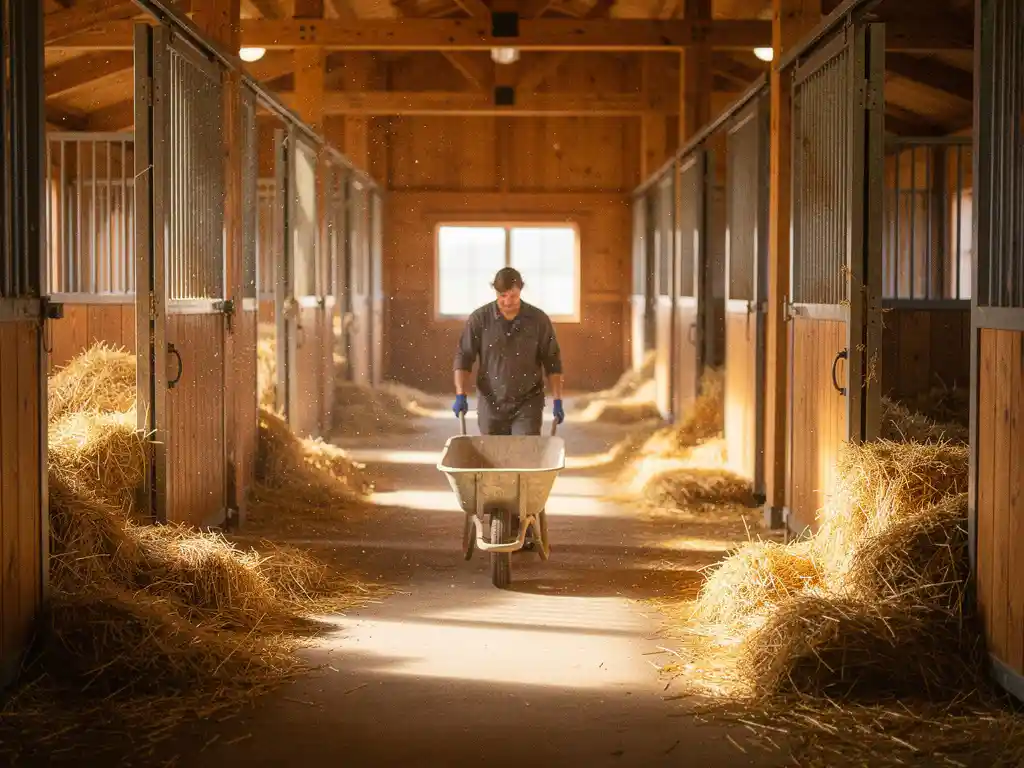
Professional stables manage bedding across many stalls by combining a consistent daily routine, the right bedding material for their setup, and smart infrastructure choices like rubber stall mats. Most large operations work through each stall on a fixed schedule, removing waste, topping up bedding, and keeping records of how much material each stall uses. The biggest efficiency gains come from reducing how much bedding you need in the first place, which is where good flooring plays a major role.
What does professional stable bedding management actually involve?
Professional stable bedding management is the daily and weekly system a stable uses to keep stalls clean, dry, and comfortable for horses. It covers waste removal, bedding top-ups, full strip-outs, moisture control, and tracking material usage across every stall in the facility.
At its core, good bedding management is about maintaining a healthy environment for the horse while keeping labor and material costs under control. Those two goals can pull in opposite directions if you let them, so professional stables build systems that make both achievable at the same time.
In practice, this means assigning specific staff to specific stalls, using the right tools to muck out efficiently, and setting clear standards for what a “clean stall” looks like before a horse goes back in. It also means tracking how much bedding each stall goes through in a week, because that number tells you a lot about drainage problems, horse behavior, and whether your current flooring is working as hard as it should.
What types of bedding do professional stables typically use?
The most common bedding types in professional stables are straw, wood shavings, wood pellets, paper, and hemp. Each material has different absorbency, dust levels, and cost profiles, so the right choice depends on your horses’ health needs, your mucking-out system, and what’s available locally.
Straw
Straw is one of the oldest and most widely used bedding materials. It’s relatively affordable, easy to source in rural areas, and horses find it comfortable to lie on. The downside is that some horses eat it, it can harbor mold if not managed carefully, and it generates a large volume of waste that takes up significant space in your muck heap.
Wood shavings and pellets
Wood shavings are popular because they’re highly absorbent and easy to manage during mucking out. Wood pellets take this a step further, expanding when wet and locking moisture away from the surface. Pellets tend to reduce the overall volume of bedding needed, which makes them a practical option for stables looking to lower their material spend over time.
Paper and hemp
Paper bedding is dust-free, making it a strong choice for horses with respiratory conditions. Hemp is gaining ground as a sustainable alternative, offering good absorbency and a relatively low volume of waste. Both tend to cost more upfront but can work out to be more economical when you factor in how much bedding you actually use per stall.
How do large stables create a bedding routine across many stalls?
Large stables build a bedding routine by dividing stalls into daily work zones, standardizing the mucking-out process, and scheduling full strip-outs on a regular rotation. A clear routine reduces the time each stall takes and ensures no stall gets neglected during a busy period.
Most professional operations start the morning with a full muck-out of every occupied stall, removing droppings and wet patches before horses go out for exercise. Staff work through their assigned zone in a set order so the process becomes second nature and nothing gets missed. After the initial clean, bedding is leveled and topped up to a consistent depth, usually measured by feel and experience rather than by a strict formula.
Beyond the daily routine, large stables schedule full strip-outs at regular intervals, where all bedding is removed, the floor is cleaned and allowed to dry, and a fresh bed is laid from scratch. Some stables do this weekly per stall; others do it monthly, depending on the bedding system they use. The key is consistency, because irregular strip-outs lead to ammonia buildup and an increased risk of respiratory and hoof problems.
Good record-keeping ties the whole routine together. Tracking material usage per stall helps you spot which stalls are using more bedding than expected, which can indicate drainage issues, a horse that’s particularly restless, or a flooring surface that’s not supporting the bedding properly.
What’s the difference between deep litter and full strip-out bedding systems?
A deep litter system involves removing droppings daily but leaving the base layer of bedding to build up over time, adding fresh material on top. A full strip-out system removes all bedding at regular intervals and starts fresh each time. The right choice depends on your stable’s size, ventilation, labor availability, and the type of bedding you use.
Deep litter
Deep litter works by allowing the base layer to compact and generate heat as it breaks down, which can help keep stalls warm in winter. It requires less labor on a daily basis because you’re only removing the obvious waste rather than the full bed. However, it demands very good ventilation and careful management, because a poorly managed deep litter system builds up ammonia quickly and creates a real health risk for horses’ hooves and lungs.
Full strip-out
Full strip-outs give you a clean slate and make it easier to inspect the floor underneath for damage, moisture, or uneven wear. They require more labor and more bedding material per cycle, but they leave less room for problems to hide. Many professional stables with large numbers of stalls use a rolling strip-out schedule, doing a handful of stalls per day so the workload stays manageable without disrupting the whole yard at once.
In practice, many stables use a hybrid approach: a semi-deep litter method where the base is refreshed every few weeks rather than every few days. This balances labor efficiency with hygiene, and it works particularly well when the floor underneath provides good drainage and insulation.
How do rubber mats reduce bedding costs in professional stables?
Rubber stall mats reduce bedding costs by creating a firm, cushioned, and insulating surface that horses find comfortable without needing a thick layer of material underneath. When horses are comfortable on the mat itself, you can use significantly less bedding to achieve the same level of rest and welfare, which directly lowers your material spend over time.
Bare concrete floors are cold, hard, and unforgiving. Horses lying on concrete without adequate bedding are at risk of pressure sores, joint stress, and reluctance to lie down, which affects their rest and recovery. To compensate, stable managers end up using large amounts of bedding just to make the floor acceptable. A quality rubber mat changes that equation entirely.
With a rubber mat in place, bedding serves primarily as an absorbent layer for moisture and waste rather than as a cushioning layer for the floor itself. That means you can maintain a thinner, more manageable bed while still meeting the horse’s welfare needs. Over a full year across a large number of stalls, the savings on shavings, straw, or pellets add up to a meaningful reduction in operating costs.
Rubber mats also protect the floor underneath from urine damage and wear, which reduces long-term repair costs. They’re non-porous, so they don’t absorb moisture themselves, and they clean up easily between strip-outs. For a large stable looking to reduce horse bedding costs without compromising animal welfare, good rubber flooring is one of the most practical investments available.
What common bedding management mistakes do professional stables make?
The most common bedding management mistakes in professional stables are using too much bedding to compensate for poor flooring, skipping strip-outs to save time, and failing to track material usage per stall. Each of these habits costs more in the long run than the short-term savings they seem to offer.
Over-bedding is surprisingly widespread. When a floor is cold, damp, or uneven, the instinct is to pile on more material. But this masks the underlying problem rather than solving it, and it drives up your bedding costs significantly. Addressing the floor itself, whether through drainage improvements, leveling, or adding rubber matting, is a more effective and more economical fix.
Skipping or delaying strip-outs is another costly habit. Ammonia builds up in the base layer of bedding over time, and even if the surface looks clean, the horse is still breathing it in every time it puts its head down. Respiratory problems, hoof conditions like thrush, and general health issues all become more likely when strip-outs are left too long. The labor saved in the short term rarely justifies the veterinary costs and performance impact down the line.
Finally, not tracking bedding usage per stall means you’re flying blind on costs. A stall that consistently uses twice as much bedding as its neighbors is telling you something, whether that’s a drainage problem, a behavioral issue with the horse, or a flooring surface that isn’t performing. Keeping simple records lets you spot these patterns early and act on them before they become expensive habits.
If you’re looking at your bedding costs and wondering where to start, the floor is almost always the right place. At LRP Matting, we’ve been helping professional stables reduce their bedding spend and improve animal welfare since 1971. Our rubber stall mats are made from high-quality, durable rubber and engineered to install easily over any existing surface. And if your stalls aren’t a standard size, our custom rubber matting solutions can be cut to any shape or dimension, so every inch of your floor is covered properly, with fewer seams and less fuss.
Frequently Asked Questions
How thick should the bedding layer be when using rubber stall mats?
With quality rubber mats installed, most professional stables maintain a bedding depth of around 2–4 inches, compared to the 6–8 inches often needed on bare concrete. The mat handles cushioning and insulation, so bedding only needs to manage moisture and waste. The exact depth can vary slightly depending on the bedding material used — wood pellets, for example, can be laid even thinner due to their high absorbency — but the key principle is that you’re no longer relying on bedding volume to compensate for the floor.
How do I know which bedding material is the best fit for my stable?
Start by identifying your primary constraints: budget, local availability, horse health requirements, and your mucking-out setup. If respiratory health is a concern, dust-free options like paper or hemp should move to the top of your list. If labor efficiency and waste volume are your biggest challenges, wood pellets are worth trialing in a few stalls before committing across the whole yard. Running a cost-per-stall-per-week comparison across two or three materials over a 4-week trial is one of the most practical ways to make a data-backed decision for your specific operation.
What's the best way to get started with tracking bedding usage across a large number of stalls?
You don’t need complex software to start — a simple spreadsheet or even a paper log recording bags or bales used per stall per week is enough to reveal meaningful patterns within a month. Assign each stall a number, log material top-ups and strip-out quantities consistently, and review the data weekly. Once you have a baseline, any stall consistently running 20–30% above average is worth investigating for drainage issues, flooring problems, or horse behavior that’s disrupting the bed.
Can rubber stall mats be used with a deep litter system, or are they better suited to full strip-outs?
Rubber mats work well with both systems, but they tend to shine most in full strip-out and semi-deep litter setups where the floor is regularly exposed for cleaning. Because rubber is non-porous, urine and moisture don’t penetrate the surface, making it easy to disinfect the mat during strip-outs. In a deep litter system, the mat still provides cushioning and insulation benefits, but you’ll want to ensure the edges are properly sealed or fitted to prevent moisture from working underneath the mat over time.
How often should full strip-outs be done to avoid ammonia buildup?
For most bedding systems, a full strip-out every 1–4 weeks per stall is a reasonable target, with the exact frequency depending on your bedding type, the individual horse, and how well your flooring drains. Wood pellets and hemp tend to lock moisture away more effectively, which can extend the interval slightly, while straw systems typically need more frequent full changes. The practical rule of thumb is: if you can detect ammonia smell at horse-head height when you enter the stall, the strip-out schedule needs to be shortened.
What should I look for when inspecting a stall floor during a strip-out?
Use strip-outs as a structured inspection opportunity rather than just a cleaning task. Look for soft or crumbling patches in concrete that indicate urine erosion, uneven areas that could cause horses to shift their weight awkwardly, and any signs of persistent moisture pooling that point to drainage problems. If you have rubber mats installed, check the edges and seams for lifting or curling, and look underneath for trapped moisture, which can cause the subfloor to deteriorate over time if left unaddressed.
Are there any bedding management practices that differ for horses with specific health conditions?
Yes — horses with respiratory conditions like equine asthma or recurrent airway obstruction should always be bedded on low-dust or dust-free materials such as paper, hemp, or well-dried wood pellets, and their stalls should be mucked out while the horse is out of the stable to minimize airborne particles. Horses prone to laminitis or hoof conditions like thrush benefit from drier stall conditions, which means more frequent removal of wet patches, shorter strip-out intervals, and good drainage support from the floor underneath. For horses recovering from injury, extra bedding depth or a higher-grade rubber mat can provide the additional cushioning needed during the recovery period.
Related Articles
- What role does drainage play in animal welfare?
- What makes a standing workstation ergonomic?
- What factors increase floor wear in manufacturing environments?
- What makes a veterinary facility safer?
- How do weather conditions affect outdoor sports surfaces?
- How does dirt affect slip resistance?
- How can you reduce fall risk in busy facilities?
- How do you protect a sports facility floor during the off-season?
- How do you keep a large animal veterinary floor hygienic?
- How does stall flooring affect a horse's joint health?