
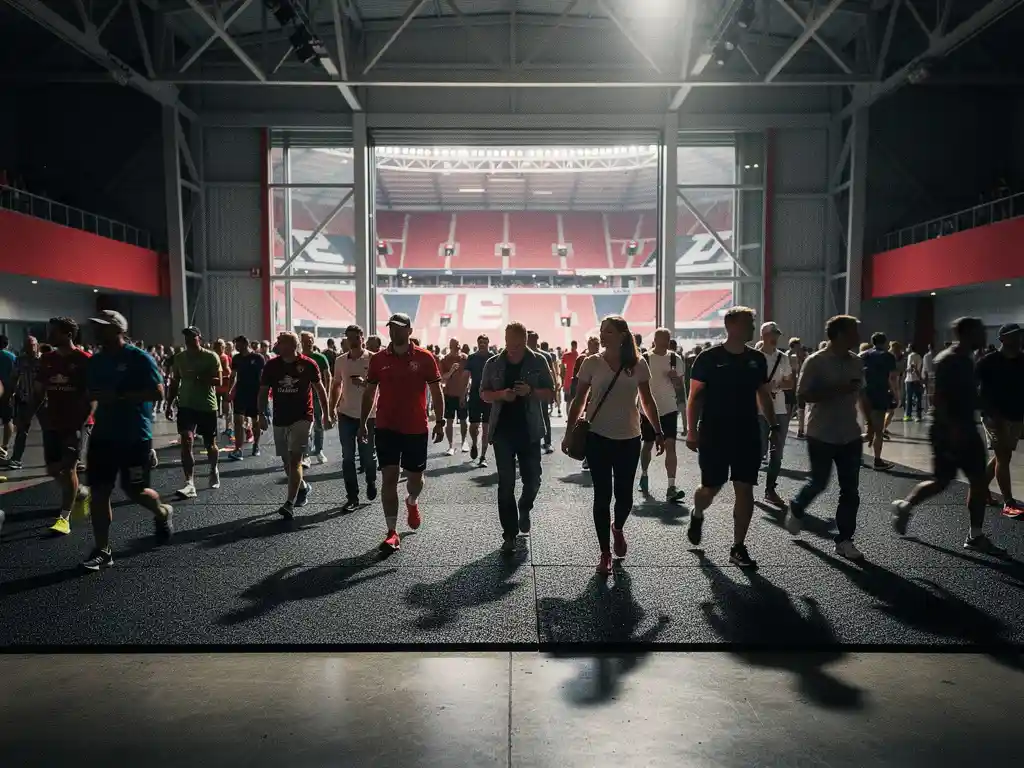
Sports venues manage heavy foot traffic through a combination of strategic flooring choices, smart crowd flow planning, and regular maintenance routines. The most effective venues use durable, non-slip flooring materials in high-traffic zones and pair that with clear pathways and regular inspections to keep surfaces safe. Below, we break down the most common questions venue managers ask about sports facility management and flooring.
What types of flooring handle heavy foot traffic best?
The flooring types that handle heavy foot traffic best in sports venues are rubber, poured polyurethane, vinyl, and hardwood. Each has its strengths depending on the area of the venue. Rubber flooring stands out for high-traffic zones because it absorbs impact, resists moisture, and holds up under constant use without cracking or peeling.
Hardwood is a classic choice for basketball courts and indoor sports surfaces, but it requires careful maintenance and does not perform well in wet or transitional areas like entryways and concourses. Vinyl and luxury vinyl tile (LVT) offer a cost-effective option for general-purpose areas, though they can show wear faster under extreme loads.
Rubber flooring is particularly well-suited for athletic facilities because it combines durability with safety. It provides natural grip underfoot, reduces fatigue for staff and visitors who stand for long periods, and handles spills without becoming a hazard. For areas like locker rooms, weight rooms, concourse corridors, and entryways, rubber consistently outperforms other materials in real-world conditions.
Why do sports venues struggle with crowd flow and safety?
Sports venues struggle with crowd flow and safety because they experience sudden, concentrated surges of foot traffic that most flooring and layout designs are not built to handle continuously. When thousands of people move through the same corridors, stairwells, and entryways at the same time, the risk of slips, trips, and congestion increases significantly.
Several factors compound the problem:
- Weather and moisture: Rain, snow, and wet shoes bring water indoors, making smooth floors slippery within minutes.
- Mixed footwear: Venues host everyone from cleated athletes to guests in dress shoes, each interacting with flooring differently.
- Layout bottlenecks: Narrow corridors, poorly placed entrances, and limited transition zones force crowds into tight spaces.
- Aging infrastructure: Many older arenas were not designed for modern attendance levels, creating safety challenges that surface-level fixes cannot fully solve.
Understanding these root causes helps venue managers make smarter decisions about where to invest in flooring upgrades and crowd management improvements.
How does rubber matting reduce slip and fall risks in arenas?
Rubber matting reduces slip and fall risks in arenas by providing a textured, high-grip surface that maintains traction even when wet. Unlike smooth hard floors, rubber mats create friction between the sole of a shoe and the ground, which helps people stay stable as they walk through busy or wet areas.
The non-porous nature of genuine rubber is a practical advantage here. Because rubber does not absorb moisture, water sits on the surface rather than soaking in, and the textured profile channels it away from the walking area. This is particularly useful at venue entrances, where rain and mud are tracked in constantly during events.
Rubber mats also absorb impact, which reduces the severity of falls if they do occur. For sports venue maintenance teams, this matters because it lowers liability exposure and reduces the frequency of incident reports. From a sports facility management perspective, installing rubber matting in transition zones is one of the more straightforward, cost-effective steps a venue can take to improve safety without a full floor replacement.
Where should rubber mats be placed in a sports venue?
Rubber mats should be placed in any area of a sports venue where moisture, heavy foot traffic, or safety risks are concentrated. The most effective placements are entryways, locker rooms, concourse corridors, stairwell landings, and areas around food and beverage stations.
Here is a practical breakdown by zone:
- Entryways and vestibules: The first point of contact for wet or muddy footwear. Mats here prevent moisture from spreading further into the venue.
- Locker rooms and showers: Wet floors are a constant hazard. Rubber mats provide grip and reduce the risk of slips on tile or concrete.
- Concourse corridors: High-volume walkways benefit from mats that reduce fatigue and provide traction during peak crowd movement.
- Food and beverage areas: Spills are frequent. Rubber mats protect both guests and staff from slick surfaces.
- Stairwell landings: Transition points between levels are high-risk zones, especially when crowds are moving quickly.
- Weight rooms and training areas: Rubber flooring protects the subfloor from equipment damage while giving athletes a stable, comfortable surface.
Covering these zones systematically is more effective than placing mats reactively after an incident occurs.
How do venues maintain flooring under constant heavy use?
Venues maintain flooring under constant heavy use by establishing a regular cleaning schedule, conducting routine inspections, and replacing worn sections before they become safety hazards. Proactive maintenance is far more cost-effective than emergency repairs after a floor failure or injury.
For rubber flooring specifically, maintenance is straightforward. Rubber is non-porous, so it does not trap dirt or bacteria the way porous materials do. Cleaning with mild detergent and water is typically enough to keep surfaces hygienic and safe. This makes rubber a practical choice for sports venue maintenance teams managing large surface areas with limited staff.
Beyond cleaning, venue managers should build in periodic inspections to check for lifting edges, surface cracking, or areas where mats have shifted. These are the most common causes of trip hazards in high-traffic facilities. Addressing them quickly keeps the venue safe and extends the lifespan of the flooring investment. For venues running events year-round in 2026, building a seasonal inspection cycle into the maintenance calendar is a reliable way to stay ahead of wear.
What’s the difference between standard and custom-sized rubber mats for venues?
Standard rubber mats come in fixed dimensions and are designed for general-purpose use, while custom-sized rubber mats are manufactured to fit a specific space, shape, or application. For sports venues with irregular floor plans, large open areas, or unique layout requirements, custom sizing offers a more practical and professional result.
The main practical difference comes down to coverage and seams. Standard mats require more pieces to cover a large area, which creates more seams. Seams are not just a visual issue, they are also points where edges can lift, dirt can accumulate, and trip hazards can develop over time. Fewer seams means a safer, cleaner, and better-looking floor.
Custom-sized mats are especially useful for athletic facilities with wide corridors, large entryways, or equipment areas that do not conform to standard dimensions. They simplify installation and reduce the ongoing maintenance effort needed to keep edges flat and surfaces aligned.
At LRP Matting, we specialize in both standard and made-to-measure rubber mats, including some of the largest mats available in the industry. Our mats are made from 100% recycled rubber and many use our proprietary Fiber Reinforced Rubber Compound (FRC®), which gives them added strength and durability for demanding environments like sports venues. If you are looking for rubber flooring built for heavy use, explore our sports and recreation matting options to find the right fit for your facility.
Frequently Asked Questions
How do I know when it's time to replace rubber mats rather than just clean or repair them?
You should consider replacing rubber mats when you notice significant surface thinning, persistent lifting edges that cannot be re-secured, deep cracking, or a noticeable loss of grip even after cleaning. A good rule of thumb is to replace mats that have lost more than 20–25% of their original thickness, as they will no longer absorb impact or provide adequate traction. For high-traffic zones like entryways and concourse corridors, scheduling a formal mat assessment at least twice a year helps you catch deterioration before it becomes a safety liability.
Can rubber mats be used outdoors at venue entrances, or are they strictly for indoor use?
Many rubber mats are suitable for outdoor use, but not all — it depends on the compound and construction of the mat. Mats made from 100% recycled rubber with UV-resistant properties and drainage-friendly profiles are well-suited for outdoor entrances, ramps, and covered walkways. When selecting outdoor mats for a sports venue, look for products specifically rated for exterior use, as indoor-only mats can degrade faster when exposed to direct sunlight, temperature swings, and standing water.
What's the best way to get buy-in from facility ownership or management to invest in flooring upgrades?
The most effective approach is to frame the investment in terms of liability reduction and long-term cost savings rather than upfront expense. Document any slip-and-fall incidents, near-misses, or maintenance calls related to flooring, and use that data to build a cost comparison between reactive repairs and proactive upgrades. Pairing that with insurance cost implications and the reputational risk of a high-profile injury at a public venue tends to make a compelling case to decision-makers who are focused on the bottom line.
Are there flooring solutions that work well for multi-use venues that host both sports events and concerts or conventions?
Yes — rubber flooring and high-quality LVT are both strong candidates for multi-use venues because they handle variable traffic types, rolling loads from equipment carts and staging gear, and frequent reconfiguration without significant wear. For multi-use spaces, custom-sized rubber mats are particularly practical because they can be laid down, repositioned, or removed depending on the event type without damaging the subfloor. The key is choosing a material with sufficient thickness and density to handle the heaviest anticipated load scenario, not just the average one.
How do rubber mats interact with ADA compliance and accessibility requirements in sports venues?
Rubber mats can support ADA compliance when selected and installed correctly, but they can also create barriers if not handled carefully. Mats should be firmly secured or beveled at the edges to eliminate trip hazards for individuals using wheelchairs, walkers, or mobility aids — raised or curling edges are a common ADA violation. The surface texture should provide grip without creating excessive rolling resistance, and mat placement should never obstruct accessible routes, ramps, or designated pathways required under ADA standards. When in doubt, consulting with an accessibility specialist during the flooring planning phase is a worthwhile step.
How many rubber mats does a typical sports venue actually need, and how should I estimate coverage?
Start by mapping out every zone in your venue that falls into a high-risk or high-traffic category — entryways, locker rooms, concourse corridors, food stations, stairwell landings, and training areas — and measure each space individually. From there, calculate total square footage per zone and factor in whether standard sizes will cover those areas efficiently or whether custom sizing would reduce seams and waste. It’s generally better to slightly overestimate coverage needs, since gaps between mats in critical zones defeat the purpose of installing them in the first place.
What should I ask a rubber mat supplier before placing a large order for a sports facility?
Before committing to a large order, ask about the mat’s rubber compound (recycled vs. virgin rubber), thickness options, available surface textures, load ratings, and whether custom sizing is available for your specific dimensions. You should also ask for information on the mat’s slip-resistance rating, fire classification if relevant, and what cleaning products are compatible with the material. Requesting samples or referencing case studies from comparable sports or recreation facilities is a practical way to validate that the product will perform as expected under your specific conditions.
Related Articles
- How does surface cushioning affect fatigue?
- What makes a standing workstation ergonomic?
- What makes a veterinary facility safer?
- How do you support a horse's joints during long periods of stabling?
- What is the best way to protect a sports facility floor from heavy equipment?
- How do you keep a horse stall dry without using excessive bedding?
- How do you protect a finished floor during a renovation project?
- What is the best flooring for a factory assembly line?
- What floor is best for a horse with arthritis?
- Can a hard barn floor cause tendon damage in horses?