
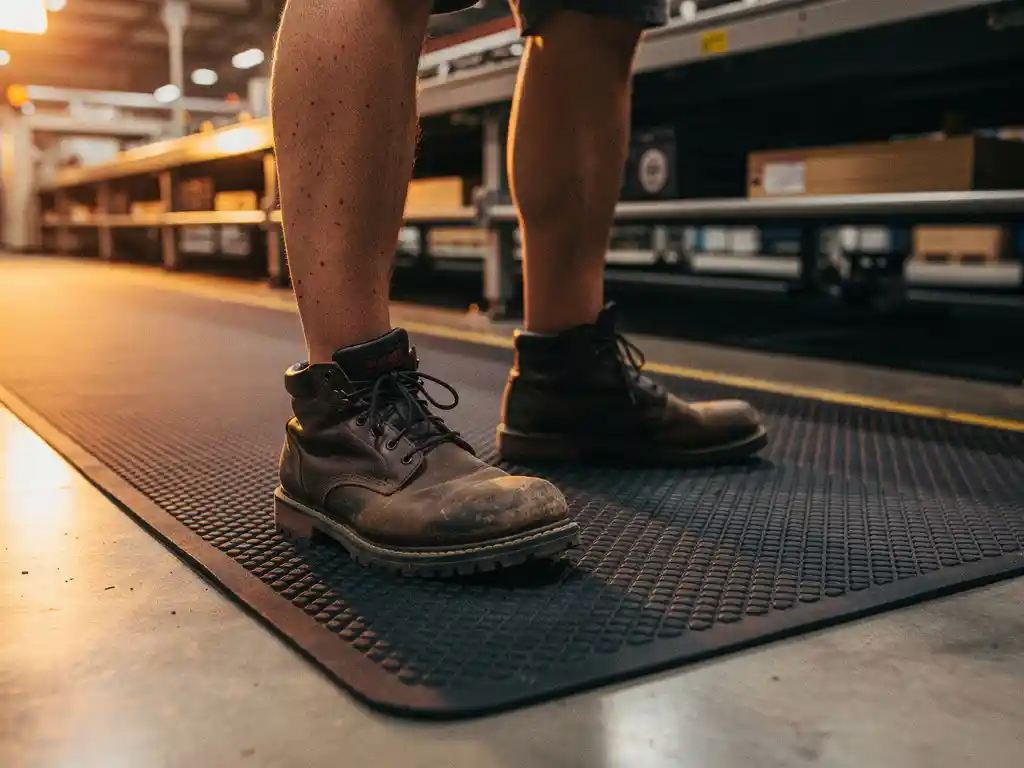
Surface cushioning directly reduces standing fatigue by absorbing the compressive forces that hard floors transmit into your joints, muscles, and lower back. When a surface gives slightly underfoot, your body expends less energy stabilizing itself and maintaining posture, which means less physical strain over the course of a shift or workday. The sections below walk through the mechanics, the differences between mat types, and how to pick the right solution for your environment.
What happens to your body when you stand on hard surfaces?
Standing on a hard surface for extended periods forces your muscles to work continuously without relief. Unlike walking, which shifts load between your legs, static standing keeps the same muscle groups under constant tension. Over time, this leads to localized fatigue in the calves, lower back, and feet, reduced circulation in the legs, and increased discomfort across the joints.
The mechanics behind this are straightforward. Concrete, tile, and other rigid floors provide no energy return. Every pound of body weight presses directly into the surface, and all of that force bounces straight back into your skeleton and soft tissue. Your body compensates by tensing postural muscles to absorb the impact, but those muscles are not designed to hold tension indefinitely. The result is a progressive build-up of fatigue that becomes noticeable within 60 to 90 minutes for most people and worsens significantly over a full shift.
Prolonged standing on hard floors is also linked to poor circulation in the lower limbs. When your leg muscles are not actively contracting and releasing, they do less to pump blood back toward the heart. This contributes to swelling, heaviness, and that familiar aching feeling at the end of a long day on your feet. Worker fatigue caused by hard floors is not just uncomfortable. It affects concentration, increases error rates, and raises the risk of slips and falls as workers become physically tired.
How does surface cushioning reduce fatigue?
Surface cushioning reduces fatigue by introducing a controlled amount of give underfoot, which prompts small, continuous micro-movements in your feet and leg muscles. These subtle adjustments improve circulation, distribute pressure more evenly across the foot, and reduce the static load on joints. The result is less muscular tension and a lower rate of fatigue accumulation over time.
When a surface compresses slightly with each step or shift in weight, it acts as a buffer between your body and the floor. This buffering effect reduces peak impact forces on the heel, arch, and ball of the foot. It also means your postural muscles do not have to work as hard to keep you balanced, because the surface itself is absorbing some of that stabilizing work.
From an ergonomic workplace standpoint, cushioned surfaces also encourage subtle weight shifting. Workers standing on a compliant surface naturally shift their weight more often than those standing on hard floors, even without thinking about it. That movement is enough to keep blood circulating in the lower legs and prevent the kind of sustained static loading that drives standing fatigue. This is why workplace ergonomics specialists consistently recommend cushioned flooring as a first-line intervention for jobs that involve prolonged standing.
What’s the difference between anti-fatigue mats and regular floor mats?
Anti-fatigue mats are specifically engineered to reduce physical strain from prolonged standing, while regular floor mats are designed primarily for dirt trapping, aesthetics, or basic slip resistance. The core difference is in the material composition and thickness: anti-fatigue mats use denser, more resilient compounds that compress and rebound under body weight, whereas standard mats are typically thinner and offer little meaningful cushioning.
A regular entrance mat or drainage mat might provide a few millimeters of rubber or foam, but that is not enough to meaningfully reduce the compressive load on joints. Anti-fatigue mats are built to a specific thickness and density range that delivers measurable ergonomic benefit without becoming so soft that they create instability. Too firm and the mat offers no cushioning benefit. Too soft and it becomes a tripping hazard and causes the ankle to work harder to stabilize.
Anti-fatigue mats also tend to include features that standard mats do not: beveled edges to reduce trip risk, textured surfaces to improve grip, and materials that resist oils, chemicals, or heavy loads depending on the application. They are purpose-built tools for employee well-being, not just floor coverings.
How much cushioning is enough to make a difference?
Research in ergonomics and occupational health consistently points to a cushioning range of roughly 9 to 19 millimeters of mat thickness as the practical sweet spot for most standing applications. Below that range, the surface does not compress enough to meaningfully reduce joint load. Above it, the mat becomes too unstable for safe, sustained standing, particularly when workers are carrying loads or operating machinery.
Material density matters as much as thickness. A very soft foam mat at 25mm may feel comfortable initially but compresses fully under body weight, effectively becoming a hard surface after a short period. A well-formulated rubber mat at 12mm, on the other hand, maintains its resilience throughout the day and continues to provide consistent cushioning. Durability and sustained performance are what separate genuinely effective anti-fatigue matting from products that feel good in the showroom but underperform in practice.
The type of work also affects how much cushioning is appropriate. Workers who stand relatively still benefit from more cushioning. Workers who move frequently, push heavy carts, or need precise footing may benefit from a firmer surface that still provides some give without compromising stability. Matching the cushioning level to the specific task is a practical part of getting workplace ergonomics right.
Which industries benefit most from cushioned rubber matting?
Any industry where workers spend extended periods on their feet benefits from cushioned rubber matting, but the impact is most significant in manufacturing, food processing, retail, healthcare, and commercial kitchens. These environments combine long standing durations with hard floor surfaces, often concrete or tile, making them high-risk settings for standing fatigue and related musculoskeletal issues.
- Manufacturing and assembly lines: Workers stand at fixed stations for hours at a time, often with repetitive upper-body tasks that prevent them from walking around to relieve lower-body strain.
- Food processing and commercial kitchens: Wet or greasy floors add a slip risk on top of fatigue, making rubber matting with both cushioning and drainage properties particularly useful.
- Retail and hospitality: Staff spend full shifts on their feet, often on polished concrete or tile, with customer-facing roles that make visible comfort solutions important.
- Healthcare: Nurses, surgeons, and lab technicians stand for long periods in environments where fatigue can directly affect performance and patient outcomes.
- Gyms and sports facilities: Both staff and users benefit from cushioned flooring that reduces joint impact during exercise and recovery periods.
Agricultural and equine environments are another area where cushioned rubber matting plays a meaningful role, though the beneficiaries there are animals rather than human workers. Livestock standing on hard barn floors experience the same compressive stress as people, which affects their health, comfort, and productivity.
Does mat material affect how well cushioning fights fatigue?
Yes, mat material has a significant effect on cushioning performance and how long that performance lasts. Rubber, foam, and gel are the three most common materials used in anti-fatigue matting, and each behaves differently under load, in different temperatures, and over time.
Rubber
Rubber is the most durable option for heavy-use environments. It resists compression set, meaning it returns to its original thickness after being loaded, which is what keeps it effective over months and years of daily use. Rubber also handles temperature extremes, oils, and chemicals better than foam or gel. For industrial and commercial settings, rubber is generally the most practical long-term choice.
Foam and gel
Foam mats are lighter and often less expensive, but they compress permanently over time, losing their cushioning benefit faster than rubber. Gel mats offer excellent initial comfort and are popular in retail and hospitality settings, but they can be less stable underfoot and more expensive to replace. For environments where mats take heavy or consistent loads, rubber outperforms both alternatives in sustained cushioning delivery.
Material quality within each category also varies. Not all rubber mats are equivalent. The compound formulation, density, and any reinforcement built into the material all affect how well the mat cushions and how long it holds up. This is why material specification matters as much as the category when selecting matting for ergonomic purposes.
How do you choose the right anti-fatigue mat for your space?
Choosing the right anti-fatigue mat comes down to four practical factors: the nature of the work being done, the floor environment, the size and layout of the area, and the durability requirements of the setting. Getting these four things right means the mat will actually perform its job rather than just occupying floor space.
Start with the work itself. Is the worker standing still, moving frequently, or alternating between the two? Static standing benefits from more cushioning; dynamic work needs a firmer, more stable surface. Consider whether the worker is barefoot, wearing safety boots, or using wheeled equipment, as each changes the load and movement pattern the mat needs to handle.
Next, look at the floor environment. Wet or greasy conditions call for mats with drainage holes or textured surfaces that channel liquid away from the standing area. Chemical exposure requires a material that resists degradation from the specific substances present. Outdoor or temperature-variable environments need a material that stays flexible and effective across a wide temperature range.
Size and layout matter more than many buyers expect. A mat that is too small leaves workers stepping on and off the edge repeatedly, which creates a trip hazard and reduces the ergonomic benefit. Ideally, the mat should cover the full standing zone with enough margin that workers naturally stay on it throughout their tasks. Larger mats also mean fewer seams, which improves both safety and appearance.
Finally, consider how long the mat needs to last and what maintenance it will receive. A high-traffic industrial area needs a mat built to withstand heavy loads, cleaning chemicals, and constant use without breaking down. At LRP Matting, we offer anti-fatigue rubber mats built from high-quality rubber compounds, including our proprietary FRC® fiber-reinforced material, which provides the kind of sustained cushioning and durability that demanding environments require. Whether you need a standard size or a custom solution for an unusual layout, we can help you find the right fit for your space and your team.
Frequently Asked Questions
How long does it take for an anti-fatigue mat to show a noticeable difference in comfort?
Most workers notice a reduction in foot and leg fatigue within the first few days of using a quality anti-fatigue mat, though the full ergonomic benefit becomes more apparent over weeks of consistent use. The improvement is most noticeable during the second half of a shift, when fatigue would normally peak on a hard floor. If you are not feeling a difference within a week, it may be worth reassessing the mat’s thickness, density, or whether it is covering the full standing zone.
Can anti-fatigue mats help with existing back pain or joint problems, or are they only useful for prevention?
Anti-fatigue mats can provide meaningful relief for workers who already experience standing-related back pain, knee discomfort, or foot issues, not just those trying to prevent them. By reducing compressive forces and encouraging subtle micro-movements, cushioned surfaces lower the ongoing strain that aggravates existing musculoskeletal conditions. That said, if a worker has a diagnosed condition, anti-fatigue matting should be seen as one part of a broader ergonomic strategy that may also include supportive footwear, scheduled rest breaks, and professional medical advice.
What is the best way to clean and maintain rubber anti-fatigue mats without degrading their cushioning?
Most rubber anti-fatigue mats can be cleaned with a stiff brush, warm water, and a mild detergent, then left to air dry before being returned to the floor. Avoid harsh solvents or bleach-based cleaners unless the manufacturer specifically confirms chemical compatibility, as these can break down the rubber compound over time and reduce cushioning performance. For mats in food processing or healthcare settings, check that your cleaning agents are approved for the surface type and rinse thoroughly to prevent residue build-up.
How do I know when an anti-fatigue mat needs to be replaced?
The clearest sign that a mat needs replacing is when it no longer springs back after being compressed, meaning it stays flattened rather than returning to its original thickness. Other indicators include surface cracking, curling edges that create a trip hazard, or workers reporting that the mat no longer feels noticeably different from the hard floor beneath it. For high-traffic industrial environments, it is worth scheduling periodic inspections every six to twelve months rather than waiting for visible wear, since cushioning performance can degrade before the mat looks obviously damaged.
Should anti-fatigue mats be used alongside supportive footwear, or is one enough on its own?
Anti-fatigue mats and supportive footwear work best together rather than as substitutes for each other. Mats address the floor surface, reducing the compressive load transmitted upward from the ground, while quality footwear addresses the interface between the foot and the mat, providing arch support, shock absorption, and a stable platform. Relying on one without the other leaves part of the fatigue equation unaddressed, particularly for workers who spend eight or more hours on their feet in demanding environments.
Are there situations where anti-fatigue mats are not appropriate or could create a safety risk?
Yes, there are specific situations where mat selection requires extra care to avoid creating new hazards. In areas with heavy forklift or pallet truck traffic, thick or soft mats can create instability for vehicle operators and increase tip risk. In environments where workers carry heavy loads, a mat that is too cushioned can compromise balance and increase the risk of ankle strain. In these cases, a firmer mat with moderate give is safer than maximum cushioning, and mats should always feature beveled edges and secure placement to prevent shifting or curling.
Can anti-fatigue matting be used outdoors or in areas exposed to extreme temperatures?
Rubber anti-fatigue mats are generally the best option for outdoor or temperature-variable environments, as quality rubber compounds remain flexible across a wide temperature range without cracking in the cold or becoming excessively soft in the heat. Foam and gel mats tend to perform poorly in these conditions, with foam becoming brittle in low temperatures and gel losing structural integrity in high heat. If you are specifying mats for an outdoor loading dock, a cold storage facility, or a space with significant seasonal temperature swings, confirming the material’s rated temperature range with the manufacturer before purchasing is strongly recommended.
Related Articles
- How does flooring affect productivity?
- How does floor design affect physical strain in the workplace?
- How do sports facilities prevent slips?
- What makes a flooring material sustainable?
- What creates a safe recovery environment for animals?
- Why do wet floors become dangerous?
- How do you perform a floor safety assessment?
- How do you keep a large animal veterinary floor hygienic?
- What is the best way to protect a warehouse floor during construction?
- What are the pros of rubber mats in a horse stall?