
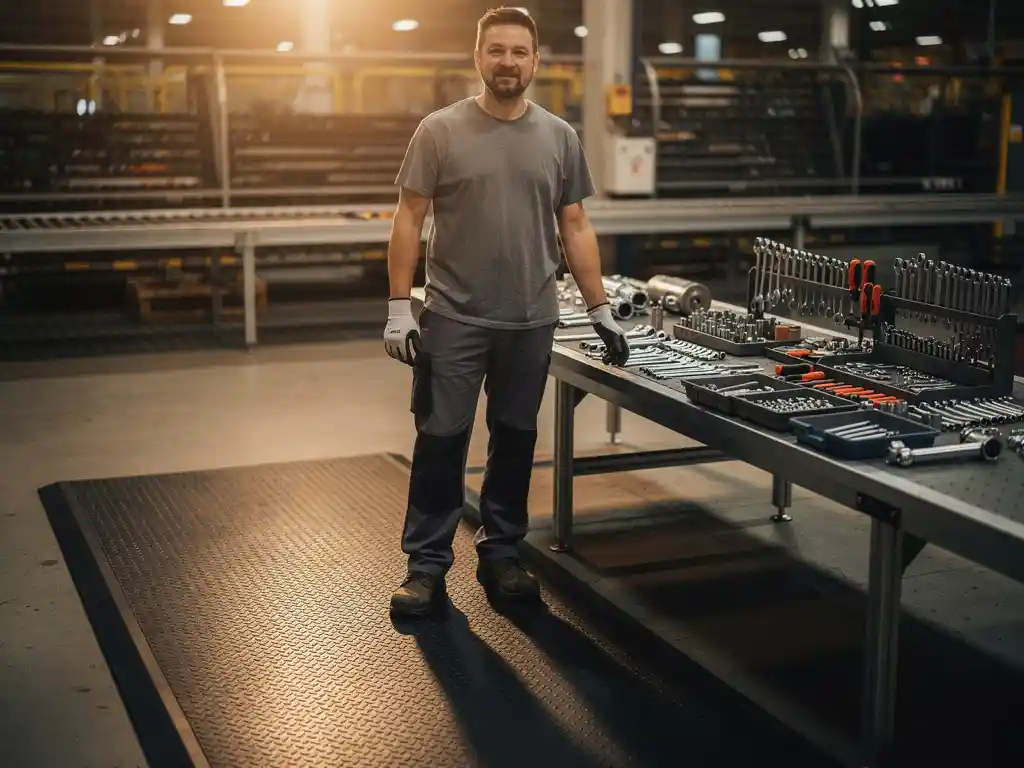
Flooring directly affects productivity by influencing how comfortable, safe, and focused workers can be throughout a shift. Hard, unforgiving surfaces cause physical fatigue more quickly, which slows people down, increases errors, and raises the risk of injury. The type of flooring underfoot has a measurable impact on energy levels, concentration, and overall output. Below, we answer the most common questions about flooring and workplace productivity.
What types of flooring reduce worker fatigue?
Flooring that provides cushioning and support reduces worker fatigue by absorbing the physical stress of prolonged standing. Anti-fatigue mats, rubber flooring, and cushioned vinyl surfaces are the most effective options for standing workstations. These materials encourage subtle muscle movement in the legs and feet, which promotes blood circulation and reduces the buildup of tension that causes tiredness.
Hard surfaces like bare concrete, tile, or stone offer no give at all. When workers stand on these surfaces for hours, their muscles lock up as they try to compensate for the lack of support. This leads to sore feet, aching legs, and lower back pain well before the end of a shift.
Rubber flooring is a particularly practical choice in demanding environments because it combines cushioning with durability. It handles heavy foot traffic, resists moisture, and stays in place without shifting. For areas where workers stand for extended periods, even a modest improvement in surface softness can translate into noticeably less fatigue by the end of the day.
How does flooring affect workplace safety and injury rates?
Flooring directly affects workplace safety by determining how much traction, stability, and impact protection workers have underfoot. Slippery or uneven surfaces are a leading cause of slips, trips, and falls in commercial and industrial settings. Choosing flooring with adequate grip and a stable, flat profile reduces these risks significantly.
Beyond slip prevention, flooring also plays a role in reducing musculoskeletal injuries. When workers stand on hard surfaces all day, the cumulative strain on joints and muscles increases the likelihood of repetitive stress injuries over time. Surfaces that absorb shock reduce this strain and lower the long-term injury risk.
In wet or greasy environments, the surface texture of the flooring becomes even more important. Raised patterns, drainage channels, and textured finishes help channel liquids away from the walking surface, keeping it drier and safer. The right flooring is not just about comfort; it is a practical safety measure with real consequences for injury rates and workers’ compensation costs.
Can flooring choice improve employee focus and output?
Yes, flooring choice can improve employee focus and output by reducing the physical discomfort that distracts workers from their tasks. When standing fatigue sets in, attention drifts, reaction times slow, and error rates climb. Flooring that reduces physical strain helps workers stay mentally present and productive for longer stretches.
The connection between physical comfort and cognitive performance is well established in workplace ergonomics research. Discomfort is a persistent distraction. A worker managing sore feet or an aching back is spending mental energy on their physical state rather than the task in front of them.
This is especially relevant in precision work, customer-facing roles, and any job where sustained attention matters. Improving the standing surface is one of the more straightforward ergonomic adjustments a business can make, and its effects are felt immediately. Workers report feeling less drained, and that directly supports better output across a shift.
What’s the difference between anti-fatigue mats and standard rubber mats?
Anti-fatigue mats are specifically engineered to reduce standing fatigue through cushioning and slight surface give, while standard rubber mats are designed primarily for protection, traction, and durability. Both are made from rubber, but their internal construction and intended purpose differ in important ways.
Anti-fatigue mats
Anti-fatigue mats are built with a softer, more compressible core that encourages micro-movements in the leg muscles while standing. This subtle movement keeps blood circulating and prevents the muscle lock-up that causes fatigue. They are best suited for workstations where an individual stands in one spot for extended periods, such as assembly lines, cashier stations, or laboratory benches.
Standard rubber mats
Standard rubber mats prioritize surface protection, grip, and resilience. They are harder underfoot and built to withstand heavy loads, vehicle traffic, or rough industrial use. While they do provide more cushioning than bare concrete, their primary function is protective rather than ergonomic. They work well in high-traffic areas, entryways, and environments where the flooring needs to handle equipment as much as people.
Choosing between the two comes down to the specific demands of the space. In many facilities, both types are used together, with anti-fatigue mats at individual workstations and standard rubber mats covering the broader floor area.
How does flooring impact productivity in industrial settings specifically?
In industrial settings, flooring impacts productivity through its effect on worker fatigue, safety, equipment movement, and maintenance demands. Workers in manufacturing, warehousing, and assembly environments are often on their feet for entire shifts on hard concrete floors, which accelerates physical exhaustion and increases the frequency of breaks, errors, and injuries.
Rubber flooring and matting in industrial environments serve multiple functions at once. They reduce the physical toll of standing on concrete, provide traction that prevents slips around machinery, protect the underlying floor from damage caused by heavy equipment, and are easy to clean in environments where spills and debris are common.
Noise reduction is another benefit worth noting. Rubber absorbs impact and vibration, which lowers ambient noise levels in loud production environments. While this is rarely the primary reason for choosing rubber flooring, it contributes to a less stressful working environment and supports better communication between workers.
The cumulative effect is real. When workers are less fatigued, less distracted by discomfort, and operating in a safer environment, output improves and absenteeism related to workplace injuries decreases.
When should a business upgrade its workplace flooring?
A business should upgrade its workplace flooring when the current surface is contributing to worker fatigue, increasing injury risk, or showing signs of deterioration that make it harder to maintain a safe and clean environment. These are practical, observable signals that the flooring is no longer doing its job effectively.
Specific situations that call for an upgrade include:
- Workers regularly reporting sore feet, leg pain, or back discomfort after shifts
- An increase in slip, trip, or fall incidents in a specific area
- Flooring that has cracked, warped, or become uneven over time
- Surfaces that are difficult to clean or that retain moisture and odors
- Expansion of a facility or changes in how a space is used
- A shift toward longer standing shifts or higher foot traffic in an area
In 2026, many businesses are reassessing their ergonomic workplace setups as part of broader employee wellbeing initiatives. Flooring is often overlooked in these reviews, but it is one of the most cost-effective improvements available. A targeted upgrade, such as adding rubber matting to high-traffic or standing-heavy zones, can deliver immediate improvements without a full facility renovation.
At LRP Matting, we specialize in helping businesses find the right matting solution for their specific environment, whether that is a single workstation or an entire production floor. Our mats are made from 100% recycled rubber, including our proprietary Fiber Reinforced Rubber Compound (FRC®), which delivers exceptional durability in demanding conditions. If you are ready to improve comfort, safety, and productivity in your workplace, explore our anti-fatigue matting solutions to find the right fit for your space.
Frequently Asked Questions
How long does it typically take to see productivity improvements after upgrading workplace flooring?
Most businesses notice improvements almost immediately after installing ergonomic flooring or anti-fatigue matting, particularly in worker comfort and reported fatigue levels. Measurable productivity gains, such as reduced error rates and fewer breaks, often become apparent within the first few weeks. Longer-term benefits like decreased absenteeism and lower workers’ compensation claims tend to show up over several months of consistent use.
How do I calculate the ROI of investing in better workplace flooring?
Start by tracking your current costs related to flooring — this includes workers’ compensation claims, lost productivity from fatigue-related errors, and absenteeism linked to musculoskeletal complaints. Compare these figures against the upfront cost of new matting or flooring and factor in the expected lifespan of the product. For most businesses, even a modest reduction in injury-related costs or a small uptick in output per shift is enough to recover the investment within the first year.
Can anti-fatigue mats be used on top of existing flooring, or does the floor need to be replaced first?
In most cases, anti-fatigue mats can be placed directly on top of existing flooring without any renovation work, making them one of the fastest and most cost-effective ergonomic upgrades available. The key requirement is that the underlying surface is flat, stable, and free of major cracks or unevenness that could cause the mat to shift or create a trip hazard. If the existing floor is severely damaged or uneven, addressing those issues first will ensure the mats perform as intended and stay safely in place.
What should I look for when choosing anti-fatigue matting for a wet or greasy industrial environment?
In wet or greasy environments, prioritize mats with a raised drainage pattern or open-grid design that channels liquids away from the surface and keeps the standing area as dry as possible. Look for materials that resist oils, chemicals, and moisture without degrading over time — high-quality rubber compounds, such as recycled rubber with reinforced construction, tend to hold up well in these conditions. Beveled edges are also important in these settings to prevent curling and reduce the risk of trips in areas where workers may be moving quickly.
How do I maintain rubber flooring and anti-fatigue mats to extend their lifespan?
Routine maintenance for rubber flooring and anti-fatigue mats is straightforward — regular sweeping or vacuuming to remove debris, combined with occasional mopping using a mild detergent, is usually sufficient for most environments. Avoid harsh solvents or oil-based cleaners, as these can break down the rubber compound over time and reduce the mat’s grip and cushioning properties. Periodically inspect mats for signs of curling, cracking, or compression loss, as a mat that has lost its cushioning is no longer providing the ergonomic benefit it was designed for.
Is there a flooring or matting solution that works well for both standing workstations and high-traffic walkways in the same facility?
Yes — a zoned approach works best in most facilities, where anti-fatigue mats are placed at fixed standing workstations and more durable standard rubber matting covers high-traffic walkways, entryways, and transition areas. This combination addresses both ergonomic and safety needs without over-engineering any single zone. Many businesses find that mapping out their facility by use case — standing-heavy areas versus transit corridors — makes it easier to select the right product for each specific location.
Are there flooring considerations specific to customer-facing or retail environments versus industrial ones?
Yes — in customer-facing environments like retail, hospitality, or healthcare, aesthetics and comfort are equally important alongside function, so flooring choices often need to balance ergonomic performance with visual appeal. Cushioned vinyl, carpet tiles, and finished rubber surfaces in neutral or branded colors are common choices that support staff comfort without compromising the look of the space. In industrial settings, the priority shifts almost entirely to durability, chemical resistance, drainage, and load-bearing capacity, which is why heavy-duty rubber matting tends to dominate those environments.
Related Articles
- How do facility layouts affect animal movement?
- What causes sports facility floors to wear out?
- How often should facility floors be inspected?
- How do entrances create floor safety risks?
- How do you protect a concrete floor in a cold storage facility?
- How do large boarding facilities manage bedding costs across many stalls?
- How do you stop floor damage in a high-traffic shipping and receiving area?
- What type of flooring reduces the risk of slip and fall accidents in a factory?
- How do you make a warehouse floor less slippery?
- How do you protect a newly installed floor in a busy facility?