
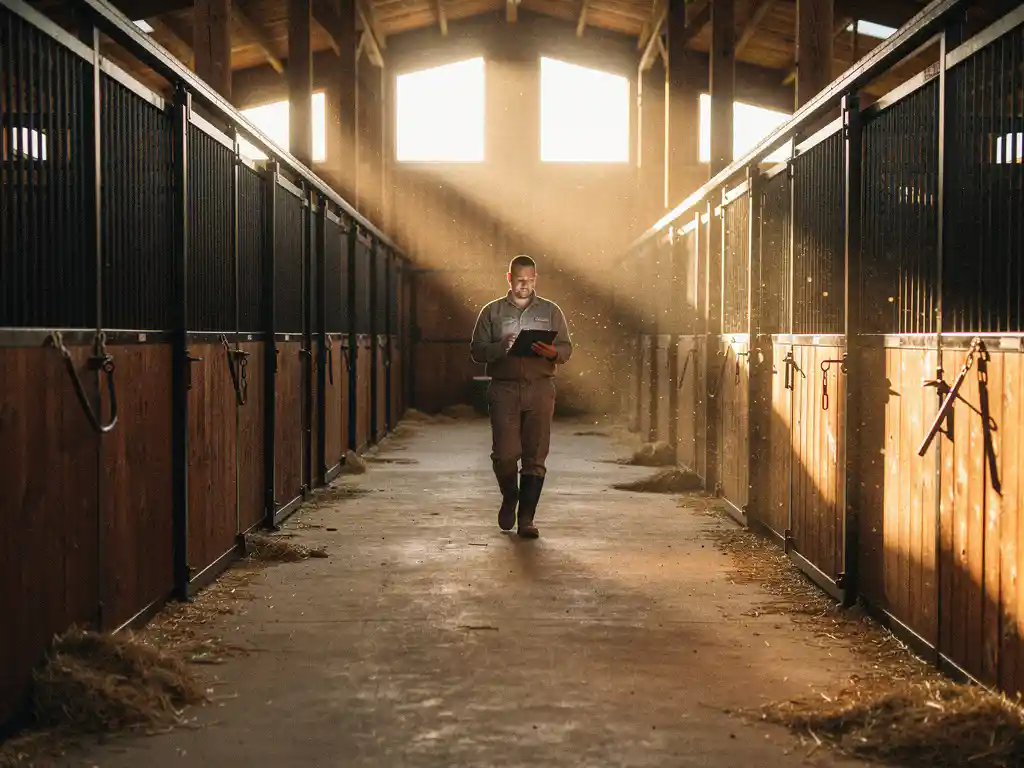
Large boarding facilities can reduce horse bedding costs by combining rubber stall mats with a thinner layer of bedding material. Mats create a cushioned, insulating base, which means you need far less shavings or straw on top to keep horses comfortable. Most facilities that make the switch report using significantly less bedding per stall, which adds up to real savings across dozens of stalls over a full year.
Why do bedding costs add up so fast in large boarding facilities?
Bedding costs escalate quickly in large facilities because every stall needs a fresh, thick layer of material to keep horses comfortable, dry, and free from injury. Multiply that by 20, 50, or 100 stalls, and you are dealing with constant, high-volume consumption that never really stops. Labor, storage, and disposal costs layer on top of the material cost itself, making bedding one of the biggest recurring expenses a boarding operation faces.
The core problem is that traditional bedding is consumable by design. Horses urinate and defecate throughout the day, which saturates the bedding and forces regular removal and replacement. Even with diligent stall management, a meaningful portion of each bag or bale goes to waste rather than serving its purpose. In a large facility, that waste compounds across every stall, every day, every week.
There is also the hidden cost of labor. Staff spend a significant portion of their working hours mucking out stalls, hauling soiled material, and laying fresh bedding. That time cost is easy to overlook when you are focused on the price per bag, but it is a real operational expense that grows in direct proportion to the number of stalls you manage.
What bedding materials do boarding facilities typically use?
The most common bedding materials in horse boarding facilities are wood shavings, straw, wood pellets, and shredded paper. Wood shavings are the most widely used option because they are absorbent, relatively affordable, and easy to source. Straw is traditional and comfortable for horses but absorbs less moisture and can be harder to manage in large quantities. Wood pellets are increasingly popular because they expand when wet and offer strong absorbency in a compact, easy-to-store format.
Each material comes with its own trade-offs. Shavings are bulky to store and generate a large volume of waste. Straw requires more frequent full changes because it breaks down quickly under heavy use. Pellets tend to be more expensive upfront but can stretch further per stall. Shredded paper is a dust-free alternative sometimes used for horses with respiratory sensitivities, though it is less widely available and can be costly.
For large facilities, the purchasing and logistics side of bedding management is its own challenge. You need reliable suppliers, adequate storage space, and a consistent delivery schedule to keep dozens of stalls properly bedded at all times. Any disruption to supply can create real operational headaches, which is another reason many facilities look for ways to reduce their dependence on high-volume bedding consumption.
How do rubber stall mats reduce bedding consumption?
Rubber stall mats reduce bedding consumption by providing a firm, cushioned, and insulating base layer that replaces the thick bedding depth horses would otherwise need for comfort. With a quality mat installed, you only need a thin top layer of shavings or straw to manage moisture and give horses something to paw at. That reduction in depth directly translates to less material purchased, less waste generated, and less time spent mucking out.
The insulation effect of rubber matting is a big part of why it works so well. Bare concrete is cold, hard, and unforgiving, which means horses need a deep layer of bedding just to stay warm and comfortable when lying down. A rubber mat addresses the hardness and the cold simultaneously, so the bedding on top only needs to handle moisture absorption rather than doing all the heavy lifting on its own.
Rubber mats also stay in place and maintain their structure over time, unlike bedding that shifts, compacts, and breaks down with use. This stability means the base of the stall stays consistently comfortable without requiring constant topping up. Horses are less likely to dig through to the bare floor, which is a common source of bedding waste in stalls without mats.
Our 4×6 Stall Mat, for example, is specifically designed to absorb shock and help reduce bedding costs while insulating against cold and damp conditions. At 3/4 inch or 5/8 inch thick, it gives horses a genuinely comfortable surface that does real work, so your bedding does not have to.
What is the long-term cost difference between mats and traditional bedding?
Over a two- to three-year period, rubber stall mats typically pay for themselves through bedding savings alone. The upfront cost of mats is real, but it is a one-time investment. Bedding, by contrast, is an ongoing expense that recurs every week for the entire life of your facility. When you reduce the amount of bedding needed per stall by a meaningful margin, the cumulative savings across a large number of stalls add up faster than most facility managers expect.
To think about it practically: if a stall without mats requires a full bag of shavings every few days, and a matted stall requires a fraction of that, the difference per stall per year is significant. Multiply that across 30, 50, or 100 stalls, and the annual savings can cover the cost of the mats themselves within a reasonable timeframe. After that payback period, the savings are essentially pure return on investment.
Labor savings compound the financial case. Mucking out a matted stall is faster and easier because soiled material sits on a smooth, non-porous surface rather than mixing into a deep bedding layer. Staff can work through stalls more efficiently, which either reduces labor hours or frees up time for other tasks. In a large facility, that efficiency gain has real dollar value.
It is also worth factoring in the durability of quality rubber mats. A well-made mat installed correctly can last many years without needing replacement, meaning the one-time cost is spread across a long service life. That longevity is a meaningful advantage over consumable bedding materials, which offer no lasting value once they are removed from the stall.
How should large facilities manage bedding inventory and purchasing?
Large boarding facilities manage bedding inventory most effectively by forecasting usage based on stall count and bedding type, maintaining a buffer stock, and negotiating volume purchasing agreements with reliable suppliers. Reactive purchasing, where you order when you are nearly out, leads to higher per-unit costs and the risk of running short during busy periods. A proactive, planned approach keeps costs predictable and gives you leverage with suppliers.
Track usage per stall type
Not all stalls use the same amount of bedding. Foaling stalls, recovery stalls, and stalls housing horses that spend more time inside will go through bedding faster than standard stalls. Tracking usage by stall type helps you forecast more accurately and avoid over-ordering for low-use areas while under-ordering for high-use ones.
Negotiate bulk pricing and delivery schedules
Volume is your biggest negotiating tool as a large facility. Suppliers are generally willing to offer better pricing for consistent, high-volume orders with predictable delivery schedules. Locking in a regular delivery cadence also reduces the administrative burden of repeated ordering and helps you plan storage capacity more effectively.
Reduce baseline consumption with mats
The single most impactful inventory management move a large facility can make is reducing how much bedding each stall needs in the first place. Installing rubber mats across your stalls lowers your baseline consumption, which shrinks your storage requirements, reduces your ordering frequency, and makes your supply chain simpler to manage overall.
What mistakes do boarding facilities make when trying to cut bedding costs?
The most common mistake boarding facilities make when trying to reduce bedding costs is simply using less bedding without changing anything else. Thinning out the bedding layer without a mat underneath leads to horses standing and lying on hard, cold floors, which causes discomfort, increases injury risk, and can affect horse health and performance. Cost-cutting that compromises animal welfare is not a sustainable strategy and often creates larger costs down the line.
Another frequent mistake is switching bedding materials without fully evaluating the practical implications. A cheaper material that requires more frequent full changes, generates more waste, or takes longer to manage can end up costing more in total than the material it replaced. The price per bag or bale is only one part of the real cost picture.
Facilities also sometimes underestimate the value of labor when calculating bedding costs. A material that seems cheaper on paper but adds 20 minutes of work per stall per day is not actually cheaper when you account for staff time across a full year. Any honest cost comparison needs to include the labor dimension.
Finally, many facilities delay investing in rubber mats because of the upfront cost, without calculating the payback period. This is a case where short-term thinking leads to higher long-term spending. The facilities that manage bedding costs most effectively tend to be the ones that made the infrastructure investment early and then benefited from lower ongoing costs for years afterward.
When is the right time to switch to rubber matting across all stalls?
The right time to switch to rubber matting across all stalls is when the cumulative cost of bedding, labor, and stall maintenance clearly outweighs the investment in mats, or when you are building, renovating, or expanding your facility. Renovation and new construction are the most practical times to install mats because the disruption is already happening. But even in an existing, fully operational facility, a phased rollout can make the transition manageable without taking stalls out of service all at once.
A phased approach works well for large facilities. Start with the highest-use stalls, where bedding consumption is greatest and the payback period will be shortest. Once those stalls are generating savings, use those savings to fund the next phase. This self-funding rollout model means the switch does not require a large capital outlay all at once.
If your facility has non-standard stall dimensions, custom sizing is worth considering from the start. Mats that fit precisely to your stall dimensions eliminate gaps where bedding can shift underneath, which undermines the mat’s effectiveness and creates extra maintenance work. Getting the sizing right the first time is more cost-effective than working around ill-fitting standard sizes.
When you are ready to make the switch, we are here to help you find the right solution for your facility. Our custom rubber matting is cut to any size or shape, so every stall gets a precise fit with minimal seams and no awkward gaps. Whether you are outfitting a handful of stalls or rolling out across an entire large facility, we can work with you to make the process straightforward and cost-effective from day one.
Frequently Asked Questions
How thick should the bedding layer be on top of rubber stall mats?
With quality rubber mats installed, most facilities find that 1 to 2 inches of bedding on top is sufficient to manage moisture and give horses something to paw at. This is a significant reduction from the 4 to 6 inches typically needed on bare concrete or dirt floors. The exact depth will depend on your bedding material and how much time each horse spends in the stall, but the key principle is that the mat handles comfort and insulation while the bedding handles moisture.
Are rubber stall mats safe for horses that tend to paw or dig at their bedding?
Yes, rubber stall mats are generally safe for horses that paw, and in many cases they actually reduce the behavior. Horses often dig and paw to find a more comfortable surface, so a mat that already provides cushion and warmth can reduce the motivation to dig in the first place. Look for mats with a textured or grooved surface, which provides better traction and reduces the risk of slipping during normal movement or when horses shift their weight while lying down.
How do you clean and maintain rubber stall mats properly?
Rubber stall mats are straightforward to maintain. During daily mucking, soiled bedding lifts cleanly off the non-porous surface, and any residual moisture or waste can be scraped away easily. For a deeper clean, mats can be removed periodically, hosed down, and left to dry before being reinstalled. It is worth checking underneath the mats occasionally for moisture buildup, especially in the early stages after installation, to ensure your stall floor underneath stays dry and structurally sound.
Can rubber mats be used with wood pellet bedding, or do they work best with shavings?
Rubber mats work well with all common bedding types, including wood pellets, shavings, and straw. Wood pellets are actually a particularly effective pairing because they expand when wet and lock in moisture efficiently, meaning you need even less material on top of the mat. The combination of rubber mats and wood pellets is one of the lowest-consumption setups available to large boarding facilities and is worth evaluating if you are looking to maximize your cost savings.
What should I look for when evaluating the quality of rubber stall mats before purchasing?
The key factors to evaluate are thickness, density, surface texture, and how the mats are cut and fitted. A mat that is at least 5/8 inch thick provides meaningful cushioning and insulation, while 3/4 inch offers even better performance for horses that spend long periods in the stall. Dense, solid rubber holds up better over time than lower-quality options that compress or crack with use. Precise cutting to your stall dimensions is also critical — gaps between mats allow bedding to shift underneath and urine to pool in hard-to-clean areas, which undermines the mat’s effectiveness.
How do I calculate whether rubber mats are a financially sound investment for my specific facility?
Start by calculating your current annual bedding cost per stall, including material, delivery, and a realistic estimate of the labor time spent mucking and re-bedding. Then estimate your bedding cost per stall with mats installed, using a conservative reduction figure such as 40 to 50 percent less material. Multiply the annual savings per stall by your total stall count, then divide the total mat investment by that annual savings figure to get your payback period in years. Most large facilities find the payback period falls between one and three years, after which the savings are ongoing.
Is a phased rollout or a full facility switch the better approach for an operational boarding facility?
For most large operational facilities, a phased rollout is the more practical and financially manageable approach. Begin with your highest-use stalls — those housing horses that are inside the most, or stalls that go through bedding the fastest — since these will generate the fastest return on investment. The savings from the first phase can then be reinvested to fund subsequent phases, creating a self-funding rollout that avoids a large single capital outlay. A full facility switch in one go makes more sense if you are already undergoing renovation or new construction, where the disruption cost is already built into the project.
Related Articles
- How do different facility environments affect floor performance?
- How do entrances create floor safety risks?
- What is the easiest floor to disinfect in an animal clinic?
- How do you keep a large animal veterinary floor hygienic?
- How do you set up a new horse stall from scratch?
- What do you put under heavy equipment to protect a floor?
- How do you reduce fatigue for workers who stand all day on a concrete floor?
- What floor protection is needed for indoor crane operations?
- How do you know if your factory floor is causing worker fatigue?
- What is the most comfortable floor surface for a horse to stand on?