
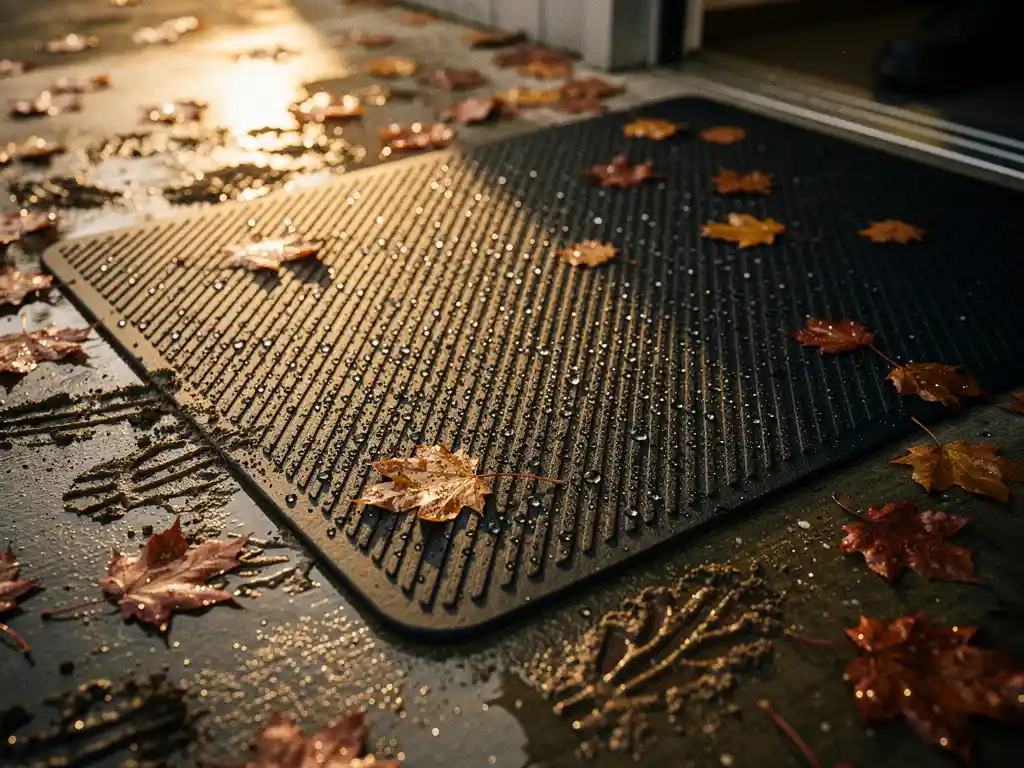
You can prevent seasonal floor hazards by combining good housekeeping habits with the right physical barriers — most importantly, placing slip-resistant rubber mats at entry points, transition zones, and high-traffic areas where moisture, mud, ice, and debris are most likely to be tracked in. The strategy is straightforward: stop the hazard at the source before it spreads across your floors. The sections below walk through the most common seasonal risks, why they matter, and exactly what you can do about them.
What types of floor hazards change with the seasons?
Seasonal floor hazards shift with the weather. In winter, the main risks are water, ice, slush, and road salt tracked in from outside. Spring and autumn bring mud, wet leaves, and rain. Summer introduces sand, grass clippings, and increased foot traffic from outdoor activities. Each season creates its own combination of slip, trip, and contamination risks on indoor floors.
The reason these hazards matter so much is that they are largely invisible to people moving quickly through a space. A thin film of water on a smooth floor can be just as dangerous as a patch of ice, but far less obvious. Mud and wet leaves compress underfoot and become slippery almost instantly. Road salt, while useful outside, leaves a residue indoors that can reduce traction and damage certain floor surfaces over time.
Understanding which hazards are most likely in your environment during each season helps you prepare proactively rather than react after an incident has already occurred. A floor safety inspection at the start of each season is a practical way to identify where the risks are concentrated and whether your current matting or drainage setup is adequate.
Why are wet and icy floors more dangerous than they look?
Wet and icy floors are more dangerous than they appear because the hazard is often invisible or underestimated. A thin layer of water reduces the friction between a shoe sole and the floor surface dramatically, and ice can look identical to a dry floor under certain lighting conditions. Most slip-and-fall incidents happen not because people are careless, but because they simply do not see the hazard in time to adjust.
The physics behind this are straightforward. Traction depends on the friction between two surfaces. Water acts as a lubricant, reducing that friction significantly. Ice reduces it even further. When friction drops below a certain threshold, even a small shift in body weight can cause a loss of balance. This is why wet floors near entrances are responsible for a large share of indoor slip-and-fall incidents, particularly during autumn and winter months.
There is also a behavioral factor at play. People entering a building from outside are often distracted, moving quickly, or carrying items. They are not looking down at the floor. This makes the transition zone between outdoors and indoors one of the highest-risk areas in any commercial or industrial building during wet or icy conditions.
How does rubber matting reduce seasonal slip-and-fall risks?
Rubber matting reduces seasonal slip-and-fall risks by providing a high-traction surface that scrapes debris from footwear, absorbs moisture, and creates a stable walking zone in areas where wet or contaminated floors would otherwise pose a hazard. The texture of rubber increases friction underfoot, while the mat’s structure channels water and dirt away from the walking surface.
At entry points, a rubber mat works in two ways at once. The surface texture scrapes mud, slush, and debris from the soles of shoes before they reach the interior floor. At the same time, the mat absorbs moisture, preventing it from being tracked further into the building. This dual action is what makes rubber entry mats so effective at reducing floor hazards during wet seasons.
In industrial and commercial settings, rubber mats with drainage holes or channeled surfaces go a step further by allowing liquids to pass through the mat entirely, keeping the walking surface dry even in areas where water is being used continuously. For seasonal use in areas like building entrances, loading docks, or covered walkways, a solid rubber mat with a textured surface and beveled edges is typically the most practical option.
What’s the difference between entry mats and anti-fatigue mats for seasonal use?
Entry mats and anti-fatigue mats serve different purposes. Entry mats are designed to capture dirt, moisture, and debris at transition points between outdoor and indoor spaces. Anti-fatigue mats are designed to reduce physical strain on people who stand for long periods. During seasonal periods with high floor hazard risk, both types may be needed, but they are placed in different locations for different reasons.
Entry mats: stopping hazards at the door
Entry mats are your first line of defense against seasonal floor hazards. They sit at doorways, building entrances, and any transition zone where people move from a wet or dirty outdoor surface to an indoor floor. A good entry mat has a textured surface that grips footwear, a non-slip backing that keeps the mat itself in place, and enough surface area to allow at least two or three steps before a person reaches the interior floor.
During winter and autumn, entry mats take on heavy loads of moisture, salt, and debris. Choosing a mat made from a dense, non-porous material like rubber means the mat will not absorb and hold that moisture, making it easier to clean and less likely to become a hygiene issue over time.
Anti-fatigue mats: comfort and safety in work zones
Anti-fatigue mats are placed in areas where workers stand for extended periods, such as at assembly stations, checkout counters, or production lines. While their primary function is ergonomic, they also contribute to floor safety by providing a stable, slip-resistant surface underfoot. During seasonal periods when floors may be more frequently wet, an anti-fatigue mat with a textured top surface and drainage features can reduce both fatigue and slip risk in work areas.
The key distinction is placement and purpose. If you are trying to prevent tracked-in moisture and debris from spreading, you need an entry mat. If you are trying to protect workers who stand in one place for hours, you need an anti-fatigue mat. In many commercial and industrial environments, both are needed simultaneously.
Where should rubber mats be placed to prevent seasonal hazards?
Rubber mats should be placed at every point where a seasonal hazard is likely to be introduced or concentrated. This includes building entrances, loading docks, stairwells, transition zones between wet and dry areas, and any interior location where water, mud, or debris is regularly tracked in from outside. Placement should follow the path that people and materials actually travel, not just the most obvious spots.
A practical approach is to walk through your building at the start of each season and observe where moisture, dirt, or debris tends to accumulate. These are the locations where matting will have the most impact. Common high-priority areas include:
- Main building entrances and lobbies, where foot traffic is highest
- Side doors and service entrances used by staff and delivery personnel
- Loading docks and warehouse entry points where vehicles and foot traffic intersect
- Stairwells and landings, where wet shoes create a compounding fall risk
- Break rooms and restrooms, where water is frequently present year-round
- Covered walkways and canopies, where rain drips off and pools on the surface
In larger facilities, a layered approach works well. Place a coarser scraper mat immediately outside the door to remove heavy debris, then a second absorbent mat just inside the entrance to capture remaining moisture. This two-mat system is one of the most effective ways to prevent seasonal floor hazards from spreading beyond the entry zone.
How do you maintain rubber mats during high-traffic seasonal periods?
During high-traffic seasonal periods, rubber mats should be cleaned more frequently than usual, inspected regularly for wear and displacement, and replaced when they no longer perform their intended function. A mat that is saturated with moisture, curling at the edges, or visibly worn in the center is no longer providing effective slip resistance and can itself become a trip hazard.
Rubber is a practical material to maintain because it is non-porous and does not absorb moisture or bacteria the way fabric or foam alternatives can. A rubber mat can typically be cleaned with mild detergent and water, rinsed thoroughly, and returned to service quickly. During peak seasons like winter or heavy rain periods, a daily cleaning routine is worth building into your standard floor safety inspection process.
A few maintenance habits that make a real difference during high-traffic seasonal periods:
- Shake out or vacuum rubber mats at least once per day to remove loose debris
- Mop or hose down mats regularly, and allow them to dry fully before replacing them
- Check mat edges and corners daily to ensure they are lying flat and not creating a trip hazard
- Rotate mats if one area receives significantly heavier traffic than another
- Keep a spare mat available so you can swap and clean without leaving a high-risk area unprotected
At LRP Matting, we make rubber mats from genuine, non-porous rubber that will not crack, peel, or absorb moisture, which makes seasonal maintenance significantly easier. Our commercial rubber matting solutions are built to handle exactly these kinds of high-traffic, high-moisture conditions, so you spend less time managing your mats and more time focusing on keeping your space safe.
Frequently Asked Questions
How do I know if my current rubber mats are still providing adequate slip resistance?
The most reliable signs that a mat has lost its effectiveness are visible surface wear in the centre, a smooth or compressed texture where the tread pattern has flattened, curling or lifting edges, and a mat that slides when stepped on. You can also do a simple friction test by scuffing your foot across the surface — a mat that still grips should feel noticeably resistant. As a general rule, if a mat is showing any of these signs, it should be replaced rather than cleaned, since worn rubber cannot restore its original traction properties.
Can I use a single mat at the entrance, or do I really need multiple mats?
A single mat can help, but research and practical experience consistently show that a two-mat system — a coarse scraper mat outside and an absorbent or textured rubber mat just inside — removes significantly more moisture and debris than one mat alone. The reason is that a single mat can only do so much in the one or two steps a person takes across it, whereas a layered system gives footwear more contact time and more surface area for cleaning and drying. During peak seasons like winter or heavy rain periods, the difference in floor cleanliness and dryness between a single-mat and two-mat setup is noticeable within hours of heavy foot traffic.
What size rubber mat do I need for an entrance or doorway?
The standard guidance is that an entry mat should be long enough to allow at least three full walking steps across its surface, which typically means a minimum length of around 1.5 to 1.8 metres for a standard commercial entrance. Width should match or slightly exceed the width of the doorway so that people entering from any angle step onto the mat rather than around it. Undersized mats are one of the most common matting mistakes — a mat that is too small simply does not give footwear enough contact time to remove moisture and debris effectively.
Are there seasonal floor hazards that rubber mats alone cannot address?
Yes — rubber mats are highly effective at entry and transition points, but they cannot address every seasonal hazard on their own. In areas with heavy snowmelt or standing water, floor drainage systems or water barriers may also be needed. Ice formation on outdoor surfaces leading up to an entrance requires gritting, salting, or heated walkway solutions before people even reach the mat. Additionally, spills and condensation in interior zones away from entry points need to be managed through housekeeping protocols, wet floor signage, and appropriate flooring materials — mats alone cannot cover an entire facility.
How often should I replace rubber mats used in high-traffic seasonal environments?
In high-traffic commercial or industrial settings, rubber entry mats typically need replacing every one to three years, depending on foot traffic volume, the severity of seasonal conditions, and how consistently the mats are maintained. Mats used at loading docks or industrial entrances will wear faster than those in a small office lobby. The most practical approach is to inspect mats at the start and end of each peak season — if the tread is visibly worn, the mat no longer lies flat, or it has developed cracks or tears, it is time to replace it rather than risk it becoming a hazard itself.
Can rubber mats cause damage to my interior floors over time?
High-quality, non-porous rubber mats with clean, smooth backings are generally safe for most floor surfaces, including tile, concrete, vinyl, and hardwood. However, mats that trap grit or debris underneath them can act like sandpaper on delicate floor finishes if they shift under foot traffic, which is why regular cleaning of both the mat and the floor beneath it is important. It is also worth checking that any mat you use is free from plasticisers or chemicals that can stain or react with certain floor coatings — genuine rubber mats without added fillers are the safest option for protecting your floor surface long-term.
What should I do if staff or visitors are still tracking moisture past the entry mat area?
If moisture is consistently getting past your entry zone, the most likely causes are an undersized mat, insufficient mat length for the number of steps taken, or a single-mat setup that is not capturing enough debris in one pass. Start by extending your matting coverage — add a second mat further into the entrance corridor, or upgrade to a longer mat that provides more walking contact. You should also check whether side doors or service entrances are being used as shortcuts and whether those points have adequate matting. Finally, reinforcing good habits with clear signage asking people to wipe their feet, combined with more frequent mat cleaning during peak periods, can make a meaningful practical difference.
Related Articles
- What are the biggest flooring maintenance mistakes?
- What makes an animal housing facility safe?
- How do you protect a sports facility floor from moisture and heavy use?
- How do you protect a sports facility floor during the off-season?
- What is the best way to cover an uneven barn floor?
- What is the best flooring for a high-traffic horse barn?
- What is the best way to protect a warehouse floor during construction?
- What type of flooring is best for a horse recovery stall?
- How do you insulate a horse stall floor in winter?
- Can a hard barn floor cause tendon damage in horses?