
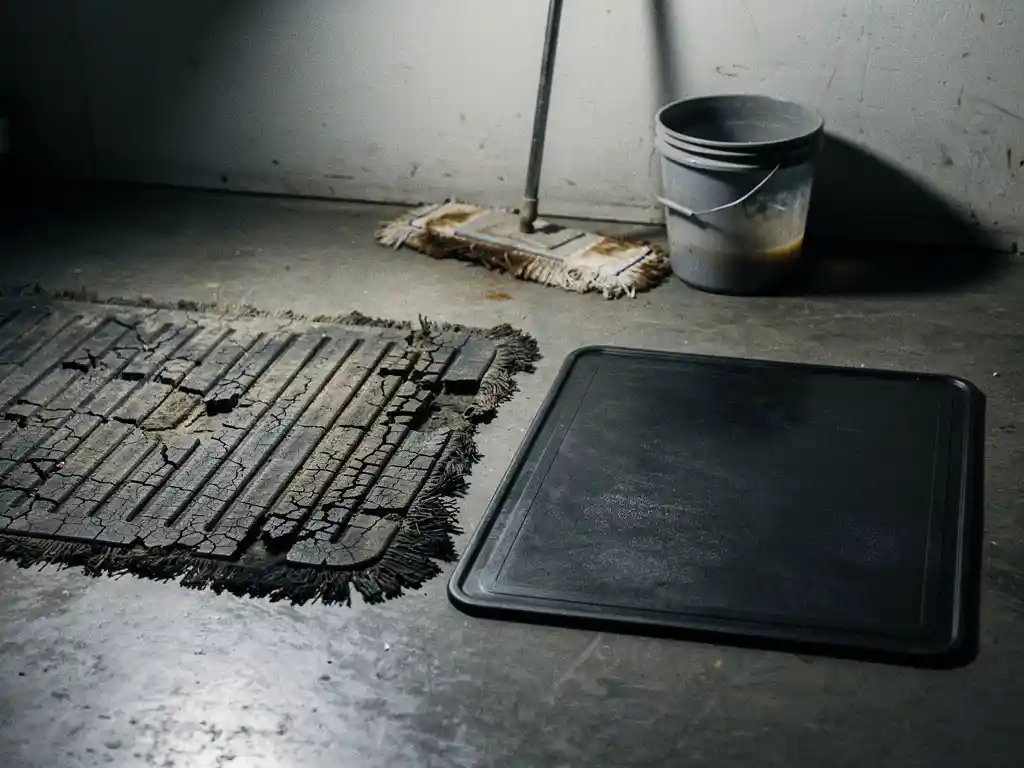
The biggest flooring maintenance mistakes are using the wrong cleaning products, neglecting seams and edges, reacting to damage instead of preventing it, and placing mats in environments they were never designed for. These habits accelerate wear, create safety hazards, and turn minor issues into expensive repairs. Whether you manage a warehouse, a gym, or a commercial facility, the same patterns come up again and again. Below, we break down each one so you can spot them before they cost you.
What types of damage do poor maintenance habits actually cause?
Poor floor maintenance habits cause surface degradation, structural weakening, slip hazards, and premature material failure. The damage builds gradually, which is exactly why it catches so many facility managers off guard. By the time it becomes visible, the underlying problem has often been developing for months.
Surface damage is the most obvious outcome. Abrasive cleaning tools scratch and roughen flooring materials, which then trap dirt more easily and become harder to clean over time. Using harsh chemicals on rubber or vinyl strips away protective layers and causes cracking or discoloration.
Structural damage is more serious. Water that seeps under mats or into flooring joints softens adhesives, warps subfloors, and promotes mold growth. In industrial and commercial settings, this kind of hidden damage can compromise the integrity of the floor itself, leading to uneven surfaces that create trip hazards and increase liability risk.
Safety deterioration is the third and most immediate concern. A mat that curls at the edges, a floor with a worn anti-slip coating, or a surface that has become uneven underfoot all increase the risk of slips and falls. Preventive floor maintenance is not just about aesthetics. It directly affects how safe a space is for the people working or moving through it.
What are the most common flooring cleaning mistakes?
The most common flooring cleaning mistakes are using too much water, choosing the wrong cleaning products, scrubbing with abrasive tools, and skipping regular cleaning schedules. Each of these mistakes accelerates wear and can cause damage that looks like aging but is actually self-inflicted.
Excess water is a frequent offender. Wet mopping leaves standing water that works its way into seams, under mats, and into porous subfloor materials. Even non-porous flooring like rubber can suffer when water pools around edges and seams repeatedly over time.
Product mismatches are another common problem. Bleach-based cleaners, solvent-heavy degreasers, and highly alkaline solutions can degrade rubber compounds, strip coatings from vinyl, and discolor natural flooring. Always check manufacturer guidance before introducing a new cleaning product to your floor care routine.
Skipping routine cleaning in favor of occasional deep cleans is also counterproductive. Dirt and grit act like sandpaper underfoot. The longer they sit on a surface, the more micro-abrasion occurs with every footstep. A consistent light-cleaning schedule does less cumulative damage than infrequent heavy scrubbing.
How does ignoring seams and edges lead to bigger problems?
Ignoring seams and edges allows moisture, dirt, and debris to accumulate in the most vulnerable areas of any floor installation. Over time, this leads to lifting, separation, mold growth, and structural damage to both the flooring material and the subfloor beneath it.
Seams are the weakest point in any floor covering. When they are not sealed properly or maintained regularly, they become entry points for liquids and contaminants. In high-traffic commercial or industrial environments, foot traffic and equipment movement create constant mechanical stress at these joints, which gradually widens gaps.
Edges that curl or lift present an immediate trip hazard. They also signal that adhesion has failed or that moisture has compromised the bond between the floor covering and the substrate. Catching this early means a repair. Ignoring it means a replacement.
Regular inspection of seams and edges should be part of any facility maintenance checklist. Running a hand along edges during routine walkthroughs takes seconds and can catch problems while they are still minor.
Why does choosing the wrong mat for the environment cause maintenance headaches?
Choosing the wrong mat for the environment causes maintenance headaches because the mat degrades faster than expected, fails to perform its intended function, and often creates new problems like moisture retention or surface damage. A mat designed for light commercial use will not hold up in a heavy industrial setting, no matter how well you maintain it.
Environmental mismatch is one of the most overlooked sources of floor maintenance problems. A mat placed in a wet or chemically active environment needs to be made from materials that resist those specific conditions. A standard foam or carpet-backed mat in a food processing area, for example, will absorb liquids, harbor bacteria, and deteriorate rapidly.
Weight and traffic load matter just as much. Mats in high-traffic corridors or under heavy equipment need sufficient thickness and density to maintain their shape under repeated compression. When a mat flattens out or deforms, it loses its anti-fatigue and anti-slip properties, and it starts to shift underfoot, creating new hazards.
Matching the mat to the environment from the start reduces cleaning frequency, extends the product’s useful life, and keeps maintenance costs predictable. Rubber mats are a practical option for many demanding environments because genuine rubber is non-porous, does not absorb moisture, and holds up under extreme temperatures without cracking or peeling.
What’s the difference between reactive and preventive floor maintenance?
Reactive floor maintenance means addressing problems after they appear. Preventive floor maintenance means following a scheduled routine to stop problems from developing in the first place. The difference in cost and disruption between the two approaches is significant, especially in commercial and industrial facilities where downtime affects operations.
Reactive maintenance is the default for many facilities, not because it is better, but because it feels more manageable. You fix what is broken when it breaks. The problem is that flooring damage rarely stops at the surface. By the time a crack or lifted edge is visible, moisture may already have reached the subfloor, or a slip hazard may have existed for weeks without anyone noticing.
Preventive maintenance works on a schedule. It includes regular cleaning, periodic inspections, prompt repair of minor damage, and planned replacement of materials before they fail. This approach costs less over time because it avoids emergency repairs, reduces liability exposure, and extends the service life of flooring investments.
For facility management teams, the shift from reactive to preventive thinking often starts with a simple inspection checklist and a realistic cleaning schedule tied to actual traffic patterns rather than calendar convenience.
How often should rubber mats and industrial flooring be inspected?
Rubber mats and industrial flooring should be inspected at least once a month in standard commercial environments, and weekly in high-traffic or chemically active industrial settings. More frequent walkthroughs are worthwhile in areas where safety is a priority, such as loading docks, production floors, or wet processing areas.
Monthly inspections should cover the full surface for signs of cracking, lifting, discoloration, or deformation. Seams and edges deserve specific attention, as these are the first areas to show stress. Any mat that has shifted, curled, or lost its grip on the surface below should be repositioned or replaced immediately.
Weekly checks in demanding environments should focus on safety-critical details: is the mat still flat, are edges secure, are anti-slip surfaces still functional, and is there any visible moisture accumulation underneath? These checks do not need to be lengthy. A systematic five-minute walkthrough is enough to catch most developing problems before they become serious.
Keeping a simple inspection log is useful for facility maintenance teams. It creates accountability, helps identify recurring problem areas, and provides documentation if a safety incident ever needs to be reviewed. At LRP Matting, we design our rubber mats to minimize maintenance demands, but no flooring product eliminates the need for regular checks entirely. If you want to explore industrial rubber matting solutions built to handle the toughest environments, we are happy to help you find the right fit.
Frequently Asked Questions
How do I know when a rubber mat needs to be replaced rather than just cleaned or repaired?
A rubber mat should be replaced when it shows permanent deformation, deep cracking, significant surface hardening, or when its edges can no longer lie flat after repositioning. Cleaning and minor repairs can extend a mat’s life, but once the material loses its structural integrity or anti-slip properties, maintenance cannot restore them. If a mat shifts underfoot, compresses unevenly, or no longer provides the grip and cushioning it was designed for, replacement is the safer and more cost-effective choice.
What cleaning products are actually safe to use on rubber flooring and mats?
Mild pH-neutral detergents diluted in warm water are the safest and most effective option for cleaning rubber flooring and mats. Avoid bleach-based cleaners, solvent-heavy degreasers, and highly alkaline or acidic solutions, as these break down rubber compounds and cause cracking, swelling, or discoloration over time. When in doubt, always check the manufacturer’s care guidelines before introducing any new product, and test on a small, inconspicuous area first.
Can I use the same maintenance routine for all types of flooring in my facility?
No — different flooring materials require different cleaning products, tools, and inspection priorities. Rubber, vinyl, epoxy, and natural flooring each respond differently to moisture, chemicals, and mechanical stress, so a one-size-fits-all routine will inevitably damage some surfaces while under-maintaining others. The most effective approach is to map out the flooring types across your facility and create material-specific care protocols for each zone, particularly in areas with mixed flooring or high chemical exposure.
What's the best way to build a preventive maintenance checklist for a commercial or industrial facility?
Start by identifying every flooring type and high-risk zone in your facility, then assign inspection frequencies based on traffic volume and environmental conditions — weekly for demanding areas, monthly for standard ones. Your checklist should cover surface condition, seam and edge integrity, mat positioning, anti-slip functionality, and any signs of moisture accumulation. Keep the checklist simple enough that any team member can complete it consistently, and log each inspection with a date and the name of the person who conducted it to maintain accountability.
How can I prevent moisture from getting under mats in wet or high-humidity environments?
Choose mats specifically designed for wet environments — ones made from non-porous materials like solid rubber that do not absorb moisture and allow drainage rather than trapping water underneath. Ensure mats are lifted and the floor beneath is dried and cleaned on a regular schedule, since even the best mat will trap moisture if the underlying surface is not maintained. In persistently wet areas, drainage matting with an open-grid design is often the most effective solution, as it allows liquid to pass through and away from the surface entirely.
Are there any common mistakes facility managers make when first switching to a preventive maintenance approach?
The most common mistake is creating an overly complex maintenance schedule that staff cannot realistically follow, which leads to the routine being abandoned within weeks. Another frequent misstep is applying a preventive schedule based on calendar dates rather than actual traffic and usage patterns, which means some areas get over-maintained while genuinely high-risk zones are neglected. Start with a simple, realistic routine focused on your highest-traffic and highest-risk areas, then expand and refine it as the habit becomes established across your team.
How do I choose the right mat thickness and density for a specific area of my facility?
Match mat thickness and density to the type and volume of traffic the area receives — thicker, denser mats are needed in zones with heavy foot traffic, wheeled equipment, or prolonged standing, while lighter-duty mats are appropriate for low-traffic transitional areas. Anti-fatigue mats for standing workstations typically need a minimum of 3/8 inch thickness to provide meaningful ergonomic benefit, while entrance and safety mats in high-traffic corridors should prioritize firmness and grip over cushioning. When in doubt, consult the manufacturer’s load and traffic ratings, as using an under-specified mat will result in premature flattening and loss of performance.
Related Articles
- How do sports facilities prevent slips?
- How does flooring affect workplace comfort?
- What makes a veterinary facility safer?
- What are the warning signs of floor deterioration?
- How do you stop floor damage in a high-traffic shipping and receiving area?
- What is the best flooring for a high-traffic horse barn?
- How do you cover an irregularly shaped horse stall floor?
- How do you keep a sports facility floor safe in wet conditions?
- How do you reduce leg strain in a horse that spends a lot of time in a stall?
- Is concrete a good floor for a horse stall?