
A safe recovery environment for animals combines non-slip, cushioned flooring, good hygiene, low stress, and appropriate space. These four factors work together to support healing and reduce the risk of secondary injury during the recovery period. Whether you are managing a veterinary clinic, an equine facility, or a livestock operation, the details of your setup matter more than most people realize. Below, we answer the most common questions about what makes a recovery space truly effective.
What surfaces are safest for animals recovering from injury or surgery?
The safest surfaces for recovering animals are non-slip, shock-absorbing, and easy to clean. Smooth concrete is one of the most common flooring materials in barns and veterinary facilities, but it is also one of the most problematic for recovery. It offers no grip, no cushioning, and puts significant stress on joints and hooves every time an animal attempts to stand or shift its weight.
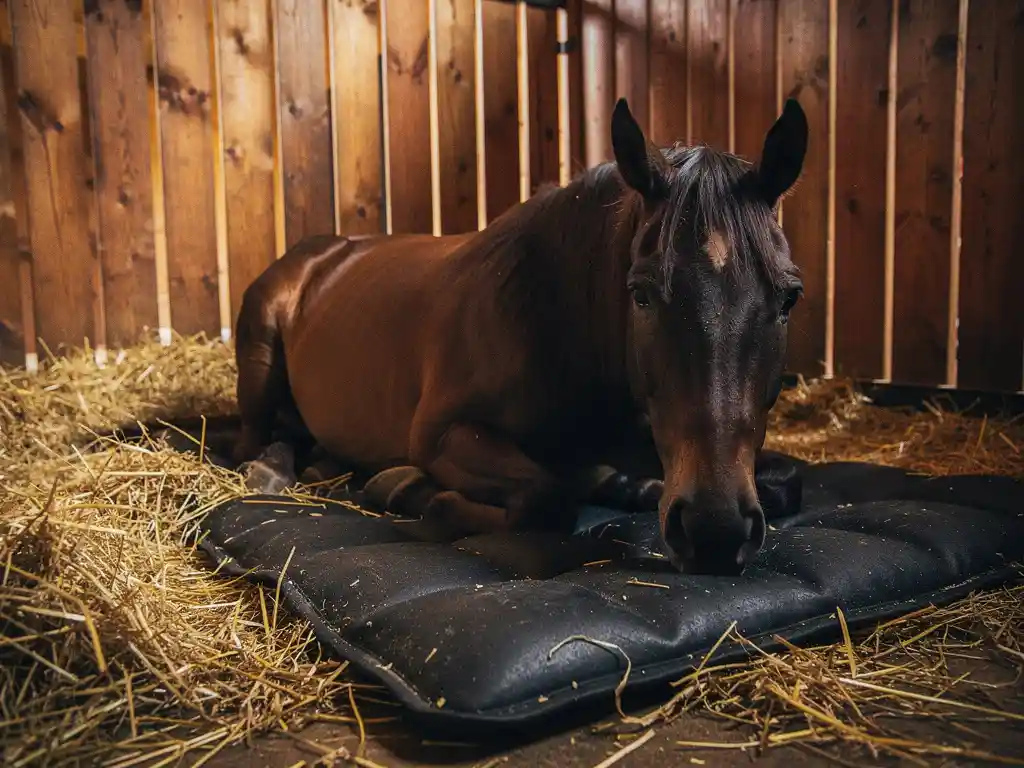
Rubber matting is widely used in recovery settings because it addresses all three of these concerns at once. It provides traction to prevent slipping, absorbs impact to reduce joint strain, and resists moisture so it can be properly disinfected between uses. For horses and large livestock in particular, the ability to get up and down without slipping is not just a comfort issue. A fall during recovery can undo surgical work, cause additional injury, or create serious complications.
Deep bedding materials like straw or shavings are also commonly used, especially in equine recovery stalls. They add cushioning and encourage animals to lie down. However, bedding alone does not solve the underlying surface problem. The best approach is to combine a rubber base layer with appropriate bedding on top, giving the animal both grip and comfort.
How does flooring affect an animal’s physical recovery?
Flooring directly affects how much physical stress an animal experiences during recovery. Hard, unforgiving surfaces increase pressure on joints, hooves, and soft tissue. Over time, this leads to discomfort, reluctance to move, and in some cases, secondary injuries that complicate the original condition. Good flooring actively supports the recovery process rather than working against it.
For large animals like horses and cattle, the ability to lie down and get back up safely is a significant part of recovery. Animals that cannot do this comfortably will spend more time standing, which increases fatigue and slows healing. A surface with adequate grip and cushioning encourages natural movement and rest, both of which are important for tissue repair and circulation.
Flooring also affects limb loading. When an animal favors an injured limb, the opposite limbs carry extra weight. If the floor is hard and slippery, that added load becomes even more stressful on joints and tendons. A stable, cushioned surface distributes weight more evenly and reduces the compensatory strain that often leads to secondary lameness.
What are the hygiene requirements for an animal recovery space?
A recovery space must be easy to clean, drain efficiently, and be disinfectable between animals. Hygiene in a recovery environment is more demanding than in a standard barn or stall because recovering animals often have open wounds, surgical incisions, or weakened immune systems. Contaminated surfaces significantly increase the risk of post-operative infection.
Flooring materials should be non-porous so they do not absorb urine, blood, or cleaning solutions. Porous materials harbor bacteria even after surface cleaning, which makes thorough disinfection nearly impossible. Rubber is a practical choice here because it is naturally non-porous and can be cleaned with standard veterinary disinfectants without degrading the material.
Drainage is another important consideration. Standing liquid encourages bacterial growth and creates slip hazards. Recovery spaces should have adequate slope toward drains, and any matting used should be positioned to allow water and waste to move away from the animal rather than pool beneath it. Regular cleaning schedules, ideally between each animal use, are a baseline requirement rather than an optional best practice.
What role does stress reduction play in animal recovery?
Stress directly slows physical recovery in animals. Elevated cortisol levels, which are the biological response to stress, suppress immune function, slow wound healing, and increase pain sensitivity. An animal that feels unsafe, uncomfortable, or agitated in its environment will recover more slowly than one that feels calm and secure, even if the medical treatment is identical.
Environmental stressors in recovery spaces include unfamiliar sounds, poor visibility of other animals, inadequate space, uncomfortable footing, and temperature extremes. Addressing these factors is a practical part of facility design, not an optional extra. Animals that can see familiar companions, stand comfortably, and move without fear of slipping tend to settle more quickly and show better recovery outcomes.
For horses in particular, the ability to adopt a natural posture and shift weight freely is closely tied to their sense of security. A surface that causes hesitation when the animal tries to stand or turn creates a persistent low-level stress response. Reducing that friction in the physical environment has a measurable effect on the animal’s overall state during recovery.
How should a recovery stall or pen be set up for large animals?
A recovery stall or pen for large animals should be spacious enough to allow the animal to lie down fully and get back up without obstruction, with safe flooring, good ventilation, and clear sightlines to reduce isolation stress. For horses, a minimum of a 14 by 14 foot stall is generally recommended for post-surgical recovery, though larger is preferable for animals with limited mobility.
Walls should be padded or lined to prevent injury if the animal falls or thrashes during the early stages of recovery from anesthesia. Rounded corners reduce the risk of an animal becoming cast, which is the term for a horse that has lain down in a position it cannot get up from without assistance.
The floor should be covered with thick rubber matting and topped with clean, dry bedding. Water and feed should be positioned at a height that does not require the animal to strain or adopt an uncomfortable posture. Lighting should be adequate but not harsh, and noise levels should be kept as low as reasonably possible, particularly in the first 24 to 48 hours after surgery or a significant injury.
What’s the difference between recovery matting and standard barn flooring?
Recovery matting is specifically designed to provide higher levels of cushioning, traction, and hygiene than standard barn flooring. Standard barn flooring, whether concrete, packed earth, or basic rubber, is built for everyday use under healthy animals. Recovery matting is built for a more demanding situation where the animal is physically compromised and the stakes of a slip or pressure injury are much higher.
The practical differences include greater mat thickness for improved shock absorption, surface textures engineered to provide grip without being abrasive to sensitive skin, and materials that withstand repeated disinfection without breaking down. Standard mats may be adequate for a healthy horse standing in a stall, but they may not provide the level of support needed for an animal recovering from colic surgery or a tendon repair.
Durability and cleanability are also more important in recovery settings because the mats are used more intensively and cleaned more frequently. Mats that crack, absorb moisture, or degrade with repeated chemical exposure become hygiene risks over time. For veterinary facilities and serious equine operations, investing in purpose-built recovery flooring is a practical decision that protects both the animal and the facility’s standards of care.
At LRP Matting, we produce rubber mats built for exactly this kind of demanding environment. Our mats are made from 100% recycled rubber, are non-porous by nature, and are designed to hold up under heavy use and frequent cleaning. Many of our products are made with our proprietary Fiber Reinforced Rubber Compound (FRC®), which adds strength and longevity beyond what standard rubber matting offers. If you are designing or upgrading a recovery space for horses or livestock, our equine matting solutions are a good place to start.
Frequently Asked Questions
How often should recovery matting be replaced, and what are the signs it needs to be changed?
Recovery matting should be inspected regularly and replaced when it shows signs of cracking, surface degradation, persistent odors that don’t clear after disinfection, or loss of surface texture that reduces grip. The lifespan of a mat depends heavily on usage intensity and cleaning frequency, but purpose-built recovery mats made with reinforced rubber compounds will generally outlast standard mats significantly. A mat that has lost its structural integrity or can no longer be reliably disinfected is no longer fit for a recovery environment and should be replaced promptly.
Can the same recovery space be used for different species, and what adjustments are needed between uses?
Yes, a recovery space can be used for different species, but thorough disinfection and a full bedding change between uses are non-negotiable. Different species carry different pathogens, and a surface that is safe for one animal may pose a cross-contamination risk for another. Beyond hygiene, you should also adjust space configuration, wall padding, and feed and water placement to suit the size, behavior, and specific recovery needs of each species before bringing a new animal in.
What are the most common mistakes facility managers make when setting up an animal recovery space?
The most common mistakes include relying on bedding alone without a proper rubber base layer, underestimating the amount of space a large animal needs to lie down and rise safely, and neglecting drainage, which leads to pooling liquid and elevated infection risk. Another frequent oversight is placing water and feed at heights or positions that force the animal into uncomfortable postures, which can stress healing tissue. Getting the fundamentals right from the start, flooring, space, hygiene, and stress reduction, prevents many of the complications that arise during recovery.
How do I manage a recovery space for an animal that is non-weight-bearing or has very limited mobility?
For non-weight-bearing or minimally mobile animals, flooring cushioning becomes even more critical because the animal will spend extended periods lying in one position, increasing the risk of pressure sores. Thick, high-density rubber matting combined with clean, dry bedding helps distribute body weight and reduce skin and tissue breakdown. You should also implement a rotation or repositioning protocol under veterinary guidance to prevent prolonged pressure on any single area, and monitor the skin and coat condition closely for early signs of pressure injury.
Does the type of surgery or injury affect how the recovery space should be configured?
Yes, the nature of the injury or procedure should directly inform your setup. For example, a horse recovering from colic surgery will need more wall padding and a larger space to manage the disorientation that follows general anesthesia, while an animal recovering from a limb injury may need ramp-free access and a floor surface with particularly high traction to reduce the risk of slipping during weight shifts. Always consult with your veterinarian about procedure-specific requirements before the animal enters the recovery space, as some conditions call for restricted movement while others benefit from controlled, encouraged activity.
What temperature and ventilation conditions are ideal for an animal recovery space?
Temperature and ventilation requirements vary by species, but the general principle is consistent: the space should be draft-free without being stagnant, and maintained at a temperature that keeps the animal comfortable without causing heat stress. For horses recovering from surgery, a well-ventilated but draught-protected stall is ideal, as both cold stress and overheating can elevate cortisol levels and slow healing. Good air circulation also helps keep the flooring and bedding drier, which directly supports hygiene and reduces bacterial growth.
How can I adapt an existing barn stall into a temporary recovery space without a full renovation?
A standard barn stall can be made recovery-ready without major structural changes by laying thick rubber recovery mats over the existing floor, adding wall padding using foam-lined panels or purpose-made stall guards, and ensuring the drainage slope is adequate. Remove any protruding fixtures, sharp edges, or unnecessary equipment from the space, and establish a rigorous cleaning routine before the animal arrives. While a purpose-built recovery stall will always offer more control, a well-prepared standard stall with the right matting and padding can meet the basic requirements for many routine post-surgical or injury recovery situations.
Related Articles
- What makes a flooring material sustainable?
- What affects the lifespan of sports flooring?
- What causes sports facility floors to wear out?
- How do you prevent seasonal floor hazards?
- How do uneven floors increase accident risk?
- How can you improve traction on existing floors?
- How often should you replace horse stall bedding?
- What do you put under heavy equipment to protect a floor?
- Can anti-fatigue matting improve worker productivity?
- What type of flooring is best for a horse recovery stall?