
Flooring has a direct impact on workplace comfort, especially for people who stand or move around for most of their shift. Hard, unforgiving surfaces like concrete put constant pressure on the feet, legs, and lower back, leading to discomfort and fatigue over the course of a workday. The right flooring choice, including materials that absorb shock and support natural posture, can make a meaningful difference in how workers feel by the end of their shift. Below, we answer the most common questions about flooring and workplace comfort so you can make a more informed decision for your space.
How does standing on hard floors affect workers over time?
Standing on hard floors over time causes progressive physical strain on the body. Without adequate cushioning underfoot, the muscles in your feet, legs, and lower back are forced to work continuously just to keep you upright. This sustained muscle activity restricts blood flow, increases fatigue, and can lead to discomfort in the joints, particularly the knees, hips, and spine.
The effects tend to build gradually. Early in a shift, workers may notice mild foot soreness. Over hours, that discomfort can spread upward through the legs and back. Over weeks and months of repeated exposure, the cumulative strain can contribute to more persistent musculoskeletal issues that affect both quality of life and attendance at work.
Concrete is one of the hardest and most common industrial flooring materials, and it offers virtually no give. Workers standing on it for six to eight hours a day absorb constant impact with little relief. This is a well-recognized challenge in manufacturing, retail, hospitality, and any industry where people spend most of their shift on their feet.
What types of flooring are best for workplace comfort?
The best flooring for workplace comfort is one that combines shock absorption, support, and slip resistance. Rubber, foam, and cushioned vinyl are among the most effective options for environments where workers stand for long periods. Of these, rubber stands out for heavy-duty and industrial settings because it holds up under significant weight and foot traffic while still providing meaningful cushioning.
Not all flooring types suit all environments equally. Here is a practical breakdown of common options:
- Rubber matting: Durable, shock-absorbing, and easy to clean. Well-suited for industrial, commercial, and agricultural settings. Holds its shape under heavy use.
- Foam tiles: Lightweight and comfortable underfoot, but less durable in high-traffic or wet environments. More common in gyms or light-duty spaces.
- Cushioned vinyl: A practical option for retail or office environments. Offers moderate comfort but may not hold up as well under heavy machinery or constant foot traffic.
- Carpet tiles: Provide some cushioning and warmth, but are difficult to keep clean in industrial or food-adjacent settings.
For most commercial and industrial environments, rubber flooring or rubber matting placed over existing hard floors is a practical and effective solution that balances comfort, durability, and hygiene.
What is anti-fatigue matting and how does it work?
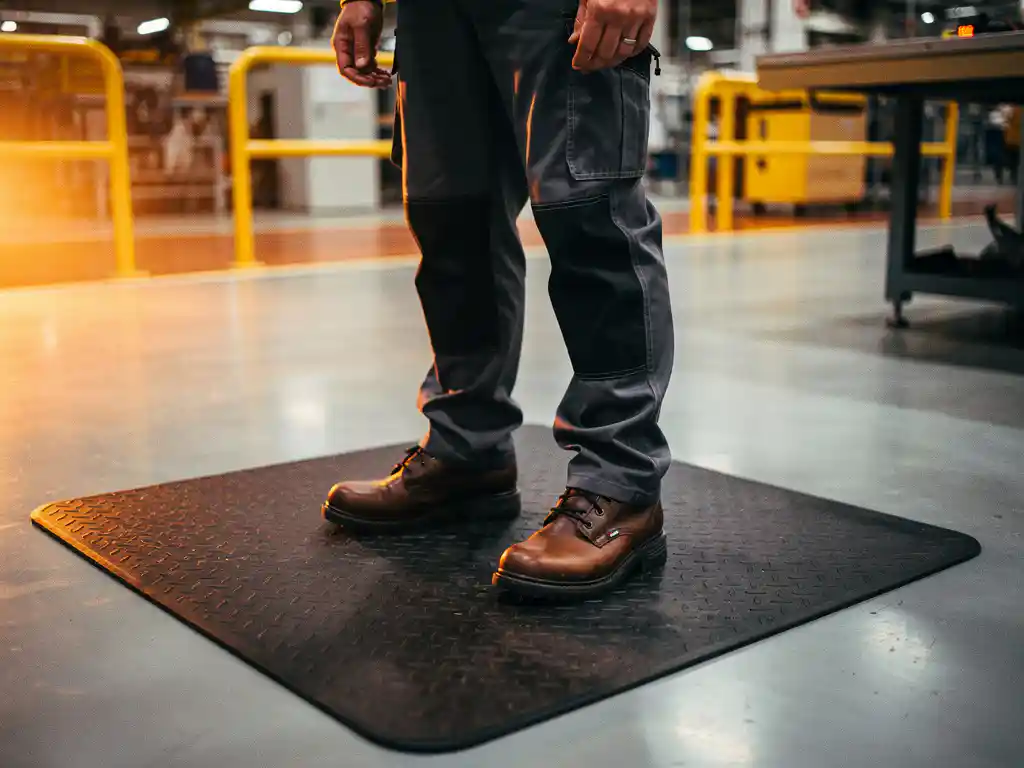
Anti-fatigue matting is a type of cushioned floor covering designed to reduce the physical strain of standing for long periods. It works by encouraging subtle, continuous micro-movements in the muscles of the legs and feet. These small movements help maintain blood circulation, which reduces the build-up of fatigue that comes from standing completely still on a hard surface.
The science behind it is straightforward. When you stand on a rigid floor, your muscles tense and hold position with little variation. Anti-fatigue mats introduce a slight give underfoot, which prompts your body to make small postural adjustments. These adjustments keep the muscles more active and the blood moving, which delays the onset of discomfort and tiredness.
Anti-fatigue mats are available in a wide range of thicknesses, materials, and surface textures depending on the application. Thicker mats generally provide more cushioning, but the right choice depends on the type of work being done, whether workers are standing still or moving around, and the specific conditions of the environment such as exposure to oils, chemicals, or moisture.
Does flooring affect workplace safety as well as comfort?
Yes, flooring directly affects workplace safety. Slippery or uneven surfaces are a leading cause of trips, slips, and falls in the workplace, which are among the most common types of workplace injuries across industries. The right flooring reduces these risks by providing stable, grippy surfaces that workers can rely on even in wet or high-traffic conditions.
Rubber flooring, in particular, offers natural slip resistance that makes it a practical choice for environments where spills, moisture, or debris are common. Surface texture plays an important role here: studded, ribbed, or diamond-pattern surfaces channel liquid away from the contact point and give footwear more to grip.
Flooring also affects safety in less obvious ways. Fatigue itself is a safety risk. Tired workers are less alert, react more slowly, and are more likely to make errors or misstep. By reducing standing fatigue, better flooring indirectly supports a more attentive and responsive workforce, which contributes to fewer incidents over time.
How does flooring choice impact employee productivity?
Flooring choice impacts employee productivity by influencing how workers feel physically throughout their shift. When workers are comfortable and not fighting off fatigue, they concentrate better, move more efficiently, and maintain a more consistent level of output. Discomfort, on the other hand, is a distraction that gradually erodes focus and performance as the day goes on.
The connection between physical comfort and productivity is well established in workplace ergonomics research. An ergonomic workplace is one designed to reduce unnecessary physical strain, and flooring is one of the most fundamental elements of that design. Improving the surface workers stand on is one of the more straightforward changes a business can make to support employee wellbeing without major operational disruption.
There are also indirect productivity benefits. Reduced discomfort means fewer breaks taken out of necessity, lower rates of short-term absence linked to musculoskeletal complaints, and potentially better staff retention in roles that involve a lot of standing. These outcomes add up over time and can have a measurable impact on how efficiently a team operates.
What should you look for when choosing workplace flooring?
When choosing workplace flooring, the most important factors are durability, slip resistance, cushioning, and ease of maintenance. The right combination depends on your specific environment, the type of work being done, and the conditions the flooring will need to handle day to day.
Here are the key considerations to guide your decision:
- Surface conditions: Will the floor be exposed to water, oils, chemicals, or heavy equipment? Choose materials rated for those conditions.
- Worker activity: Are employees standing still at a workstation or moving around constantly? Static standing benefits most from thicker anti-fatigue matting, while high-movement areas need durable, flat surfaces with good grip.
- Maintenance requirements: Some materials are much easier to clean than others. Non-porous rubber, for example, does not absorb moisture or bacteria and can be cleaned with mild detergent and water.
- Load and traffic levels: Heavy machinery, pallet trucks, or high foot traffic demand flooring that holds its structure under pressure without compressing or wearing unevenly.
- Coverage and seams: Fewer seams mean fewer places for dirt to accumulate and fewer trip hazards. Larger format mats or rolls reduce seam count and simplify installation.
It is also worth thinking about customization. Not every workspace has a standard footprint, and flooring that fits the space properly performs better and looks more professional than a patchwork of mismatched pieces. At LRP Matting, we offer a full range of anti-fatigue matting solutions in standard and made-to-measure sizes, built from 100% recycled rubber and designed to meet the demands of real working environments.
Frequently Asked Questions
How long does anti-fatigue matting typically last in a busy industrial environment?
High-quality rubber anti-fatigue mats can last anywhere from 5 to 10 years in demanding industrial settings, depending on the level of foot traffic, exposure to chemicals or oils, and how well they are maintained. Mats made from 100% recycled rubber tend to hold their structure and cushioning properties particularly well under heavy use. To extend lifespan, clean mats regularly with mild detergent, inspect them periodically for signs of compression or edge curling, and replace sections that show significant wear before they become trip hazards.
Can I place anti-fatigue matting over existing concrete floors without any special preparation?
In most cases, yes — anti-fatigue mats and rubber matting can be laid directly over existing concrete without adhesives or specialist installation, making them one of the most practical upgrades a business can make. However, the concrete surface should be clean, dry, and reasonably level before installation to ensure the mat lies flat and does not shift underfoot. For permanent installations or areas with heavy equipment movement, some facilities choose to use adhesive or interlocking mat systems to prevent displacement and eliminate edge trip hazards.
What is the difference between anti-fatigue matting and standard rubber matting, and which one do I need?
Standard rubber matting is primarily designed for durability, slip resistance, and floor protection, while anti-fatigue matting adds a layer of cushioning specifically engineered to reduce standing fatigue through micro-movement stimulation. If your priority is protecting a floor from heavy machinery, channelling away water, or providing a grippy surface in a high-traffic corridor, standard rubber matting may be sufficient. However, if workers are standing at fixed workstations for extended periods — such as on a production line, at a checkout, or in a kitchen — anti-fatigue matting is the better investment for their physical wellbeing and long-term productivity.
Are there flooring solutions suitable for outdoor or semi-outdoor workspaces?
Yes, rubber matting is one of the most versatile options for outdoor and semi-outdoor environments such as loading bays, covered walkways, agricultural settings, and stable yards. It is naturally resistant to moisture, UV exposure, and temperature fluctuations, and its non-porous surface prevents the growth of mould and bacteria. Look for mats with drainage holes or channelled surface patterns specifically designed to handle standing water, and ensure the product is rated for outdoor use, as some foam-based options degrade quickly when exposed to the elements.
How do I know if the flooring in my workplace is contributing to staff fatigue or discomfort?
Common indicators include workers frequently shifting their weight, leaning against surfaces, or taking more breaks than expected — all of which are natural responses to standing discomfort. If you are seeing a pattern of musculoskeletal complaints, increased short-term absences, or declining afternoon productivity among staff in standing roles, flooring is one of the first ergonomic factors worth evaluating. A straightforward way to assess this is to introduce anti-fatigue matting in one area on a trial basis and gather direct feedback from the workers using it over a two-to-four week period.
Can the wrong thickness of anti-fatigue mat actually cause more discomfort?
Yes — thicker is not always better when it comes to anti-fatigue matting. Mats that are excessively thick or too soft can cause the ankle and foot muscles to work harder to stabilise the body, which can actually increase fatigue rather than reduce it, particularly for workers who are moving around rather than standing still. As a general guide, mats between 9mm and 15mm are well suited to most standing workstation environments, while thicker mats above 20mm are typically better reserved for static, low-movement applications. Always match mat thickness to the specific activity being performed in that area.
Is it worth investing in custom-sized matting, or will standard sizes work just as well?
Custom-sized matting is worth considering whenever your workspace has an irregular footprint, machinery cutouts, or areas where standard sizes would leave significant gaps or require awkward overlapping. Poorly fitted mats create seams and edges that collect dirt, present trip hazards, and wear unevenly — all of which undermine both safety and the professional appearance of the space. Made-to-measure matting eliminates these issues, ensures full coverage of the intended area, and typically performs better over its lifespan than a patchwork of standard pieces trimmed to fit.
Related Articles
- What makes a sports surface safe?
- How do entrances create floor safety risks?
- What is the best rubber mat thickness for a horse stall?
- How do you reduce impact on a horse's legs during stabling?
- How does the type of stall floor affect how much bedding you need?
- How do you make a warehouse floor less slippery?
- What should you put on a concrete barn floor to protect your horse?
- How do you know if your factory floor is causing worker fatigue?
- How do you maintain anti-fatigue mats in a food production environment?
- How do you stop horse stall mats from shifting?