
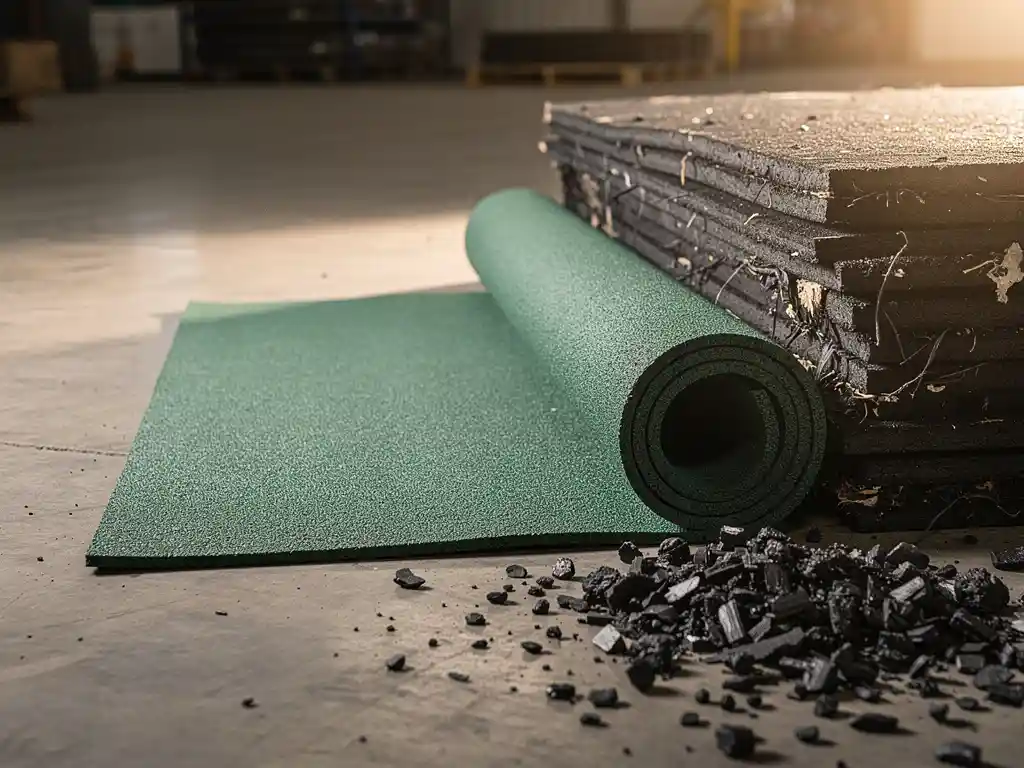
Most flooring materials can be reused or recycled, though the options depend on the material type and its condition. Concrete, hardwood, ceramic tile, and rubber are among the most recyclable flooring materials. Rubber flooring, in particular, has a strong end-of-life story: old rubber can be reprocessed into new products, keeping it out of landfills and reducing the demand for virgin raw materials. Below, we answer the most common questions about flooring recycling, reuse, and responsible disposal.
What types of flooring materials can actually be recycled?
Several common flooring materials can be recycled, including rubber, hardwood, ceramic tile, concrete, and certain types of carpet. Rubber flooring is one of the most recyclable options available: it can be ground down and reprocessed into new rubber products without significant loss of quality. Hardwood can be reclaimed and resold. Ceramic tile can be crushed and used as aggregate. Carpet recyclability depends heavily on fiber type and whether a take-back program exists.
Not all flooring materials are equal when it comes to recycling. Vinyl and laminate flooring, for example, are notoriously difficult to recycle because they combine multiple materials that are hard to separate. Luxury vinyl tile (LVT) typically ends up in landfills because the plasticizers and backing layers make mechanical recycling impractical.
Rubber flooring sits at the other end of the spectrum. Because it is a single-material product, it can be shredded, granulated, and reprocessed without chemical separation. This makes it a strong performer from a lifecycle costing perspective: the material retains real value even after its first use.
How is old rubber flooring recycled into new products?
Old rubber flooring is recycled by first shredding it into small granules or crumb rubber. These granules are then cleaned, sorted by size, and either mixed with binders to form new rubber sheets or used as a raw material in other rubber manufacturing processes. The result is a recycled rubber product that maintains many of the performance characteristics of the original material.
This process is at the heart of what we do at DRI Rubber, the parent company behind LRP Matting. We have been pioneering reprocessed rubber compounds for over 75 years. Our Fiber Reinforced Rubber Compound (FRC®) integrates recycled rubber with fiber reinforcement, producing a material that is actually stronger and more durable than many conventional rubber products made from virgin materials.
The recycling process for rubber flooring typically follows these steps:
- Collection and sorting of used rubber flooring or off-cuts
- Shredding into coarse pieces, then granulating into crumb rubber
- Cleaning to remove contaminants like metal or debris
- Blending with binders, fiber reinforcement, or other additives
- Compression molding or extrusion into new flooring sheets or mats
Because rubber is a non-porous, single-material product, very little is wasted in this process. This closed-loop approach supports circular rubber flooring systems where the material keeps cycling back into productive use.
What’s the difference between recycled and reclaimed flooring?
Recycled flooring refers to materials that have been broken down and reprocessed into a new product, while reclaimed flooring refers to materials that are salvaged and reused in their original form without significant reprocessing. Both approaches extend the life of flooring materials and reduce waste, but they involve different processes and result in different products.
Reclaimed hardwood flooring is a good example of the reclaimed approach: old barn boards or factory floors are pulled up, cleaned, and resold as flooring with visible character marks from their previous life. The material is not broken down; it is simply given a second use.
Recycled rubber flooring, on the other hand, involves actual reprocessing. The old rubber is ground into granules and reformed into a new product. The end result does not look like the original flooring; it is a genuinely new material made from recovered content.
From a sustainability standpoint, both approaches reduce the environmental impact compared to using entirely new raw materials. Reclaimed flooring avoids the energy cost of reprocessing, while recycled flooring can handle materials that are too worn or damaged to be reused directly. For most rubber flooring at end of life, recycling is the more practical route.
Can rubber flooring be reused instead of replaced?
Yes, rubber flooring can often be reused rather than replaced, provided it is still structurally sound and has not been chemically contaminated. Rubber mats and flooring tiles are well suited to reuse because rubber does not crack, peel, or absorb moisture, meaning a mat that has been used in one location can often be cleaned and reinstalled elsewhere without any loss of performance.
This is one of the practical advantages of genuine rubber over synthetic alternatives. A rubber mat that has served a gym floor, for example, might be perfectly functional for a warehouse or agricultural setting where cosmetic appearance matters less. Because rubber is non-porous and easy to clean with mild detergent and water, reuse is straightforward from a hygiene perspective.
Reuse is also relevant in commercial and industrial settings where flooring is installed in sections. Individual tiles or mats that are still in good condition can be removed, stored, and reinstalled in a different area or configuration. This flexibility reduces waste and lowers lifecycle costs over time.
How do you dispose of old flooring responsibly?
Responsible disposal of old flooring starts with identifying whether the material can be recycled, reclaimed, or donated before sending it to landfill. For rubber flooring, contacting a rubber recycler or the original manufacturer is the best first step. For hardwood, tile, and concrete, local salvage yards, Habitat for Humanity ReStore programs, or construction waste recyclers are practical options.
Here are the main responsible disposal routes to consider:
- Recycle: Contact specialist recyclers for rubber, carpet, or concrete. Many rubber manufacturers accept off-cuts and end-of-life material back into their supply chain.
- Donate or resell: Flooring in good condition can be donated to salvage stores, community organizations, or resold through online marketplaces.
- Return to manufacturer: Some flooring manufacturers offer take-back schemes, particularly for carpet and rubber products.
- Construction waste facilities: If recycling is not possible, use a licensed construction waste facility rather than general landfill, as many materials can still be sorted and diverted there.
- Hazardous material check: Older flooring, particularly vinyl tiles from before the 1980s, may contain asbestos. Always test before removal and follow local regulations for safe disposal.
The worst outcome is sending flooring to general landfill when a better option exists. A quick call to your local waste authority or the flooring manufacturer can often reveal recycling options you were not aware of.
Does choosing recycled-content flooring reduce environmental impact?
Yes, choosing flooring made from recycled content meaningfully reduces environmental impact compared to flooring made entirely from virgin materials. Recycled-content flooring requires less raw material extraction, lower energy input in manufacturing, and keeps waste materials out of landfill. For rubber flooring specifically, using recycled rubber reduces the demand for new rubber production and supports a more circular supply chain.
The environmental benefit is not just about the raw material. Sustainable flooring made from recycled content also tends to perform well over long periods, which means fewer replacements and less total material consumed over time. This is where lifecycle costing becomes a useful way to evaluate flooring choices: a product that costs more upfront but lasts significantly longer and can be recycled at end of life often has a lower total environmental cost than a cheaper alternative that ends up in landfill after a few years.
Rubber flooring made from 100% recycled materials, like the mats we produce at LRP Matting, also avoids some of the chemical concerns associated with virgin synthetic flooring materials. Genuine rubber is a stable, non-porous material that does not off-gas the same way some vinyl or adhesive-backed flooring can.
Choosing sustainable materials is not just an environmental decision; it is a practical one. Products built from high-quality recycled rubber, reinforced with fiber technology, can outperform conventional alternatives in durability, safety, and total cost of ownership. If you are looking at industrial rubber flooring options, we would be glad to walk you through what makes our recycled-content mats a long-term investment worth considering.
Frequently Asked Questions
How do I know if my old rubber flooring is still suitable for reuse rather than recycling?
Inspect the flooring for structural integrity: if it holds its shape, shows no deep cracking or crumbling, and has not been exposed to chemical spills or contamination, it is likely a good candidate for reuse. Surface scuffs, fading, or minor wear do not affect performance in most applications. A simple cleaning test is a useful indicator — if the mat cleans up well with mild detergent and water and returns to a firm, non-deformed state, it can almost certainly be reused in a lower-demand setting.
Are there take-back or recycling programs specifically for rubber flooring?
Yes, some rubber flooring manufacturers operate take-back schemes that accept end-of-life mats and off-cuts back into their recycling process — LRP Matting’s parent company, DRI Rubber, is one example of a manufacturer with deep roots in reprocessed rubber. It is always worth contacting your original supplier first, as they may have established routes for recovering the material. If a manufacturer program is not available, specialist crumb rubber recyclers and construction waste facilities that handle rubber are the next best option.
What should I do with rubber flooring off-cuts and offcuts from an installation project?
Do not send off-cuts to general landfill — they represent clean, uncontaminated rubber that has real recycling value. Contact your flooring supplier or a local rubber recycler to arrange collection or drop-off. Smaller off-cuts can sometimes be repurposed on-site as anti-fatigue matting, protective underlays, or edge protectors, squeezing additional value out of the material before it enters the recycling stream.
How does recycled rubber flooring compare in performance to flooring made from virgin rubber?
High-quality recycled rubber flooring, particularly products reinforced with fiber technology like FRC®, can match or exceed the performance of virgin rubber in key metrics such as durability, slip resistance, and load-bearing capacity. The recycling process does not inherently degrade rubber’s core properties when done correctly, and the addition of fiber reinforcement can actually improve tensile strength beyond what standard virgin rubber achieves. The key differentiator is manufacturing quality — not all recycled rubber products are created equal, so checking the compound technology and product specifications matters.
Is rubber flooring a better long-term investment than cheaper vinyl or laminate alternatives from an environmental standpoint?
In most cases, yes — especially when you factor in the full lifecycle rather than just the upfront cost. Vinyl and laminate flooring are difficult to recycle, often end up in landfill, and may need replacing more frequently due to wear. Rubber flooring, by contrast, can be reused, recycled back into new products, and typically lasts significantly longer in demanding environments. This means less total material consumed and less waste generated over the life of a building or facility, which translates into a meaningfully lower environmental footprint over time.
What precautions should I take before removing old flooring, especially in older buildings?
Before removing any flooring installed prior to the 1980s — particularly vinyl floor tiles — you should test for asbestos, as it was commonly used as a binding agent in that era. Do not disturb the material until testing is complete, as asbestos fibres become hazardous when airborne. Contact a licensed asbestos surveyor or your local environmental health authority for guidance, and follow all local regulations for safe removal and disposal. For post-1980s rubber, hardwood, or ceramic tile, standard construction safety precautions apply, but no special hazardous material handling is typically required.
Can rubber flooring contribute to green building certifications like LEED or BREEAM?
Yes, rubber flooring made from recycled content can contribute credits toward green building rating systems such as LEED (Leadership in Energy and Environmental Design) and BREEAM, particularly under categories related to recycled materials, responsible sourcing, and indoor environmental quality. The specific credit value depends on the percentage of recycled content, the sourcing documentation provided by the manufacturer, and the version of the rating system being applied. If you are targeting a certification, ask your flooring supplier for Environmental Product Declarations (EPDs) or recycled content documentation to support your submission.
Related Articles
- How do high traffic areas affect floor performance?
- How do modern animal facilities improve safety?
- What causes sports facility floors to wear out?
- What makes a floor safe?
- How do you clean and maintain a horse trailer floor?
- What flooring is used in equine surgery facilities?
- What is the best floor surface for a standing workstation?
- What type of flooring reduces the risk of slip and fall accidents in a factory?
- What flooring do professional equestrian facilities use in their stalls?
- How do you cover a large factory floor area with anti-fatigue matting?