
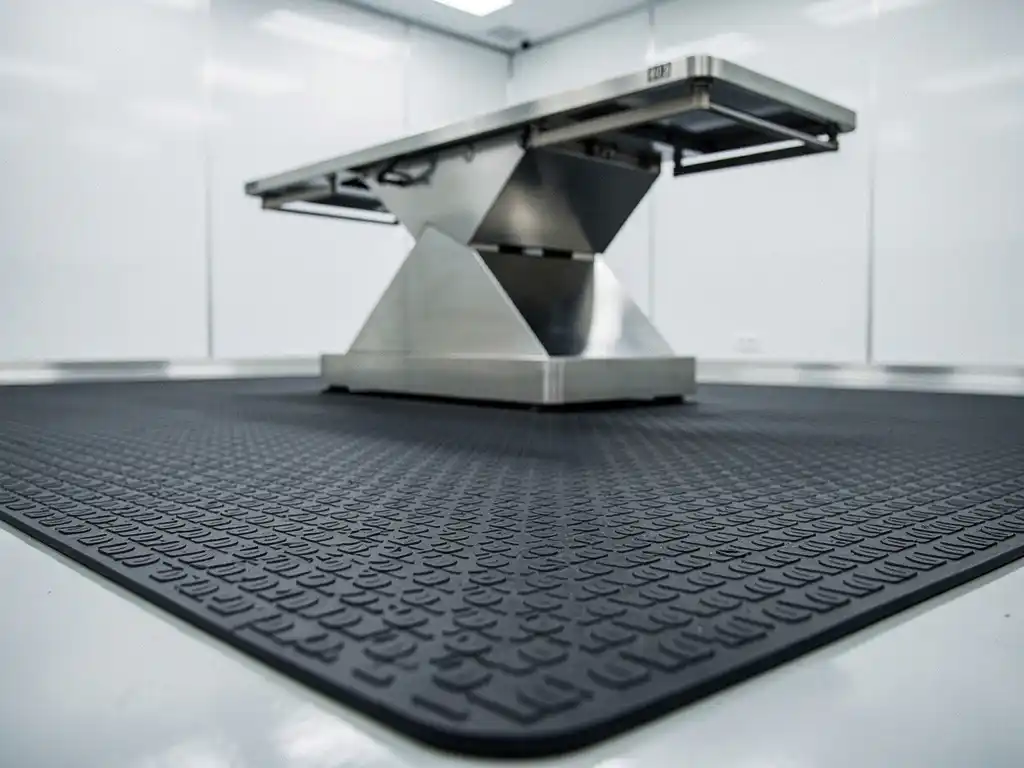
Equine surgery facilities typically use rubber matting as their primary flooring solution. Rubber is the preferred choice because it combines slip resistance, cushioning, and hygiene in a way that most other materials simply cannot match. Hard concrete alone is too unforgiving for recovering horses, while softer materials tend to absorb fluids and harbor bacteria. A well-chosen rubber floor keeps horses safer, supports veterinary staff during long procedures, and holds up to the rigorous cleaning demands of a surgical environment.
Why does flooring matter so much in equine surgery rooms?
Flooring in equine surgery facilities directly affects the safety of the horse, the surgical team, and the outcome of the procedure itself. A horse weighing anywhere from 900 to 1,500 pounds and going under general anesthesia places enormous physical demands on the floor beneath it. The wrong surface can cause slips during induction or recovery, pressure injuries during the procedure, and serious stress on joints when the animal tries to stand again.
Beyond the horse itself, the surgical team works in close proximity to a large, unpredictable animal during induction and recovery. Staff need a surface that provides secure footing even when fluids are present. A floor that shifts, becomes slippery when wet, or fails to absorb impact puts both people and animals at risk. Flooring is not just a background detail in equine surgery—it is an active part of the safety system.
There is also the hygiene dimension to consider. Surgical environments must be cleaned and disinfected thoroughly between procedures. Flooring that absorbs blood, fluids, or debris creates a persistent contamination risk that no amount of surface cleaning can fully address. The floor needs to be non-porous and easy to sanitize from the start.
What properties should equine surgical flooring have?
Equine surgical flooring needs to be slip-resistant, non-porous, impact-absorbing, easy to clean, and durable enough to withstand repeated disinfection. These five properties work together to create an environment in which the horse is protected from injury, the team can work safely, and the space can be reliably sterilized between cases.
Slip resistance
A horse regaining consciousness after anesthesia has limited coordination and may attempt to stand before it is fully alert. A slippery floor at this moment can result in catastrophic falls, broken limbs, or injuries to nearby handlers. The surface texture of the flooring needs to provide grip even when wet with water, blood, or disinfectant solution.
Cushioning and impact absorption
During recovery, horses often thrash or lunge before they regain full motor control. A floor with some degree of give absorbs that impact and reduces the risk of bruising, abrasions, or more serious trauma. This cushioning also benefits the surgical team, who may stand for hours during complex procedures—a surface with anti-fatigue properties reduces physical strain on the people in the room.
Non-porous surface
Any flooring that absorbs fluids becomes a breeding ground for bacteria and pathogens. In a surgical suite, this is unacceptable. The floor must be completely non-porous so that cleaning agents can do their job fully and no biological material is retained between procedures.
Chemical and temperature resistance
Equine surgical suites use strong disinfectants regularly, and the floor needs to withstand that chemical exposure without degrading, cracking, or peeling. Similarly, the material should remain stable across temperature variations, since facilities may be heated, cooled, or exposed to outdoor conditions during animal transport.
How does rubber matting compare to other equine surgery flooring options?
Rubber matting outperforms most alternatives for equine surgical use because it combines grip, cushioning, and hygiene in a single material. Concrete, epoxy coatings, and synthetic tiles each have their uses, but none of them meets all the demands of an equine surgical environment as effectively as rubber does.
Bare concrete is the most common base floor in veterinary facilities. It is durable and easy to construct, but it is hard, cold, and offers poor grip when wet. Horses recovering on concrete are at high risk of abrasions and impact injuries. Epoxy coatings can improve the hygiene of concrete by sealing the surface, but they add only minimal cushioning and can become very slippery when wet unless a textured finish is applied—and textured epoxy is harder to clean thoroughly.
Rubber matting laid over concrete addresses the shortcomings of both. It adds the cushioning and grip that concrete lacks while remaining fully non-porous and easy to disinfect. Unlike epoxy, rubber matting can be replaced in sections if it becomes damaged, without resurfacing the entire floor. Synthetic foam tiles are sometimes used in recovery stalls, but foam compresses over time and is more difficult to clean than solid rubber.
What type of rubber matting is best for equine surgical suites?
The best rubber matting for equine surgical suites is a thick, solid rubber mat with a textured, anti-slip surface, a non-porous composition, and enough density to absorb impact from a large animal. Custom-cut or large-format mats are preferable because they minimize seams, which are potential weak points for fluid infiltration and bacterial growth.
Thickness matters significantly in this context. A thicker mat provides better cushioning during recovery and better insulation against cold concrete floors, which helps maintain the horse’s body temperature during and after surgery. A mat that is too thin will compress quickly under the weight of a large horse and lose its protective properties.
The surface texture is equally important. A mat with a raised pattern, hammer-top finish, or similar textured surface provides the grip needed for both horses and handlers. Smooth rubber, while easy to clean, does not offer adequate traction in wet conditions. Large-format mats are particularly useful in surgical suites because they reduce the number of seams in the installation, making the floor easier to clean and less likely to shift or separate under the movement of a large animal.
How is equine surgery flooring installed and maintained?
Equine surgery flooring is typically installed by laying rubber mats directly over an existing concrete subfloor, with large or custom-cut mats used to minimize seams. Maintenance involves regular cleaning with mild detergent and water, periodic inspection for wear or damage, and prompt replacement of any sections that show signs of deterioration.
Installation
The installation process for rubber matting in a surgical suite is straightforward. The concrete subfloor should be clean, level, and dry before mats are laid. Large-format mats reduce the number of joints in the floor, which is important in a surgical setting where fluid can seep into gaps between smaller tiles. Interlocking designs or made-to-measure cuts help achieve a tight, seamless fit in rooms with irregular dimensions. For equine surgery facilities where standard sizes do not match the room layout, our custom rubber matting solutions can be cut to any size or shape, eliminating unnecessary seams and simplifying the installation process.
Maintenance
Rubber matting is one of the lower-maintenance flooring options available for veterinary use. Because genuine rubber is non-porous, it does not absorb fluids or retain bacteria the way porous materials do. Cleaning is as simple as mopping with a mild detergent and water, followed by a rinse. Most veterinary-grade disinfectants are compatible with rubber, though it is worth confirming compatibility with highly concentrated chemical formulations to avoid accelerated wear.
Periodic inspection is good practice. Check for any lifting at the edges, surface cracking, or compression in high-impact zones. Rubber matting that has been properly selected and installed typically has a long service life, but a surgical suite experiences intense use, and the floor should be reviewed regularly to ensure it continues to perform as needed. Replacing a worn section promptly is far less disruptive than dealing with an injury caused by a degraded floor surface.
Frequently Asked Questions
How thick should rubber matting be for an equine surgical suite?
For equine surgical suites, rubber matting should generally be at least 3/4 inch (19mm) thick, with many facilities opting for mats in the 1 to 1.5 inch range for maximum cushioning and impact absorption. Thicker mats better protect a large horse during recovery thrashing and provide improved insulation against cold concrete subfloors. The right thickness also depends on the density of the rubber—a denser, heavier mat at 3/4 inch may outperform a lighter mat at 1 inch, so always consider both measurements together when selecting a product.
Can the same rubber matting be used in both the surgical suite and the recovery stall?
While the core requirements—slip resistance, cushioning, and non-porous surfaces—are the same in both spaces, recovery stalls typically benefit from even thicker or higher-density mats due to the prolonged and intense physical activity of a horse waking from anesthesia. The surgical suite itself prioritizes a seamless, easy-to-disinfect surface, whereas the recovery stall may prioritize maximum impact absorption above all else. Using purpose-selected matting in each area, rather than a one-size-fits-all solution, will give you the best safety outcomes across both spaces.
What are the most common mistakes facilities make when choosing equine surgical flooring?
The most frequent mistake is prioritizing upfront cost over performance, which often leads facilities to choose thin mats, smooth-surfaced rubber, or foam tiles that degrade quickly under a large animal’s weight. Another common error is installing standard-sized tiles that leave multiple seams across the floor—these gaps collect fluids and pathogens and can shift under a recovering horse, creating a trip hazard. Finally, some facilities overlook chemical compatibility, only to find that their preferred disinfectant degrades the matting prematurely, requiring costly early replacement.
How often should rubber matting in an equine surgical suite be replaced?
There is no fixed replacement schedule, as service life depends on usage frequency, mat quality, and maintenance practices—but a well-selected, properly maintained rubber mat in a surgical suite can realistically last 10 years or more. The key is routine inspection rather than a calendar-based replacement policy: look for surface cracking, significant compression in high-impact zones, lifting edges, or any areas where the texture has worn smooth. Any section showing these signs should be replaced promptly, since a degraded surface in a surgical environment is a direct safety risk rather than just a cosmetic issue.
Are there any disinfectants that should be avoided on rubber surgical matting?
Most veterinary-grade disinfectants, including quaternary ammonium compounds and diluted bleach solutions, are generally safe for use on quality rubber matting. However, highly concentrated phenolic disinfectants and certain solvent-based cleaners can accelerate surface degradation, causing the rubber to dry out, crack, or become tacky over time. Always check the disinfectant manufacturer’s dilution guidelines and, if possible, request compatibility data from your matting supplier before committing to a cleaning protocol—especially if you are using newer or less common disinfectant formulations.
Is it necessary to adhere rubber mats to the concrete subfloor, or can they simply be laid loose?
In most equine surgical suite applications, heavy-duty rubber mats can be laid loose over a clean, level concrete subfloor without adhesive, as their own weight and interlocking or tight-fit design keeps them stable. Adhesive bonding is sometimes used at the perimeter or along seams to prevent edge lifting in high-traffic zones, but full adhesion can actually complicate future replacement of individual sections. The priority is ensuring the installation is seamless and tight-fitting enough that mats cannot shift under the movement of a large animal—custom-cut mats that match the exact room dimensions are often the most effective way to achieve this without adhesive.
Can rubber matting be retrofitted into an existing equine surgical facility, or does it require a full renovation?
Rubber matting is one of the most retrofit-friendly flooring solutions available, which is a significant practical advantage for established facilities. As long as the existing concrete subfloor is structurally sound, level, and free of major cracks or contamination, mats can typically be installed directly on top with minimal disruption to the facility’s operations. Custom-cut options make it possible to achieve a precise, seam-minimized fit even in older rooms with non-standard dimensions, meaning a full renovation is rarely necessary to achieve a high-quality surgical flooring upgrade.
Related Articles
- How does regular maintenance extend the life of sports flooring?
- Why do wet floors become dangerous?
- How do you design a safe flooring layout for an equine hospital?
- How do you protect a concrete floor in a cold storage facility?
- What is the best flooring for an indoor training facility?
- How does the type of stall floor affect how much bedding you need?
- What is the best floor surface for a standing workstation?
- How do you reduce fall risk for horses in a veterinary facility?
- How do you set up a new horse stall from scratch?
- How do you choose the right anti-fatigue mat thickness for a factory?