
Floor design directly affects physical strain in the workplace by determining how much shock, pressure, and fatigue your body absorbs throughout a shift. Hard, unforgiving surfaces force your muscles and joints to work harder to stabilize your body, leading to discomfort, pain, and long-term injury risk. Flooring that offers resilience, grip, and ergonomic support reduces that load significantly. Below, we answer the most common questions about floor design and worker fatigue.
What types of floor surfaces cause the most physical strain?
Concrete, ceramic tile, and stone are the floor surfaces that cause the most physical strain for workers. These materials have virtually no give, meaning every step sends impact directly up through your feet, ankles, knees, and lower back. Workers standing or walking on these surfaces for hours at a time experience significantly higher rates of musculoskeletal discomfort than those on more forgiving floors.
The problem is not just hardness. Surface texture and friction levels also play a role. Floors that are too smooth create slip hazards, forcing workers to tense their muscles and adjust their gait to stay stable. Floors that are uneven or poorly maintained add another layer of strain by disrupting natural posture and balance. In most industrial and commercial settings, concrete is the default choice because it is cheap and durable, but that cost saving often shifts the burden onto the people working on it.
How does standing on hard floors affect the body over time?
Standing on hard floors over time compresses the joints, restricts circulation in the legs and feet, and leads to chronic muscle fatigue. When your body has no cushioning underfoot, your muscles stay constantly engaged to absorb impact and maintain balance. Over weeks and months, this contributes to conditions like plantar fasciitis, lower back pain, varicose veins, and joint inflammation.
The effects build gradually, which is why many workers do not connect their discomfort to their floor surface. Fatigue sets in faster, concentration drops, and workers may shift their weight awkwardly to relieve pressure, which creates new postural problems. For businesses, this translates into increased sick days, lower productivity, and higher injury-related costs. Addressing the floor surface is one of the most direct ways to interrupt this cycle.
What is the difference between anti-fatigue mats and standard rubber mats?
Anti-fatigue mats are specifically engineered to reduce standing fatigue by encouraging subtle, continuous micro-movements in the legs and feet, which promotes blood circulation and reduces muscle tension. Standard rubber mats, by contrast, are primarily designed for protection, grip, or hygiene rather than ergonomic support. Both have their place, but they solve different problems.
Standard rubber mats do provide some cushioning compared to bare concrete, and they are valuable for slip resistance, drainage, and surface protection. Anti-fatigue mats go further by optimizing the density, thickness, and surface texture of the material to actively support the body during prolonged standing. If your goal is specifically to reduce worker fatigue in a standing workstation or assembly line, an anti-fatigue mat is the more targeted solution.
How does floor resilience reduce fatigue in industrial settings?
Floor resilience reduces fatigue by absorbing a portion of the impact energy that would otherwise travel through your body with each step or shift in weight. A resilient floor surface compresses slightly underfoot and then returns to its original shape, creating a small but meaningful buffer between your joints and the ground. Over an eight-hour shift, that buffer adds up to a significant reduction in cumulative physical load.
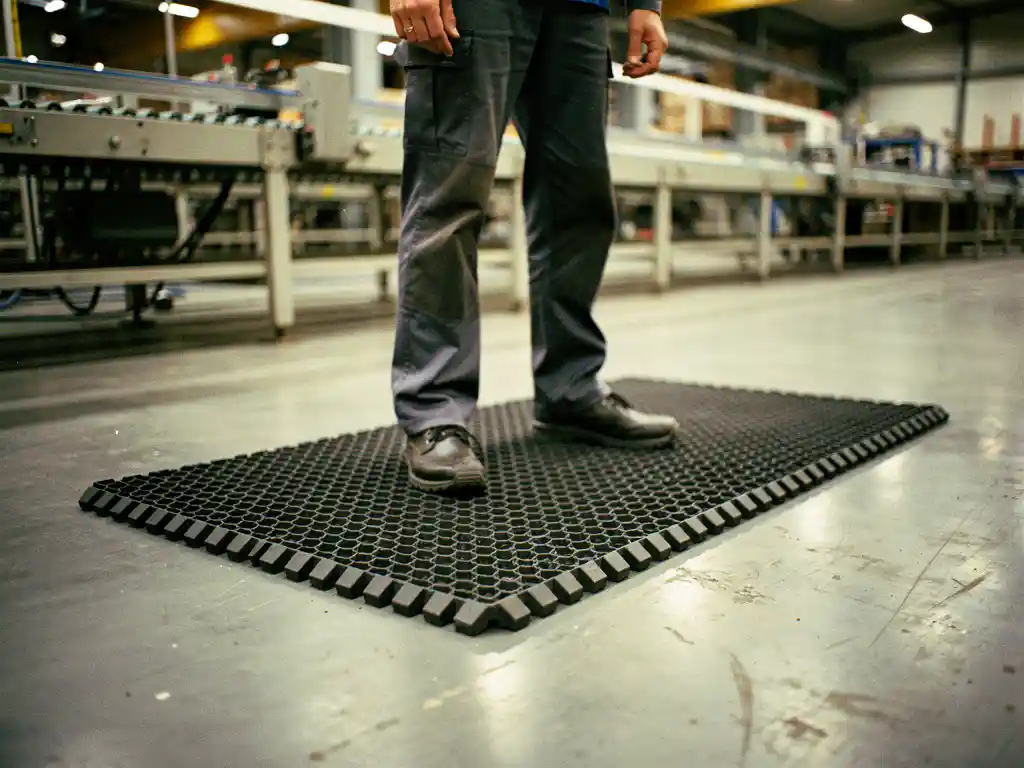
In industrial settings, where workers often stand for long periods in fixed positions at machines, conveyor belts, or workbenches, floor resilience is especially relevant. It reduces the static load on the lower body, keeps blood moving more freely through the legs, and lowers the overall energy cost of simply staying upright. Rubber matting is one of the most practical ways to add resilience to an existing hard floor without major renovation, and it can be placed precisely where workers spend the most time.
Which workplaces benefit most from ergonomic floor design?
Workplaces where employees stand for extended periods benefit most from ergonomic floor design. This includes manufacturing facilities, assembly lines, commercial kitchens, retail environments, hair salons, healthcare settings, and any workspace where workers are on their feet for the majority of their shift. The longer the standing time, the greater the potential benefit from a well-designed floor surface.
That said, ergonomic floor design is not limited to standing environments. Workplaces with heavy foot traffic, frequent lifting, or repetitive movement patterns also benefit because better flooring improves grip, reduces slip risk, and softens the impact of dynamic activity. Warehouses and distribution centers, for example, see benefits not just for standing workers but also for those walking long distances across hard floors throughout the day.
Does floor mat thickness actually make a difference for comfort?
Yes, floor mat thickness does make a meaningful difference for comfort, but only up to a point. Thicker mats generally provide more cushioning and better shock absorption, which helps reduce standing fatigue. However, a mat that is too thick can become unstable underfoot, creating a different kind of physical strain as workers compensate for the soft surface with altered posture and balance.
For most standing workstations, a mat thickness in the range of half an inch to one inch offers a practical balance between cushioning and stability. Heavier industrial environments may benefit from thicker, denser materials that can withstand equipment loads without compressing permanently. The material composition matters as much as the thickness. A dense rubber mat of moderate thickness will often outperform a thicker foam mat that bottoms out quickly under sustained pressure.
What should you look for when choosing flooring to reduce workplace strain?
When choosing flooring to reduce workplace strain, prioritize resilience, slip resistance, and appropriate thickness for your specific environment. The right flooring should absorb impact without becoming unstable, provide reliable grip even when wet or contaminated, and be durable enough to maintain its properties under the load and traffic patterns of your workspace.
Here are the most important factors to evaluate:
- Cushioning and resilience: Look for materials that compress underfoot and recover their shape, rather than staying permanently compressed after use.
- Slip resistance: Textured or beveled surfaces help reduce the risk of falls, especially in environments where liquids or debris are present.
- Durability: Flooring in industrial or commercial settings needs to withstand heavy use without cracking, peeling, or degrading.
- Ease of cleaning: Non-porous surfaces resist moisture and bacteria, making hygiene maintenance practical rather than burdensome.
- Coverage and fit: Larger mat sizes reduce the number of seams in a space, which improves both safety and appearance.
- Application match: Anti-fatigue properties matter most at fixed workstations; drainage matters most in wet environments; chemical resistance matters in labs or processing areas.
At LRP Matting, we design our rubber mats to address exactly these factors. Our products are made from 100% recycled rubber, including options built with our proprietary Fiber Reinforced Rubber Compound (FRC®) for added strength and longevity. Whether you need coverage for a single workstation or an entire facility floor, we offer standard and custom sizes to fit the space. If you are ready to improve ergonomic conditions in your workplace, explore our anti-fatigue matting solutions to find the right fit for your environment.
Frequently Asked Questions
How do I know if my current flooring is contributing to worker fatigue and not another cause?
A practical first step is to track when and where fatigue symptoms occur — if workers consistently report discomfort in areas with hard, bare floors and less so in areas with matting or softer surfaces, the floor is likely a contributing factor. You can also conduct a simple walk-test: stand on your current floor for 30 minutes and note any pressure buildup in your feet, ankles, or lower back. If symptoms appear quickly, the surface lacks adequate resilience. Consulting an ergonomist for a formal workplace assessment can also help isolate flooring as a variable from other factors like footwear, posture, or workstation height.
Can the right footwear replace the need for ergonomic flooring?
Supportive footwear and ergonomic flooring work best together — neither fully replaces the other. Quality work boots or insoles can reduce some of the impact from hard surfaces, but they cannot compensate for an entirely unforgiving floor over a full shift. Ergonomic flooring addresses the problem at the source by reducing the baseline impact energy before it ever reaches the foot, while footwear provides an additional personal layer of protection. For the best results, implement both as part of a broader ergonomics strategy rather than treating one as a substitute for the other.
How often should anti-fatigue mats be replaced, and what are the signs they need replacing?
Most high-quality anti-fatigue mats in commercial or industrial settings should be evaluated for replacement every one to three years, depending on traffic volume and environmental conditions. The clearest sign a mat needs replacing is permanent compression — if the mat no longer springs back underfoot and feels flat or hard, it has lost its ergonomic benefit and is essentially functioning as a thin, uneven surface. Other warning signs include curling edges (a trip hazard), surface cracking, or visible deterioration of the material. Choosing mats made from dense, durable rubber rather than foam will significantly extend their effective lifespan.
What is the best way to transition a facility from bare concrete to ergonomic flooring without shutting down operations?
The most practical approach is to phase the rollout by starting with the highest-priority areas — fixed workstations, assembly lines, or any spot where workers stand for the longest uninterrupted periods. Rubber mats can be placed directly over existing concrete without adhesives or major installation work, making them easy to deploy without disrupting operations. Once the highest-impact areas are covered, you can expand coverage progressively to walkways, transition zones, and secondary work areas. This phased approach also lets you evaluate worker feedback and comfort improvements before committing to full-facility coverage.
Are there environments where anti-fatigue matting is not recommended or could create safety risks?
Yes — in environments with heavy moving equipment like forklifts, pallet jacks, or carts, thick or unsecured mats can create tripping hazards or interfere with wheel movement. In these cases, low-profile mats with beveled edges and high load ratings are essential, or a resilient poured floor coating may be a safer alternative. Mats should also be avoided in areas where they cannot be kept clean and dry, as a saturated or contaminated mat can reduce grip rather than improve it. Always match the mat specification to the specific environmental demands of each area rather than applying a one-size-fits-all solution.
Does ergonomic flooring have any measurable impact on productivity or injury rates?
Research consistently shows that reducing physical fatigue through better flooring has a positive downstream effect on both productivity and injury rates. Workers who experience less discomfort maintain focus longer, make fewer errors, and are less likely to develop the musculoskeletal conditions that lead to absenteeism and workers’ compensation claims. Studies in manufacturing and retail environments have linked anti-fatigue matting to measurable reductions in reported lower back and leg pain. While flooring is rarely the only variable, it is one of the highest-leverage ergonomic investments a facility can make given its relatively low cost compared to the long-term savings in health-related expenses.
Can ergonomic flooring solutions be customized for irregularly shaped workspaces or unique facility layouts?
Yes — many matting suppliers, including those offering industrial-grade rubber products, provide custom sizing and cutting options to fit non-standard workstation layouts, machinery footprints, or irregularly shaped floor areas. Custom mats eliminate the patchwork of smaller mats that create seams, edges, and gaps — all of which are both trip hazards and ergonomic weak points. When planning a custom order, it helps to provide accurate floor measurements and note any drainage needs, load requirements, or chemical exposure the mat will face. A well-fitted mat that covers the full work zone is always more effective than a standard size that leaves portions of the floor uncovered.
Related Articles
- What factors influence animal comfort in housing facilities?
- What should you consider when designing an animal facility?
- What affects the lifespan of sports flooring?
- How do entrances create floor safety risks?
- What are the most common causes of slip and fall accidents?
- What areas of a facility have the highest slip risk?
- How can you reduce fall risk in busy facilities?
- How do you choose flooring for a professional sports locker room?
- What is the best flooring for a horse wash rack?
- How do you prevent floor damage from forklifts in a warehouse?