
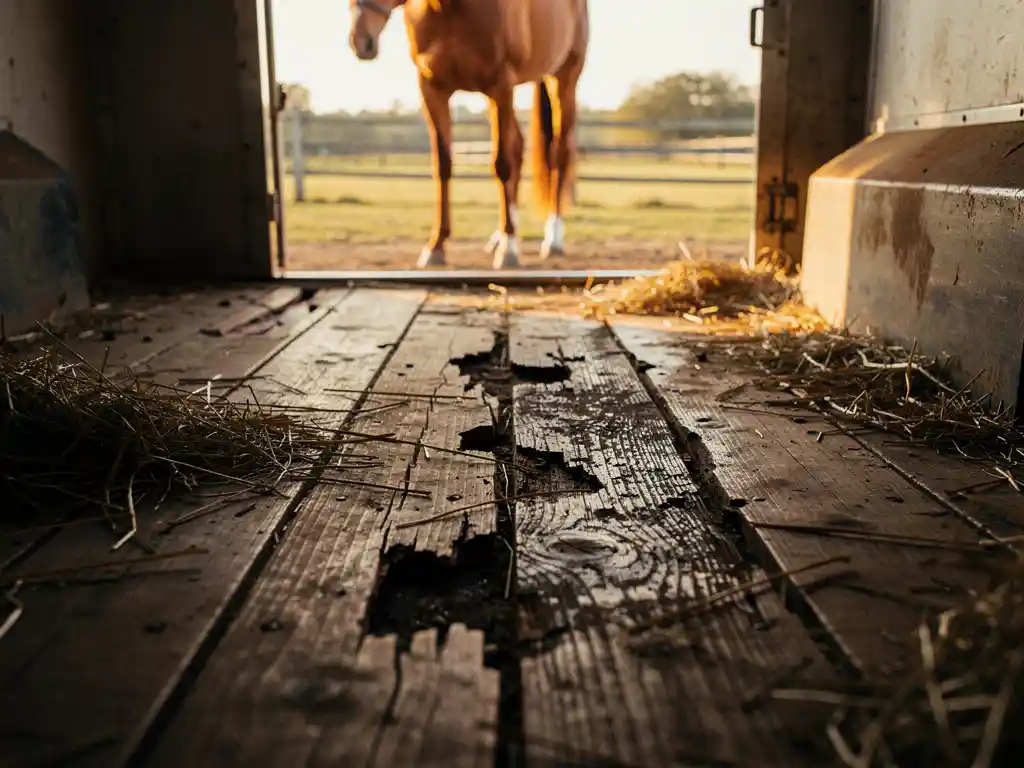
You can tell a horse trailer floor needs replacing when you notice soft or spongy spots underfoot, visible rot or rust, cracked or warped boards, or a strong musty smell that doesn’t go away after cleaning. If the floor flexes noticeably when a horse steps on it, or if you can see daylight through gaps in the boards, it’s time to act. Don’t wait for a full failure—a compromised trailer floor is a serious safety risk for your horse and anyone loading or unloading it.
Why does the horse trailer floor matter so much for safety?
The horse trailer floor is the only thing standing between your horse and the road beneath. A structurally sound floor supports the full weight of one or more horses during movement, braking, and cornering—often for hours at a time. If it fails, the consequences can be catastrophic: a horse breaking through the floor at highway speed is a life-threatening emergency for the animal and everyone nearby.
Beyond the obvious structural risk, the trailer floor also affects your horse’s balance and stress levels during travel. A slippery, uneven, or unstable surface forces horses to constantly shift their weight and brace themselves, which leads to fatigue, anxiety, and a higher risk of injury. A solid, grippy, well-maintained floor helps horses travel more calmly and arrive in better condition.
What are the signs that a horse trailer floor needs replacing?
The clearest signs that a horse trailer floor needs replacing include soft or spongy areas when you press down, visible rot or rust, strong persistent odors, cracks or splits in wood planks, and any floor movement or flex when weight is applied. If mats are covering damage that has already progressed beneath them, the floor may need replacing even if the surface looks acceptable.
Here are the warning signs to watch for:
- Soft or spongy spots — wood that gives underfoot has started to rot from moisture exposure.
- Visible cracks or splits — boards that have dried out, warped, or taken impact damage.
- Rust on metal components — especially around bolts, brackets, and metal crossmembers.
- Persistent odor — a musty or ammonia smell that returns quickly after cleaning can signal deep contamination.
- Daylight visible through gaps — any gap in the floor is a red flag.
- Mats that won’t lie flat — if your rubber mats are buckling or lifting, the subfloor beneath them may have warped.
Trust your instincts here. If something feels off when you walk across the floor, investigate it properly before your next trip.
How do you inspect a horse trailer floor properly?
To inspect a horse trailer floor properly, remove all mats and bedding first, then systematically check every section of the floor by pressing firmly with your foot and a tool such as a screwdriver. Probe wooden boards for soft spots, check metal components for rust, and, where possible, inspect the underside of the floor from beneath the trailer.
Follow these steps for a thorough inspection:
- Clear everything out — pull up mats, remove bedding, and clean the surface so you can see and feel the actual floor.
- Walk the entire floor — press down firmly in every section, paying extra attention to areas near walls and corners where moisture tends to collect.
- Use a screwdriver or awl — probe wooden boards by pressing the point into the surface; if it sinks in easily, the wood has rotted.
- Check from underneath — get under the trailer and inspect the floor from below, looking for rust, rot, soft spots, and gaps.
- Inspect all hardware — examine bolts, brackets, and fasteners for rust or looseness.
- Look at the edges and seams — moisture often enters at the perimeter where the floor meets the walls.
Aim to do a full inspection at least once a year, and always check before a long trip or after the trailer has been sitting unused through a wet season.
What causes horse trailer floors to deteriorate faster?
Horse trailer floors deteriorate faster when exposed to repeated moisture, urine, and manure without adequate drainage or cleaning. These factors break down wood fibers over time and accelerate rust on metal components. Infrequent cleaning, lack of proper matting, and extended periods of storage without ventilation all significantly speed up the damage.
Urine is particularly damaging because it soaks into wood and stays there, creating a wet, acidic environment that rots boards from the inside out. You might not see the damage on the surface until it’s already severe underneath. This is why cleaning frequency matters so much—the longer waste sits on the floor, the deeper it penetrates.
Other factors that accelerate deterioration include:
- Overloading the trailer beyond its rated capacity.
- Horses pawing or stomping repeatedly in the same spots.
- Leaving mats in place without removing them and cleaning underneath.
- Parking the trailer in areas where water pools beneath it.
- Ignoring small cracks or damage that allow moisture to enter.
What’s the difference between wood and rubber trailer flooring?
Wood and rubber trailer flooring differ primarily in durability, maintenance requirements, and moisture resistance. Wood is the traditional choice and provides a solid structural base, but it absorbs moisture, urine, and waste, making it vulnerable to rot and requiring regular replacement. Rubber is non-porous, meaning it doesn’t absorb liquids and is far easier to clean and maintain over time.
Wood trailer flooring
Wood floors are typically made from hardwoods such as oak or pine and provide a firm, load-bearing surface. They’re relatively affordable to install initially, but they require consistent maintenance and will eventually rot—especially in trailers that see heavy use. The hidden cost of wood is the repeated replacement cycle over the life of the trailer.
Rubber trailer flooring
Rubber flooring, whether as full-floor panels or as mats laid over a wood subfloor, adds a layer of protection that wood simply can’t match on its own. Rubber is non-porous, so urine and waste sit on the surface rather than soaking in. It also provides grip, cushioning, and insulation—all of which benefit the horse during travel. The tradeoff is that rubber mats can trap moisture against the wood beneath them if they aren’t removed and cleaned regularly, which is why proper maintenance still matters.
For most horse owners, the practical answer is a combination: a structurally sound wood subfloor protected by quality rubber mats. This gives you the load-bearing strength of wood with the hygiene and comfort benefits of rubber on top.
How do rubber mats extend the life of a horse trailer floor?
Rubber mats extend the life of a horse trailer floor by creating a protective barrier between the horse and the wood subfloor. They absorb the impact of hooves, prevent urine from soaking directly into the wood, reduce slipping, and provide insulation against temperature extremes. This protection significantly slows the rate of wear and moisture damage to the structural floor beneath.
A good rubber mat takes the punishment that would otherwise go directly into your trailer floor. Every hoof strike, every shift in weight, every splash of urine—the mat handles it first. This dramatically reduces the stress on the wood or metal beneath and keeps the structural components in better condition for longer.
Rubber mats also improve safety and comfort for the horse during the journey. A non-slip surface reduces the constant muscle effort required to stay balanced, which means horses arrive less tired and stressed. That’s a practical benefit that goes well beyond floor protection.
One important maintenance point: rubber mats must be removed regularly for cleaning. Moisture that gets trapped between the mat and the floor is the primary cause of accelerated rot beneath mats. Remove them, clean both the mat and the floor surface, let everything dry thoroughly, and then replace them. This routine keeps the protection working as intended.
When should you replace mats versus the entire trailer floor?
Replace the mats when they show surface wear, cracking, thinning, or loss of grip—but the structural floor beneath is still solid. Replace the entire trailer floor when the wood or metal subfloor shows rot, significant rust, soft spots, or any structural weakness, regardless of how the mats look on top. Never use new mats to cover a floor that’s already compromised.
Mats are a maintenance item. They wear out over years of use, and replacing them is a normal, relatively affordable part of trailer upkeep. If your mats are cracked, have thinned significantly in high-traffic areas, or no longer lie flat, it’s time for new ones. The floor beneath may be perfectly fine.
The trailer floor itself is a structural component. If you find rot, serious rust, or soft spots during your inspection, new mats won’t fix the problem—they’ll just hide it. A horse can break through a compromised floor even if there’s a mat on top. In that situation, the floor needs to come out and be replaced before any mats go back in.
If you’re unsure whether the damage is mat-level or floor-level, always err on the side of caution and have a professional assess it. The cost of a floor repair is far lower than the cost of an accident on the road.
When it’s time to replace your trailer mats, choosing the right product makes a real difference. We at LRP Matting — the natural solution offer custom rubber mats cut to your exact trailer dimensions, so you get full coverage with minimal seams and no awkward gaps. Our trailer mats are made from high-quality, non-porous rubber that won’t absorb moisture or waste, are easy to clean, and are built to handle the demands of regular horse transport. If you’d like help finding the right fit for your trailer, reach out to us, and we’ll get you sorted.
Frequently Asked Questions
How often should I remove and clean rubber mats in my horse trailer?
Ideally, you should remove and clean your rubber mats after every use, or at minimum once a month if the trailer sees regular activity. At the very least, do a thorough mat-removal clean before any long trip and after any period of storage. Moisture and waste trapped beneath mats are the leading cause of premature floor rot, so this routine is one of the most impactful things you can do to extend the life of your trailer floor.
Can I replace just a section of the horse trailer floor, or does the whole floor need to come out?
Partial floor repairs are possible if the damage is genuinely isolated to one or two boards and the surrounding structure—including crossmembers and fasteners—is fully sound. However, be cautious: moisture damage and rot often spread further than what’s visible on the surface, so what looks like a small problem can turn out to be much larger once you start pulling boards. Have a professional assess the extent of the damage before committing to a partial repair, as replacing a compromised section with new wood next to rotted wood you didn’t catch is a safety risk.
What type of wood is best for replacing a horse trailer floor?
Oak is the most widely recommended wood for horse trailer floors because of its density, hardness, and resistance to wear under heavy hoof traffic. Some owners also use apitong (also called keruing), a tropical hardwood that offers excellent strength and natural moisture resistance, making it a popular choice in commercial and heavy-use trailers. Avoid softwoods like pine for the structural subfloor—they’re less expensive upfront but deteriorate much faster under the conditions inside a horse trailer.
Is there anything I can apply to a wood trailer floor to help protect it between replacements?
Yes—applying a wood sealant or linseed oil to bare wood surfaces can help slow moisture absorption and extend the life of your trailer floor. Some trailer owners also use a rubber-based undercoating on the underside of the floor boards for added protection against road moisture and rust. Keep in mind that these treatments complement, but do not replace, proper mat maintenance and regular cleaning; no coating will fully protect wood that is regularly soaked in urine and left to sit.
How do I know if the metal crossmembers under my trailer floor are still safe, even if the wood looks okay?
Get underneath the trailer and visually inspect every crossmember for surface rust, pitting, cracks, or any areas where the metal has thinned significantly. Use a hammer to tap along the crossmembers—a solid ring indicates healthy metal, while a dull or hollow sound can signal internal corrosion. If you notice significant rust scale, flaking, or any visible structural weakness, have a trailer mechanic or welder assess the integrity before your next trip, as compromised crossmembers can fail even if the wood floor above them appears intact.
What's the biggest mistake horse owners make when it comes to trailer floor maintenance?
The most common and costly mistake is leaving rubber mats in place for months or years without removing them to clean underneath. Mats do an excellent job of protecting the floor from above, but if moisture or waste seeps under the edges, the mat traps it against the wood and creates the perfect environment for rot—out of sight and out of mind until the damage is severe. Building a habit of lifting mats regularly, even when the surface looks clean, is the single most effective way to catch problems early and avoid an expensive floor replacement.
How much does it typically cost to replace a horse trailer floor, and is it worth doing on an older trailer?
The cost of a horse trailer floor replacement varies widely depending on trailer size, materials, and labor, but most owners can expect to spend anywhere from a few hundred dollars for a DIY job on a small two-horse trailer to well over a thousand dollars for a larger trailer with professional installation. Whether it’s worth doing on an older trailer depends on the overall condition of the frame, axles, and structure—if the rest of the trailer is sound, a floor replacement is almost always more cost-effective than purchasing a new trailer. Get a full structural assessment alongside any floor repair quote so you can make an informed decision.
Related Articles
- Which types of floor damage should be repaired first?
- What should be included in a sports surface safety inspection?
- How do durable materials reduce waste?
- How can flooring materials be reused or recycled?
- How do sports venues manage heavy foot traffic?
- How do weather conditions affect outdoor sports surfaces?
- What flooring works best under heavy sports equipment?
- How do you reduce noise in a sports facility through flooring choice?
- How do you make a veterinary recovery stall safer for horses?
- What is the best flooring for a horse stable grooming area?