

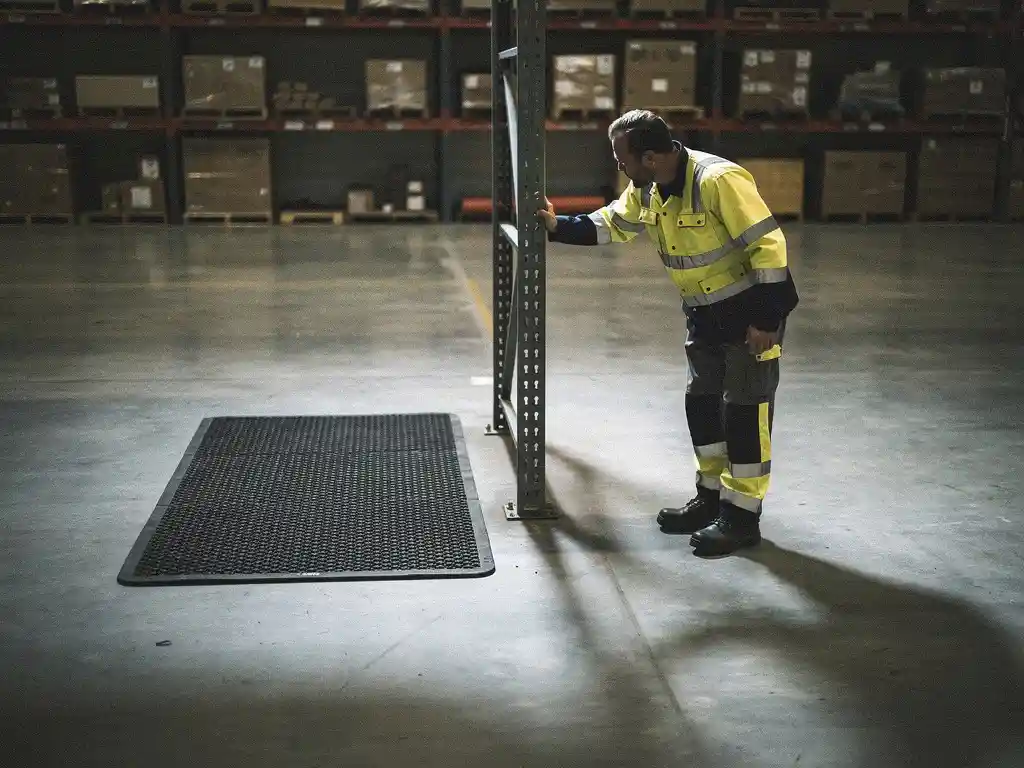
Floor-related fatigue directly impacts workplace safety by increasing the risk of slips, trips, falls, and musculoskeletal injuries. When workers stand on hard, unforgiving surfaces for extended periods, their muscles tire, their concentration drops, and their reaction time slows. This combination makes accidents significantly more likely. The sections below break down exactly how this happens, which industries feel it most, and what you can do about it.
What are the most common physical effects of standing on hard floors?
Standing on hard floors for long periods causes a predictable set of physical problems: foot pain, lower back discomfort, swollen ankles, knee strain, and general muscle fatigue. These effects build up gradually throughout a shift, often starting in the feet and radiating upward through the legs and spine. Workers may not notice the early signs until the discomfort becomes difficult to ignore.
The root cause is simple. Hard surfaces like concrete, tile, or bare steel give no energy back to the body. Every step absorbs impact without any cushioning, forcing your muscles and joints to compensate constantly. Over hours, this continuous low-level effort drains muscle endurance and triggers inflammation in the soft tissues of the feet and lower limbs.
Poor circulation is another common result. Standing still on a hard floor restricts blood flow in the legs, which contributes to fatigue, heaviness, and, in some cases, varicose veins over time. Workers often shift their weight, lock their knees, or adopt awkward postures to cope, all of which add strain to different parts of the body.
How does floor-related fatigue lead to workplace accidents?
Floor-related fatigue leads to workplace accidents by degrading the physical and mental performance workers need to stay safe. As muscles tire, coordination and balance suffer. As discomfort increases, attention shifts away from the task at hand. The result is a worker who is slower to react, more likely to make errors, and more vulnerable to slipping, tripping, or mishandling equipment.
Fatigue also affects decision-making. A tired worker is more likely to skip a safety step, rush a task, or take a shortcut that introduces risk. This is not a character flaw but a physiological response. When the body is under sustained physical stress, the brain prioritizes managing that discomfort over maintaining full alertness.
There is also a mechanical dimension. Fatigued muscles are less stable, which means workers are more likely to lose their footing, especially on wet or uneven surfaces. A stumble that a rested worker would recover from easily can become a serious fall when the legs are already worn out.
Which industries are most at risk from flooring-related fatigue?
Industries where workers stand for most of their shift on hard surfaces carry the highest risk from flooring-related fatigue. Manufacturing, food processing, retail, healthcare, hospitality, and construction are among the most affected. In these sectors, standing on concrete or similar hard flooring for six to ten hours a day is common, and the cumulative physical toll is significant.
In manufacturing and assembly environments, workers often stand at fixed stations for the entire shift with minimal movement. This static posture is harder on the body than walking, because it prevents the natural pumping action that keeps blood circulating in the legs.
Healthcare workers face a different version of the problem. They move frequently but spend long hours on hard hospital floors, often while carrying equipment or supporting patients. The combination of physical exertion and hard flooring accelerates fatigue and raises the risk of both worker injury and patient care errors.
In food processing and commercial kitchens, wet floors compound the issue. Fatigue reduces a worker’s ability to move carefully on slippery surfaces, turning a manageable hazard into a real danger.
What’s the difference between anti-fatigue mats and standard rubber mats?
The key difference between anti-fatigue mats and standard rubber mats is their purpose and construction. Standard rubber mats are designed primarily for protection, grip, and durability. Anti-fatigue mats are specifically engineered to reduce physical strain on workers who stand for long periods, using materials and designs that encourage subtle muscle movement and improve blood flow.
Anti-fatigue mats typically use softer, more compressible materials or layered construction that creates a slight instability underfoot. This prompts the small muscles in the legs and feet to make constant micro-adjustments, which keeps blood circulating and reduces the static load on joints. Standard rubber mats do not do this. They offer a firm, stable surface, which is exactly what you want in many environments, but they do not actively reduce standing fatigue.
That said, a good-quality rubber mat still outperforms bare concrete or hard tile in terms of comfort. The distinction matters most in environments where workers stand in one spot for extended periods. In those situations, an anti-fatigue mat is the more targeted solution for worker wellbeing.
How do anti-fatigue mats reduce the risk of workplace injuries?
Anti-fatigue mats reduce the risk of workplace injuries by addressing both the physical and behavioral effects of standing fatigue. By keeping muscles more active and reducing discomfort, they help workers maintain better posture, sharper focus, and more reliable coordination throughout their shift. A worker who is less tired is simply less likely to make the kind of error that leads to an accident.
From a physical standpoint, anti-fatigue mats cushion impact, reduce pressure on the feet and lower back, and support better blood flow in the legs. This lowers the rate at which fatigue sets in, extending the window during which a worker can perform at their best.
There is also a slip-resistance benefit. Many anti-fatigue mats include textured surfaces that improve grip, which is especially valuable in environments where spills or moisture are common. Reducing both fatigue and slip risk together creates a meaningful improvement in overall workplace safety.
Should employers provide anti-fatigue matting for standing workers?
Yes, employers should provide anti-fatigue matting wherever workers stand for extended periods on hard surfaces. This is both a practical safety measure and a straightforward investment in employee wellbeing. Reduced fatigue leads to fewer injuries, lower absenteeism, and better productivity. The cost of quality matting is modest compared to the cost of a workplace injury or a compensation claim.
From a duty-of-care perspective, employers are responsible for identifying and addressing ergonomic hazards in the workplace. Prolonged standing on hard floors is a recognized ergonomic risk, and providing appropriate matting is one of the most direct ways to address it. Many workplace health and safety frameworks recommend or require ergonomic controls for standing workers, and matting is consistently listed as an effective measure.
Beyond compliance, there is a practical case. Workers who are more comfortable are more engaged and make fewer errors. Providing anti-fatigue matting signals that the employer takes worker health seriously, which can have a positive effect on morale and retention as well.
What should you look for when choosing flooring to combat workplace fatigue?
When choosing flooring or matting to combat workplace fatigue, focus on cushioning quality, slip resistance, durability, and fit for your specific environment. No single product works equally well in every setting, so the right choice depends on the nature of the work, the surface conditions, and how long workers are on their feet.
- Cushioning and compression: Look for materials that provide enough give to reduce joint impact without being so soft that they create instability. The surface should support movement, not hinder it.
- Slip resistance: Especially in wet or oily environments, a textured or beveled surface helps prevent slips and falls. Check that the mat stays in place and does not curl or shift underfoot.
- Durability: In heavy-use areas, the matting needs to hold its shape and performance over time. Materials that compress permanently or crack under load lose their ergonomic benefit quickly.
- Ease of cleaning: In food, healthcare, or industrial settings, hygiene matters. Non-porous materials that resist moisture and can be cleaned with basic detergent are the practical choice.
- Size and coverage: Make sure the matting covers the full area where workers stand. Gaps between mats create trip hazards and reduce the ergonomic benefit.
At LRP Matting, we offer a range of rubber matting solutions built for demanding environments, including options designed specifically for standing workers. Our mats are made from genuine, non-porous rubber that resists moisture, cleans easily, and holds up under heavy daily use. If you are looking for a practical starting point, our anti-fatigue matting solutions are worth exploring. We can also work with you on custom sizes if your space has specific requirements.
Frequently Asked Questions
How long does it take before standing on hard floors starts causing noticeable fatigue?
Most workers begin to feel the effects of standing on hard surfaces within 60 to 90 minutes, though this varies depending on footwear, individual fitness, and the hardness of the floor. By the four-hour mark, fatigue-related discomfort is significant enough in most people to measurably affect concentration and coordination. This is why anti-fatigue matting is particularly important for any role that involves standing for more than an hour at a time without adequate breaks.
Can the right footwear replace the need for anti-fatigue matting?
Supportive footwear and anti-fatigue matting serve complementary roles and work best when used together, not as substitutes for each other. Good footwear addresses the individual worker’s foot support and cushioning needs, while anti-fatigue matting targets the surface itself, encouraging micro-muscle movement and reducing impact at the floor level. Relying solely on footwear leaves the underlying problem of a hard, unyielding floor unaddressed, particularly for workers who stand in a fixed position for most of their shift.
How often should anti-fatigue mats be replaced, and how do you know when they've stopped working?
The lifespan of an anti-fatigue mat depends on the material quality, the weight load it bears, and how heavily the area is used, but a practical rule of thumb is to inspect mats every six to twelve months. The clearest sign that a mat has lost its effectiveness is permanent compression, where the surface no longer springs back and feels nearly as hard as the floor beneath it. Other warning signs include curling edges that create trip hazards, surface cracking, or visible deformation in high-traffic zones. Replacing worn mats promptly is important because a degraded mat can give a false sense of protection while providing little actual ergonomic benefit.
Are there any situations where anti-fatigue mats would not be appropriate or could create a hazard?
Yes, there are environments where mat placement requires careful planning to avoid introducing new risks. In areas with heavy forklift or pallet truck traffic, mats can shift, bunch, or create uneven surfaces that cause equipment instability or pedestrian trip hazards. Similarly, mats that are not properly sized or secured in high-footfall corridors can curl at the edges and become a tripping risk themselves. In these cases, beveled edges, proper mat anchoring, or alternative ergonomic flooring solutions such as cushioned interlocking tiles may be more appropriate.
What else can employers do alongside anti-fatigue matting to further reduce standing fatigue?
Anti-fatigue matting is one of the most effective single interventions, but it works best as part of a broader ergonomic strategy. Employers should also consider introducing sit-stand options such as adjustable workstations or perching stools, scheduling regular short movement breaks, and rotating workers between standing and non-standing tasks where operationally possible. Encouraging workers to wear appropriate footwear and providing education on posture and weight distribution can further reduce the cumulative toll of long standing shifts.
Does floor-related fatigue affect all workers equally, or are some people more vulnerable?
Floor-related fatigue affects everyone who stands on hard surfaces for extended periods, but certain groups are more vulnerable to its effects. Workers with pre-existing musculoskeletal conditions, older employees, those who are pregnant, and workers returning from injury tend to feel the impact more quickly and more severely. Body weight also plays a role, as greater load increases the pressure on joints and soft tissues with every hour of standing. Employers carrying out risk assessments should take individual factors into account and prioritise matting and ergonomic support for the most vulnerable members of their workforce.
Is there a measurable productivity or business case for investing in anti-fatigue matting?
Research consistently links reduced physical fatigue to improvements in worker performance, including fewer errors, better concentration, and lower rates of absenteeism due to musculoskeletal complaints. Studies in manufacturing and retail environments have shown that workers using anti-fatigue matting report significantly lower discomfort levels by the end of a shift, which translates directly into sustained output quality. When you factor in the cost of workplace injury claims, lost working days, and staff turnover linked to physical strain, the return on investment for quality anti-fatigue matting is typically realised within months rather than years.
Related Articles
- What makes a sports surface safe?
- How often should commercial floors be maintained?
- How do you protect a sports facility floor from moisture and heavy use?
- What is the best flooring for an outdoor athletic facility?
- What is the difference between anti-fatigue mats and standard rubber mats?
- How do you fit stall mats to a non-standard stall size?
- How do you make a horse feel more comfortable during long trailer rides?
- What is the best flooring for a high-traffic horse barn?
- How do anti-fatigue mats reduce workplace injury claims?
- How do you choose the right floor protection for a construction site?