
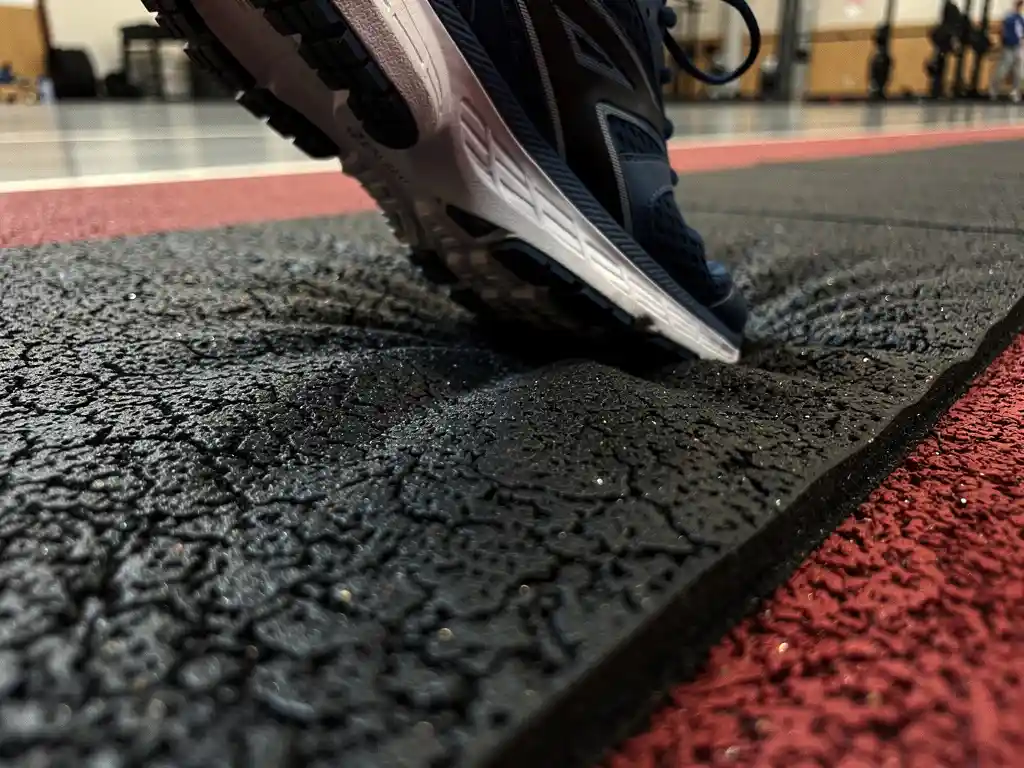
A safe sports surface needs to combine shock absorption, slip resistance, and appropriate firmness for the activity it supports. These three properties work together to reduce the risk of falls, joint injuries, and fatigue during play or training. The right flooring choice depends on the sport, the intensity of use, and the age range of the athletes using the space. Below, we break down the most important questions facility managers and coaches ask when evaluating sports flooring safety.
What are the key safety features to look for in a sports surface?
The most important safety features in a sports surface are shock absorption, slip resistance, surface stability, and durability under repeated use. A surface that lacks any one of these properties puts athletes at greater risk of acute injuries like sprains and falls, as well as long-term issues like joint stress and fatigue.
When evaluating sports flooring for an athletic facility, look for these core properties:
- Shock absorption: The surface should cushion impact to protect joints, especially during high-impact activities like running, jumping, or weightlifting.
- Slip resistance: The texture and material of the surface should provide reliable grip even when wet or under heavy foot traffic.
- Surface stability: The flooring should not shift, buckle, or compress unevenly under load, which can cause athletes to lose their footing or balance.
- Durability: A surface that holds its safety properties over time avoids the gradual degradation that turns a once-safe floor into a hazard.
- Cleanability: Surfaces that trap moisture or bacteria create hygiene risks and can become slippery over time.
For sports venue maintenance, it helps to think of these features as a checklist rather than a hierarchy. A surface can be excellent at shock absorption but poor at slip resistance, and that imbalance is enough to create a real safety problem.
How does shock absorption protect athletes on sports flooring?
Shock absorption in sports flooring works by spreading and dissipating the impact energy generated when an athlete lands, pivots, or jumps. Instead of that force traveling directly through the foot and into the joints, the surface absorbs a portion of it. This reduces stress on the knees, ankles, hips, and lower back over time.
The practical benefit is most obvious in high-repetition environments: think of a gym floor used for jump training, or a fitness studio where athletes train daily. On a hard, unforgiving surface, those repeated impacts accumulate. On a properly cushioned sports surface, the load on joints is meaningfully lower across a full training session.
It is worth noting that shock absorption is not the same as softness. A surface that is too soft can actually increase injury risk by causing instability during lateral movements or heavy lifts. The goal is a surface that absorbs impact without compromising the firmness athletes need to push off, pivot, and maintain balance.
What causes slips and falls on sports surfaces?
Slips and falls on sports surfaces are most commonly caused by moisture, worn surface texture, incorrect footwear, and flooring that is not suited to the activity. Each of these factors reduces the friction between the athlete’s foot and the surface, making it harder to maintain control during fast movements.
Moisture is the most frequent culprit. Sweat, water tracked in from outside, and humidity can all reduce grip on surfaces that are not designed to handle them. Smooth or worn flooring compounds the problem because the texture that creates friction has degraded.
Footwear mismatch is also a common but overlooked issue. A surface that performs well with athletic shoes may become dangerously slippery when someone walks across it in socks or street shoes. Recreational facilities often see this problem when different user groups share the same space.
Finally, flooring that was not designed for the sport being played creates friction mismatches. A surface optimized for basketball, for example, may be too grippy for a sport that requires sliding movements, leading to ankle injuries from sudden stops.
What’s the difference between rubber and foam sports flooring for safety?
The key difference between rubber and foam sports flooring is that rubber offers greater durability, stability, and slip resistance, while foam provides softer cushioning but compresses over time and offers less surface stability. For most athletic facilities, rubber is the more reliable long-term safety choice.
Rubber sports flooring
Rubber flooring holds its shape under heavy, repeated use. It resists compression, meaning the shock absorption properties stay consistent over years rather than degrading after a few months of heavy traffic. Rubber surfaces are also non-porous, which means they do not absorb moisture, reducing the risk of slippery patches and bacterial buildup. For sports venue maintenance, rubber is straightforward to clean and inspect.
Foam sports flooring
Foam flooring is softer underfoot and can feel more comfortable for lower-intensity activities like yoga or stretching. However, foam compresses permanently over time, especially under heavy equipment or concentrated foot traffic. Once compressed, it no longer absorbs shock evenly, which creates inconsistent surface behavior and potential trip hazards where compressed and uncompressed areas meet. Foam is also more susceptible to moisture damage, which can affect both hygiene and surface grip.
For high-traffic athletic facilities or areas with heavy equipment, rubber is generally the more practical and safer long-term investment. Foam may be appropriate for lower-intensity, lower-traffic spaces where comfort is the priority and the flooring will be replaced regularly.
How does flooring thickness affect safety on sports surfaces?
Flooring thickness directly affects how much shock a sports surface can absorb. Thicker flooring generally provides more cushioning for high-impact activities, while thinner flooring offers better stability and firmness for activities that require precise footwork or heavy lifting.
There is no single correct thickness for all sports flooring. The right choice depends on the type of activity the space supports:
- High-impact activities (jumping, running, CrossFit): Thicker flooring in the range of 3/4 inch to 1 inch or more provides meaningful impact protection for joints.
- Weightlifting and strength training: Thicker, dense rubber flooring protects the subfloor from dropped weights and provides a stable base, but it should not be so soft that it creates instability during lifts.
- Court sports and lateral movement: Moderate thickness with a firm, consistent surface supports quick direction changes without the instability of overly thick or soft flooring.
- Low-impact activities: Thinner flooring may be sufficient where the primary goal is comfort rather than impact protection.
For sports facility management, it is worth thinking about the mix of activities happening in each zone. A single facility may need different flooring specifications in different areas to match the actual demands of each space.
When should sports facility flooring be replaced for safety reasons?
Sports facility flooring should be replaced when it shows visible signs of structural degradation, uneven compression, surface damage, or persistent hygiene issues that cannot be resolved through cleaning. Waiting until flooring looks completely worn out often means athletes have already been training on a compromised surface for some time.
Watch for these specific warning signs during regular sports venue maintenance inspections:
- Uneven surface: Bubbling, curling edges, or compressed areas that create an inconsistent surface and increase trip risk.
- Loss of grip: Surfaces that feel slippery even when dry, indicating the texture has worn down beyond a safe level.
- Visible cracks or tears: These create edges that can catch footwear and cause falls, and they allow moisture to penetrate the flooring material.
- Persistent odor or discoloration: Signs that moisture has been absorbed into the flooring, creating hygiene risks and potentially weakening the material structure.
- Reduced shock absorption: If athletes report more joint soreness than usual, or if the floor feels noticeably harder than when it was installed, the cushioning properties may have degraded.
A practical approach for recreational facilities is to schedule formal flooring inspections at regular intervals, not just when something looks obviously wrong. Catching early signs of wear means you can plan replacements proactively rather than reactively, keeping your space safer and avoiding more costly repairs down the line.
At LRP Matting, we design rubber flooring specifically for the demands of athletic and recreational environments. Our mats are made from genuine, non-porous rubber that holds its grip, resists moisture, and maintains its structural properties under heavy use. Whether you are outfitting a gym, a training facility, or a multi-use sports space, we can help you find the right flooring for your specific needs. Explore our sports and recreation matting solutions to see what we offer.
Frequently Asked Questions
How do I know which sports flooring is right for a multi-use facility that hosts different activities?
For multi-use facilities, the best approach is to zone your flooring based on the primary activities in each area rather than choosing one surface for the entire space. For example, a dense rubber floor of 3/4 inch or more works well in weightlifting and high-impact zones, while a firmer, moderate-thickness surface suits court sports areas. If zoning is not possible, prioritize the most demanding or highest-risk activity in the space and choose flooring that meets those requirements, then supplement with portable mats where softer cushioning is occasionally needed.
Can I install sports flooring over an existing concrete or hardwood subfloor without affecting safety?
Yes, but the condition of your subfloor matters significantly. Concrete subfloors should be level, dry, and free of cracks before installation, since any unevenness will transfer through the flooring and create instability or trip hazards above. For hardwood subfloors, ensure there is no moisture damage or soft spots, as these can cause the sports surface to shift or compress unevenly over time. A professional subfloor assessment before installation is a worthwhile step that can prevent safety issues and premature flooring failure down the line.
What is the most common mistake facility managers make when choosing sports flooring?
The most common mistake is prioritizing cost or aesthetics over performance specifications matched to the actual activity. Choosing a thinner or softer flooring to save money in a high-impact training area, for instance, often leads to faster degradation and higher replacement costs over time, as well as increased injury risk. Another frequent error is selecting flooring based on how it looks or feels when new, without considering how it will perform after months of heavy use, moisture exposure, and cleaning cycles.
How often should sports flooring be cleaned to maintain its slip resistance?
High-traffic sports flooring should be cleaned daily to prevent the buildup of sweat, dust, and debris that can reduce surface grip over time. For rubber flooring specifically, a damp mop with a pH-neutral cleaner is typically sufficient for routine maintenance, while a deeper scrub should be performed weekly or more frequently in heavily used areas. Avoid harsh chemical cleaners or excessive water, as these can degrade the surface texture that provides slip resistance and may cause moisture to seep into seams or edges.
Does sports flooring need to meet any safety certifications or standards?
Yes, reputable sports flooring products are often tested against recognized standards such as ASTM F2772 for athletic floor performance or EN 14904 for indoor sports surfaces, depending on the region and application. These standards assess properties like shock absorption, ball bounce consistency, and slip resistance under controlled conditions. When evaluating flooring options, ask suppliers for test data or certification documentation relevant to your specific sport or activity, as this gives you an objective benchmark rather than relying solely on product descriptions.
What should I do if athletes are reporting more joint soreness or discomfort after training sessions?
Increased joint soreness after training sessions can be an early indicator that your flooring’s shock absorption has degraded, even if the surface does not yet show obvious visible damage. Start by inspecting the flooring for compressed areas, uneven spots, or sections that feel noticeably harder underfoot compared to when the flooring was new. If the flooring is several years old and showing any of these signs, it is worth consulting with a flooring specialist to assess whether replacement is needed, as continuing to train on a compromised surface increases the risk of both acute injuries and cumulative joint stress.
Are there any temporary or portable flooring options that offer the same safety as permanent installations?
High-quality interlocking rubber tiles and portable rubber mats can offer safety performance comparable to permanent installations, provided they are thick enough for the activity and properly secured to prevent shifting or edge lifting. The key risk with portable flooring is that tiles or mats can separate or curl at the edges during use, creating trip hazards, so it is important to choose products with secure interlocking systems and to inspect them before each use. Portable options work well for temporary setups, event spaces, or areas where permanent installation is not feasible, but they require more frequent inspection than fixed flooring.
Related Articles
- How do facility layouts affect animal movement?
- How do sports facilities prevent slips?
- How can you improve traction on existing floors?
- What is the best way to protect a sports facility floor from heavy equipment?
- How does the type of stall floor affect how much bedding you need?
- What is the difference between anti-fatigue mats and standard rubber mats?
- How do you reduce fall risk for horses in a veterinary facility?
- What causes back pain in workers who stand on hard floors all day?
- Why is my horse stiff after being in the stall overnight?
- What should you put on a concrete barn floor to protect your horse?