

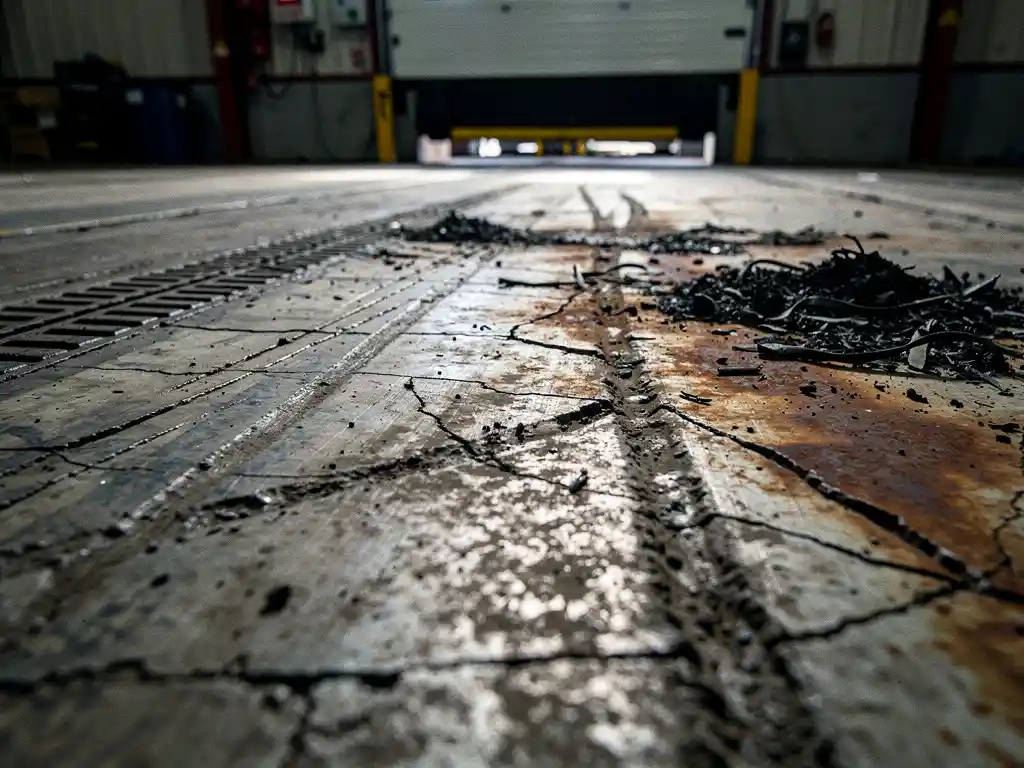
Floor surface damage in high-traffic facilities is caused by a combination of repeated mechanical stress, moisture exposure, chemical contact, and the gradual breakdown of joints and seams. Heavy foot traffic, wheeled equipment, and constant load-bearing wear away surface materials over time, while liquids and cleaning agents accelerate that process from below and within. The result is a floor that becomes not just unsightly, but genuinely unsafe and expensive to repair. Below, we break down the specific causes and what you can do about them.
What types of floors are most vulnerable to high-traffic damage?
Concrete, vinyl, epoxy-coated, and ceramic tile floors are among the most vulnerable to high-traffic damage in industrial and commercial facilities. Each material has different tolerances for impact, abrasion, and moisture, but all of them degrade faster when exposed to repeated stress without adequate protection. Understanding your floor type helps you choose the right strategy to extend its life.
Concrete is the most common flooring choice in warehouses, manufacturing plants, and agricultural buildings because it is strong and relatively affordable. However, it is also porous, which means it absorbs moisture, oils, and chemicals over time. Once the surface layer begins to pit or crack, deterioration accelerates quickly.
Epoxy-coated floors offer better chemical resistance and a smoother finish, but the coating itself is susceptible to impact damage and can delaminate when exposed to temperature fluctuations or heavy point loads. Vinyl and tile floors face similar challenges: they handle moderate traffic well but tend to crack, chip, or separate at the edges when subjected to the kind of stress typical in industrial settings. For concrete floor protection in particular, surface wear is a slow but consistent problem that compounds over time.
How does heavy foot and equipment traffic wear down floor surfaces?
Heavy foot and equipment traffic wear down floor surfaces through repeated mechanical abrasion and impact loading. Every footstep, forklift pass, or pallet drop transfers force directly into the floor material. Over time, this erodes surface coatings, opens micro-cracks in concrete, and compresses softer flooring materials beyond their recovery point, reducing both floor durability and surface performance.
Foot traffic alone can be surprisingly destructive when it involves hard-soled boots, steel-tipped shoes, or grit carried in from outside. That grit acts like sandpaper against the floor surface with every step. In facilities where workers are on their feet for long shifts, the same areas get hit thousands of times per day.
Equipment traffic compounds the problem significantly. Forklifts, pallet jacks, and heavy carts concentrate enormous weight onto small wheel contact areas. This creates localized stress points that crack epoxy coatings, chip tile edges, and grind down concrete surfaces. Turning movements are especially damaging because they generate lateral shear forces that few floor materials are designed to handle repeatedly.
What role do moisture and chemicals play in floor deterioration?
Moisture and chemicals accelerate floor deterioration by penetrating surface materials, weakening their structural integrity from within. Water that seeps into concrete causes freeze-thaw cracking in cold environments and promotes mold growth in humid ones. Cleaning agents, oils, and industrial chemicals can dissolve surface coatings, stain porous materials, and break down adhesives that hold tiles or coverings in place.
In food processing facilities, commercial kitchens, and agricultural settings, moisture is almost unavoidable. Repeated wet-dry cycles cause concrete to expand and contract, gradually widening existing micro-cracks. Spilled oils and lubricants in manufacturing environments are absorbed by porous surfaces, making them slippery and structurally weaker over time.
Chemical exposure is a particular concern for epoxy and coated floors. Many industrial cleaning products contain acids or solvents that react with floor coatings, causing them to bubble, peel, or lose adhesion. Once the protective layer is compromised, the base material underneath is exposed to the full force of traffic and moisture simultaneously, and floor wear accelerates dramatically.
Why do floor seams and joints fail faster in busy facilities?
Floor seams and joints fail faster in busy facilities because they are the weakest structural points in any flooring system. Traffic repeatedly stresses these transitions, while moisture and debris accumulate in the gaps. Over time, the edges chip, sealants break down, and tiles or panels begin to lift, creating tripping hazards and allowing water to penetrate below the surface layer.
In large industrial spaces, flooring is rarely installed as a single continuous surface. Expansion joints, tile grout lines, and panel edges are all points where two materials meet, and that meeting point is always more vulnerable than the material itself. When a forklift wheel rolls over a seam, the impact is concentrated right at that edge rather than distributed across a solid surface.
Sealants used to fill joints have a limited lifespan, especially in environments with temperature swings, chemical exposure, or constant mechanical stress. Once a sealant fails, the joint opens up. Debris gets trapped in the gap, water infiltrates below the floor, and the surrounding material begins to crack outward from that point. This is one reason why minimizing the number of seams in a floor installation is a practical way to improve long-term durability.
How can rubber matting prevent floor surface damage?
Rubber matting prevents floor surface damage by creating a protective barrier between the floor and the sources of wear. Mats absorb impact from foot traffic and equipment, reduce the abrasive effect of grit and debris, and block moisture and chemicals from reaching the floor surface directly. This extends the life of the underlying floor and reduces the frequency and cost of repairs.
In high-traffic zones like entryways, production lines, and loading areas, rubber mats take the brunt of daily wear so the floor underneath does not have to. Because rubber is non-porous, it does not absorb liquids or harbor bacteria, and it can be cleaned easily with mild detergent and water. This makes it particularly effective in environments where hygiene and floor durability both matter.
Rubber matting also reduces the damage caused by wheeled equipment. A thick, dense mat distributes the load of a forklift or pallet jack across a wider area, reducing the point pressure that cracks coatings and chips concrete. Placing mats at turning points and high-load zones addresses the specific areas where floor wear tends to concentrate.
What should you look for in a rubber mat for a high-traffic facility?
For a high-traffic facility, look for rubber mats that offer high density, chemical resistance, a non-slip surface, and minimal seams. The mat should be thick enough to absorb impact and distribute load, durable enough to resist compression over time, and sized appropriately to cover the full area of use without creating additional trip hazards at edges or joints.
Density and thickness matter most in industrial settings. A mat that compresses permanently under heavy equipment quickly loses its protective function. Look for mats made from high-quality rubber compounds that maintain their shape and surface performance under repeated loads. Materials like fiber-reinforced rubber compound provide extra structural strength that standard rubber cannot match.
Surface texture is equally important. A mat with a raised pattern or textured top layer improves traction for workers, especially in wet or oily conditions. At the same time, beveled edges reduce the risk of trips at the mat perimeter, which is a common safety concern in busy walkways and production areas.
Sizing is worth thinking about carefully. Larger mats mean fewer seams, which reduces both the tripping risk and the gaps where moisture and debris can accumulate. In facilities where coverage needs to be continuous, choosing the largest available mat size simplifies installation and creates a cleaner, more uniform surface.
At LRP Matting, we design our industrial rubber mats with exactly these priorities in mind. Our mats are made from 100% recycled rubber, including our proprietary FRC® fiber-reinforced compound, which gives them the strength and durability to hold up in demanding environments. We also offer some of the largest mat sizes in the industry, so you can cover more ground with fewer seams and less hassle. If you are looking for a practical way to protect your floors and improve safety, we are happy to help you find the right fit.
Frequently Asked Questions
How do I know when it's time to replace my rubber mats versus just cleaning or repositioning them?
It’s time to replace rubber mats when they show permanent compression, surface cracking, curling edges, or a significant loss of traction — signs that the material can no longer absorb impact or distribute load effectively. Cleaning and repositioning can extend mat life in early wear stages, but once structural integrity is compromised, a worn mat can become a safety hazard rather than a protective asset. A good rule of thumb is to inspect mats quarterly in high-traffic zones and replace them as soon as surface performance visibly declines.
Can rubber matting be used on top of already damaged floors, or does the floor need to be repaired first?
Rubber matting can be placed over mildly damaged floors — such as surfaces with minor surface pitting or light cracking — as long as the floor is structurally stable and level enough not to create a tripping hazard under the mat. However, if the floor has deep cracks, significant unevenness, or active moisture infiltration, those issues should be addressed first to prevent further deterioration beneath the mat. Using matting over a severely compromised floor may mask the problem temporarily but will not stop the underlying damage from worsening.
What are the most common mistakes facilities make when placing rubber mats?
The most common mistakes include placing mats that are too small for the area, leaving uncovered gaps between mat sections, and failing to use beveled-edge mats at entry points — all of which create tripping hazards and reduce protection. Another frequent error is neglecting high-stress zones like forklift turning points and loading dock edges, which are exactly where floor damage concentrates most. Choosing the right mat size and positioning them strategically based on actual traffic patterns makes a significant difference in both safety and floor protection outcomes.
How should rubber mats be cleaned and maintained in facilities with chemical or oil exposure?
In facilities with chemical or oil exposure, rubber mats should be cleaned regularly with a mild detergent and water, using a stiff brush or pressure washer to remove embedded grit and residue from the surface texture. Avoid harsh solvents or acid-based cleaners, as these can degrade the rubber compound over time and reduce the mat’s structural performance. Establishing a routine cleaning schedule — daily in the most contaminated zones — keeps mats hygienic, maintains traction, and helps you spot wear or damage early before it becomes a safety issue.
Are there specific zones in a facility that should always be prioritized for floor protection?
Yes — entryways and transition zones, forklift travel paths, turning points, loading docks, and any area with regular liquid exposure should be the top priorities for floor protection. These are the locations where mechanical stress, moisture, and grit accumulate most intensely, making them the first places where floor deterioration typically begins. Addressing these high-risk zones first delivers the greatest return on investment by preventing the most costly and safety-critical damage before it spreads to surrounding areas.
Does rubber matting also help with worker fatigue and safety, or is it purely about floor protection?
Rubber matting delivers meaningful benefits on both fronts. Anti-fatigue properties built into many rubber mat designs reduce the physical strain on workers who stand for long shifts, which has been shown to improve productivity and reduce injury risk. At the same time, the non-slip surface texture provides critical traction in wet, oily, or high-traffic conditions where slip-and-fall incidents are a serious concern. Choosing mats that address both floor protection and worker safety is a practical way to get more value from a single investment.
How does the number of seams in a mat installation affect long-term floor protection?
Fewer seams mean fewer weak points — both for the matting system itself and for the floor underneath. Every gap between mat sections is a potential entry point for moisture, debris, and chemicals, and it’s also a location where mat edges can curl or lift over time, creating trip hazards. Opting for larger mat sizes that minimize the number of joins in your installation simplifies maintenance, improves coverage uniformity, and extends the effective protective life of the entire system.
Related Articles
- What causes floor damage in warehouses?
- What role does flooring play in preventing musculoskeletal strain?
- What should be included in a sports surface safety inspection?
- What flooring improvements can increase workplace comfort?
- What causes a floor surface to become slippery over time?
- What type of flooring is used in professional sports training facilities?
- How does stall flooring affect a horse's overall well-being?
- What type of flooring holds up best in a high-traffic athletic venue?
- How does stall flooring affect a horse's hooves long term?
- How do you choose the right anti-fatigue mat thickness for a factory?