

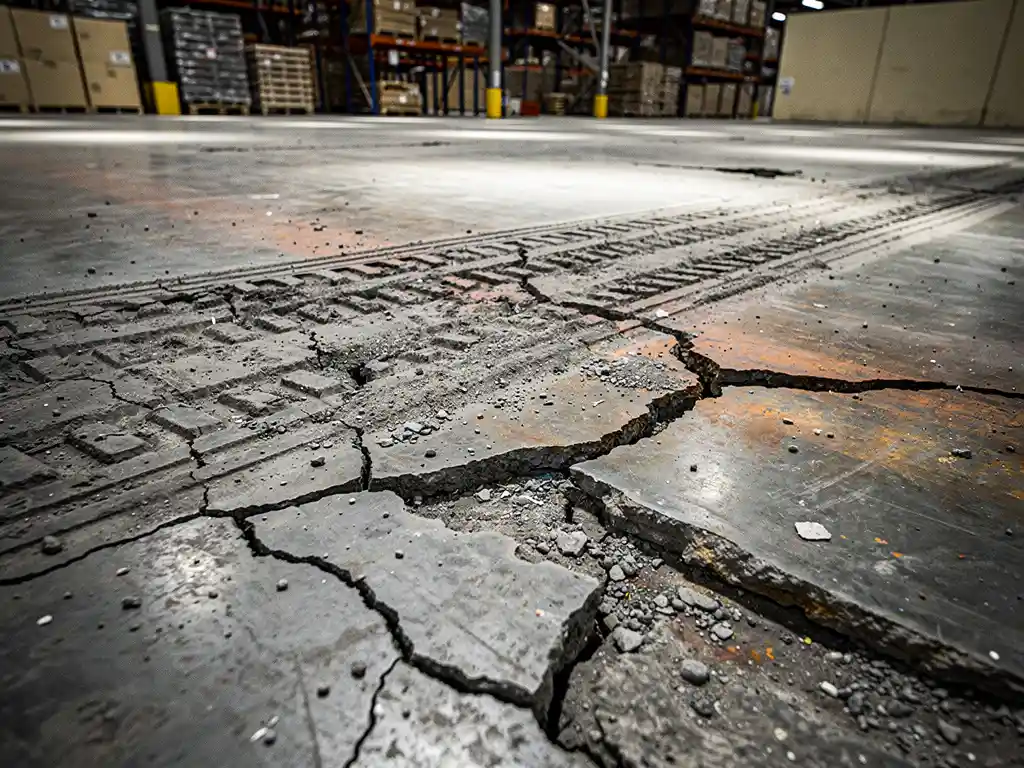
Warehouse floors commonly suffer from surface cracking, joint deterioration, coating breakdown, and deep structural damage caused by a combination of heavy traffic, chemical exposure, moisture infiltration, and repeated impact loading. These types of damage often develop gradually and go unnoticed until repair costs become significant. Understanding what drives each type of deterioration helps you take practical steps to slow it down or prevent it altogether.
What types of damage do warehouse floors commonly suffer?
Warehouse floors typically experience four main categories of damage: surface abrasion and coating wear, cracking from impact or load stress, joint and edge deterioration, and chemical or moisture-related breakdown of the concrete matrix. In active logistics facilities, these problems rarely appear in isolation. Most warehouse flooring failures result from several stressors working together over time.
Surface abrasion is the most visible form of damage. Constant forklift traffic, pallet dragging, and foot traffic gradually grind down the top layer of the floor, exposing the aggregate beneath and creating an uneven surface. Once the surface becomes rough or pitted, it collects debris and moisture more easily, which accelerates further breakdown.
Cracking is the most structurally serious issue. Cracks can develop from point loading, thermal expansion, subbase settlement, or poor original construction. Even hairline cracks allow moisture and chemicals to penetrate deeper layers, turning a minor surface problem into a costly structural repair.
Joint and edge damage is especially common near loading docks and transition zones where heavy equipment repeatedly crosses uneven surfaces. Over time, the edges of control joints chip and spall, creating tripping hazards and making the floor harder to clean and maintain.
How does heavy equipment traffic damage warehouse floors?
Heavy equipment traffic damages warehouse floors primarily through repeated dynamic loading, which causes fatigue stress in the concrete over time. Forklifts, pallet jacks, and order pickers concentrate significant weight on small contact areas, and every pass creates stress cycles that gradually weaken the floor slab. The damage is cumulative and often invisible until cracking or surface failure appears.
The turning and braking movements of forklifts are particularly damaging. When a loaded forklift turns sharply, the wheels apply lateral shear forces that can delaminate surface coatings and initiate cracks at the surface. Braking concentrates load at the front wheels, creating localized pressure spikes that exceed what the floor was originally designed to handle.
Traffic patterns matter too. Areas where forklifts consistently travel the same route develop wear channels and fatigue zones much faster than areas with varied traffic. High-traffic corridors and staging areas near loading docks are especially vulnerable, making warehouse safety in those zones a practical concern for both floor condition and personnel.
Why do chemical spills cause permanent floor damage?
Chemical spills cause permanent warehouse floor damage because many industrial chemicals react with the calcium compounds in concrete, breaking down its internal structure in a way that cannot be reversed by cleaning alone. Acids, solvents, oils, and certain cleaning agents penetrate the porous surface of untreated concrete and weaken it from within, often without any visible sign until the surface begins to pit or crumble.
Oils and lubricants are among the most common culprits in warehouse environments. They do not attack the concrete chemically in the same way acids do, but they saturate the surface, reduce friction dramatically, and create serious slip hazards. Oil-saturated concrete also becomes much harder to clean and can interfere with any coating or repair material applied later.
Battery acid from electric forklifts is a specific risk in charging areas. When battery electrolyte spills and is not cleaned up immediately, it etches the concrete surface and can cause deep pitting. Repeated exposure in the same area can eventually compromise the structural integrity of the slab in that zone.
The practical takeaway is that chemical spill response speed matters enormously. The longer a spill sits on an untreated concrete floor, the deeper the penetration and the more permanent the damage. Sealed or coated floors slow this process, but no surface treatment eliminates the risk entirely.
What role does moisture play in warehouse floor deterioration?
Moisture is one of the most damaging and underestimated factors in warehouse floor deterioration. Water infiltrates concrete through cracks, joints, and porous surfaces, and once inside the slab, it drives a range of destructive processes including freeze-thaw cycling, rebar corrosion, and chemical leaching that weakens the concrete matrix over time.
In facilities with loading dock access, moisture enters from multiple directions. Rain and runoff come in through open dock doors, condensation forms when warm, humid air meets a cold floor surface, and groundwater can wick upward through the slab if the vapor barrier beneath it is compromised. Each of these moisture pathways contributes to long-term floor deterioration.
Freeze-thaw damage is relevant in facilities that are not fully climate controlled. When water trapped inside concrete freezes, it expands and creates internal pressure that widens existing cracks and can cause surface spalling. Over multiple freeze-thaw cycles, this process progressively degrades the floor surface even without any traffic or chemical exposure.
Rebar corrosion is a slower but more serious consequence of moisture infiltration. When water carries chlorides or other corrosive agents into the slab and reaches the steel reinforcement, the rebar begins to rust. Corroding rebar expands, which causes the concrete above it to crack and delaminate in a process called concrete spalling. This type of structural damage is expensive to repair and can compromise load-bearing capacity.
How does dropped inventory and impact loading crack warehouse floors?
Dropped inventory and sudden impact loading crack warehouse floors by delivering concentrated energy to a small surface area in a fraction of a second, far exceeding the dynamic load capacity of the concrete. Unlike the gradual stress of rolling traffic, impact loading is instantaneous, giving the floor no time to distribute the force across a wider area. The result is radial cracking that spreads outward from the point of impact.
The severity of impact damage depends on the weight of the dropped object, the height from which it falls, and the condition of the floor surface at the point of impact. A floor with existing microcracks or a weakened surface coating is significantly more vulnerable than a sound, well-maintained slab. This is why impact damage tends to cluster in areas where the floor has already been stressed by traffic or chemical exposure.
Repeated smaller impacts can be just as damaging as single large ones. In picking and packing areas where cases or pallets are regularly dropped or slid across the floor, the cumulative effect of many moderate impacts creates surface crazing and eventually leads to deeper cracking. Industrial facility maintenance planning should account for these high-impact zones specifically, rather than treating the entire floor as a uniform surface.
Can rubber matting prevent warehouse floor damage?
Yes, rubber matting can meaningfully reduce warehouse floor damage by absorbing impact energy, distributing point loads across a wider surface area, and protecting the floor from chemical spills and abrasion. It does not eliminate all risk, but in high-traffic zones, staging areas, and loading dock environments, rubber matting reduces the rate of surface deterioration and extends the working life of the floor beneath it.
The impact absorption benefit is particularly relevant in areas where inventory is frequently dropped or where heavy equipment makes repeated turns. A thick rubber mat cushions the blow of dropped objects before it reaches the concrete, reducing the peak stress on the slab. For forklift turning zones, rubber matting also reduces the lateral shear forces that cause surface delamination.
Chemical and moisture protection is another practical benefit. Rubber is non-porous, so spills pool on the mat surface rather than soaking into the concrete below. This gives your team time to clean up before damage occurs, and it keeps the floor underneath in better condition for longer. Rubber mats are also easy to clean with mild detergent and water, which supports the kind of regular maintenance that keeps warehouse safety standards high.
Not every area of a warehouse needs matting, and the right approach is to identify your highest-risk zones first: loading docks, charging stations, staging areas, and high-traffic corridors. Covering these selectively with durable rubber matting is a cost-effective way to protect your floor investment without matting an entire facility.
At LRP Matting, we manufacture heavy-duty rubber mats specifically designed for demanding industrial environments. Our mats are made from 100% recycled rubber, and many are reinforced with our proprietary Fiber Reinforced Rubber Compound (FRC®) technology, which gives them extra strength and durability for the kind of continuous use warehouse floors demand. If you want to explore options built for your specific environment, take a look at our industrial matting solutions to find the right fit for your facility.
Frequently Asked Questions
How do I know if my warehouse floor damage is a surface issue or a structural problem?
Surface damage typically includes shallow abrasion, coating wear, minor spalling, and hairline cracks that don’t extend through the full depth of the slab. Structural damage, on the other hand, involves cracks that are wide, deep, or actively growing, areas where the floor feels soft or hollow when walked on, or visible rebar corrosion and delamination. If you’re unsure, a professional concrete assessment using a sounding hammer or ground-penetrating radar can identify the depth and severity of damage before you commit to a repair approach.
What's the best way to get started with a warehouse floor protection plan if I don't know where to begin?
Start by walking your facility and mapping the highest-stress zones: loading docks, forklift turning areas, battery charging stations, staging areas, and any corridors with consistent heavy traffic. These are the areas where damage concentrates first and where protective measures deliver the most return. Once you’ve identified your risk zones, you can prioritize interventions like rubber matting, joint sealing, or surface coatings based on the type and severity of stress each area experiences, rather than trying to treat the entire floor at once.
How often should warehouse floors be inspected to catch damage early?
A practical baseline is a thorough visual inspection every three to six months, with more frequent spot checks in high-traffic and chemical-exposure zones. Look for new cracks, joint edge chipping, surface pitting, coating delamination, and any areas where the floor surface has become uneven or rough. Catching damage early — especially cracking and joint deterioration — is significantly cheaper to address than waiting until structural repair becomes necessary. Documenting inspections with photos also helps you track how quickly damage is progressing over time.
Can a damaged warehouse floor be repaired, or does it need to be fully replaced?
In most cases, targeted repair is possible and far more cost-effective than full slab replacement. Surface abrasion and minor cracking can be addressed with grinding, patching compounds, and recoating. Joint edges can be rebuilt with polyurea or epoxy-based repair mortars. Full replacement is typically only necessary when the subbase has failed, rebar corrosion is extensive, or the slab has deteriorated to the point where repairs would cover more area than the original floor. Getting a professional assessment before committing to either approach will help you avoid over-investing in repairs or unnecessarily replacing a floor that still has structural integrity.
Does sealing or coating a warehouse floor actually prevent chemical damage, or just slow it down?
Sealing and coating significantly slow chemical penetration but do not provide indefinite protection, especially against strong acids or prolonged exposure. A quality epoxy or polyurethane coating creates a barrier that resists many common industrial chemicals and gives your team more time to clean up spills before they reach the concrete. However, coatings wear down over time under traffic, and any cracks or chips in the coating create entry points for chemicals. The most effective strategy combines a well-maintained surface coating with fast spill response protocols and regular coating inspections to catch breakdown before it leads to concrete damage.
What are the most common mistakes facilities make when trying to maintain warehouse floors?
The most common mistake is reactive maintenance — waiting for visible damage to appear before taking action, by which point repair costs are already significantly higher than prevention would have been. Other frequent errors include using the wrong cleaning chemicals that degrade coatings or concrete over time, ignoring joint maintenance until edges have fully spalled, and treating the entire warehouse floor as a uniform surface rather than identifying and prioritizing high-risk zones. Establishing a proactive inspection schedule and addressing minor damage promptly are the two most impactful habits a facility can develop.
Are there specific rubber mat features I should look for in heavy forklift traffic areas?
In areas with heavy forklift traffic, prioritize mats with high thickness (typically 3/4 inch or greater) for better load distribution and impact absorption, a textured or diamond-plate surface for traction under loaded equipment, and reinforced construction that resists compression and deformation under repeated wheel loads. Mats that curl, compress permanently, or shift under traffic become hazards rather than protective measures, so durability and dimensional stability matter as much as the initial protective benefit. Look for mats specifically rated or designed for industrial vehicle use rather than general-purpose options.
Related Articles
- What is recycled rubber?
- What role does drainage play in animal welfare?
- What makes an animal housing facility safe?
- What causes sports facility floors to wear out?
- What type of matting is best for a wet industrial work environment?
- What is the best flooring for an equine breeding facility?
- What do you put on a horse trailer ramp to prevent slipping?
- How do you cover an irregularly shaped horse stall floor?
- What is the best flooring for a factory assembly line?
- How do you calculate how much bedding a horse stall needs?