

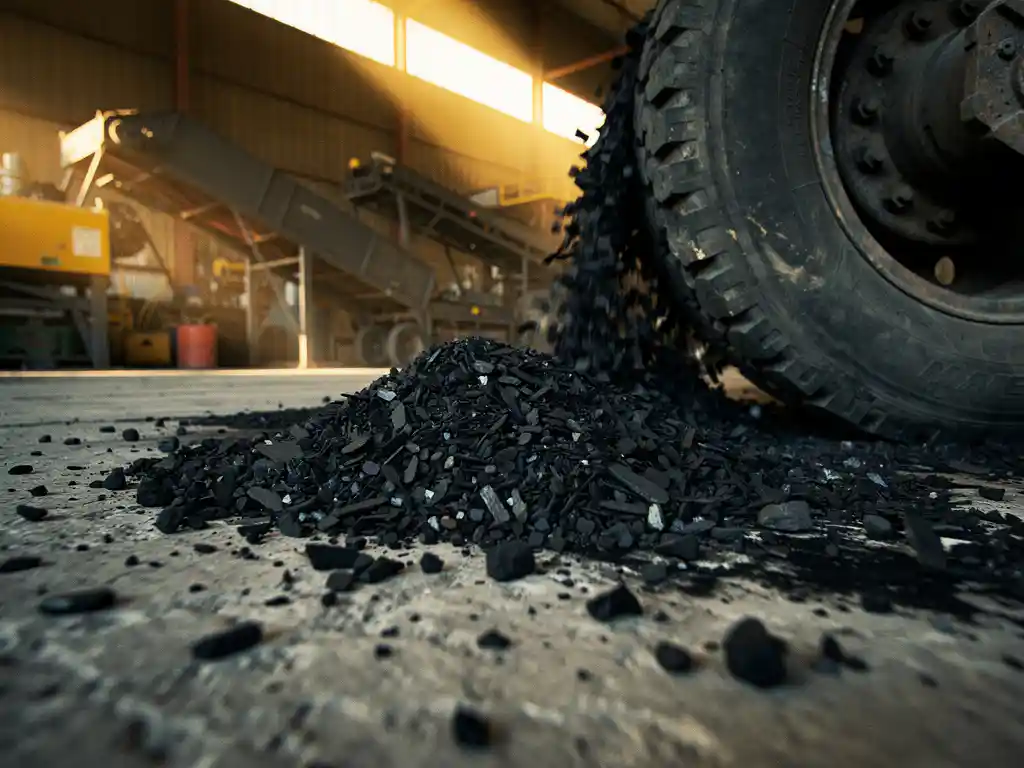
Recycled rubber is rubber that has been recovered from used products, most commonly old tires, and reprocessed into new materials. Instead of ending up in a landfill, the rubber goes through a series of mechanical or chemical steps that break it down and transform it into a usable raw material again. This makes recycled rubber a practical, sustainable alternative to virgin rubber in a wide range of products, from playground surfaces to industrial flooring. Below, we answer the most common questions people have about recycled rubber, how it works, and why it matters.
How is rubber recycled and processed?
Rubber recycling starts with collecting used rubber products, primarily old tires, and then breaking them down through mechanical grinding or cryogenic processing. The result is crumb rubber, a granular material that can be cleaned, refined, and blended with other compounds to create new rubber products. The process removes steel wire and textile fibers, leaving behind pure rubber particles ready for reuse.
The most common recycling method is ambient grinding, where tires are shredded at room temperature using a series of mills and granulators. Cryogenic processing is an alternative approach that freezes the rubber with liquid nitrogen before shattering it into fine particles. Both methods produce crumb rubber of varying sizes depending on the intended end use.
Once the rubber is granulated, manufacturers can blend it with binders, additives, or reinforcing fibers to improve its performance. One example of this kind of innovation is Fiber Reinforced Rubber Compound (FRC®), a proprietary material that combines reprocessed rubber with fiber reinforcement to create a significantly stronger and more durable end product than standard crumb rubber alone.
What are the properties of recycled rubber?
Recycled rubber shares many of the same core properties as virgin rubber. It is flexible, resilient, non-porous, and resistant to moisture, temperature extremes, and heavy loads. It also provides natural slip resistance and absorbs impact effectively, which makes it a reliable material for flooring, matting, and surface protection applications.
Because recycled rubber is non-porous, it does not absorb water or harbor bacteria the way porous materials can. This makes it easy to clean with mild detergent and water, and it holds up well in environments where hygiene matters. It also resists cracking, peeling, and crumbling, even when exposed to harsh conditions.
The exact properties of recycled rubber depend on the quality of the source material, the processing method, and any additives or reinforcements used. Higher-quality recycled rubber, especially when fiber-reinforced, can match or exceed the performance of standard virgin rubber in many demanding applications.
What products are made from recycled rubber?
Recycled rubber is used in a wide variety of products across industries. Common applications include rubber flooring and matting, playground surfaces, athletic tracks, shoe soles, automotive parts, garden mulch, and construction materials. The versatility of recycled rubber means it can be shaped, pressed, and molded into almost any form.
In the flooring and matting sector, recycled rubber is especially popular because it delivers the durability and safety performance that demanding environments require. You will find it used in:
- Industrial and commercial flooring for factories, warehouses, and assembly lines
- Gym and sports facility flooring
- Anti-fatigue mats for standing workstations
- Livestock and equine barn mats
- Playground and outdoor surface tiles
- Entrance and walkway matting
The range of applications keeps expanding as manufacturers develop better ways to process and reinforce recycled rubber, opening doors to uses that were previously only possible with virgin materials.
Is recycled rubber as strong as virgin rubber?
In many applications, recycled rubber performs comparably to virgin rubber, and in some cases it can be made even stronger through reinforcement. The key factor is how the recycled rubber is processed and what it is blended with. Standard crumb rubber has slightly lower tensile strength than virgin rubber, but this gap narrows significantly when the recycled material is combined with fiber reinforcement or other performance-enhancing compounds.
For most everyday uses, including flooring, matting, and surface protection, the difference in raw strength between recycled and virgin rubber is not practically meaningful. What matters more is the overall formulation of the product. A well-engineered recycled rubber mat will outlast a poorly made virgin rubber product in most real-world conditions.
The perception that recycled rubber is inherently weaker comes from early-generation products that used lower-quality crumb rubber without reinforcement. Modern processing techniques and compound engineering have changed this picture considerably. When you choose a quality recycled rubber product from a reputable manufacturer, you are not making a performance compromise.
What are the environmental benefits of recycled rubber?
The environmental benefits of recycled rubber are significant and well-documented. Recycling rubber diverts used tires and other rubber waste from landfills, where rubber can take decades to break down. It also reduces the demand for virgin rubber, which lowers the energy and resources needed to produce new raw material. Choosing recycled rubber products is one of the most direct ways to support a more circular approach to materials use.
From a life-cycle costing perspective, recycled rubber products often deliver strong long-term value. Because the material is durable and resistant to wear, products made from recycled rubber tend to last longer, which reduces replacement frequency and the associated waste and cost over time. This makes sustainable flooring made from recycled rubber not just an environmentally responsible choice but also a financially sensible one.
Additional environmental benefits include:
- Reduced landfill pressure from used tires, which are difficult to dispose of safely
- Lower carbon footprint compared to producing virgin rubber from natural or synthetic sources
- Support for a circular rubber economy, where materials stay in use longer
- Reduction in stockpiled tire waste, which poses fire and disease risks in large quantities
At LRP Matting, all of our rubber mats are made from 100% recycled materials, and many incorporate our proprietary FRC® technology for added strength. If you are looking for circular rubber flooring that combines sustainability with long-term performance, explore our full range of industrial rubber matting solutions designed for demanding environments.
Frequently Asked Questions
How do I know if a recycled rubber product is high quality before buying it?
Look for products that specify the grade and source of their crumb rubber, and check whether the manufacturer uses any reinforcement technology or performance-enhancing compounds. Reputable manufacturers will provide technical data sheets with information on tensile strength, density, and durability ratings. It is also worth checking whether the product meets relevant industry certifications or standards for your intended application, such as slip resistance ratings for flooring or impact attenuation standards for playground surfaces.
Can recycled rubber flooring be used outdoors, and how does it hold up in extreme weather?
Yes, recycled rubber is well-suited for outdoor use because it is naturally resistant to UV exposure, moisture, freeze-thaw cycles, and temperature extremes. It does not crack, warp, or degrade the way wood or some plastics do when exposed to the elements. For best results in outdoor applications, choose a product specifically formulated for exterior use, as some binders and surface finishes perform better outdoors than others.
Is recycled rubber safe for use around children, animals, and food preparation areas?
High-quality recycled rubber products are generally safe for use around children and animals, and many playground and barn mat products are specifically designed with this in mind. However, it is important to check whether the product has been tested for harmful substances such as heavy metals or volatile organic compounds (VOCs), particularly for indoor or sensitive environments. For food preparation or processing areas, look for products that meet food-safe standards and confirm with the manufacturer that the specific formulation is appropriate for that use.
What is the best way to install recycled rubber matting, and do I need a professional to do it?
Most recycled rubber mats and tiles are designed for straightforward installation and do not require professional help for standard applications. Interlocking tiles can typically be laid directly on a clean, flat surface without adhesive, making them easy to install, reposition, or replace. For larger flooring installations or applications where the matting needs to be permanently bonded to the subfloor, using a recommended adhesive and following the manufacturer’s installation guidelines will ensure the best long-term result.
How should I clean and maintain recycled rubber flooring to maximize its lifespan?
Recycled rubber flooring is low-maintenance by nature. Regular sweeping or vacuuming to remove debris, combined with periodic mopping using a mild detergent and water, is sufficient for most environments. Avoid harsh solvents, oil-based cleaners, or abrasive scrubbing tools, as these can degrade the surface over time. For industrial or high-traffic settings, a more frequent cleaning schedule will help preserve both appearance and performance.
What happens to recycled rubber products at the end of their lifespan — can they be recycled again?
Many recycled rubber products can be reprocessed again at the end of their useful life, which is one of the key advantages of rubber as a circular material. Some manufacturers and recycling programs accept worn rubber flooring and mats for reprocessing into new crumb rubber. When purchasing, it is worth asking your supplier whether they offer a take-back or end-of-life recycling program, as this closes the loop further and ensures the material stays out of landfill.
Are there any applications where recycled rubber is NOT recommended?
While recycled rubber is highly versatile, there are a few applications where it may not be the best fit. It is generally not recommended for environments with prolonged exposure to petroleum-based chemicals or strong solvents, which can cause the rubber to swell or degrade. Additionally, applications requiring extremely precise dimensional tolerances or very high-temperature resistance may be better served by specialized virgin or synthetic rubber compounds. When in doubt, consult with the manufacturer to confirm the product is suitable for your specific conditions.
Related Articles
- What causes floor surface damage in high traffic facilities?
- How do you extend the lifespan of facility floors?
- What causes floor damage in warehouses?
- What makes a standing workstation ergonomic?
- What should be included in a commercial floor inspection?
- How do you support a horse's joints during long periods of stabling?
- What is the safest floor surface for a food processing facility?
- How does stall flooring affect a horse's hooves long term?
- What is the best flooring for a factory assembly line?
- How do you make a paddock safer for horses in wet weather?