
The most effective flooring improvements for workplace comfort are anti-fatigue matting, ergonomic rubber flooring, and surface upgrades that reduce hard contact underfoot. These changes directly address standing fatigue, which is one of the most common causes of discomfort and reduced productivity in workplaces where employees spend long hours on their feet. Below, we answer the most common questions about flooring and workplace ergonomics so you can make informed decisions for your space.
How does flooring affect worker fatigue and productivity?
Hard flooring surfaces like concrete, tile, and stone force the muscles in your legs, back, and feet to work continuously just to keep you upright and balanced. Over a full shift, this constant low-level muscular effort adds up, leading to standing fatigue, joint discomfort, and reduced concentration. The type of flooring underfoot has a direct impact on how tired workers feel by the end of the day.
When workers are physically uncomfortable, their focus tends to drift. Discomfort is a distraction, and distraction leads to slower work, more errors, and a higher likelihood of accidents. Ergonomic research consistently links prolonged standing on hard surfaces to musculoskeletal complaints, including lower back pain and foot soreness. These are not minor inconveniences. They contribute to absenteeism, reduced output, and long-term health costs for both workers and employers.
Flooring that provides cushioning and slight instability encourages small, continuous muscle movements in the legs and feet. This micro-movement keeps circulation active and reduces the static load on joints, which is the core reason softer flooring materials outperform hard surfaces for employee well-being in standing environments.
What types of flooring are best for workplace comfort?
For workplace comfort, the best flooring options are those that provide cushioning, grip, and support underfoot. Rubber matting, foam anti-fatigue mats, and cushioned vinyl flooring are the most widely used solutions. Among these, rubber matting stands out for heavy-duty environments because it combines comfort with durability, resistance to moisture, and long-term stability.
Foam mats are lightweight and inexpensive, making them a popular choice for lighter-duty settings. However, they compress over time and lose their ergonomic benefit faster than rubber alternatives. Cushioned vinyl offers a softer surface than concrete but is better suited to cleaner, drier environments.
Rubber flooring works across a wide range of conditions. It holds its shape under heavy loads, resists oils and chemicals, and provides consistent cushioning over years of use. For manufacturing floors, assembly lines, commercial kitchens, and retail environments, rubber matting delivers the most reliable combination of comfort and practicality.
What is anti-fatigue matting and how does it work?
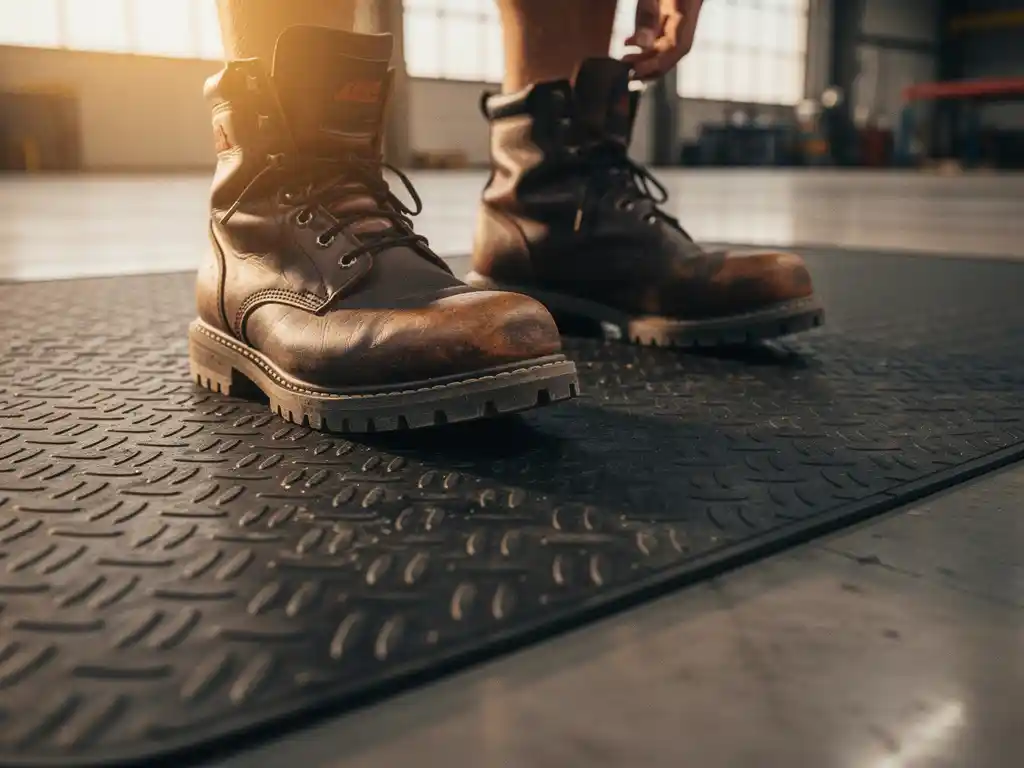
Anti-fatigue matting is a type of flooring designed to reduce the physical strain of prolonged standing by providing a cushioned, slightly flexible surface underfoot. It works by encouraging subtle, continuous movement in the leg and foot muscles, which promotes blood circulation and reduces the static muscle tension that builds up when standing on hard floors for extended periods.
The mechanism is straightforward. When you stand on a rigid surface, your muscles lock into a fixed position to keep you stable. This sustained contraction restricts blood flow and causes fatigue to set in relatively quickly. A compliant surface like anti-fatigue matting introduces gentle instability that prompts your muscles to make small adjustments continuously. These micro-movements keep the circulatory system more active and reduce the buildup of lactic acid that causes that familiar aching and heaviness in the legs.
Good anti-fatigue mats are not simply soft. They need to be firm enough to provide stable footing while still offering enough give to deliver the ergonomic benefit. Rubber is particularly effective here because it balances these two requirements well, offering controlled compression without bottoming out under weight.
Where should rubber mats be placed for maximum comfort?
Rubber mats deliver the most comfort benefit when placed in locations where workers stand in one position for extended periods. The highest-priority areas are workstations, assembly lines, checkout counters, kitchen prep areas, and any floor space where an employee spends the majority of a shift on their feet without regular opportunities to sit or move around freely.
Beyond individual workstations, consider these high-impact placement areas:
- Production lines and assembly areas where workers stand at fixed positions for hours at a time
- Commercial kitchens and food prep zones where hard tile floors are standard and fatigue sets in quickly
- Retail counters and service desks where staff stand throughout their shifts
- Warehouse packing stations where concrete floors are common and rest breaks are limited
- Workshop and tool areas where workers perform detailed, stationary tasks
Entranceways and transition zones are also worth considering. Mats in these areas do not primarily serve an ergonomic function, but they reduce slip risks and keep debris from spreading across the work floor, which contributes to overall safety and cleanliness.
How do rubber mats improve workplace safety alongside comfort?
Rubber mats improve workplace safety by providing a non-slip surface that reduces the risk of slips and falls, which are among the most common causes of workplace injuries. At the same time, the cushioning they provide reduces the physical strain that leads to fatigue-related accidents, where tired workers are more likely to make mistakes or react slowly to hazards.
The safety benefits of rubber matting go beyond grip. A quality rubber mat is non-porous, which means it does not absorb liquids. Spills sit on the surface rather than soaking in, making them easier to clean up quickly and reducing the window of time during which a wet floor poses a slip hazard. This is particularly relevant in food processing, commercial kitchens, and any industrial environment where liquids, oils, or other substances are present on the floor.
Rubber mats also protect the floor surface itself and reduce noise in high-activity areas. In environments with heavy equipment or foot traffic, a rubber surface absorbs impact and vibration, which reduces both wear on the floor and the physical stress transferred to workers’ joints over the course of a working day.
What should you look for when choosing workplace comfort mats?
When choosing workplace comfort mats, focus on material quality, thickness, surface texture, and fit for your specific environment. The right mat for a dry retail floor looks very different from the right mat for a wet industrial setting or a food preparation area. Getting the match right determines how long the mat lasts and how much ergonomic benefit it actually delivers.
Here are the key factors to evaluate:
- Material: Rubber is the most durable option for heavy-duty and wet environments. Foam suits lighter, drier settings but degrades faster.
- Thickness: A thickness of around 10 to 20mm is typically effective for anti-fatigue purposes. Thicker is not always better. Too much give can create instability and increase trip risk.
- Surface texture: Look for a surface that provides grip without being abrasive. Raised patterns or drainage channels are useful in wet areas.
- Size and coverage: Larger mats with fewer seams are easier to maintain and reduce the risk of edges curling up and becoming trip hazards.
- Chemical and moisture resistance: In industrial or food environments, the mat needs to withstand cleaning agents, oils, and moisture without degrading.
- Beveled edges: Sloped edges reduce the risk of tripping and make it easier to move equipment across the mat.
At LRP Matting, we offer rubber mats built specifically for demanding workplace environments, including options made from our proprietary Fiber Reinforced Rubber Compound (FRC®) for added strength and longevity. Whether you need standard sizes or a custom fit for an unusual floor layout, we can help you find the right solution. Explore our anti-fatigue matting options to see what works best for your workspace.
Frequently Asked Questions
How long does it typically take to notice a difference in worker comfort after installing anti-fatigue matting?
Most workers report a noticeable reduction in leg and foot fatigue within the first few days of using anti-fatigue matting. The improvement is most apparent toward the end of a shift, when discomfort on hard floors would normally peak. For measurable productivity and absenteeism benefits, many employers observe meaningful changes within the first few weeks of installation.
Can anti-fatigue mats be used with standing desks in office environments?
Yes, anti-fatigue mats are an excellent complement to standing desks and are increasingly common in office settings. For office use, a medium-density rubber or foam mat in the 10–15mm thickness range typically strikes the right balance between comfort and stability. Make sure the mat is sized to accommodate natural weight shifts and small movements, as standing desk users tend to shift position frequently throughout the day.
How do I properly clean and maintain rubber workplace mats to extend their lifespan?
Rubber mats should be cleaned regularly with a mild detergent and warm water, using a stiff brush or mop to remove debris from textured surfaces and drainage channels. Avoid harsh solvents or bleach-based cleaners, as these can degrade the rubber compound over time. Periodically lifting the mats to clean underneath them also prevents moisture buildup and keeps the subfloor in good condition, which helps the mat lie flat and maintain its ergonomic properties.
What is the most common mistake employers make when buying workplace comfort mats?
The most common mistake is choosing a mat based on price alone without considering the specific demands of the environment. A low-cost foam mat may seem like a practical choice, but in a wet, high-traffic, or chemically active setting, it will compress, degrade, or become a safety hazard far sooner than a purpose-built rubber alternative. Matching the mat material, thickness, and surface texture to the actual working conditions is the single most important factor in getting lasting value from the investment.
Are there any situations where anti-fatigue matting is not recommended or could create a hazard?
Anti-fatigue mats can create hazards if they are poorly fitted, have raised or curled edges, or are placed in areas with heavy forklift or pallet jack traffic, where the mat can shift or bunch underfoot. In high-traffic transit zones, a flush-to-floor rubber flooring solution is generally safer than a loose mat. Always ensure mats have beveled edges, are appropriately anchored or weighted, and are sized to fit the space without overlapping other surfaces or creating uneven transitions.
Do anti-fatigue mats make a difference for workers who are already wearing supportive footwear?
Yes, anti-fatigue mats and supportive footwear work together rather than substituting for each other. Ergonomic footwear addresses cushioning and arch support at the foot level, while anti-fatigue matting addresses the surface-level compliance and micro-movement stimulation that reduces static load on the entire lower body. Workers using both typically experience better outcomes than those relying on either solution alone, particularly in environments where shifts are long and the floor surface is hard.
How do I calculate how much matting I need for my workplace?
Start by identifying every fixed standing position in your facility, including individual workstations, counters, assembly points, and prep areas, then measure the floor area each worker occupies during a typical shift. A mat should cover at least the full standing footprint plus enough surrounding space to accommodate natural weight shifts, typically around 60–90cm of depth and at least the width of the workstation. For large or irregularly shaped areas, custom-cut matting is often a more practical and safer option than piecing together multiple smaller mats.
Related Articles
- What are the first signs a commercial floor needs maintenance?
- What causes leg fatigue at work?
- How do weather conditions affect outdoor floor safety?
- How do you reduce impact on a horse's legs during stabling?
- How does the type of stall floor affect how much bedding you need?
- What is the best flooring solution for a temporary work site?
- What flooring is used in equine surgery facilities?
- How do you reduce noise in a sports facility through flooring choice?
- What floor is best for a horse with arthritis?
- Can a hard barn floor cause tendon damage in horses?