
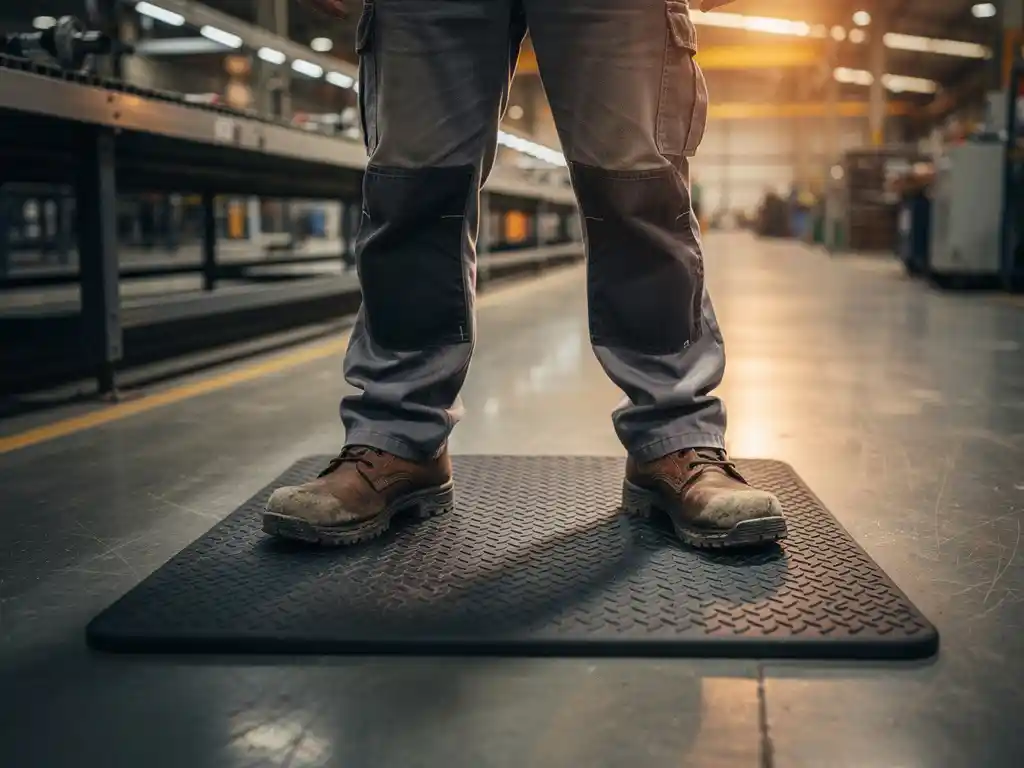
Flooring plays a direct role in preventing musculoskeletal strain by reducing the physical stress that hard, unforgiving surfaces place on your body over time. When you stand or walk on concrete or tile for hours, your joints, muscles, and tendons absorb repeated impact with no relief, leading to fatigue and long-term injury. The right flooring absorbs shock, encourages natural movement, and reduces the cumulative load on your body. Below, we answer the most common questions about flooring and musculoskeletal health at work.
How does hard flooring cause musculoskeletal strain?
Hard flooring causes musculoskeletal strain by forcing your body to absorb impact without any cushioning or energy return. Surfaces like concrete, tile, and stone have almost no give, so every step sends a shockwave up through your feet, ankles, knees, hips, and lower back. Over a full workday, this repetitive loading adds up quickly and leads to pain, fatigue, and eventually injury.
The problem goes beyond just the impact itself. When you stand still on a hard floor, your muscles stay contracted to keep you upright because there is no surface variation to encourage small postural shifts. This static muscle tension restricts blood flow, accelerates fatigue, and puts sustained pressure on spinal discs and joint cartilage. Workers who spend six or more hours per day on hard flooring are significantly more likely to report lower back pain, knee discomfort, and foot problems like plantar fasciitis.
The risk is not limited to standing. Workers who walk, push, or carry loads on hard surfaces experience additional joint stress with each step. Without proper flooring support, that stress compounds over weeks and months into chronic musculoskeletal conditions that affect both performance and quality of life.
What types of flooring reduce musculoskeletal injuries at work?
The flooring types most effective at reducing musculoskeletal injuries are those that provide cushioning, energy return, and surface variation. Anti-fatigue matting, rubber flooring, foam-based mats, and ergonomic floor tiles all outperform hard surfaces when it comes to protecting workers. Among these, rubber matting is widely used in industrial and commercial settings because of its durability, grip, and ability to maintain its cushioning properties under heavy use.
Softer flooring works by compressing slightly under the weight of your body, absorbing impact before it travels up through your joints. It also encourages subtle micro-movements in your feet and legs, which keeps muscles active, promotes circulation, and prevents the static tension that builds up on rigid floors.
Not all soft flooring performs equally. Foam mats, for example, may compress too much over time and lose their ergonomic benefit. Rubber matting holds its shape and provides consistent support across its entire lifespan, making it a more reliable long-term solution for high-traffic or heavy-duty environments.
What makes anti-fatigue matting different from standard rubber mats?
Anti-fatigue matting is specifically engineered to reduce physical strain during prolonged standing, while standard rubber mats are primarily designed for grip, protection, or drainage. The difference lies in the internal structure and material density. Anti-fatigue mats use a controlled level of cushioning that encourages gentle muscle movement in the legs and feet, which improves circulation and reduces fatigue without creating instability.
Standard rubber mats are firm and flat. They do a great job of protecting floors, providing traction, and reducing slip risks, but they are not optimized for ergonomic support. Anti-fatigue mats, by contrast, are calibrated to a specific compression range. Too soft and the mat becomes unstable, creating a tripping hazard and actually increasing muscle effort. Too hard and it offers no ergonomic benefit over the floor beneath it.
The best anti-fatigue mats also feature beveled edges to reduce trip hazards, textured surfaces for grip, and materials that resist compression fatigue over time. In practical terms, this means a worker standing on a well-designed anti-fatigue mat for eight hours will experience measurably less lower back and leg discomfort than one standing on bare concrete or a basic rubber mat.
Which industries benefit most from ergonomic rubber flooring?
Industries where workers stand or move for most of the day benefit most from ergonomic rubber flooring. Manufacturing, food processing, healthcare, retail, and assembly work are among the clearest examples. In these environments, workers are on their feet for extended shifts with little opportunity to sit, making floor quality a direct factor in their physical well-being.
In manufacturing and assembly lines, workers often stand in fixed positions for long periods performing repetitive tasks. Ergonomic flooring reduces the strain of static standing and helps prevent the upper and lower back pain that is common in these roles. In food processing facilities, rubber matting also provides the added benefit of slip resistance in wet or greasy conditions, addressing both safety and comfort at the same time.
Healthcare workers, including nurses and surgeons, are another group who spend long hours on hard hospital floors. Studies in occupational health consistently identify flooring as a contributing factor to musculoskeletal complaints in clinical settings. Retail environments, commercial kitchens, and hair salons share similar profiles: workers on their feet all day with minimal variation in movement.
How do you choose the right mat thickness for injury prevention?
Choosing the right mat thickness depends on the type of work being done, the duration of standing, and the weight or equipment involved. As a general guideline, mats between 3/8 inch and 5/8 inch thick are effective for most standing workstations. Thicker mats are not always better, because excessive cushioning can create instability and actually increase muscle effort in the legs and core.
For light to moderate standing tasks, a mat in the 3/8 to 1/2 inch range typically provides enough cushioning to reduce fatigue without compromising balance. For heavier industrial environments where workers are on their feet for longer durations or handling significant loads, a 5/8 inch mat offers more support while still maintaining stability.
You should also consider what happens at the mat’s edges. A mat that is too thick without beveled edges creates a raised lip that becomes a trip hazard, which introduces a new injury risk in trying to solve another. The right thickness is the one that balances cushioning with stability and integrates safely into the workspace layout.
Can flooring improvements reduce workers’ compensation claims?
Yes, flooring improvements can reduce workers’ compensation claims, particularly those related to musculoskeletal disorders and slip-and-fall incidents. These two categories consistently rank among the most common and costly workplace injury claims. Addressing the root cause through better flooring is a practical, preventive approach that can lower both the frequency and severity of these incidents over time.
Musculoskeletal disorders caused by prolonged standing and repetitive strain are often gradual, meaning they develop over months or years before becoming a formal claim. Ergonomic flooring reduces the daily physical load on workers, which slows or prevents that progression. The result is fewer long-term injury claims and lower overall costs for employers.
Slip-and-fall prevention is more immediate. Rubber matting with proper texture and drainage channels reduces the likelihood of falls in wet, oily, or high-traffic areas. Falls are one of the leading causes of acute workplace injuries, and the cost of a single serious fall, in medical expenses, lost productivity, and legal liability, can far exceed the cost of equipping an entire facility with quality matting.
At LRP Matting, we offer a wide range of rubber matting solutions designed for exactly these environments, from anti-fatigue mats for standing workstations to heavy-duty industrial flooring for demanding facilities. All of our mats are made from 100% recycled rubber and many feature our proprietary FRC® fiber-reinforced compound for added strength and longevity. If you are looking for a practical starting point, our anti-fatigue matting solutions are a good place to explore options that match your specific workplace needs.
Frequently Asked Questions
How long does it take to notice a difference after switching to ergonomic flooring?
Most workers report a noticeable reduction in leg fatigue and foot discomfort within the first few days of using quality anti-fatigue matting. Lower back and joint relief may take one to two weeks to become fully apparent, as your body adjusts to reduced cumulative strain. The key is consistency — the flooring needs to be in place for every shift to deliver its full ergonomic benefit.
Can ergonomic flooring still help if workers are already wearing supportive footwear?
Yes, ergonomic flooring and supportive footwear work together rather than replacing each other. Footwear addresses cushioning and arch support at the shoe level, while anti-fatigue matting reduces impact and encourages micro-movement from the ground up. Using both together provides a more complete solution and is generally recommended for workers who stand for six or more hours per day.
How do I know when my anti-fatigue mat needs to be replaced?
The most reliable sign that a mat needs replacing is visible compression set — when the mat no longer returns to its original thickness after being stood on, it has lost its ergonomic value. You may also notice workers reporting increased fatigue or discomfort despite the mat being in place, which is a practical indicator that the cushioning has degraded. As a general rule, high-traffic mats in industrial or commercial settings should be inspected every six to twelve months for signs of wear.
What is the best way to introduce ergonomic flooring across a large facility without disrupting operations?
The most effective approach is to start with a targeted rollout focused on the highest-risk workstations — typically fixed standing positions, assembly lines, or areas with known injury history. This allows you to assess performance and gather worker feedback before scaling facility-wide. Prioritizing modular or interlocking mat systems also makes installation faster and less disruptive, since they can be laid without adhesive and adjusted as workspace layouts change.
Are there flooring solutions suitable for outdoor or semi-outdoor work environments?
Yes, rubber matting is one of the most versatile options for outdoor and semi-outdoor environments because it is naturally resistant to moisture, temperature fluctuations, and UV exposure. Look for mats with drainage channels or open-grid designs that allow water to pass through, preventing pooling and maintaining slip resistance in wet conditions. Heavy-duty rubber tiles designed for outdoor use also hold up well against heavy equipment and foot traffic in loading docks, covered warehouses, and similar settings.
Can poor flooring contribute to injuries beyond the lower body, such as neck or shoulder pain?
Absolutely. When the lower body is under sustained stress from hard flooring, workers often unconsciously shift their posture to compensate — tensing the core, locking the knees, or leaning forward. These compensatory postures create secondary strain that travels up the kinetic chain into the hips, lower back, shoulders, and neck. Addressing floor-level ergonomics is therefore not just a lower-body fix; it supports whole-body postural alignment throughout the workday.
Is there a cost-effective way for small businesses to get started with ergonomic flooring?
Small businesses can make a meaningful impact without a large upfront investment by focusing first on the one or two workstations where employees spend the most continuous time standing. A single quality anti-fatigue mat at a cashier station, prep counter, or assembly bench can deliver significant relief for the workers who use it most. Starting small also allows you to evaluate performance and build a business case for expanding coverage to other areas over time.
Related Articles
- How does regular maintenance extend the life of sports flooring?
- What areas of a facility have the highest slip risk?
- How can you reduce fall risk in busy facilities?
- How do you support a horse's joints during long periods of stabling?
- What type of matting is best for a wet industrial work environment?
- What causes concrete floors to crack and chip in industrial facilities?
- What do you put under heavy equipment to protect a floor?
- How do you protect a newly installed floor in a busy facility?
- What is the most comfortable floor surface for a horse to stand on?
- What is the best flooring for a horse barn aisle?