
Hock sores in stabled horses are pressure wounds that develop on the point of the hock—the bony prominence on the back of the horse’s lower leg. They form when a horse repeatedly lies down and gets up on hard, unforgiving surfaces, causing friction and compression that damage the skin. Left untreated, they can progress from a small bald patch to a painful, infected wound. The good news is that hock sores are largely preventable with the right stable management and flooring choices.
What are hock sores in horses?
Hock sores, also called capped hocks or hock hygromas, are localized swellings or skin lesions that develop on the point of the hock joint. They occur when repeated pressure or trauma to that bony area causes the underlying bursa—a small, fluid-filled sac—to become inflamed, or when the skin itself breaks down from constant friction against a hard surface.
In mild cases, a hock sore may appear as nothing more than a small, hairless patch of skin. In more advanced cases, the area can become swollen, thickened, and tender to the touch. Horses that spend a lot of time indoors are particularly vulnerable because they repeatedly lie down and rise on surfaces that offer little cushioning or grip. A horse’s joint health in the stall is directly tied to the quality of the environment it lives in every day.
What causes hock sores in stabled horses?
The primary cause of hock sores in stabled horses is repeated mechanical trauma to the hock from contact with hard, abrasive stable floors. Every time a horse lies down or stands up, the point of the hock bears significant pressure and friction against the ground. Over time, this repeated impact damages the skin and underlying tissue, leading to sores.
Several factors increase the risk beyond floor hardness alone:
- Insufficient bedding — thin or poorly maintained bedding leaves the hock in direct contact with concrete or compacted dirt
- Stall size — a horse confined to a stall that is too small cannot position itself comfortably when lying down, increasing awkward contact with walls and floors
- Individual conformation — horses with prominent, angular hocks have less natural padding over the joint and are more prone to developing sores
- Time spent stabled — the more hours a horse spends indoors, the more opportunities there are for friction and pressure to accumulate
- Poor drainage — wet, soiled bedding softens the skin and makes it far more susceptible to abrasion
Understanding these contributing factors helps you address the problem at its root rather than simply treating the wound after it appears.
How do hard stable floors lead to hock injuries?
Hard stable floors lead to hock injuries by providing no shock absorption when a horse lies down or rises. Concrete—the most common stable floor material—is rigid and unforgiving. When a horse’s full body weight repeatedly transfers through the hock onto that surface throughout the day, the tissue over the joint takes the full impact every single time.
The mechanics are straightforward. A horse can weigh anywhere from 900 to 1,500 pounds, and when it shifts that weight onto a bony, low-fat area like the hock while lying down, the concentrated pressure on such a small surface area is considerable. Without cushioning, the skin compresses against the bone from below and the floor from above simultaneously.
Concrete also tends to be abrasive. Even when a horse moves slowly, the texture of the floor acts like sandpaper against the thin skin covering the hock. Over weeks and months, this gradual abrasion strips away hair, irritates the skin, and eventually breaks it down entirely. Add in the fact that concrete is cold and often damp, and you have a surface that compromises both comfort and skin integrity at the same time.
What are the signs that a horse has a hock sore?
The early signs of a hock sore include a small patch of missing or thinning hair on the point of the hock, mild swelling, or slight firmness in the tissue in that area. As the condition progresses, the skin may become visibly irritated, cracked, or scabbed, and the swelling can become more pronounced and fluid-filled.
Here is what to look for when checking your horse’s hocks:
- Hair loss or bald patches on the point of the hock
- Soft or firm swelling directly over the hock joint
- Redness, warmth, or sensitivity when you touch the area
- Scabbing, crusting, or open skin
- Discharge or signs of infection in more advanced cases
- Changes in the way the horse lies down or reluctance to get up
It is worth noting that in the early stages, hock sores are not always painful. A horse may show no obvious signs of discomfort even when the skin is visibly damaged. This is why regular, hands-on inspection of your horse’s legs—especially the hocks—is an important part of daily stable management. Catching a hock sore early makes treatment far simpler and recovery much faster.
Can hock sores in horses become serious?
Yes, hock sores can become serious if they are left untreated or if the underlying cause is not addressed. What starts as a small area of hair loss can progress to an open wound that becomes infected. In severe cases, infection can spread to deeper tissues, including the bursa or the joint itself, which is a significant veterinary concern that can affect the horse’s long-term soundness.
A superficial hock sore that is caught early and treated with appropriate wound care will usually heal well with no lasting effects. However, chronic hock sores—those that keep recurring because the horse continues to be exposed to the same hard surface—can lead to permanent thickening of the skin and underlying tissue. This thickening, sometimes called fibrosis, does not reverse easily and can leave a visible lump on the hock even after healing.
The takeaway here is simple: treat early, address the cause, and do not assume a small bald patch will resolve on its own. A horse’s joint health in the stall is a long-term commitment, not a one-time fix.
How does stable flooring affect the risk of hock sores?
Stable flooring has a direct and significant impact on the risk of hock sores. The harder, colder, and more abrasive the floor surface, the greater the risk. Conversely, flooring that provides cushioning, warmth, and grip dramatically reduces the mechanical stress placed on the hock each time the horse lies down or rises.
The problem with bare concrete
Bare concrete offers zero shock absorption and is inherently abrasive. It also retains cold, which can stiffen joints and make the horse less comfortable lying down for extended periods. Horses on bare concrete tend to shift positions more frequently, which actually increases the total number of times the hock contacts the floor.
The role of bedding
Deep, well-maintained bedding—whether straw, shavings, or rubber-based alternatives—creates a buffer between the horse and the floor. However, bedding compresses over time, thins in the areas where the horse lies most often, and requires consistent topping up and management to remain effective. Wet or soiled bedding also loses its protective quality quickly and introduces the added risk of skin softening from moisture.
Why the floor itself matters
Even with good bedding, the base floor matters. A floor that provides inherent cushioning reduces the total impact load on the hock regardless of how the bedding settles. A floor with good grip also allows the horse to rise more confidently and smoothly, reducing scrambling and awkward movements that put extra stress on the hock during the transition from lying to standing.
What can horse owners do to prevent hock sores?
Preventing hock sores comes down to reducing the pressure and friction that the hock experiences during daily stable life. The most effective approach combines good flooring, consistent bedding management, and regular monitoring of your horse’s hocks.
Here are the most practical steps you can take:
- Install cushioned stall flooring — rubber matting under bedding provides a consistent layer of shock absorption that bedding alone cannot guarantee
- Maintain deep, dry bedding — check bedding depth daily and top up regularly, especially in the areas where your horse tends to lie
- Keep stalls clean and dry — wet conditions soften the skin and increase abrasion risk, so remove soiled bedding promptly
- Ensure adequate stall size — a horse that has room to lie down and rise comfortably puts less awkward stress on its joints
- Check hocks regularly — make it a habit to run your hands over the hock area during grooming so you catch any early changes quickly
- Provide turnout time — horses that spend time on softer ground outdoors naturally reduce the total time their hocks are exposed to hard stable surfaces
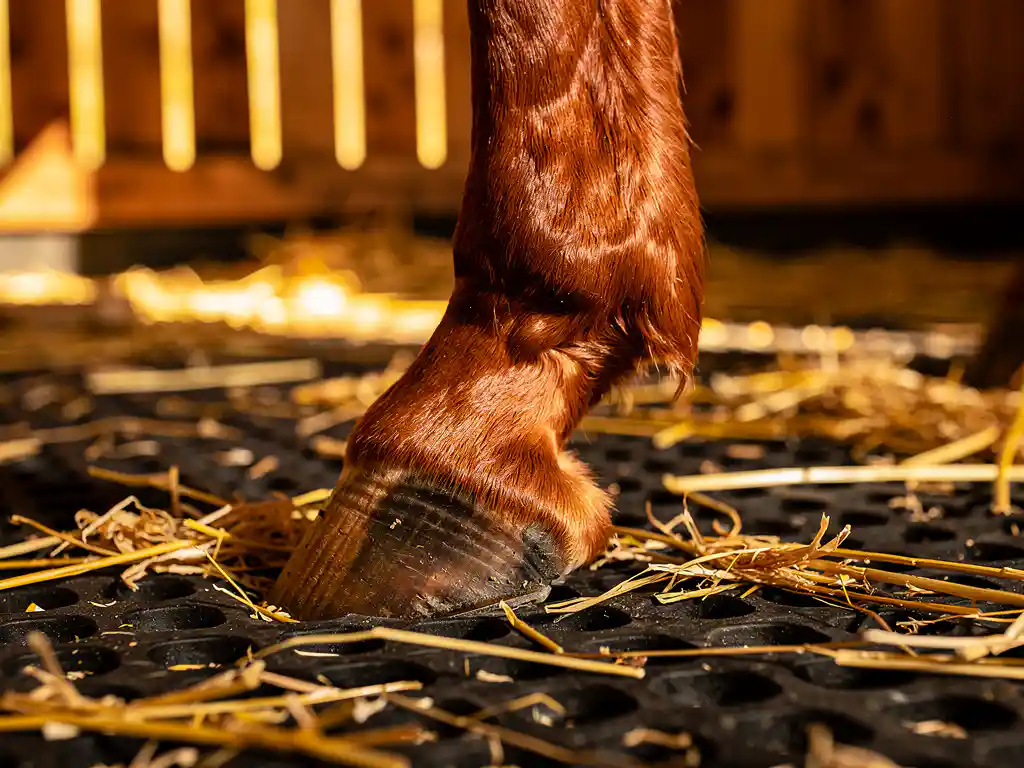
When it comes to flooring specifically, rubber stall mats are one of the most reliable tools available to horse owners. They provide consistent cushioning, insulation against cold, and a non-slip surface that makes lying down and rising easier and safer for the horse. At LRP Matting, our rubber horse mats are engineered from our proprietary Fiber-Reinforced Rubber Compound (FRC®), making them tougher and longer-lasting than standard rubber flooring. Our 4×6 Stall Mat and Hammer Top Mat are both designed to give horses a more comfortable surface to rest on while insulating against cold and damp conditions. And if your stalls are non-standard dimensions, our custom-made, made-to-measure rubber matting can be cut to fit any size or shape, so you get full coverage without gaps or awkward seams. Fewer seams mean a cleaner, safer surface for your horse’s hooves and joints every single day.
Frequently Asked Questions
How thick should rubber stall mats be to effectively prevent hock sores?
For meaningful shock absorption, rubber stall mats should be at least 3/4 inch (19mm) thick. Thicker mats — in the range of 3/4 to 1 inch — provide noticeably better cushioning and insulation, particularly on concrete subfloors. Pairing a quality thick mat with a layer of dry bedding on top gives you the most effective combination of impact absorption and surface comfort for your horse.
Can a hock sore heal on its own if I improve the stable conditions?
Minor, superficial hock sores — such as small bald patches with no broken skin — may resolve on their own once the source of friction and pressure is removed and conditions are improved. However, any sore involving broken skin, swelling, heat, or discharge should be assessed and treated by a veterinarian, as these signs indicate tissue damage that requires proper wound care. Improving stable conditions is essential, but it addresses prevention rather than treatment once a wound has already developed.
Are certain horse breeds or types more prone to developing hock sores?
Yes, horses with naturally prominent, angular hocks and less soft tissue covering the joint are at higher risk — this often includes Thoroughbreds, warmbloods, and other lean, fine-boned breeds. Draft horses and heavier breeds can also be vulnerable simply due to the greater body weight concentrated on the hock when they lie down. Regardless of breed, conformation that results in a particularly bony or exposed hock point warrants extra attention to bedding depth and flooring quality.
What is the difference between a capped hock and a hock sore, and does the distinction matter for treatment?
A capped hock specifically refers to a fluid-filled swelling (hygroma) over the point of the hock caused by bursal inflammation, while a hock sore is a broader term that also includes surface skin wounds and abrasions in the same area. The distinction does matter for treatment: surface skin wounds are managed with wound care and infection prevention, whereas a true capped hock with significant fluid accumulation may require veterinary intervention such as drainage or anti-inflammatory therapy. Both conditions share the same root cause — repeated trauma from hard surfaces — so prevention strategies are identical for both.
How do I know if my stall mats are still providing adequate protection, or if they need replacing?
Check your mats regularly for signs of compression, cracking, curling edges, or permanent indentations in the areas where your horse lies most often — these are all signs that the mat has lost its cushioning integrity. A mat that has thinned or hardened in high-contact zones is no longer providing the shock absorption it was designed for. As a practical test, press your knee firmly into the mat surface; if it feels hard rather than yielding, it is time to consider replacement or supplementing with additional bedding depth.
My horse already has a hock sore — should I change the flooring immediately, or wait until it heals first?
You should address the flooring as soon as possible rather than waiting, because continuing to expose a healing wound to a hard, abrasive surface will actively prevent recovery and risk re-injury or infection. Installing rubber matting and improving bedding depth are the most important steps you can take to support healing alongside any veterinary treatment. If a full flooring upgrade is not immediately possible, at minimum add extra deep bedding in the specific area where your horse lies until proper matting is in place.
How much daily turnout is recommended to reduce the risk of hock sores in stabled horses?
There is no single universal minimum, but most equine welfare guidelines suggest that horses benefit significantly from at least 4–6 hours of turnout per day on suitable ground. Time spent on grass or soft footing naturally reduces the cumulative hours the hock is exposed to hard stable surfaces and also encourages more varied, natural movement that supports overall joint health. Where daily turnout is limited due to weather, yard management, or the horse’s health, prioritising high-quality stable flooring and deep bedding becomes even more critical as a compensating measure.
Related Articles
- What role does drainage play in animal welfare?
- How can preventative maintenance reduce unexpected floor repairs?
- What are the most common causes of slip and fall accidents?
- What is the best rubber mat thickness for a horse stall?
- How do you protect a performance horse's legs during stabling?
- What is the best way to protect a sports facility floor from heavy equipment?
- What is the best way to protect a loading dock floor?
- What is the best floor surface for a standing workstation?
- How do you prevent floor damage from forklifts in a warehouse?
- Can anti-fatigue matting improve worker productivity?