

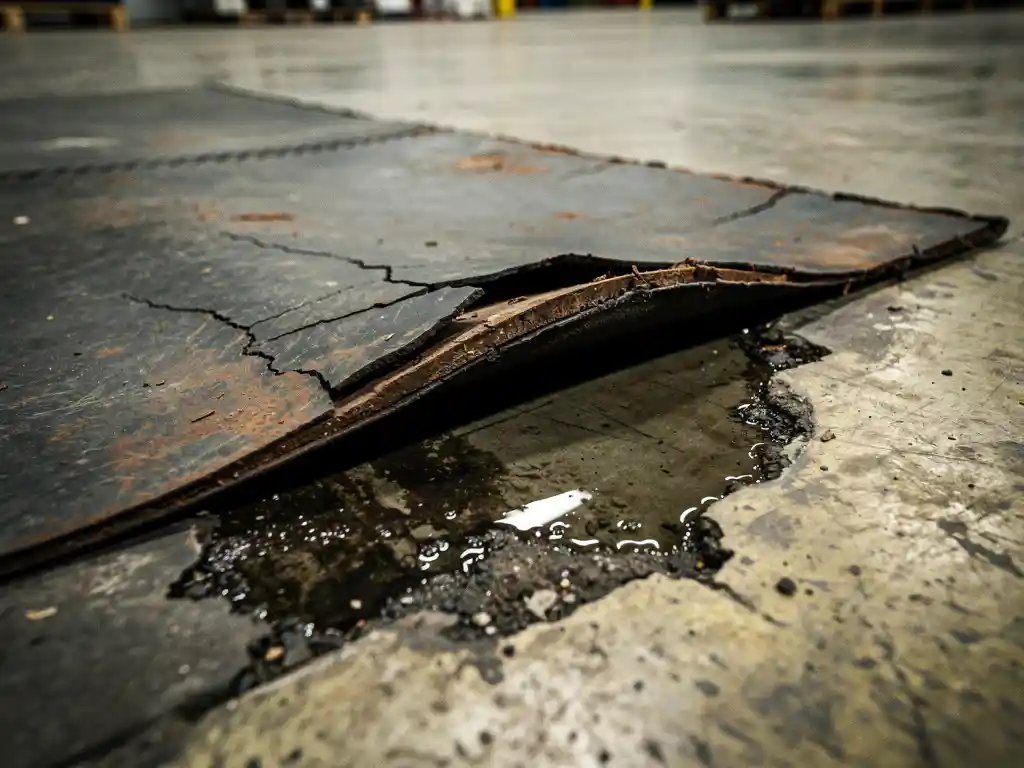
Premature floor failure happens when flooring breaks down, deteriorates, or becomes unsafe well before its expected lifespan, typically because of moisture exposure, incorrect material selection, poor installation, or inadequate maintenance. In commercial and industrial settings, these failures rarely happen overnight. They build up gradually through a combination of factors that, left unaddressed, lead to costly repairs, safety hazards, and unplanned downtime. The sections below walk through each of the main causes and what you can do about them.
What are the most common causes of premature floor failure?
The most common causes of premature floor failure are moisture infiltration, incorrect material selection for the environment, poor or rushed installation, and inconsistent floor maintenance. In commercial and industrial facilities, these factors often work together. A floor that was installed correctly but exposed to heavy moisture without proper protection will fail faster than one that was installed imperfectly in a dry environment. Facility management teams who understand these causes are in a much better position to prevent them.
Preventive maintenance is one of the most effective tools available. Floors that are regularly inspected, cleaned, and treated for wear last significantly longer than those that only receive attention when something goes visibly wrong. Beyond maintenance habits, the choice of flooring material and how well it matches the demands of the space are the two biggest factors in how long a floor actually lasts.
How does moisture damage flooring from the inside out?
Moisture damages flooring by penetrating the surface or rising from below through the subfloor, weakening the bond between layers, promoting mold and bacteria growth, and causing materials to swell, warp, or delaminate. This process often starts invisibly, which is what makes moisture one of the most damaging and underestimated causes of floor failure in commercial spaces.
In facilities like food processing plants, commercial kitchens, or agricultural environments, water is constantly present on the floor surface. If the flooring material is porous, it absorbs that moisture over time. Once water reaches the adhesive layer or the subfloor, it breaks down structural integrity from the inside, and by the time you see surface damage, the underlying problem is often already serious.
Subfloor moisture is a separate but related issue. Concrete subfloors naturally emit moisture vapor, and if a floor covering is installed without an adequate vapor barrier, that moisture migrates upward and causes the same kind of internal damage. Regular floor maintenance that includes checking for moisture intrusion at seams and edges can catch these problems early before they escalate.
Why does the wrong flooring material cause early wear?
Using the wrong flooring material for a specific environment accelerates wear because the material is not built to handle the actual mechanical, chemical, or thermal stresses it faces. A material that performs well in a retail setting may fail quickly in a manufacturing facility, simply because it was never designed for that level of demand.
For example, vinyl flooring can handle light foot traffic but degrades quickly under heavy equipment, chemical spills, or extreme temperature changes. Similarly, some materials that look durable on the surface are porous underneath, meaning they absorb contaminants, oils, or cleaning chemicals that gradually break down their structure. Matching the material to the environment is one of the most practical steps in any facility maintenance strategy.
Key factors to match when selecting flooring material include:
- Load-bearing requirements (foot traffic versus heavy equipment)
- Exposure to moisture, oils, or chemicals
- Temperature range in the space
- Slip resistance requirements
- Ease of cleaning and long-term hygiene
What role does poor installation play in floor failure?
Poor installation is a direct cause of premature floor failure because even the best flooring material will underperform if it is not fitted correctly. Common installation problems include uneven subfloor preparation, improper adhesive application, inadequate seam sealing, and insufficient acclimatization of the flooring material before laying.
Seams are particularly vulnerable. When flooring panels or tiles are not properly aligned and sealed, gaps form over time. Moisture, dirt, and debris accumulate in those gaps, and the edges of the flooring begin to lift or crack. In high-traffic commercial environments, this process happens quickly.
Subfloor preparation is equally important. A subfloor that is not level, not dry, or not clean before installation creates stress points in the flooring above it. Over time, those stress points become visible as cracking, bubbling, or uneven wear. Investing in proper installation from the start is far more cost-effective than replacing flooring that failed prematurely because of shortcuts taken during fitting.
How can you tell if your flooring is failing prematurely?
Signs that your flooring is failing prematurely include visible surface cracking or peeling, edges that are lifting or curling, soft or spongy spots underfoot, discoloration or staining that does not clean away, persistent odors suggesting moisture or mold, and increased slip risk in areas that were previously safe. These signs often appear before the floor becomes completely unusable, which means there is usually a window to act.
From a facility management perspective, it helps to build regular floor inspections into your preventive maintenance schedule. Walk the floor systematically, paying close attention to seams, edges, areas near drains or water sources, and zones that receive the heaviest traffic. Catching a small area of lifting or a developing crack early can prevent a much larger and more expensive repair later.
It is also worth tracking when the flooring was installed and what its expected lifespan was at the time of purchase. If you are seeing significant wear well before that point, it is a strong indicator that one of the underlying causes discussed here is at work.
What flooring materials are most resistant to premature failure?
Flooring materials most resistant to premature failure are those that are non-porous, chemically stable, mechanically strong, and suited to the specific demands of the space. In commercial and industrial environments, rubber flooring consistently stands out as one of the most durable options available because it resists moisture, does not crack under heavy loads, and maintains its structure across a wide temperature range.
Genuine rubber is non-porous, which means it will not absorb water, oils, or cleaning chemicals. This makes it far less vulnerable to the internal moisture damage that causes so many other flooring materials to fail early. It is also highly resistant to surface wear, which is particularly relevant in areas with heavy foot traffic or moving equipment.
For facilities that need extra performance, fiber-reinforced rubber compounds take durability further by adding structural strength to the material itself. This is especially useful in heavy manufacturing, agricultural, and industrial settings where standard flooring options simply cannot keep up with the demands of daily use.
At LRP Matting, we manufacture rubber matting from 100% recycled materials, including our proprietary Fiber Reinforced Rubber Compound (FRC®), which is designed to outperform conventional flooring in demanding environments. Our mats are non-porous, easy to clean, and built to stay stable under extreme conditions. If you are looking for flooring that holds up where others fail, our industrial rubber matting solutions are worth a closer look.
Frequently Asked Questions
How often should commercial floors be inspected to prevent premature failure?
For most commercial and industrial facilities, a formal floor inspection should be conducted at least once a month, with more frequent walkthroughs in high-traffic or high-moisture areas. Inspections should cover seams, edges, drain surrounds, and zones under heavy equipment. Building this into a documented preventive maintenance schedule ensures problems are caught early and addressed before they escalate into costly repairs or safety incidents.
Can a floor that is already showing early signs of failure be salvaged, or does it need to be fully replaced?
It depends on how far the damage has progressed and what is causing it. Localized issues like a small section of lifting edges, a minor crack, or a single soft spot can often be repaired if caught early enough, especially if the subfloor beneath is still structurally sound. However, if moisture has already compromised the adhesive layer or the subfloor, or if the damage is widespread, a full replacement is usually more cost-effective in the long run than repeated patching.
What is the most important thing to check before installing new flooring in an industrial or commercial space?
The condition and moisture content of the subfloor is the single most critical factor to verify before any flooring installation. Concrete subfloors should be tested for moisture vapor emission levels, checked for levelness, and confirmed to be clean and free of contaminants before any material is laid. Skipping or rushing this step is one of the most common reasons new flooring fails well ahead of its expected lifespan.
Are there specific industries or environments where premature floor failure is especially common?
Yes — food processing plants, commercial kitchens, agricultural facilities, and heavy manufacturing environments are among the highest-risk settings for premature floor failure. These spaces combine constant moisture exposure, heavy mechanical loads, chemical contact, and rigorous cleaning cycles, all of which accelerate wear on materials that are not specifically engineered for those conditions. Choosing flooring that is non-porous, chemically resistant, and load-rated for the specific environment is essential in these sectors.
Does the type of cleaning product used affect how quickly a floor deteriorates?
Absolutely. Harsh chemical cleaners, high-pH degreasers, or solvents that are incompatible with the flooring material can break down surface coatings, degrade adhesives, and cause porous materials to absorb damaging residues over time. Always verify that the cleaning products used in your facility are approved for the specific flooring material installed, and follow the manufacturer’s recommended dilution ratios and application methods to avoid accelerating wear through routine cleaning.
How do I make the case to management for investing in higher-quality flooring upfront?
The strongest argument is total cost of ownership rather than initial purchase price. Premature floor failure leads to replacement costs, labor downtime during repairs, potential liability from safety hazards, and lost productivity — all of which typically far exceed the price difference between a budget material and a durable one. Presenting a side-by-side comparison of a lower-cost flooring option replaced every few years versus a higher-quality material with a longer verified lifespan usually makes the financial case clearly.
Is rubber flooring difficult to install or maintain compared to other commercial flooring options?
Rubber flooring, particularly in mat or modular tile form, is generally straightforward to install and requires minimal ongoing maintenance compared to many alternatives. Its non-porous surface means spills, oils, and cleaning chemicals sit on top rather than soaking in, making routine cleaning quick and effective. In industrial settings especially, the reduced maintenance burden and resistance to the conditions that cause other materials to fail early make rubber a practical long-term choice.
Related Articles
- How does flooring affect productivity?
- What makes a standing workstation ergonomic?
- What are the warning signs of floor deterioration?
- How do different floor materials affect slip resistance?
- What areas of a facility have the highest slip risk?
- What is the best rubber mat thickness for a horse stall?
- What are the hidden costs of poor horse stall flooring?
- What is the safest floor surface for a food processing facility?
- What is the best way to protect a warehouse floor during construction?
- What is the most durable flooring for a professional athletic facility?