
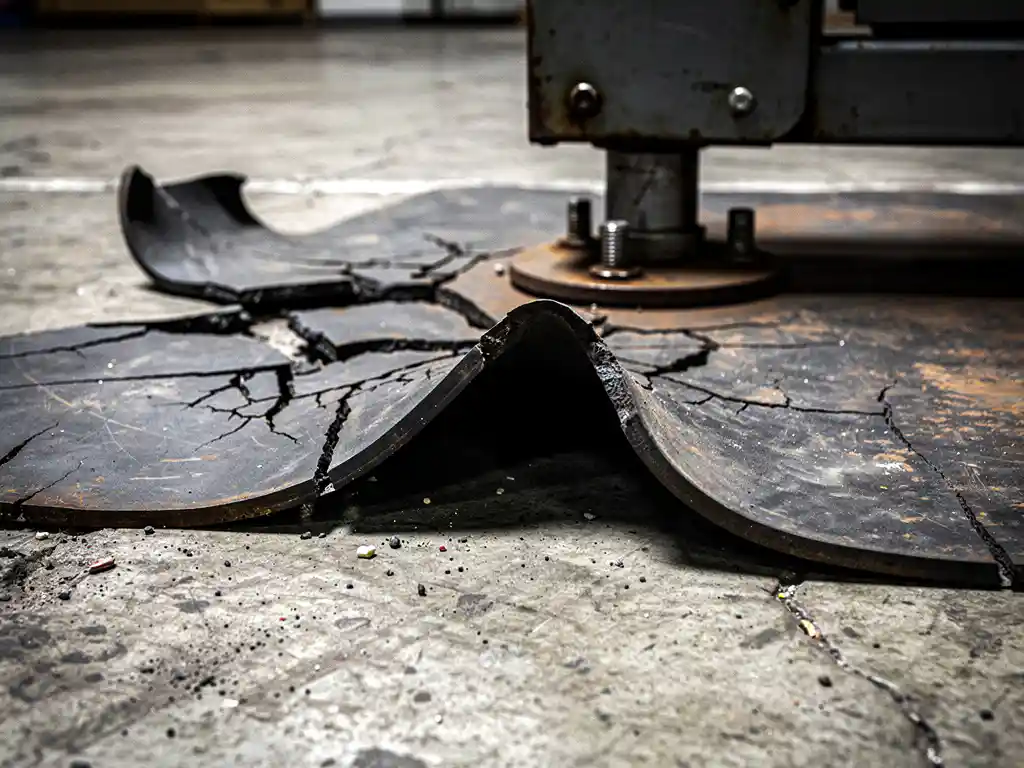
The warning signs of floor deterioration include visible cracks, surface pitting, uneven areas, discoloration, peeling coatings, and a noticeable loss of slip resistance. These signs can appear gradually, which makes them easy to overlook until the damage becomes serious. Floors in high-traffic or wet environments tend to show these signs earlier than floors in lighter-use settings. The sections below walk through the most common questions about floor deterioration and what to do about it.
What types of damage signal that a floor is starting to fail?
A floor is starting to fail when you notice cracks, surface erosion, soft or spongy spots, uneven sections, or a worn-down surface that no longer grips footwear properly. Discoloration, staining that won’t clean off, and bubbling or peeling coatings are also reliable early indicators. Any of these changes suggest the floor’s structure or surface integrity is compromised.
Some of these signs are purely cosmetic at first, but they rarely stay that way. A hairline crack in a concrete floor, for example, allows moisture to work its way in. Over time, that moisture expands and contracts with temperature changes, widening the crack and weakening the surrounding material. Similarly, a worn surface that looks like a minor scuff zone is often the beginning of a slip hazard.
Here are the most common physical warning signs to watch for:
- Visible cracks, chips, or fractures across the surface
- Uneven or raised sections that create trip hazards
- Soft spots or areas that flex underfoot
- Peeling, bubbling, or flaking surface coatings
- Persistent staining or discoloration that doesn’t respond to cleaning
- Loss of texture or surface grip
If you spot more than one of these at the same time, the floor is likely further along in the deterioration process than it appears on the surface.
Why do floors deteriorate faster in some environments than others?
Floors deteriorate faster in environments with high foot traffic, exposure to moisture, chemicals, extreme temperatures, or heavy equipment. These factors accelerate the breakdown of surface materials and underlying structures. Industrial facilities, commercial kitchens, gyms, and agricultural spaces are particularly demanding because they combine several of these stressors at once.
Moisture is one of the biggest accelerators of floor deterioration. Water that sits on a floor or seeps into cracks encourages mold growth, weakens adhesives, and causes materials like concrete and wood to degrade from within. In cold environments, water that penetrates the surface freezes and expands, causing spalling and cracking at a faster rate.
Chemical exposure is another major factor. Cleaning agents, oils, fuels, and agricultural substances can react with floor materials, breaking down protective coatings and softening the base layer. Floors that weren’t designed for chemical resistance will show signs of deterioration much sooner in these settings.
Heavy loads and constant movement also play a role. Forklifts, pallets, livestock, and heavy machinery concentrate weight in specific areas, causing compression and surface fatigue over time. Floors in these environments need materials that are built for that level of stress, and when they aren’t, deterioration accelerates noticeably.
How can you tell if a floor has become a safety hazard?
A floor has become a safety hazard when it creates conditions that increase the risk of slips, trips, or falls. The most direct indicators are a loss of slip resistance, uneven or raised surfaces, exposed sharp edges, and areas where the floor surface has become unstable underfoot. Floor safety inspection should be part of any regular facility maintenance routine.
Slip resistance is one of the first things to test. A floor that feels smooth or slick underfoot, especially when wet, has lost the texture needed to prevent sliding. This is a common problem in commercial and industrial spaces where foot traffic gradually polishes the surface down. You don’t need specialized equipment to notice this: if walking across a wet floor feels uncertain, it’s a hazard.
Uneven surfaces are equally serious. A raised edge of just a few millimeters is enough to catch a foot and cause a fall. These issues often develop gradually as sections of flooring shift, swell, or compress unevenly. Regular floor safety inspections help catch these changes before they cause an incident.
Other signs that a floor has crossed into hazard territory include:
- Pooling water that can’t drain properly due to uneven surfaces
- Exposed fasteners, broken tiles, or torn matting edges
- Sections that move or shift when walked on
- Visible gaps between floor sections that catch footwear
Slip and fall prevention starts with identifying these conditions early and addressing them before an accident happens.
What causes rubber flooring to crack or break down over time?
Rubber flooring cracks or breaks down over time due to UV exposure, chemical contact, temperature extremes, improper installation, and the use of low-quality base materials. Rubber is naturally durable, but it is not immune to degradation, especially when it’s exposed to conditions it wasn’t designed to handle.
UV exposure is a significant factor for rubber flooring used outdoors or near large windows. Prolonged sunlight causes rubber to dry out, lose flexibility, and eventually crack. This process is called oxidative degradation, and it happens gradually, often going unnoticed until the surface becomes brittle.
Chemical exposure is another common cause. Certain solvents, oils, and cleaning products are incompatible with standard rubber compounds. Using the wrong cleaning agent repeatedly can break down the surface layer, causing it to soften, swell, or crack. This is why it matters to use cleaning products that are appropriate for the specific type of rubber flooring in place.
Installation quality also plays a bigger role than many people expect. Rubber flooring that isn’t laid flat, or that’s installed over an uneven subfloor, experiences uneven stress distribution. Over time, the areas under the most pressure compress and crack, while edges that aren’t properly secured curl and tear.
Finally, the quality of the rubber compound itself makes a significant difference. Lower-grade rubber is more susceptible to all of these factors. Flooring made from higher-quality or fiber-reinforced rubber compounds holds up considerably better under the same conditions.
When should a deteriorating floor be replaced rather than repaired?
A deteriorating floor should be replaced rather than repaired when the damage is widespread, structural, or when repeated repairs are no longer holding. If the underlying cause of deterioration hasn’t been addressed, repairs become a temporary fix that delays the inevitable and can increase long-term costs. Replacement makes more sense when the floor no longer meets safety standards or when the cost of repair approaches the cost of replacement.
Repair works well for isolated, surface-level damage. A single crack, a small section of worn coating, or one loose tile can often be addressed without replacing the entire floor. But when damage appears in multiple areas simultaneously, or when the same spot has been repaired more than once, that’s a sign the floor has reached the end of its functional life.
Structural damage is a clear signal to replace rather than patch. If the subfloor is compromised, if moisture has penetrated deeply, or if the base material has softened or shifted, surface repairs won’t solve the underlying problem. The floor will continue to fail, and the safety risk grows with each delay.
From a floor safety standpoint, any floor that consistently fails to meet slip resistance requirements or that creates repeated trip hazards should be replaced. No amount of maintenance can compensate for a floor that is fundamentally unsuitable for its environment.
When choosing a replacement, it’s worth thinking carefully about the material and its suitability for the specific conditions it will face. For environments with heavy use, moisture, or demanding loads, industrial rubber matting is a practical option that holds up well over time. At LRP Matting, we manufacture rubber mats from 100% recycled materials, including our proprietary Fiber Reinforced Rubber Compound (FRC®), which gives our mats added strength and a longer service life compared to standard rubber flooring. If you’re evaluating your options, we’re happy to help you find the right fit for your space.
Frequently Asked Questions
How often should floors in high-traffic or industrial environments be inspected for deterioration?
In high-traffic or industrial environments, floors should be inspected at least once a month, with a more thorough assessment conducted quarterly. Facilities that involve moisture, chemicals, or heavy equipment should err on the side of more frequent checks, since deterioration in these settings can progress quickly between inspections. Keeping a simple log of observed changes over time also helps identify patterns — such as recurring damage in the same area — that point to an underlying issue rather than surface wear.
Can floor deterioration be prevented, or is it just inevitable over time?
While some degree of wear is unavoidable, the rate and severity of floor deterioration can be significantly reduced with the right preventive measures. Choosing a flooring material that matches the specific demands of the environment is the single most impactful decision you can make upfront. Beyond that, consistent cleaning with compatible products, prompt repair of minor damage, and using protective matting in the highest-stress zones — such as entryways, loading areas, and workstations — can meaningfully extend a floor’s service life.
What's the best way to test whether a floor has lost adequate slip resistance?
The simplest field test is to walk across the floor in normal footwear while it’s wet and note whether your footing feels uncertain or your steps require extra caution. For a more objective measurement, a portable slip resistance tester (also called a tribometer) can measure the coefficient of friction against recognized safety thresholds, such as those outlined in ASTM or HSE guidelines. If professional testing isn’t immediately available, erring on the side of caution and adding temporary anti-slip matting while you arrange a proper assessment is the safest course of action.
Are there specific cleaning products I should avoid using on rubber flooring to prevent premature breakdown?
Yes — solvent-based cleaners, bleach at high concentrations, petroleum-based products, and harsh degreasers should generally be avoided on rubber flooring, as they can break down the surface layer and accelerate cracking or swelling. Stick to pH-neutral or rubber-safe cleaning solutions and always check the manufacturer’s guidelines for your specific flooring product. Rinsing thoroughly after cleaning is equally important, since residue buildup from even mild products can degrade rubber over time if left to sit.
If I'm replacing a deteriorated floor, how do I make sure the new floor doesn't fail for the same reasons?
Start by identifying the root cause of the previous floor’s failure — whether that was moisture ingress, chemical exposure, inadequate load capacity, or simply the wrong material for the environment — and make sure your replacement choice directly addresses those factors. Don’t skip proper subfloor preparation, since laying new flooring over an uneven or compromised base is one of the most common reasons new installations fail prematurely. Consulting with a flooring specialist who understands your specific use case can help you avoid repeating the same mismatch between material and environment.
Is rubber matting a good option for outdoor or semi-outdoor environments where UV exposure is a concern?
Standard rubber flooring can degrade under prolonged UV exposure, but rubber mats formulated with UV-stabilizing compounds or made from fiber-reinforced rubber compounds are significantly more resistant to oxidative degradation and surface cracking. For outdoor or semi-outdoor settings, it’s important to confirm that the product you’re selecting is specifically rated for UV and weather resistance before installing it. Positioning mats away from direct, prolonged sunlight where possible and inspecting them seasonally for early signs of brittleness will also help extend their lifespan in these conditions.
What should I do if only part of my floor is deteriorating — is it worth replacing the whole floor at once?
If the damage is genuinely isolated and the rest of the floor is structurally sound, targeted repair or partial replacement is a reasonable and cost-effective approach. However, it’s worth investigating why that specific section deteriorated faster than the rest — a concentrated load, a drainage issue, or a subfloor problem in that zone could mean the surrounding areas are not far behind. If the floor is aging uniformly and the damaged section is simply the first to show visible signs, a full replacement planned in the near term is often more economical than a series of piecemeal repairs.
Related Articles
- How does flooring lifespan affect total cost of ownership?
- How does flooring affect workplace comfort?
- How can flooring materials be reused or recycled?
- What is the best flooring solution for a temporary work site?
- What is the best way to protect a loading dock floor?
- How often should you replace horse stall bedding?
- What flooring is used in equine surgery facilities?
- How do you reduce re-injury risk in a horse recovery stall?
- How do you keep a horse stall floor from getting slippery when wet?
- How do you choose the right floor protection for a construction site?