
Preventative maintenance reduces unexpected floor repairs by catching small problems before they turn into large, costly ones. Regular cleaning, inspection, and protective measures keep your flooring in good condition longer, which means fewer emergency fixes and less downtime. This applies to virtually every commercial and industrial environment, from warehouses and gyms to farms and food processing facilities. Below, we answer the most common questions about floor maintenance so you can build a routine that actually works.
What types of floor damage does regular maintenance prevent?
Regular floor maintenance prevents surface degradation, joint failure, moisture damage, and slip hazards from developing into structural problems. Consistent cleaning removes abrasive debris that grinds down flooring materials over time, while routine inspections catch early signs of wear before they spread. For rubber flooring specifically, maintenance also prevents the buildup of oils, chemicals, and biological matter that can break down the surface.
The most common types of preventable damage include:
- Surface abrasion caused by grit and debris tracked in from outside
- Edge lifting and curling from repeated foot or equipment traffic on unsecured mats
- Moisture infiltration under flooring where subfloor damage can go undetected
- Slip hazards from surface contamination with oils, water, or worn anti-slip textures
- Joint and seam failure in areas where multiple flooring pieces meet under heavy load
Each of these issues starts small. A bit of grit, a slightly lifted edge, or a damp corner rarely looks alarming on day one. But left unaddressed, they compound. Preventive maintenance interrupts that cycle before repairs become unavoidable.
How does a rubber mat maintenance routine work?
A rubber mat maintenance routine works by combining regular cleaning with periodic inspections and occasional conditioning. The goal is to remove contaminants, check for wear, and address any minor issues before they affect performance. Most rubber mats require very little effort to maintain, which is one of their practical advantages over softer or more porous flooring materials.
A basic routine looks like this:
- Daily or shift-end cleaning: Sweep or vacuum to remove loose debris. In wet or food-adjacent environments, mop with a mild detergent and water.
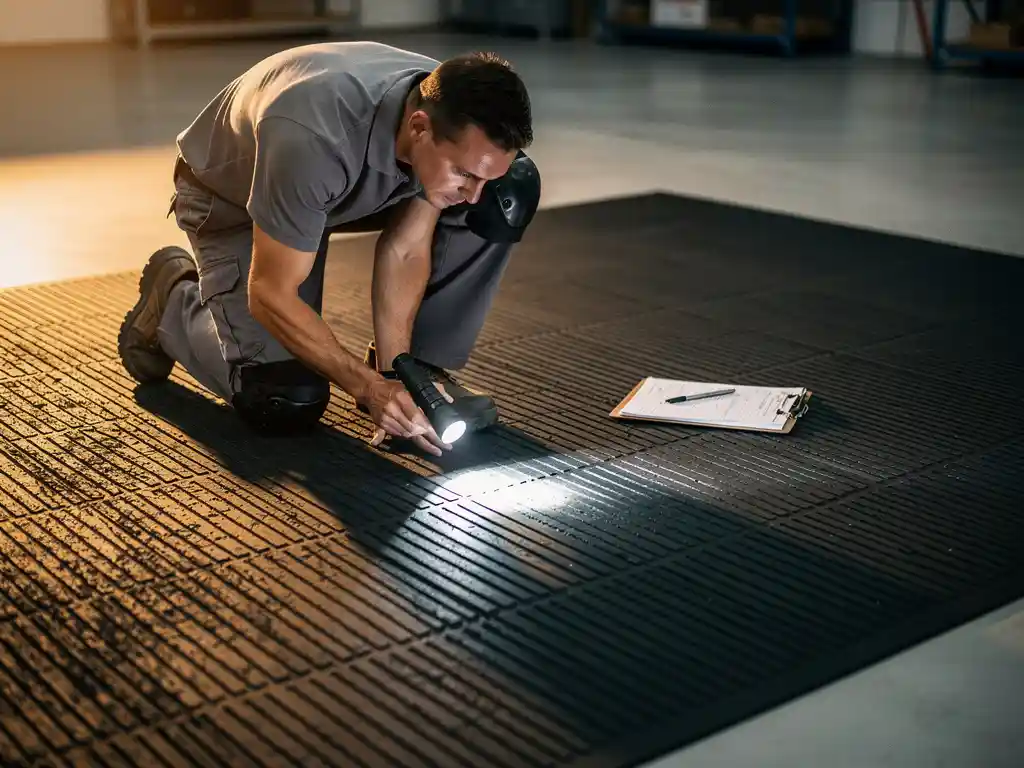
- Weekly inspection: Check edges, seams, and high-traffic zones for lifting, cracking, or unusual wear patterns.
- Monthly deep clean: Use a scrubbing machine or stiff brush to clean textured surfaces where dirt can accumulate in grooves.
- Quarterly review: Assess whether mats are still positioned correctly and whether any areas need replacement or repositioning.
Because rubber is non-porous, it does not absorb moisture or retain bacteria the way carpet or foam flooring does. That makes cleaning faster and more effective. A simple detergent-and-water approach handles the vast majority of facility maintenance needs without requiring specialty products.
What are the signs that a rubber floor needs attention before it fails?
The signs that a rubber floor needs attention before it fails include visible surface cracking, edge curling, persistent slipperiness, discoloration, and unusual softness or compression in specific zones. Catching these early gives you time to address the problem without shutting down operations or replacing entire flooring sections.
Watch for these specific indicators:
- Cracking or surface crazing: Fine cracks on the surface signal material fatigue, often from UV exposure, chemical contact, or extreme temperature cycles.
- Edge and corner lifting: Mats that curl at the edges become trip hazards and allow moisture and debris to collect underneath.
- Reduced grip: If a surface that was once slip-resistant now feels slick, the texture may be worn down or contaminated in a way that cleaning alone cannot fix.
- Uneven compression: Soft spots or areas that compress more than the surrounding material indicate internal breakdown, particularly in high-load zones.
- Persistent odor or discoloration: These can signal contamination that has worked its way into surface damage, even if the mat looks intact from above.
In facility management, these early warning signs are worth building into your inspection checklist. A five-minute walkthrough once a week can save hours of emergency repair work later.
How does mat quality affect long-term maintenance needs?
Mat quality directly affects how often you need to clean, inspect, and replace your flooring. Higher-quality rubber mats resist surface wear, moisture, and chemical exposure more effectively than lower-grade alternatives, which means they stay functional longer with less intervention. In practical terms, a better mat reduces the total labor and cost associated with floor maintenance over its lifetime.
Key quality factors that influence maintenance frequency include:
- Material density and composition: Dense, high-grade rubber holds its shape and surface texture longer under repeated load.
- Reinforcement technology: Mats made with fiber-reinforced rubber compound (FRC®) are structurally stronger, which reduces the risk of compression, cracking, and edge failure over time.
- Surface finish: Mats with well-engineered textures maintain grip longer and are easier to clean without losing their anti-slip properties.
- Thickness: Thicker mats absorb impact more evenly, which reduces wear concentration in any single area.
Investing in quality upfront is a practical facility management decision. A mat that lasts twice as long and needs half the maintenance attention is a better long-term value, even if the initial cost is higher.
What’s the difference between repairing and replacing rubber flooring?
Repairing rubber flooring means addressing a specific localized issue, such as sealing a small crack, re-securing a lifted edge, or patching a damaged section, while replacing means removing and installing new flooring in an area. The right choice depends on the extent of the damage, the age of the flooring, and whether the underlying subfloor has been affected.
When repair makes sense
Repair is the right call when damage is isolated and the rest of the mat or flooring system is still structurally sound. A lifted corner that can be re-secured, a small surface crack that has not penetrated the full thickness, or a single damaged tile in a modular system are all good candidates for repair. Addressing these quickly prevents the damage from spreading and extends the usable life of the floor.
When replacement is the better option
Replacement becomes necessary when damage is widespread, when the material has reached the end of its effective lifespan, or when repairs would need to be repeated so frequently that they cost more than a new installation. If the subfloor has been compromised by moisture that worked through damaged flooring, replacement is often unavoidable. In commercial and industrial environments, continuing to patch flooring that has fundamentally failed also introduces safety risks that no amount of maintenance can reliably manage.
How can custom mat sizing reduce floor maintenance frequency?
Custom mat sizing reduces floor maintenance frequency by minimizing the number of seams in a floored area. Fewer seams mean fewer edges that can lift, fewer gaps where moisture and debris collect, and fewer transition points that experience concentrated wear. In practical terms, a large custom-cut mat covering an entire zone requires less ongoing attention than the same area covered by multiple smaller mats pieced together.
Seams are consistently the weakest points in any matting installation. They are where edges curl, where cleaning is most difficult, and where contamination tends to accumulate. Reducing them through larger or custom-sized mats directly reduces the number of maintenance problems you are likely to encounter over time.
Custom sizing also means mats fit the actual dimensions of a space rather than being cut down or overlapped on-site, which creates cleaner, more stable installations. This is particularly relevant in industrial and agricultural environments where heavy equipment, livestock, or repeated foot traffic put constant stress on flooring.
At LRP Matting, we take pride in offering some of the largest mats in the industry, along with made-to-measure custom solutions designed to reduce seams and simplify installation. Whether you are managing a commercial facility, a manufacturing floor, or an agricultural operation, our commercial matting solutions are built to perform with minimal maintenance and maximum durability over the long term.
Frequently Asked Questions
How do I choose the right cleaning products for rubber flooring without damaging it?
For most rubber flooring, a mild pH-neutral detergent diluted in warm water is all you need for routine cleaning. Avoid harsh solvents, bleach-based cleaners, or petroleum-based products, as these can break down the rubber compound over time, causing premature cracking and surface degradation. If your facility deals with heavy grease or chemical exposure, look for cleaners specifically formulated as rubber-safe and always test a small inconspicuous area before applying broadly.
Can rubber flooring be maintained in food processing or wet environments without becoming a hygiene risk?
Yes, rubber flooring is well-suited to food processing and wet environments precisely because it is non-porous and does not harbor bacteria the way carpet or foam materials do. The key is maintaining a consistent cleaning schedule — ideally after each shift — using food-safe, rubber-compatible detergents and ensuring the flooring dries adequately to prevent standing water from pooling under edges or seams. Choosing mats with antimicrobial surface treatments adds an extra layer of hygiene protection in these high-risk settings.
How often should rubber flooring in a high-traffic industrial facility be fully replaced?
There is no universal replacement timeline, as it depends on traffic intensity, load types, chemical exposure, and mat quality. However, in demanding industrial environments, a well-maintained, high-quality rubber mat can last anywhere from 5 to 15 years before full replacement becomes necessary. The most reliable indicator is not time, but condition — if you are noticing widespread compression loss, repeated edge failures, or persistent slip hazards that cleaning cannot resolve, it is time to evaluate replacement regardless of age.
What is the best way to handle rubber flooring maintenance in agricultural settings with livestock?
Agricultural environments introduce unique challenges including organic waste, moisture, urine, and the constant mechanical stress of hooves and heavy equipment. In these settings, daily removal of organic matter is critical, as biological waste accelerates rubber breakdown and creates hygiene risks. Use a stiff-bristle brush or pressure washer for deep cleaning, ensure adequate drainage beneath mats where possible, and prioritize thick, dense rubber mats engineered for agricultural use — these hold up far better under the specific stresses of a barn or milking parlor environment.
What common mistakes do facility managers make when maintaining rubber flooring?
The most common mistake is treating floor maintenance as reactive rather than preventive — only addressing flooring when a visible problem has already developed. Other frequent errors include using the wrong cleaning chemicals that degrade rubber over time, neglecting to inspect seams and edges during routine walkthroughs, and underestimating the importance of subfloor condition when moisture issues arise. Building a simple, documented inspection checklist and assigning clear maintenance responsibilities to staff goes a long way toward avoiding these pitfalls.
Does temperature or climate affect how rubber flooring should be maintained?
Yes, temperature extremes and climate conditions can significantly impact rubber flooring performance and maintenance needs. In cold environments, rubber can become stiffer and more brittle, making edges and seams more prone to cracking under impact. In hot or UV-exposed areas, such as outdoor entryways or sun-facing loading docks, surface crazing and color fading can accelerate. In these conditions, increase inspection frequency during seasonal transitions and consider UV-stabilized or temperature-rated rubber compounds designed to handle your specific climate conditions.
How do I get started building a floor maintenance program from scratch for a new facility?
Start by mapping your facility and categorizing each zone by traffic type, load intensity, and environmental exposure — this determines how demanding the maintenance routine for each area needs to be. From there, establish a tiered schedule covering daily cleaning tasks, weekly inspections, monthly deep cleans, and quarterly assessments, and assign clear ownership for each task. Document your baseline conditions with photos when flooring is first installed so you have a reference point for identifying wear over time, and revisit your program every six months to adjust based on what you are actually observing on the floor.
Related Articles
- What should you consider when designing an animal facility?
- What makes a sports surface safe?
- What causes polished concrete to become slippery?
- How do professional stables manage bedding across a large number of stalls?
- What type of matting is best for a wet industrial work environment?
- What flooring is best for a large animal veterinary examination room?
- How do you reduce fall risk for horses in a veterinary facility?
- Why is my horse stiff after being in the stall overnight?
- How do anti-fatigue mats reduce workplace injury claims?
- How do you maintain anti-fatigue mats in a food production environment?