

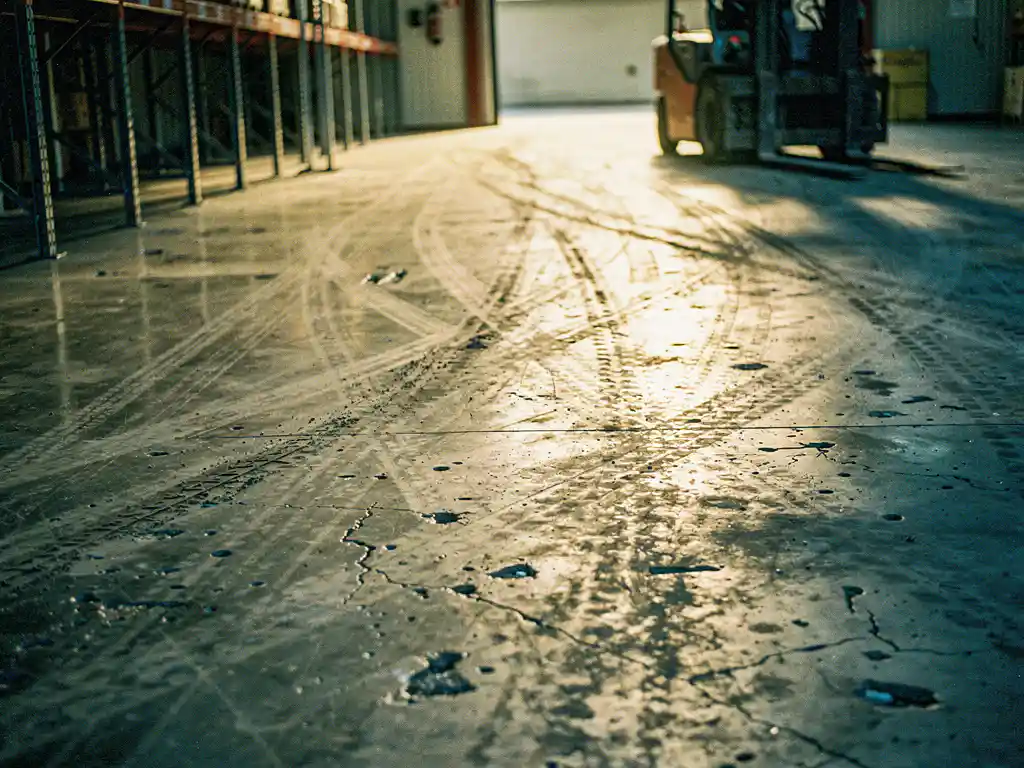
The areas of a warehouse that experience the most floor wear are loading docks, main traffic aisles, forklift travel paths, and high-activity workstations. These zones take repeated heavy loads, constant movement, and concentrated foot or vehicle traffic every single day. Understanding where and why wear happens is the first step toward smarter floor maintenance and better facility management.
Which warehouse zones take the most punishment from daily traffic?
The zones that wear fastest in a warehouse are loading docks, main aisles, forklift turning points, and packing or assembly stations. These areas share one thing in common: they handle the highest concentration of movement, weight, and repetitive contact. Wear in these spots is not random; it follows predictable traffic patterns tied to how your warehouse operates.
Loading docks absorb constant impact from pallet jacks, hand trucks, and heavy freight. The floor surface at dock doors takes repeated point-load stress every time a loaded pallet is set down or dragged across it. Main traffic aisles run the full length of the warehouse and carry forklift traffic throughout the entire shift, meaning the same stretch of floor is hit hundreds of times a day. Turning zones near racking ends and intersections are especially vulnerable because forklift tires generate lateral friction when steering, which grinds away surface material faster than straight travel.
Workstations where employees stand for extended periods also show wear, though the damage here is more gradual. The combination of foot traffic, dropped tools, and the occasional wheeled cart adds up over months and years of daily use.
What causes warehouse floors to wear out faster in some spots?
Warehouse floors wear out faster in specific spots because of concentrated loads, repetitive motion, and surface abrasion acting on the same area over and over again. When traffic is funneled through narrow paths, the floor in those paths receives far more stress than open areas that see little movement.
Several factors accelerate wear in problem zones:
- Load weight: Heavier loads create greater pressure on the floor surface with every pass.
- Tire type: Hard solid rubber or polyurethane forklift tires are more abrasive than softer materials.
- Surface contamination: Grit, sand, and debris act like sandpaper under moving wheels and boots.
- Moisture: Water and chemical spills can weaken concrete surfaces over time, making them more susceptible to cracking and pitting.
- Temperature fluctuations: In facilities that experience cold storage or outdoor exposure, freeze-thaw cycles stress the floor material and accelerate surface degradation.
Preventive maintenance programs that identify these contributing factors early can significantly slow the rate of floor deterioration. Facility management teams that monitor traffic patterns and surface conditions regularly are better positioned to intervene before minor wear becomes a costly repair.
How does forklift traffic damage warehouse flooring?
Forklift traffic damages warehouse flooring through a combination of point-load pressure, abrasive tire friction, and impact from uneven surfaces. A fully loaded forklift can weigh several tons, and that weight is concentrated on a small contact area between the tires and the floor. Over time, this repeated pressure cracks, chips, and erodes even reinforced concrete.
Turning movements are particularly damaging. When a forklift steers through a tight turn, its tires scrub sideways across the floor rather than rolling cleanly forward. This lateral scrubbing removes surface material with every maneuver. Turning zones near racking ends, loading bays, and aisle intersections show this damage clearly as scuff marks, surface pitting, and eventually deeper gouges.
Uneven floors compound the problem. When a forklift rolls over a raised joint, a crack, or a bump, the impact transfers directly to the floor surface and can widen existing damage. This is why floor maintenance in forklift travel paths is not just a cosmetic concern. Damaged floors cause forklifts to bounce and shift loads, which increases the risk of accidents and puts additional stress back on the floor itself.
What are the safety risks of worn warehouse floors?
Worn warehouse floors create serious safety risks, including slip and trip hazards, unstable forklift operation, and an increased risk of load drops. Cracks, uneven surfaces, and degraded coatings all reduce traction and create obstacles that workers and vehicles encounter during normal operations.
For pedestrian workers, worn floors mean:
- Raised edges and cracks that catch feet and cause trips
- Smooth, polished wear zones that reduce grip underfoot, especially when wet
- Pooled liquids that collect in low spots created by surface depressions
For forklift operators, degraded floors introduce instability. A forklift carrying a raised load is sensitive to surface irregularities. Bumps and dips shift the center of gravity and can cause loads to tip. In worst-case scenarios, severe floor damage can contribute to forklift tip-overs, which are among the most serious incidents in warehouse environments.
From a facility maintenance perspective, ignoring floor wear does not just create safety exposure. It also accelerates the rate of further damage, meaning a small repair left unaddressed becomes a much larger and more expensive one within months.
How can rubber matting reduce floor wear in warehouses?
Rubber matting reduces floor wear in warehouses by acting as a protective layer between the floor surface and the traffic, loads, and abrasion that cause damage. Mats absorb impact, distribute weight more evenly, and prevent direct contact between hard surfaces and the floor underneath.
In high-traffic areas, rubber mats take the daily punishment instead of the floor. This is particularly useful at loading docks, where repeated pallet drops and heavy cart movement would otherwise chip and crack concrete directly. A durable rubber mat in that zone absorbs the impact and keeps the underlying floor intact.
At workstations, rubber matting serves a dual purpose. It protects the floor from concentrated foot traffic and dropped objects, while also reducing fatigue for workers who stand for long periods. Less fatigue means workers move more carefully and deliberately, which further reduces the chance of accidental drops or spills that could damage the floor surface.
For commercial flooring applications, rubber mats also make floor maintenance more straightforward. Mats can be lifted, cleaned, and replaced independently without any repair work to the floor below, which simplifies maintenance routines and reduces downtime.
Where should rubber mats be placed in a warehouse for maximum protection?
Rubber mats should be placed at loading docks, forklift turning zones, main pedestrian aisles, and fixed workstations to provide maximum floor protection. These are the spots where wear concentrates, so that is where matting delivers the greatest return in terms of both floor maintenance savings and safety improvement.
A practical placement strategy looks like this:
- Loading dock areas: Cover the full dock plate transition zone and the immediate floor area where pallets are set down and moved.
- Forklift turning points: Place mats at aisle ends and intersections where lateral tire scrubbing is most intense.
- Packing and assembly stations: Use anti-fatigue rubber mats at fixed workstations to protect the floor and support worker comfort.
- Entrance and exit points: Mats at entry zones trap grit and debris before it gets tracked onto the main floor surface, reducing abrasive wear throughout the facility.
- High-spill zones: Areas near wash stations, chemical storage, or food processing benefit from rubber mats that resist moisture and prevent floor surface degradation from liquid exposure.
The goal is to match mat placement to your actual traffic map. Walk the warehouse and identify the spots that already show wear. Those locations tell you exactly where protection is needed most. At LRP Matting, we offer a wide range of durable rubber mats built for exactly these conditions. Whether you need standard sizes or custom-cut solutions for specific zones, our industrial rubber mats are designed to handle heavy warehouse use and protect your floors for the long term.
Frequently Asked Questions
How do I know when warehouse floor damage has gone beyond matting protection and needs professional repair?
If you notice cracks wider than a quarter inch, deep spalling or pitting that creates uneven surfaces, or floor joints that have shifted and created raised edges, the damage likely requires professional concrete repair before matting can be effective. Rubber mats work best as a preventive and protective layer on structurally sound floors — placing them over severely damaged surfaces can mask worsening problems and create additional trip hazards. A quick visual inspection combined with a straightforward walk test (looking for rocking, shifting, or noise underfoot) will help you identify areas that need repair first.
What thickness of rubber mat is recommended for heavy forklift traffic areas?
For zones with regular forklift traffic, a rubber mat with a minimum thickness of 3/4 inch to 1 inch is generally recommended to provide adequate impact absorption and durability. Thinner mats may compress and degrade quickly under the concentrated weight of loaded forklifts, reducing their protective value over time. For turning zones and loading dock areas specifically, look for mats rated for heavy industrial use and verify the load capacity matches the weight class of your equipment.
How often should rubber mats in high-wear warehouse zones be inspected or replaced?
High-traffic warehouse mats should be visually inspected at least once a month, with particular attention to edges, surfaces, and any signs of compression, tearing, or curling that could create trip hazards. In the most demanding zones — loading docks and forklift turning points — a more frequent weekly check is a good practice to catch deterioration early. Replacement timelines vary by mat quality and traffic intensity, but a mat that has lost significant thickness, no longer lies flat, or shows surface cracking should be replaced promptly rather than left in place.
Can rubber mats be used on warehouse floors that already have an epoxy or resin coating?
Yes, rubber mats are compatible with epoxy and resin-coated floors and can actually help extend the life of those coatings by shielding them from direct abrasion and impact in high-traffic zones. However, it is important to ensure the mats are non-staining and that the backing material will not trap moisture against the coated surface, which can cause adhesion issues or discoloration over time. Choosing mats specifically designed for use on finished floors and ensuring adequate ventilation under the mat will help protect both the coating and the concrete beneath it.
What is the most common mistake warehouse managers make when trying to protect their floors?
The most common mistake is waiting until visible damage appears before taking protective action — by that point, the cost of repair almost always exceeds what prevention would have cost. A second frequent error is placing mats only at obvious spots like entrances while overlooking forklift turning zones and loading dock transition areas, which are actually the highest-wear locations in most warehouses. A proactive approach that maps actual traffic patterns and places protection at wear-prone zones before damage begins is far more cost-effective than a reactive repair strategy.
Are there specific rubber mat features to look for when dealing with warehouses that handle wet or chemical-heavy environments?
In wet or chemical-heavy environments, prioritize mats made from materials with proven chemical resistance — nitrile rubber, for example, offers better resistance to oils and certain chemicals than standard natural rubber. Look for drainage-channel or open-grid surface designs that allow liquids to flow away from the walking or working surface rather than pooling on top of the mat. Additionally, confirm that the mat’s backing is resistant to the specific substances present in your facility, as prolonged chemical contact can degrade certain rubber compounds and cause the mat to break down prematurely.
How can I build a simple floor protection plan if I'm starting from scratch?
Start by walking your warehouse during an active shift and marking every zone where you see existing wear, scuff marks, or surface discoloration — these are your immediate priority areas. Next, trace your main forklift travel paths and identify all turning points, dock transition zones, and fixed workstations, as these are the predictable high-wear locations even if damage hasn’t fully appeared yet. From that map, source mats sized and rated for each zone’s specific demands, then set a recurring inspection schedule so protection stays effective as traffic patterns and operations evolve over time.
Related Articles
- What causes floor damage in warehouses?
- Why do floor surfaces wear unevenly?
- What factors influence animal comfort in housing facilities?
- How do you design a safe flooring layout for an equine hospital?
- What are the hidden costs of poor horse stall flooring?
- How often should you replace horse stall bedding?
- What floor surface is best for an equine rehabilitation center?
- How do you reduce fatigue for workers who stand all day on a concrete floor?
- How does stall flooring affect a horse's joint health?
- What flooring works best in an outdoor or covered sports venue?