

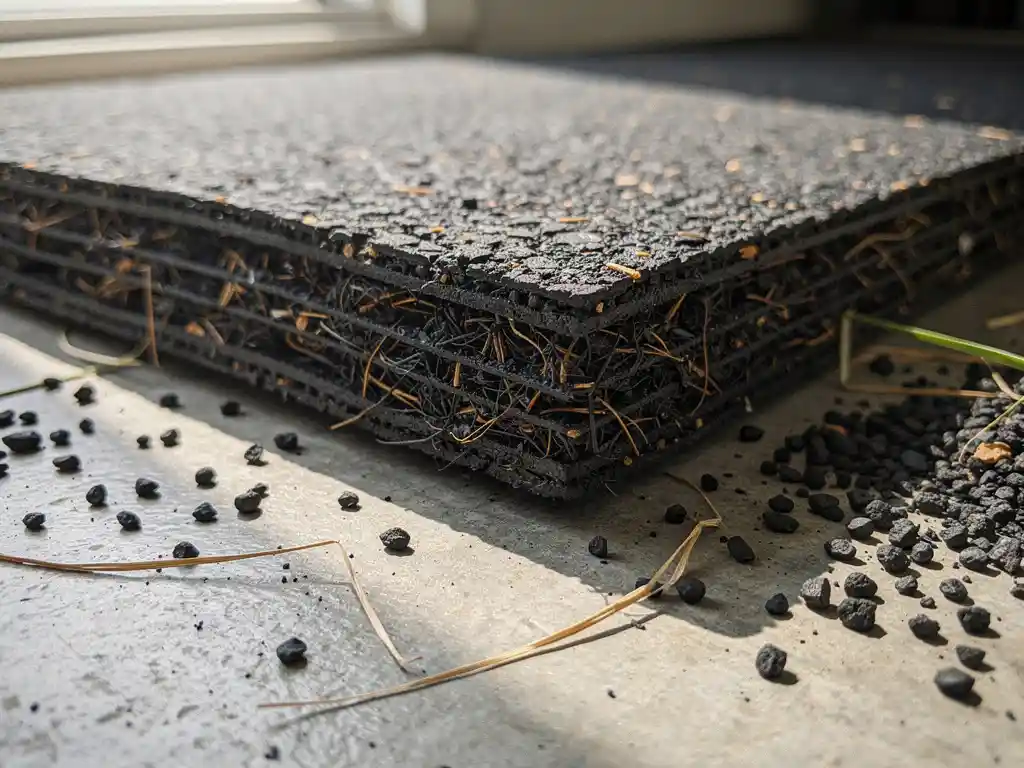
When buying sustainable flooring, look for materials with high recycled content, long service life, and low maintenance requirements. The most sustainable floors combine durability with responsible sourcing — meaning they stay out of landfills longer and reduce the need for replacement. Certifications, supplier transparency, and lifecycle costing all play a role in making a well-informed choice. Below, we answer the most common questions buyers have when evaluating sustainable flooring materials.
What makes a flooring material truly sustainable?
A flooring material is truly sustainable when it reduces environmental impact across its entire lifecycle — from raw material sourcing through manufacturing, installation, use, and end-of-life disposal. No single factor defines sustainability on its own. The most sustainable flooring options combine recycled or responsibly sourced materials, long service life, low maintenance demands, and the ability to be recycled or repurposed at the end of their useful life.
Recycled content is one of the clearest indicators. Materials made from post-consumer or post-industrial waste reduce the demand for virgin resources and keep usable material out of landfills. But recycled content alone is not enough. A floor that wears out in three years and ends up in a skip is not a sustainable choice, regardless of what it was made from.
Durability and repairability matter just as much. Flooring that holds up under heavy use, resists moisture and temperature changes, and can be cleaned without specialist chemicals will always have a smaller environmental footprint than a cheaper alternative that needs frequent replacement. Sustainable flooring is, at its core, flooring that does not need to be thrown away any time soon.
How does material durability affect a floor’s environmental footprint?
Material durability directly reduces a floor’s environmental footprint by extending the time between replacements. Every replacement cycle means new raw materials, new manufacturing energy, new transport, and old material going to waste. A floor that lasts twice as long effectively halves those impacts over any given period, even if the initial production footprint is slightly higher.
This is where lifecycle costing becomes a practical tool. Rather than comparing the upfront cost or environmental impact of two flooring options, lifecycle costing looks at the total cost and impact over a defined period — typically ten to twenty years. A durable floor that costs more upfront often performs better on both counts when you factor in replacement frequency, maintenance, and disposal.
Resistance to moisture, temperature extremes, heavy loads, and chemical exposure all contribute to longevity. Flooring that absorbs moisture, for example, tends to degrade faster, harbour bacteria, and require more intensive cleaning. Non-porous materials that resist moisture hold up better in demanding environments and stay cleaner with less effort, which reduces both maintenance costs and the use of cleaning products over time.
What certifications should buyers look for in sustainable flooring?
Buyers should look for certifications that verify recycled content, low chemical emissions, and responsible manufacturing practices. The most relevant certifications for sustainable flooring include GREENGUARD, which tests for chemical emissions and indoor air quality; FloorScore, which applies similar standards specifically to hard surface flooring; and Cradle to Cradle, which evaluates a product’s full material health and recyclability.
For recycled content specifically, look for products that clearly state the percentage of post-consumer or post-industrial recycled material and can back that claim with documentation. Some manufacturers also carry ISO 14001 certification, which signals that their environmental management systems meet internationally recognised standards.
Not every sustainable product carries every certification, and not every certification is equally relevant to your application. A gym floor and a factory floor have different priorities. Focus on the certifications that address the specific concerns most relevant to your environment — whether that is indoor air quality, slip resistance, chemical resistance, or recycled content.
Which flooring materials have the highest recycled content?
Recycled rubber flooring consistently ranks among the flooring materials with the highest recycled content, often made from 100% post-consumer recycled material — primarily reclaimed vehicle tyres. Other high-recycled-content options include carpet tiles made from recycled PET plastic, cork flooring from reclaimed cork waste, and certain composite materials that incorporate industrial byproducts.
Recycled rubber stands out because the raw material — used tyres — is abundant, widely collected, and otherwise difficult to dispose of responsibly. Diverting rubber from landfill and processing it into durable flooring is a genuinely circular use of a material that would otherwise represent a significant waste problem. The resulting product is dense, resilient, and well-suited to high-traffic or heavy-load environments.
The key question to ask any supplier is how recycled content is measured and verified. Some products blend recycled and virgin material, and the ratio matters. Ask for documentation, not just a label. Circular rubber flooring made entirely from reclaimed material represents the strongest claim in this category.
Are recycled rubber floors safe for indoor environments?
Yes, recycled rubber floors are safe for indoor environments when they meet recognised emissions standards. High-quality recycled rubber flooring is non-porous, does not harbour bacteria or mould, and does not off-gas harmful chemicals at levels that would pose a health risk under normal conditions. Products that carry GREENGUARD or FloorScore certification have been independently tested to confirm low chemical emissions.
Some buyers are concerned about odour, which can be present in lower-quality recycled rubber products, particularly in the short period after installation. This is generally a sign of inadequate processing rather than an inherent property of recycled rubber. Well-manufactured recycled rubber flooring, produced under controlled conditions, should have minimal odour and stabilise quickly in a ventilated space.
For environments with specific indoor air quality requirements — such as schools, healthcare facilities, or food production areas — it is worth requesting third-party test data from the supplier before purchasing. Reputable manufacturers will have this information readily available.
What’s the difference between recycled rubber and virgin rubber flooring?
The key difference between recycled rubber and virgin rubber flooring is the source of the raw material. Virgin rubber flooring is produced from newly harvested natural rubber or freshly synthesised synthetic rubber. Recycled rubber flooring is made from post-consumer rubber waste, most commonly shredded and reprocessed vehicle tyres. Both types share rubber’s core properties — resilience, non-porosity, and durability — but they differ in environmental impact and, in some cases, structural performance.
From a sustainability standpoint, recycled rubber has a clear advantage. It reduces dependence on new raw materials, diverts waste from landfill, and often requires less energy to produce than virgin rubber. From a performance standpoint, the picture is more nuanced. Standard recycled rubber products are excellent for most applications. However, advanced manufacturing techniques — such as fibre reinforcement — can produce recycled rubber flooring that matches or exceeds the structural performance of virgin alternatives.
For buyers choosing between the two, the practical question is whether the recycled product meets the performance requirements of the specific environment. In most commercial and industrial applications, it will. The environmental case for recycled rubber is strong, and the performance gap that once existed has narrowed significantly with improvements in processing technology.
How do you evaluate a sustainable flooring supplier’s credentials?
To evaluate a sustainable flooring supplier’s credentials, start by asking for documentation rather than accepting marketing claims at face value. A credible supplier should be able to provide third-party certifications, recycled content verification, product data sheets, and clear information about where and how their materials are manufactured. Transparency is a reliable indicator of genuine commitment to sustainability.
Look at the supplier’s manufacturing history and whether they have a track record in the industry. Longevity matters — a company that has been producing high-quality flooring for decades is more likely to have refined its processes and quality controls than a newer entrant making broad claims. Ask whether products are made domestically or imported, and whether the supplier can speak clearly about their supply chain.
It is also worth asking about end-of-life options. A truly sustainable supplier will have thought about what happens to their product when it reaches the end of its useful life. Can the material be recycled again? Is there a take-back programme? These questions reveal how seriously a company has thought through the circular dimension of their product.
At LRP Matting, we have been manufacturing rubber flooring since 1971, and all of our mats are made from 100% recycled materials. Many of our products use our proprietary Fiber Reinforced Rubber Compound (FRC®), which delivers extra strength and durability without compromising on sustainability. If you are looking for flooring that performs in demanding conditions and stands up to scrutiny on the environmental side, explore our industrial rubber matting solutions to see what we offer.
Frequently Asked Questions
How do I calculate the true lifecycle cost of sustainable flooring before making a purchase?
Start by estimating the total cost over a fixed period — ten to twenty years works well for most commercial and industrial settings. Factor in the purchase price, installation cost, expected maintenance frequency and product costs, and the likely number of replacement cycles within that window. A floor that costs 30% more upfront but lasts twice as long and requires minimal maintenance will almost always come out ahead on total cost. Ask suppliers for expected service life data and maintenance requirements in writing so you can make a like-for-like comparison.
Can sustainable flooring handle heavy industrial or high-traffic environments without compromising on performance?
Yes — many sustainable flooring options are specifically engineered for demanding conditions. Recycled rubber flooring, for example, is used extensively in warehouses, manufacturing facilities, gyms, and transport hubs precisely because of its resilience under heavy loads, resistance to moisture and chemicals, and ability to absorb impact. Technologies such as fibre reinforcement have further closed the performance gap between recycled and virgin materials. Always check the supplier’s load ratings, slip resistance classifications, and chemical resistance data for your specific environment before purchasing.
What are the most common mistakes buyers make when choosing sustainable flooring?
The most common mistake is treating sustainability as a single-factor decision — for example, choosing a product purely because it contains recycled content, without considering how long it will actually last or how it will be disposed of. Another frequent error is relying on unverified marketing claims rather than asking for third-party certification and documented recycled content percentages. Buyers also sometimes underestimate the importance of supplier transparency; a company that cannot clearly explain where its materials come from or how its products are tested is a red flag, regardless of how its branding is positioned.
How should sustainable flooring be maintained to preserve both its performance and its environmental credentials?
Sustainable flooring should be maintained using the mildest effective cleaning method to minimise chemical use and avoid degrading the material prematurely. For non-porous surfaces like recycled rubber, regular dry sweeping or vacuuming followed by damp mopping with a pH-neutral cleaner is typically sufficient. Avoid harsh solvents or abrasive tools that can break down the surface and shorten service life. Keeping the floor in good condition through routine maintenance is itself a sustainability practice — a well-maintained floor lasts longer and stays out of landfill.
What should I do with old flooring when it comes time to replace it?
Before disposing of old flooring, contact the original manufacturer or supplier to ask whether a take-back or recycling programme exists — many reputable sustainable flooring companies have end-of-life options built into their offering. If no programme is available, check with local recycling facilities to see whether the material can be processed. Rubber flooring, in particular, can often be shredded and reprocessed into new flooring or other rubber products. Landfill should be a last resort; the end-of-life question is worth asking at the point of purchase, not after the floor has already been removed.
Is sustainable flooring suitable for environments with strict hygiene requirements, such as food production or healthcare?
Yes, provided you select the right product and verify it against the relevant standards for your sector. Non-porous flooring materials — such as high-quality recycled rubber — do not harbour bacteria or mould and can be cleaned effectively without specialist chemicals, making them well-suited to hygiene-sensitive environments. For food production or healthcare applications specifically, request third-party emissions test data and check that the product complies with any sector-specific regulations in your region. A reputable supplier will be familiar with these requirements and should be able to guide your selection accordingly.
How do I verify that a flooring product's recycled content claims are accurate and not just greenwashing?
Ask the supplier for documented evidence — not just a percentage on a brochure. Legitimate recycled content claims should be backed by third-party verification, supplier chain-of-custody records, or recognised certification schemes that audit material composition. Be specific in your questions: ask whether the recycled content is post-consumer or post-industrial, how it is measured, and whether the figure refers to the finished product or just one component. A supplier confident in their sustainability credentials will welcome these questions; vague or evasive answers are a reliable indicator that the claims may not hold up to scrutiny.
Related Articles
- What are the first signs a commercial floor needs maintenance?
- How does floor design affect physical strain in the workplace?
- How do sports facilities prevent slips?
- How do professional equine facilities improve horse welfare?
- What causes a floor surface to become slippery over time?
- How do you protect a finished floor during a renovation project?
- How do you choose the right anti-fatigue mat thickness for a factory?
- How do anti-fatigue mats reduce workplace injury claims?
- How do you make a paddock safer for horses in wet weather?
- How do you maintain rubber flooring in a high-traffic sports venue?