
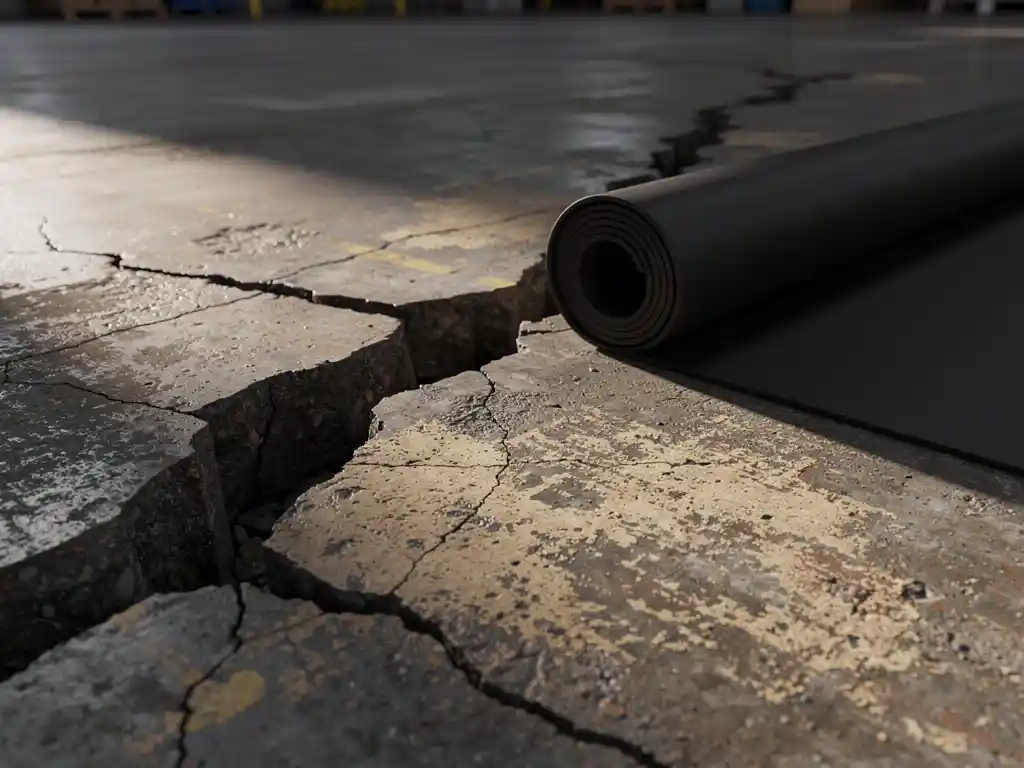
Prioritize floor damage that creates immediate safety risks: cracks, uneven surfaces, spalling, and deteriorating joints that can cause trips, falls, or structural failure. Cosmetic issues like surface discoloration or minor scuffs can wait. For facility managers, the rule of thumb is simple: if the damage affects traction, stability, or load-bearing capacity, it needs attention now. This article walks through how to identify, assess, and address different types of floor damage before small problems become expensive ones.
What makes floor damage a safety risk versus a cosmetic issue?
Floor damage becomes a safety risk when it changes the surface in a way that affects how people or equipment interact with it. Raised edges, sunken sections, exposed rebar, cracked joints, or deteriorating anti-slip surfaces all create conditions where trips, slips, or equipment instability can occur. Cosmetic damage, by contrast, affects appearance but leaves the surface structurally sound and safe to use.
A useful way to think about this distinction is to ask one question: does this damage change what happens when someone walks or drives over it? Discoloration, surface staining, or minor surface scuffs do not. A crack that catches a foot or wheel does. A section of flooring that has lifted even a few millimeters creates a real trip hazard, regardless of how small it looks.
In commercial and industrial settings, the stakes are higher because floors handle more traffic, heavier loads, and more demanding conditions. Facility maintenance teams need a consistent framework for classifying damage quickly, so the right repairs get scheduled at the right time rather than being lumped together in a general maintenance backlog.
Which types of floor damage should be fixed immediately?
The types of floor damage that require immediate repair are those that directly compromise safety or risk spreading rapidly. These include deep cracks that create trip hazards, spalling concrete that leaves loose debris underfoot, uneven or sunken sections, damaged expansion joints, and any area where the surface has become slippery due to coating failure or moisture infiltration.
Here is a practical breakdown of high-priority damage types:
- Cracks wider than 3mm or with vertical displacement: These catch feet, wheels, and pallet jacks, and they allow water to penetrate and accelerate structural deterioration.
- Spalling and delamination: Loose concrete or flooring material becomes a slip and trip hazard and can damage equipment.
- Sunken or raised sections: Even minor elevation changes across a walking or driving surface create significant fall risks.
- Damaged anti-slip coatings or surfaces: When traction is compromised, especially in wet or oily environments, the risk of a slip-and-fall incident increases sharply.
- Deteriorating expansion or control joints: Failed joints allow moisture ingress and can cause surrounding concrete to crack further.
- Exposed rebar or subsurface voids: These signal structural compromise and require professional assessment before the area is used again.
From a facility management perspective, any of these conditions should trigger an immediate work order, not a scheduled inspection cycle. Delaying repairs in these categories tends to increase both the repair cost and liability exposure.
What causes floor damage to worsen faster in industrial settings?
Floor damage worsens faster in industrial settings because of the combination of heavy loads, repeated mechanical stress, chemical exposure, and temperature fluctuations that floors in these environments face daily. Each of these factors accelerates the degradation process, and when they occur together, damage that might stay stable in a commercial office can spread rapidly in a warehouse or production facility.
Mechanical stress from equipment and traffic
Forklifts, pallet jacks, and heavy machinery concentrate loads onto small contact points, which amplifies the stress on the floor surface. Over time, this repeated impact causes micro-fractures that grow into visible cracks. High-traffic areas near loading docks, production lines, and storage aisles are particularly vulnerable because the same paths are used continuously throughout the day.
Chemical and moisture exposure
Industrial floors are frequently exposed to oils, cleaning agents, acids, and other substances that degrade concrete sealers and surface coatings. Once the protective layer breaks down, moisture can penetrate the substrate. In cold climates, freeze-thaw cycles then expand that moisture inside the concrete, accelerating cracking and spalling. In manufacturing or food processing environments, chemical exposure can weaken the floor structure faster than physical wear alone.
How do you assess floor damage severity before choosing a repair approach?
Assessing floor damage severity involves examining the type, size, depth, and location of the damage, then determining whether it is structural or surface-level. Start with a visual inspection, then use physical tests to check for hollow sections, instability, or active movement. The findings determine whether you need a surface patch, a full section replacement, or a structural repair.
A practical assessment process looks like this:
- Visual inspection: Walk the area systematically and document all visible damage, including cracks, chips, staining, and surface irregularities.
- Crack measurement: Note the width, length, and direction of cracks. Horizontal cracks in concrete walls or diagonal cracks radiating from corners often indicate structural movement rather than surface wear.
- Tap test: Use a hammer or coin to tap across the surface. A hollow sound indicates delamination or a void beneath the surface, which requires more than a surface patch.
- Check for vertical displacement: Run your hand or a straightedge across cracks and joints. Any vertical difference between sections is a trip hazard that needs immediate correction.
- Assess the environment: Consider what the floor is exposed to: moisture, chemicals, heavy equipment, or temperature extremes. This context determines which repair materials will hold long-term.
For complex damage or any situation where structural integrity is in question, a professional assessment is the right next step before committing to a repair method. Preventive maintenance programs that include scheduled floor inspections catch damage at an early stage, when repairs are simpler and less disruptive to operations.
Can protective rubber matting prevent floor damage from recurring?
Yes, protective rubber matting can significantly reduce floor damage from recurring by absorbing impact, distributing load, and protecting the surface from direct contact with equipment, foot traffic, and spills. Matting acts as a buffer between the floor and the forces that cause wear, which extends the life of the underlying surface and reduces how often repairs are needed.
In industrial and commercial floor maintenance, rubber mats are particularly effective in high-traffic zones, under heavy machinery, at loading areas, and in wet environments. They protect the floor coating and substrate from mechanical wear, chemical contact, and moisture infiltration, which are the primary drivers of recurring damage in these settings.
When selecting matting for floor protection, a few factors matter:
- Thickness and density: Thicker, denser mats absorb more impact and distribute load more evenly, which reduces stress on the floor beneath.
- Material quality: Genuine rubber mats are non-porous, so they do not absorb moisture or chemicals that could transfer to the floor surface. They also hold up under temperature extremes without cracking or deforming.
- Coverage and seams: Larger mat sizes reduce the number of seams, which minimizes the risk of edges lifting and creating new trip hazards. Fewer seams also make cleaning easier and prevent debris from accumulating in gaps.
- Application fit: Anti-fatigue mats, heavy-duty industrial mats, and drainage mats each serve different functions. Matching the mat type to the specific environment ensures it performs as intended.
At LRP Matting, we manufacture rubber mats specifically designed for demanding commercial and industrial environments. Our mats are made from 100% recycled rubber, including options built with our proprietary Fiber Reinforced Rubber Compound (FRC®) for extra strength and durability. We also offer some of the largest mat sizes in the industry, which means fewer seams and a cleaner, safer installation. If you are looking for a practical way to protect your floors and reduce recurring maintenance costs, explore our industrial matting solutions to find the right fit for your facility.
Frequently Asked Questions
How often should industrial floors be formally inspected for damage?
Industrial floors in high-traffic or chemically exposed environments should be inspected at least quarterly, with informal walk-through checks conducted monthly or even weekly in the most demanding areas like loading docks and production lines. Facilities that operate heavy equipment or deal with frequent spills may benefit from monthly formal inspections. Building floor assessments into a preventive maintenance schedule — rather than reacting to visible problems — is the most cost-effective way to catch damage early and avoid costly shutdowns.
What is the difference between a surface patch and a full section replacement, and how do I know which one I need?
A surface patch addresses shallow, localized damage confined to the top layer of the floor, such as minor spalling, small cracks, or coating failure, without affecting the structural integrity beneath. A full section replacement is necessary when the damage extends deep into the substrate, when there are subsurface voids, or when the affected area shows active movement or structural compromise. The tap test described in the post is a reliable first step: a hollow sound under the surface almost always means a patch alone will not hold, and a more thorough repair is needed.
Can I use standard concrete filler for industrial floor crack repairs, or do I need a specialized product?
Standard concrete filler is generally not suitable for industrial floor repairs because it lacks the flexibility, compressive strength, and chemical resistance that demanding environments require. High-traffic and load-bearing floors need repair materials like polyurethane or epoxy-based compounds that can handle dynamic stress without re-cracking. For expansion and control joints specifically, a semi-rigid polyurea or polyurethane joint filler is typically the right choice because it accommodates the natural movement of the concrete without breaking down over time.
What are the most common mistakes facility managers make when dealing with floor damage?
The most common mistake is treating all floor damage as a low-priority cosmetic issue and allowing it to accumulate in a general maintenance backlog rather than triaging by safety risk. Another frequent error is applying a surface-level patch over damage that is actually structural, which results in the repair failing quickly and the underlying problem continuing to worsen. Finally, many facilities address damage reactively without identifying and correcting the root cause — such as a drainage issue, chemical exposure, or an overloaded traffic route — which means the same damage recurs shortly after repair.
Are rubber mats safe to use on floors that are already damaged, or do the floors need to be repaired first?
If the existing damage includes raised edges, deep cracks, or uneven sections, those hazards should be repaired before matting is installed, since placing a mat over an unstable surface can cause the mat to shift, buckle, or create new trip hazards at its edges. However, rubber matting can be used as a temporary protective measure over minor surface wear while a repair is being scheduled, as long as the mat lies flat and stable. In all cases, matting is a complement to floor maintenance, not a substitute for it — it protects a sound surface from further damage rather than compensating for existing structural problems.
How do I document floor damage effectively to support repair prioritization and liability management?
Effective floor damage documentation should include dated photographs, written descriptions of the damage type and location, measurements of crack width and length, and notes on any vertical displacement or hollow sections identified during assessment. Mapping damage locations on a simple facility floor plan makes it easy to track whether conditions are stable, improving, or worsening over time. This documentation serves a dual purpose: it supports repair prioritization by giving maintenance teams a clear picture of what needs attention first, and it creates a defensible record that demonstrates due diligence in the event of an incident or liability claim.
At what point does floor damage require shutting down an area of the facility?
An area should be taken out of service immediately when the damage poses a direct and imminent safety risk that cannot be adequately controlled through temporary measures like barriers or signage. Specific conditions that typically warrant shutdown include exposed rebar, confirmed subsurface voids, significant vertical displacement across a walking or driving surface, and any structural damage that could affect load-bearing capacity. When in doubt, erring on the side of restricting access is the right call — the operational disruption of a temporary shutdown is far less costly than the consequences of a serious injury or a structural failure.
Related Articles
- How can preventative maintenance reduce unexpected floor repairs?
- How does floor design affect physical strain in the workplace?
- What role does floor maintenance play in safety?
- How does the type of stall floor affect how much bedding you need?
- What type of matting is best for a wet industrial work environment?
- How often should you replace horse stall bedding?
- How do rubber mats extend the life of a warehouse floor?
- What flooring is used in equine surgery facilities?
- What is the safest floor surface for a food processing facility?
- How do you make a warehouse floor less slippery?