

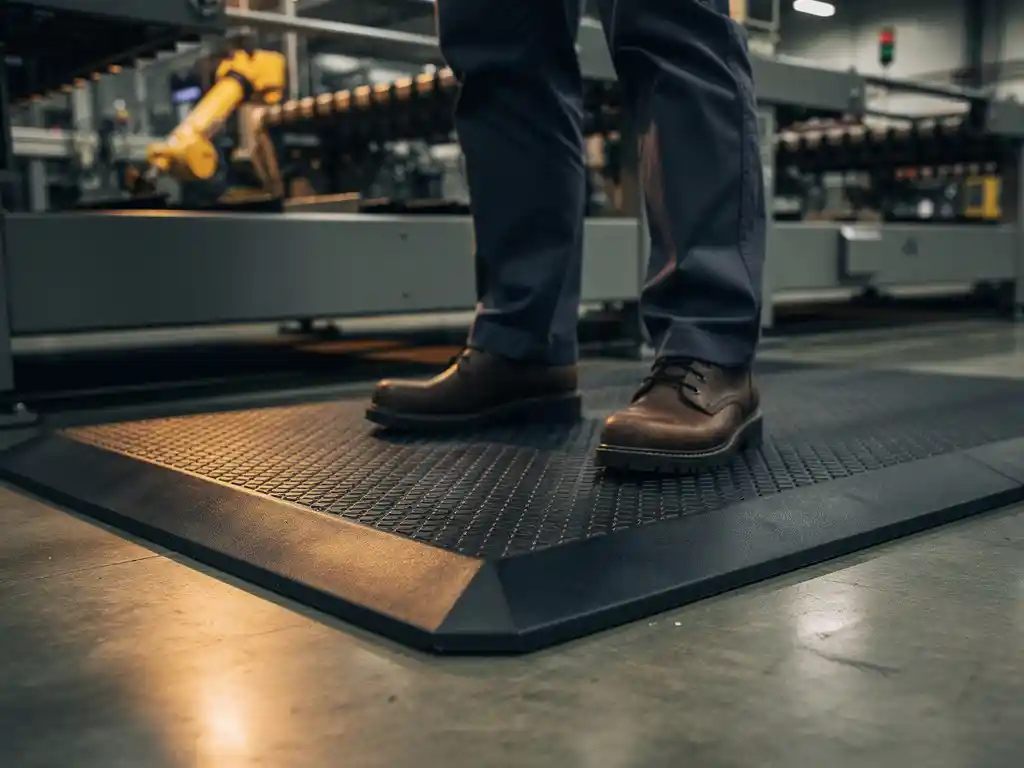
Employers can reduce standing fatigue by combining ergonomic workplace design with practical interventions like anti-fatigue matting, scheduled movement breaks, and adjustable workstations. The most effective approach addresses both the physical environment and how work is organized throughout the day. Below, we cover the most common questions about standing fatigue so you can take action with confidence.
What causes standing fatigue in the workplace?
Standing fatigue occurs when workers remain in a static upright position for extended periods, causing muscles in the legs, lower back, and feet to work continuously without adequate rest. This sustained muscle tension restricts blood flow, leads to fluid pooling in the lower limbs, and triggers the discomfort and exhaustion most workers describe as fatigue from prolonged standing.
Hard, unforgiving floor surfaces make the problem worse. Concrete, tile, and similar materials offer no give, which means your body absorbs all the impact with every small shift in weight. Over time, this contributes to joint stress in the knees, hips, and spine. Workers on hard floors for six or more hours a day are particularly prone to developing chronic discomfort and musculoskeletal complaints.
Footwear plays a role too. Inadequate arch support or thin soles reduce the natural cushioning your body depends on. Combine poor footwear with a hard floor and a long shift, and the physical toll adds up quickly. Worker fatigue from standing is rarely caused by one factor alone. It is almost always the result of several conditions working together.
How do anti-fatigue mats reduce standing fatigue?
Anti-fatigue mats reduce standing fatigue by providing a cushioned surface that encourages subtle, continuous micro-movements in the leg muscles. These small movements promote better blood circulation, reduce static muscle loading, and take pressure off joints. The result is less physical strain during long periods of standing, which directly supports employee well-being and productivity.
The mechanism is straightforward. When you stand on a firm surface, your muscles lock into position to keep you upright. On a slightly yielding surface like a rubber anti-fatigue mat, your body makes constant small adjustments to maintain balance. Those adjustments keep your muscles gently active rather than rigidly contracted, which is much less tiring over time.
Quality matters significantly here. A mat that is too soft will compress fully under body weight and lose its effectiveness quickly. A mat that is too firm provides little benefit over bare floor. The right balance is a mat with enough resilience to support micro-movement without bottoming out. Rubber mats are widely regarded as one of the most durable and effective materials for this purpose, holding their shape and performance even under heavy daily use.
What other workplace changes help reduce standing fatigue?
Beyond matting, several workplace changes help reduce standing fatigue. These include introducing sit-stand workstations, scheduling regular movement breaks, encouraging proper footwear, and reorganizing tasks so workers alternate between standing, sitting, and walking throughout the shift. No single change works in isolation. An ergonomic workplace combines multiple strategies for the best outcome.
- Sit-stand workstations: Adjustable desks or platforms allow workers to alternate postures throughout the day, which significantly reduces the time spent in any one position.
- Scheduled micro-breaks: Short breaks every 30 to 60 minutes give muscles time to recover. Even a two-minute walk or stretch can reset circulation and reduce accumulated tension.
- Task rotation: Rotating workers between standing tasks and seated or mobile tasks spreads physical load more evenly across the body.
- Supportive footwear policies: Encouraging or requiring footwear with proper arch support and cushioning reduces the strain that reaches the knees, hips, and lower back.
- Floor surface assessment: Evaluating whether current flooring is appropriate for the tasks performed is a practical first step that is often overlooked.
Workplace ergonomics is most effective when it is treated as an ongoing process rather than a one-time fix. Regular assessments, worker feedback, and a willingness to adjust the setup over time make a real difference in long-term employee well-being.
Which industries are most affected by standing fatigue?
The industries most affected by standing fatigue are those where workers spend the majority of their shift on their feet with limited opportunity to sit or move freely. Manufacturing, food processing, retail, healthcare, hospitality, and construction are among the sectors where worker fatigue from prolonged standing is a well-recognized occupational health concern.
In manufacturing and assembly environments, workers often stand at fixed stations for entire shifts, repeating the same movements on hard concrete floors. Food processing facilities share similar conditions, with the added challenge of wet or slippery surfaces. Healthcare workers, including nurses and surgical staff, can be on their feet for ten or more hours at a stretch. Retail and hospitality workers face long standing hours with relatively few ergonomic accommodations in place.
Agriculture and livestock management also involve significant standing and physical labor, often on uneven terrain or hard barn floors. The common thread across all these industries is that the floor surface and the duration of standing directly affect how fatigued workers become, and how quickly that fatigue turns into injury or long-term health issues.
What should employers look for in an anti-fatigue mat?
Employers should look for anti-fatigue mats that offer the right combination of cushioning, durability, slip resistance, and size for the specific environment. A mat that performs well in a dry office will not necessarily hold up in a wet industrial setting or a busy commercial kitchen. Matching the mat to the environment is the most important decision.
Material and durability
Rubber is one of the most reliable materials for anti-fatigue matting in demanding environments. It is non-porous, resistant to oils and chemicals, and holds its shape under heavy use. Unlike foam alternatives, quality rubber mats do not compress permanently over time, which means they continue to provide the cushioning effect that makes them effective. For high-traffic or heavy-load areas, fiber-reinforced rubber compounds offer additional strength and longevity.
Safety features and fit
Slip resistance is non-negotiable, particularly in environments where liquids, oils, or debris are present. Look for mats with beveled edges to eliminate trip hazards at the perimeter. Size and coverage matter too. A mat that is too small leaves workers standing off it for part of their shift, reducing the benefit. Larger mats with fewer seams improve both safety and aesthetics, and make cleaning easier. Custom sizing options are worth considering for irregular workspaces or areas where standard dimensions do not fit well.
How long does it take anti-fatigue matting to show results?
Most workers notice a reduction in end-of-shift discomfort within the first few days of using anti-fatigue matting. Measurable improvements in worker fatigue, comfort, and productivity typically become apparent within two to four weeks. The timeline depends on the quality of the mat, the nature of the work, and whether other ergonomic changes are made alongside the matting.
Immediate effects include reduced pressure on the feet and joints during standing. Over the first few weeks, workers often report less lower back pain, fewer leg cramps, and improved energy levels toward the end of the day. These are practical signs that the matting is working as intended.
Longer-term results, such as reduced absenteeism and fewer musculoskeletal complaints, generally take several months to become visible at an organizational level. This is why it helps to track worker feedback from the start. Simple check-ins with staff about comfort levels before and after matting is introduced give you a clear picture of the impact over time.
At LRP Matting, we have spent over five decades helping employers create safer, more comfortable work environments through high-quality rubber matting. Our mats are made from 100% recycled materials, including our proprietary fiber-reinforced rubber compound (FRC®), which delivers durability that holds up in the most demanding conditions. Whether you need standard sizes or custom solutions for a specific workspace, we can help you find the right fit. Explore our anti-fatigue matting solutions to see what works best for your environment.
Frequently Asked Questions
How do I know if our current anti-fatigue mats need to be replaced?
The clearest signs that a mat needs replacing are visible compression, cracking, curling edges, or a noticeable loss of cushioning underfoot. A simple test is to press your thumb firmly into the surface — if the mat does not spring back, it has lost its resilience and is no longer providing meaningful fatigue relief. Most quality rubber mats last several years under normal use, but high-traffic areas may require more frequent inspection. Replacing worn mats promptly is important because a degraded mat can actually increase trip hazard risk while providing little ergonomic benefit.
Can anti-fatigue mats be used alongside other flooring like epoxy coatings or drainage grating?
Yes, anti-fatigue mats are designed to work on top of most existing floor surfaces, including epoxy-coated concrete, sealed tile, and even open drainage grating. When placing mats over drainage grating, look for open-grid or drainage-style anti-fatigue mats that allow liquids to pass through rather than pool on the surface. For smooth epoxy or sealed floors, ensure the mat has a non-slip backing to prevent shifting. Always confirm that the mat’s base material is compatible with any chemical treatments or cleaning agents used on your existing floor.
What is the most common mistake employers make when introducing anti-fatigue matting?
The most common mistake is treating anti-fatigue matting as a standalone solution rather than one part of a broader ergonomic strategy. Mats significantly reduce standing fatigue, but if workers are still wearing unsupportive footwear, taking no movement breaks, or standing on undersized mats that leave parts of their workstation uncovered, the results will be limited. Another frequent error is choosing mats based on price alone without considering the specific demands of the environment — a mat suited to a dry office may fail quickly in a wet or chemically active industrial setting.
Are there specific mat thickness recommendations depending on the type of work being done?
Generally, mats in the range of 9mm to 19mm (approximately 3/8u0022 to 3/4u0022) are considered effective for most standing work environments. Lighter-duty settings such as office or retail environments typically perform well with thinner mats, while industrial, manufacturing, or food processing environments benefit from thicker, more resilient options. Thickness alone is not the only factor — the density and material composition of the mat matter just as much. A thick but low-density foam mat will compress and bottom out far faster than a thinner, high-quality rubber mat under the same conditions.
How should anti-fatigue mats be cleaned and maintained to preserve their effectiveness?
Most rubber anti-fatigue mats can be cleaned with a stiff brush, mild detergent, and water, then left to air dry. In food processing or healthcare environments where hygiene standards are higher, mats should be cleaned daily using approved sanitizing agents — always check that the cleaning product is compatible with the mat material to avoid degradation. Avoid using harsh solvents or high-pressure steam on rubber mats unless the manufacturer specifically approves it. Regular cleaning not only extends the mat’s lifespan but also prevents the buildup of oils, debris, or moisture that can compromise slip resistance.
Is it worth investing in custom-sized mats, or do standard sizes work well enough for most workplaces?
Standard mat sizes work well in many settings, but custom sizing becomes genuinely worthwhile when workstations have irregular dimensions, machinery footprints, or workflow layouts that standard rectangles cannot efficiently cover. Gaps in mat coverage mean workers inevitably stand off the mat for portions of their shift, reducing the ergonomic benefit and potentially creating uneven surfaces that are a trip hazard. Custom mats also tend to look more professional and are easier to keep in place. For facilities with multiple identical workstations, the per-unit cost of custom mats often becomes very competitive when ordered in volume.
How can we measure whether our ergonomic interventions are actually reducing standing fatigue over time?
The most practical approach is to combine subjective worker feedback with objective operational data. Before introducing changes, survey workers about their end-of-shift comfort levels, specific pain points, and energy levels — then repeat the survey at regular intervals after implementation. On the operational side, track metrics such as absenteeism rates, workers’ compensation claims related to musculoskeletal issues, and productivity output over a three-to-six month period. Even informal check-ins with supervisors and workers can surface early signals that interventions are working or that adjustments are needed, helping you refine your ergonomic program continuously.
Related Articles
- What areas of a warehouse experience the most floor wear?
- Why does product lifespan matter for sustainability?
- Why do floor surfaces wear unevenly?
- How can preventative maintenance reduce unexpected floor repairs?
- What flooring is best for a large animal veterinary examination room?
- What is the best flooring for a horse wash rack?
- What causes back pain in workers who stand on hard floors all day?
- What is the fastest way to muck out a horse stall?
- How do you fit flooring in an irregularly shaped sports facility area?
- What flooring works best in an outdoor or covered sports venue?