

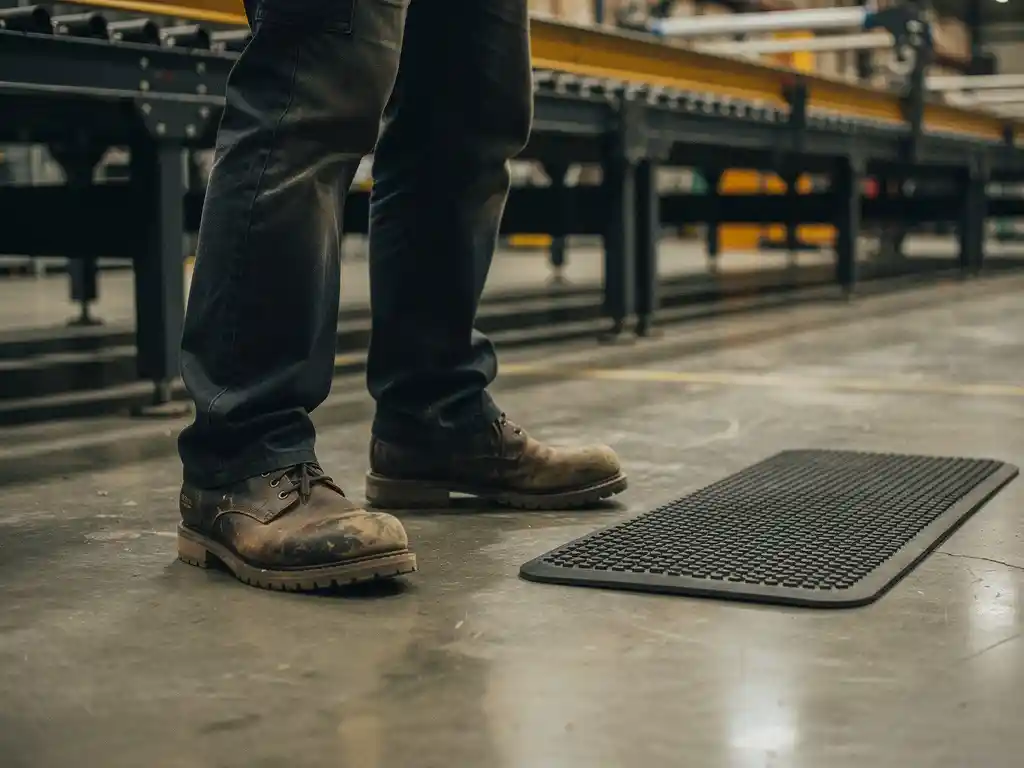
Prolonged standing puts continuous strain on your muscles, joints, and circulatory system, leading to fatigue, discomfort, and, over time, more serious health problems. When you stand without moving for extended periods, blood tends to pool in your legs, your muscles work constantly just to keep you upright, and pressure builds on your spine and joints. This affects millions of workers across industries every day. Below, we answer the most common questions about standing fatigue and what you can actually do about it.
What happens to your body when you stand for too long?
When you stand for too long, your muscles, joints, and blood vessels all come under sustained pressure. Without the pumping action of walking, blood circulation slows and fluid builds up in your lower legs. Your postural muscles work overtime to keep you balanced, and your spine absorbs compressive forces it was not designed to handle for hours on end.
The effects start gradually. Within the first hour of continuous standing, many people notice mild discomfort in their feet or lower back. Over a full shift, that discomfort can develop into genuine pain, swelling, and a feeling of heavy, aching legs. Your concentration also takes a hit, because physical discomfort is a real distraction from the task in front of you.
What makes prolonged standing particularly hard on the body is that it combines static muscle effort with restricted blood flow. Unlike dynamic movement, static postures give your muscles no recovery time. They stay contracted, oxygen delivery decreases, and metabolic waste products accumulate, which is what causes that deep, burning tiredness you feel after a long shift on your feet.
What are the most common health problems caused by prolonged standing?
The most common health problems caused by prolonged standing include lower back pain, varicose veins, foot and leg pain, joint inflammation, and fatigue-related musculoskeletal disorders. These conditions develop gradually through repeated exposure and can become chronic if the root cause is not addressed.
- Lower back pain: Standing compresses the lumbar spine, especially when posture is poor or the surface underfoot offers no cushioning.
- Varicose veins and swelling: Blood pools in the lower extremities when the calf muscle pump is inactive, stretching vein walls over time.
- Foot pain and plantar fasciitis: Continuous pressure on the soles of the feet can inflame the plantar fascia, the band of tissue running along the bottom of the foot.
- Knee and hip joint stress: Holding a fixed standing posture forces your joints to absorb load without the relief that movement provides.
- Fatigue and reduced alertness: Physical strain from standing drains energy, which affects both mood and cognitive performance over a shift.
These issues are not inevitable, but they are common enough that workplace ergonomics researchers consistently identify prolonged standing as a significant occupational health risk. The good news is that practical, affordable interventions exist for most of them.
Who is most at risk from prolonged standing at work?
Workers who stand on hard surfaces for most of their shift, with limited opportunity to sit, walk, or change posture, are most at risk. This includes people in manufacturing, retail, food service, healthcare, and assembly line roles. Workers who are older, who have existing musculoskeletal conditions, or who are pregnant face a higher level of risk.
The type of flooring matters enormously here. A worker standing on concrete for eight hours absorbs far more cumulative impact than someone on a cushioned or resilient surface. Similarly, workers who wear unsupportive footwear, or who stand in fixed positions without any variation, experience greater strain than those who can shift their weight or move around.
Body weight is also a factor, since heavier loads increase joint compression. And in workplaces where the pace is relentless and breaks are infrequent, workers simply do not get the recovery time their bodies need. Standing fatigue in these environments is not just discomfort. It is a genuine worker well-being and productivity issue.
How does flooring surface affect standing fatigue?
The flooring surface directly affects how much impact and compression your body absorbs while standing. Hard, rigid surfaces like concrete or tile offer no give, meaning every bit of force travels straight up through your feet, ankles, knees, and spine. Softer or more resilient surfaces absorb some of that force, reducing the strain on your muscles and joints.
This is not just about comfort. Research into workplace ergonomics consistently shows that surface hardness is one of the main environmental factors contributing to lower limb and back discomfort in standing workers. On concrete, muscles work harder to stabilize the body because there is no surface compliance to assist. On a more forgiving surface, some of that stabilization effort is reduced.
The texture and grip of a surface also matter for safety. A surface that reduces slip risk means workers can shift their weight and move naturally without hesitation, which itself reduces static posture time. A surface that encourages small, frequent weight shifts is far better for circulation and muscle recovery than one that locks you into a single position.
Do anti-fatigue mats actually reduce the effects of prolonged standing?
Yes, anti-fatigue mats do reduce the effects of prolonged standing when used correctly. They work by providing a slightly yielding surface that encourages small, continuous micro-movements in the legs and feet. These micro-movements stimulate blood circulation, reduce static muscle load, and distribute pressure more evenly across the foot. The result is less fatigue, less discomfort, and better endurance over a full shift.
The effectiveness of an anti-fatigue mat depends on its material, thickness, and how well it suits the specific environment. A mat that is too soft can actually increase instability and cause different muscle groups to overwork. A mat that is too thin provides little meaningful cushioning on a hard floor. The best mats strike a balance: enough give to encourage movement and absorb impact, but enough firmness to support proper posture.
For industrial and commercial environments, rubber mats are a particularly practical choice. Rubber is durable, non-porous, easy to clean, and holds up under heavy foot traffic and equipment loads. Unlike foam-based alternatives, quality rubber mats do not compress permanently over time, which means they continue to provide the same level of support months and years after installation. For workplaces where worker fatigue and employee well-being are priorities, anti-fatigue matting is one of the most straightforward and cost-effective interventions available.
What else can reduce the negative effects of standing all day?
Beyond flooring, several practical changes can significantly reduce the negative effects of standing all day. The most effective approach combines multiple strategies rather than relying on any single fix. Footwear, posture habits, break scheduling, and workstation design all play a role in managing standing fatigue.
- Supportive footwear: Shoes with proper arch support and cushioned soles reduce the impact transmitted to your joints and lower back.
- Scheduled movement breaks: Even short breaks of two to three minutes to walk, stretch, or sit help restore circulation and give muscles a chance to recover.
- Sit-stand alternation: Where workstations allow, alternating between sitting and standing throughout the day is more effective than standing or sitting exclusively.
- Footrests and floor rails: Allowing workers to rest one foot on a raised surface shifts weight distribution and relieves spinal compression.
- Stretching and strengthening: Regular stretching of the calves, hamstrings, and hip flexors, along with core strengthening exercises, helps the body handle standing loads more efficiently.
- Workstation layout: Positioning tools and materials at a comfortable height reduces awkward reaching and encourages a more neutral spine position.
A good ergonomic workplace is never built around one solution. It is built around understanding how the body responds to sustained effort and removing as many of the contributing stressors as possible. Anti-fatigue matting, proper footwear, and movement breaks together make a far bigger difference than any one of them alone.
At LRP Matting, we design rubber mats specifically for environments where people stand for long periods. Our anti-fatigue matting solutions are built from high-quality rubber, including our proprietary Fiber Reinforced Rubber Compound (FRC®), to provide lasting support and durability in the most demanding workplaces. If you are looking for a practical, long-term way to improve worker comfort and reduce standing fatigue, we are happy to help you find the right fit.
Frequently Asked Questions
How long does it take before prolonged standing starts causing lasting damage?
There is no single threshold that applies to everyone, but occupational health research suggests that standing for more than four hours continuously without adequate breaks or postural variation begins to create meaningful cumulative strain. The risk of lasting damage, such as chronic lower back pain, varicose veins, or plantar fasciitis, increases with repeated daily exposure over months and years rather than from a single long shift. This is why addressing the contributing factors early, through matting, footwear, and movement breaks, is far more effective than waiting for symptoms to become serious.
How do I know if my anti-fatigue mat is still working effectively or needs replacing?
The most reliable sign that an anti-fatigue mat has lost its effectiveness is permanent compression, where the mat no longer springs back to its original thickness after use. You may also notice that workers are reporting more discomfort than usual, or that the surface has become visibly flattened or uneven. Foam-based mats tend to degrade faster than rubber alternatives, often within one to two years in high-traffic environments. Quality rubber mats, particularly those made with reinforced compounds, maintain their structural integrity significantly longer and are easier to assess visually for wear.
Can the wrong anti-fatigue mat actually make standing fatigue worse?
Yes, it can. A mat that is too soft or too thick can create instability underfoot, forcing your stabilizing muscles to work harder to compensate, which increases rather than reduces fatigue over a shift. Mats that are too thin on a hard concrete floor provide negligible cushioning and little circulatory benefit. The ideal mat provides enough give to encourage micro-movements and absorb impact, while remaining firm enough to support a neutral posture. Choosing a mat suited to the specific environment, including load type, footwear worn, and shift duration, makes a significant difference in outcomes.
What is the best way to introduce anti-fatigue matting in a workplace where it has not been used before?
Start by identifying the highest-risk standing stations, typically those on hard concrete or tile floors where workers stand for the majority of their shift with little opportunity to move. Introduce mats at these locations first and gather feedback from workers after a few weeks of use, since their experience on the floor is the most reliable indicator of whether the solution is working. Pair the introduction of matting with a brief explanation of why it is being installed, as workers who understand the ergonomic purpose tend to use and maintain the mats more effectively. From there, expand coverage based on priority and budget.
Are there specific industries or job roles where anti-fatigue matting is especially important?
Anti-fatigue matting delivers the greatest benefit in roles where workers stand on hard surfaces for extended periods with limited freedom to move, which includes manufacturing and assembly lines, commercial kitchens, retail checkout stations, laboratory benches, and healthcare environments such as operating theatres and pharmacy counters. In these settings, the combination of hard flooring, high shift duration, and task-focused attention means workers rarely shift their posture naturally. Matting in these environments addresses one of the most controllable risk factors and can make a measurable difference to both comfort and end-of-shift fatigue levels.
Should employers or employees be responsible for addressing prolonged standing risks at work?
In most jurisdictions, employers carry the primary legal and ethical responsibility for managing occupational health risks, including those associated with prolonged standing. This typically falls under broader workplace health and safety legislation that requires employers to assess risks and implement reasonable controls. In practice, the most effective workplaces treat this as a shared responsibility: employers invest in ergonomic equipment, scheduling, and workstation design, while employees are encouraged to use movement breaks, wear appropriate footwear, and report discomfort early. Early reporting is particularly important, as it allows issues to be addressed before they develop into chronic conditions.
Can stretching and exercise outside of work actually reduce standing fatigue during shifts?
Yes, and this is an underutilised strategy. Strengthening the core, glutes, and lower limb muscles improves the body’s ability to manage sustained postural load, meaning the same amount of standing produces less fatigue over time. Regular calf raises, hip flexor stretches, and lower back mobility work are particularly relevant for standing workers, as these are the muscle groups most affected by prolonged static posture. That said, exercise and stretching work best as a complement to workplace interventions, not a substitute for them. Reducing the physical demands of the job through better flooring, footwear, and scheduling remains the priority.
Related Articles
- What are the most common safety risks in horse facilities?
- How do you design a safer livestock facility?
- What creates a safe recovery environment for animals?
- What flooring improvements can increase workplace comfort?
- How do uneven floors increase accident risk?
- How do professional stables manage bedding across a large number of stalls?
- What is the best flooring for an equine breeding facility?
- How do you reduce noise in a sports facility through flooring choice?
- How do you make a workshop floor more comfortable to work on?
- What type of floor is easiest to keep clean in a horse barn?