

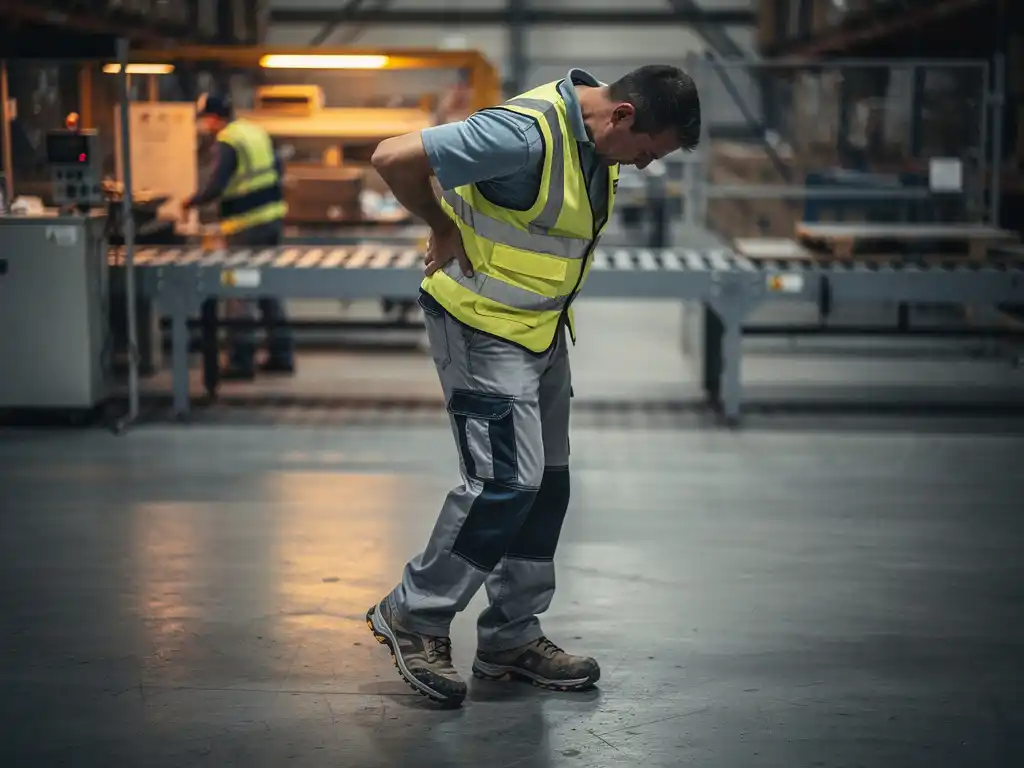
Employees experiencing floor-related fatigue typically show physical signs like aching feet, sore lower backs, swollen legs, and stiff joints by the end of a shift. These symptoms appear when workers stand or walk on hard, unforgiving surfaces for extended periods without adequate support. Below, we break down how to recognize floor fatigue, who is most at risk, and what you can do about it.
What physical symptoms indicate floor-related fatigue at work?
The most common physical symptoms of floor-related fatigue include foot pain, lower back aches, swollen ankles, sore knees, and general leg heaviness. Workers often report that these symptoms worsen throughout the day and ease after rest, which is a strong indicator that the flooring surface is a contributing factor rather than an underlying health condition.
Hard concrete and tile floors force the body to absorb constant impact with little cushioning. Over time, this repeated stress travels up through the feet and into the joints, hips, and spine. You might also notice workers shifting their weight frequently, leaning against surfaces for support, or changing their posture in ways that look uncomfortable. Neck tension and shoulder stiffness can also develop as a secondary effect, since poor posture adopted to compensate for foot or leg discomfort puts strain on the upper body as well.
How does floor-related fatigue affect employee productivity?
Floor-related fatigue reduces employee productivity by lowering concentration, slowing movement, and increasing the number of errors workers make. When the body is focused on managing physical discomfort, mental focus drops. Tasks that require precision or quick decision-making become harder to perform consistently, especially in the second half of a long shift.
Beyond individual performance, fatigue affects the whole team. Workers who are physically uncomfortable take more frequent breaks, move more slowly between tasks, and are more likely to call in sick. Over time, chronic standing fatigue can also contribute to higher staff turnover, which carries its own costs in recruitment and training. Addressing floor fatigue is not just about comfort; it has a direct impact on operational efficiency.
Which work environments carry the highest risk of floor fatigue?
Work environments with hard flooring surfaces and long standing or walking requirements carry the highest risk of floor-related fatigue. This includes manufacturing facilities, assembly lines, commercial kitchens, retail floors, warehouses, healthcare settings, and hair salons. Any job where workers are on their feet for four or more hours without adequate floor support is a risk environment.
Concrete is the most common problem surface. It is dense, inflexible, and provides zero shock absorption. Workers in industrial and production settings often spend entire shifts on bare concrete, which significantly accelerates the onset of fatigue. Cold concrete floors can also cause additional stiffness in the feet and legs, making the experience even more physically demanding.
What’s the difference between general tiredness and floor-related fatigue?
General tiredness affects the whole body and typically results from lack of sleep, illness, or overall physical exertion. Floor-related fatigue, by contrast, is localized and progressive. It concentrates in the feet, legs, and lower back, and it builds steadily throughout a standing shift rather than being present from the start of the day.
A practical way to tell the difference is to ask workers when and where they feel discomfort. If symptoms start in the feet or legs a few hours into a standing shift and ease significantly after sitting down, floor fatigue is a likely cause. General tiredness tends to feel more diffuse and does not respond as quickly to simply changing position. Tracking when symptoms appear and which body areas are affected gives you a clearer picture of what you are dealing with.
How can employers tell if flooring is causing fatigue problems?
Employers can identify floor-related fatigue by looking at patterns in worker complaints, absence records, and productivity data tied to specific workstations or floor areas. If multiple workers in the same physical zone report similar symptoms, the flooring is likely a contributing factor rather than individual health issues.
Direct observation is also useful. Watch how workers position themselves during tasks. Frequent weight shifting, toe-raising, or leaning against equipment are all behavioral signs that the floor surface is uncomfortable. You can also simply ask. A short, anonymous survey about physical comfort at workstations often surfaces flooring problems that workers have normalized but never formally reported. Comparing complaint rates between areas with different flooring types can quickly reveal where the problem is most serious.
What flooring solutions reduce floor-related fatigue for employees?
The most effective flooring solutions for reducing worker fatigue are anti-fatigue mats, rubber flooring, and ergonomic matting systems placed at standing workstations. These solutions work by cushioning the feet, promoting micro-movements in the leg muscles, and reducing the amount of direct impact the body absorbs from hard floor surfaces.
Anti-fatigue matting is one of the most practical and cost-effective starting points. A quality rubber mat placed at a standing workstation creates a surface that is slightly compressible underfoot, which encourages small, natural muscle movements that keep blood circulating in the legs. This reduces the pooling of blood in the lower limbs that contributes to swelling and fatigue. The mat should have a non-slip surface, beveled edges to prevent tripping, and enough thickness to provide genuine cushioning without becoming unstable.
For larger areas like production floors or assembly lines, a full rubber flooring system may be more appropriate than individual mats. Rubber flooring covers more ground, is easier to maintain, and provides consistent support across the entire work area. It also handles heavy foot traffic and equipment loads well, making it a durable long-term investment.
Beyond flooring, it helps to pair surface improvements with other ergonomic workplace adjustments. Workstation height, footrests, and scheduled movement breaks all contribute to reducing standing fatigue. Flooring improvements work best as part of a broader approach to worker well-being rather than as a standalone fix. At LRP Matting, we specialize in rubber matting solutions built for exactly these kinds of demanding environments. If you want to explore options for your workspace, take a look at our anti-fatigue matting solutions to find a fit that works for your team.
Frequently Asked Questions
How thick should an anti-fatigue mat be to actually make a difference?
For genuine fatigue relief, anti-fatigue mats should typically be between 3/8 inch and 3/4 inch (about 9–19mm) thick. Thinner mats may feel comfortable initially but provide insufficient cushioning during a full shift, while mats that are too thick can become unstable underfoot and create a tripping hazard. The ideal thickness depends on the specific work environment — heavier industrial settings often benefit from thicker, denser rubber, while lighter-duty retail or kitchen environments may perform well with a mid-range option.
Can the right footwear replace the need for anti-fatigue matting?
Supportive footwear and anti-fatigue matting serve complementary roles and work best when used together rather than as substitutes for one another. Good footwear addresses individual biomechanics and provides arch and heel support, but it cannot fully compensate for the relentless impact of hard concrete or tile floors over an entire shift. Anti-fatigue matting reduces the load at the floor level before it ever reaches the foot, so combining both solutions delivers significantly better results than relying on either one alone.
How do I get started if I want to address floor fatigue across a large facility?
Start by mapping your facility and identifying the highest-risk zones — areas with hard flooring where workers stand or walk for four or more hours, such as assembly lines, packing stations, or service counters. Prioritize those areas first rather than attempting a facility-wide overhaul at once, which helps manage costs and lets you measure results before scaling up. Consulting with a matting specialist who understands industrial and commercial environments can help you match the right product type, thickness, and coverage to each specific zone.
How often should anti-fatigue mats be replaced, and what are the signs they need replacing?
Anti-fatigue mats should typically be inspected every six to twelve months and replaced when they show visible signs of compression, cracking, curling edges, or surface wear that reduces grip. A mat that has lost its cushioning — one that feels flat and hard underfoot rather than slightly springy — is no longer providing meaningful fatigue relief and should be replaced promptly. High-traffic areas and environments with heavy equipment or chemical exposure will wear through mats faster, so those zones warrant more frequent checks.
Are there any safety risks associated with anti-fatigue mats that employers should be aware of?
Yes — poorly chosen or improperly maintained mats can introduce their own hazards. Mats without beveled edges create a trip risk, particularly in busy work areas where workers are moving quickly or carrying loads. Mats that are too soft or too thick can feel unstable and increase the risk of ankle rolling. It is also important to ensure mats are slip-resistant on both the top surface and the underside, and that they are appropriate for the specific environment — for example, mats used in commercial kitchens need to be grease-resistant and easy to sanitize.
What role do scheduled movement breaks play alongside flooring improvements?
Scheduled movement breaks are a valuable complement to flooring improvements because they give the body an opportunity to recover and reset circulation before fatigue accumulates to a debilitating level. Even short breaks of five to ten minutes that involve sitting, light stretching, or walking a different route can meaningfully reduce the buildup of lower-limb discomfort over a long shift. Flooring improvements reduce the rate at which fatigue develops, while movement breaks help manage the fatigue that does accumulate — together, they form a much more effective strategy than either approach on its own.
Is floor-related fatigue considered a workplace health and safety issue, and do employers have obligations around it?
In many jurisdictions, prolonged standing on hard surfaces is recognized as a musculoskeletal risk factor under workplace health and safety regulations, meaning employers may have a legal duty to assess and mitigate it. While specific obligations vary by country and industry, general duties of care typically require employers to identify ergonomic hazards — including flooring conditions — and take reasonably practicable steps to reduce them. Documenting worker complaints, conducting workstation assessments, and implementing flooring solutions like anti-fatigue matting all demonstrate proactive compliance and can reduce liability in the event of a worker injury claim.
Related Articles
- What are the most common safety risks in horse facilities?
- How do different facility environments affect floor performance?
- How do chemicals affect floor durability?
- What causes sports facility floors to wear out?
- What are the warning signs of floor deterioration?
- What should be included in a floor safety checklist?
- How do you prevent cross-contamination through flooring in an animal clinic?
- How do you prevent floor damage from forklifts in a warehouse?
- How do you make a warehouse floor less slippery?
- How do you reduce re-injury risk in a horse recovery stall?