

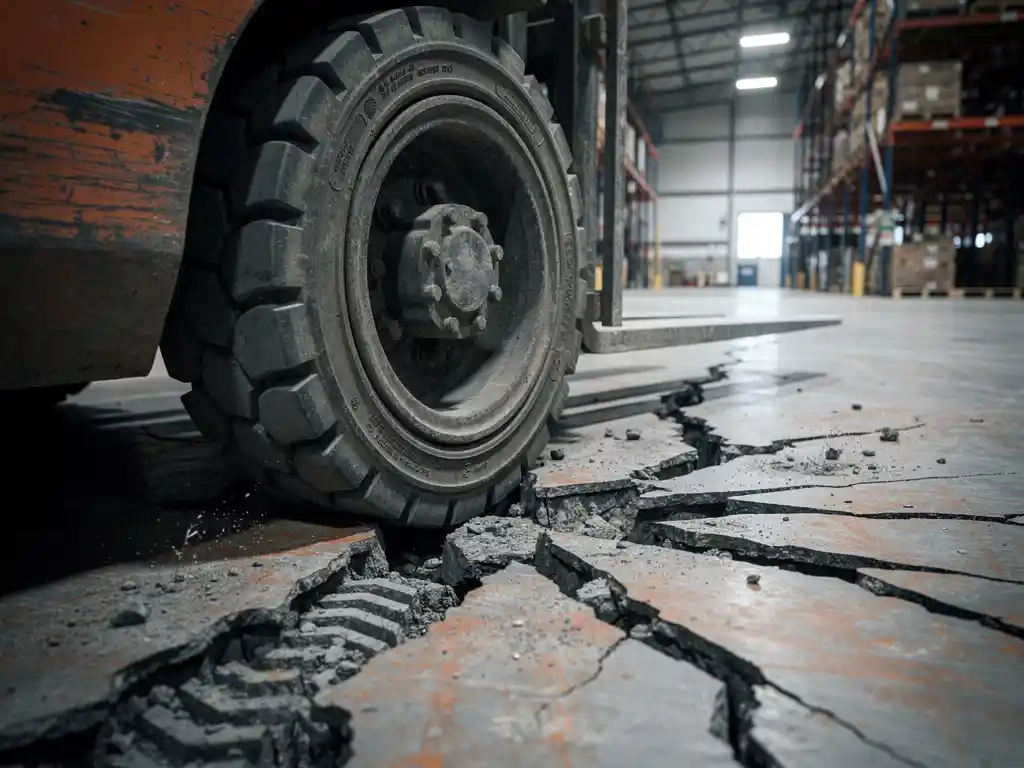
Forklifts damage facility floors through a combination of concentrated weight, repeated friction, and sudden mechanical stress. Hard wheels rolling under heavy loads grind away at surface coatings, chip concrete edges, and compress the floor material over time. This kind of wear happens gradually, which means many facilities do not notice the damage until it becomes a safety concern. Below, we break down exactly how and where forklift damage occurs, and what you can do to protect your floors.
What types of floor damage do forklifts cause?
Forklifts cause several types of floor damage, including surface abrasion, joint and edge cracking, coating delamination, and deep gouging. The specific type of damage depends on the floor material, the forklift’s load, and how frequently it travels the same route. Industrial flooring in high-traffic facilities tends to show multiple damage types at once.
Surface abrasion is the most common form. It shows up as worn patches, scuff marks, and a gradual thinning of any protective coating applied to the floor. Over time, this exposes the raw concrete beneath, which then becomes vulnerable to moisture, chemical spills, and further mechanical wear.
Gouging happens when a forklift carrying a very heavy or unbalanced load creates localized pressure spikes. These can crack the surface or leave visible indentations. Joint damage is another frequent issue, especially at expansion joints and control joints in concrete floors, where the edges chip and crumble as forklifts roll over them repeatedly.
Why do forklift wheels cause so much floor wear?
Forklift wheels cause significant floor wear because they are typically made from hard polyurethane or solid rubber, which creates intense point pressure on the floor surface rather than spreading the load the way a pneumatic tire would. Combined with the weight of the forklift and its load, this concentrated pressure grinds away at the floor with every pass.
The physics here are straightforward. A standard counterbalance forklift can weigh several tons before any load is added. That total weight is distributed across just a few small wheel contact patches. The pressure per square inch at those contact points is much higher than it looks, and on every turn or acceleration, the wheel surface drags slightly against the floor, adding friction wear on top of compression stress.
Polyurethane wheels are especially hard on coated or sealed concrete floors. They do not flex or absorb impact, so all the energy from bumps, joints, and surface irregularities transfers directly into the floor. Over months of daily use, this adds up to visible and structural floor degradation.
How does forklift traffic damage concrete specifically?
Forklift traffic damages concrete through surface scaling, joint deterioration, and subsurface cracking. Concrete is strong under compression but relatively brittle under repeated impact and lateral stress. Forklifts deliver both, especially during turns, sudden stops, and travel over uneven surfaces.
Scaling starts at the top layer of the concrete slab, where the cement paste is weakest. Hard wheels abrade this layer away, exposing the aggregate beneath. Once the surface is rough and porous, moisture and contaminants penetrate more easily, accelerating the deterioration cycle.
Joint edges are particularly vulnerable. Every time a forklift wheel crosses an expansion joint or a saw-cut control joint, it delivers an impact to the unsupported edge of the concrete panel. Over time, these edges chip and spall, creating raised lips that then cause more impact on the next pass. This feedback loop can turn a minor joint gap into a significant trip hazard and structural weak point.
Subsurface cracking is less visible but equally serious. Heavy, repeated loads can cause micro-fractures beneath the surface, especially if the sub-base beneath the slab is not perfectly uniform. These cracks eventually work their way to the surface, reducing the load-bearing capacity of the floor and shortening its service life.
What are the safety risks of forklift-damaged floors?
Forklift-damaged floors create real safety risks, including trip hazards from raised edges and cracks, reduced traction for both forklifts and pedestrians, and unstable surfaces that affect forklift steering and load control. These risks increase as damage accumulates and goes unaddressed.
Trip hazards are the most immediate concern for workers on foot. Spalled concrete edges, floor coating bubbles, and cracked joints are easy to catch a foot on, especially in busy facilities where attention is focused on tasks rather than the floor surface.
For forklifts themselves, damaged floors affect handling. An uneven surface causes the load to shift, which changes the forklift’s center of gravity. On a heavily loaded vehicle, even a small surface irregularity can increase the risk of tipping or load drop. Floor durability is not just a maintenance issue, it is directly tied to operational safety.
Damaged floors also trap water, oil, and debris in cracks and pits, reducing surface traction. This makes it harder for forklift tires to grip during braking and turning, and creates slippery patches for pedestrians walking through the area.
How can rubber mats protect floors from forklift damage?
Rubber mats protect floors from forklift damage by acting as a sacrificial layer between the hard forklift wheels and the floor surface. They absorb impact, distribute load more evenly, and reduce the friction and abrasion that cause surface wear. In high-traffic zones, placing durable rubber matting over concrete can significantly extend the floor’s service life.
The key mechanism is load distribution. A thick rubber mat spreads the concentrated pressure from forklift wheels across a larger area, reducing the stress delivered to any single point on the concrete beneath. This is especially useful at turning points and loading zones where forklifts repeatedly apply lateral force to the same spot.
Rubber matting also provides a buffer against impact at joints and transitions. Instead of the wheel edge striking the concrete joint directly, it rolls over the mat, which absorbs much of the shock. This slows the edge deterioration that leads to spalling and raised lips.
For concrete floor protection, the mat material matters. Solid rubber mats made from high-quality rubber hold up under the weight and repeated stress of forklift traffic far better than foam or composite alternatives. They resist compression set, meaning they do not permanently deform after heavy use, and they maintain their protective function over time.
Where in a facility should floor protection be prioritized?
Floor protection should be prioritized in areas where forklifts slow down, turn, stop, or transition between surfaces. These are the spots where wheel pressure and lateral friction are highest, and where floor damage accumulates fastest. Protecting these zones first delivers the most practical benefit for floor durability and safety.
The highest-priority locations include:
- Loading dock approaches: Forklifts accelerate and brake here repeatedly, and the transition from dock plate to floor creates impact stress at the joint.
- Aisle intersections and turning zones: Turning generates lateral wheel drag, which is one of the most abrasive forces a floor experiences.
- Staging and parking areas: Stationary forklifts with loads still place sustained pressure on the floor surface.
- Ramp transitions: The angle change creates uneven load distribution and increases impact at the transition point.
- High-frequency travel routes: Any corridor or aisle used dozens of times per shift will show accelerated wear without surface protection.
Beyond these forklift-specific zones, it is also worth protecting areas where workers on foot are most exposed to floor hazards, such as near machinery, at workstations, and around pedestrian crossings within the facility.
At LRP Matting, we design rubber matting solutions specifically for demanding industrial environments like these. Our industrial rubber mats are built to handle the weight, friction, and repeated stress that forklifts generate, helping you protect your floors while keeping your facility safer for everyone in it.
Frequently Asked Questions
How do I know if my facility's floor damage is serious enough to require immediate repair?
Look for cracks wider than 1/8 inch, raised joint edges taller than 1/4 inch, spalled areas larger than a dinner plate, or any surface depression deep enough to catch a forklift wheel. These thresholds generally indicate structural risk, not just cosmetic wear. If you notice forklifts visibly jolting over floor irregularities or loads shifting during travel, treat it as an urgent safety issue rather than a scheduled maintenance item.
What type of rubber mat thickness is recommended for forklift traffic areas?
For areas with regular forklift traffic, a solid rubber mat with a minimum thickness of 3/4 inch to 1 inch is generally recommended, with heavier-duty options in the 1.5-inch range for high-load staging zones or loading dock approaches. Thicker mats provide better load distribution and impact absorption, but the key factor is density — a thin, high-density solid rubber mat will outperform a thicker foam-core or recycled composite mat under forklift loads. Always check the mat’s load rating against your heaviest loaded forklift weight before purchasing.
Can rubber mats be used on floors that are already damaged, or do cracks need to be repaired first?
Rubber mats can be placed over mildly damaged floors as a temporary protective measure, but significant cracks, spalled joints, and raised edges should be repaired before installing permanent matting. Placing mats over uneven surfaces can cause the mat to flex unevenly, reducing its protective effectiveness and potentially creating a new trip hazard at the mat’s edges. For best results, patch and level the floor first, then install matting to prevent future damage from recurring.
How often should high-traffic forklift zones be inspected for floor damage?
High-traffic forklift zones should be visually inspected at least once a week, with a more thorough hands-on inspection — including checking joint edges and looking for subsurface cracking — conducted monthly. Facilities running multiple shifts or operating heavy forklifts (over 10,000 lb capacity) should increase the frequency accordingly. Catching damage early, when cracks are hairline and joint edges are just beginning to chip, is dramatically cheaper and faster to fix than addressing advanced spalling or structural deterioration.
Do forklift tires themselves contribute to the damage, and is switching tire types a practical solution?
Yes, tire type plays a significant role — polyurethane wheels are the hardest on floors, followed by solid rubber, with cushion and pneumatic tires being considerably gentler. Switching to softer tire compounds or cushion tires can reduce floor wear, but it comes with trade-offs: softer tires wear faster, may reduce load capacity ratings, and are not suitable for all forklift models or operating environments. A more practical and cost-effective approach for most facilities is to keep existing tires and focus on surface protection — such as rubber matting in high-wear zones — rather than changing out the forklift’s tire specification.
What's the most common mistake facilities make when trying to protect their floors from forklift damage?
The most common mistake is applying a protective floor coating — such as epoxy or polyurethane sealant — and assuming that alone is sufficient. While coatings reduce moisture penetration and surface abrasion, they are not designed to withstand the concentrated point pressure and lateral drag that forklift wheels generate, and they typically delaminate within months in heavy-traffic zones. A layered approach works best: repair the concrete substrate, apply a coating for chemical and moisture resistance, and then add physical matting protection in the specific zones where forklift stress is highest.
Are there any regulatory or compliance requirements related to forklift floor damage in industrial facilities?
OSHA’s General Industry standards (29 CFR 1910.22) require that walking and working surfaces, including floors, be kept in clean, orderly, and sanitary condition and maintained in good repair — which directly applies to forklift-damaged floors that create trip hazards or unsafe surfaces. OSHA’s powered industrial truck standard (29 CFR 1910.178) also requires that floor surfaces be inspected and that forklifts not be operated on surfaces that are unsafe. While there is no specific regulation mandating rubber matting, facilities with documented floor hazards that go unaddressed can face citations, especially following an incident or inspection.
Related Articles
- How do workplace surfaces affect employee wellbeing?
- How does facility design affect animal welfare?
- Why do floor surfaces wear unevenly?
- How do different facility environments affect floor performance?
- How does dirt affect slip resistance?
- How do you keep a horse stall dry without using excessive bedding?
- How do you stop floor damage in a high-traffic shipping and receiving area?
- What causes back pain in workers who stand on hard floors all day?
- What should you put on a concrete barn floor to protect your horse?
- What is the fastest way to muck out a horse stall?